

What you'll learn
- How to calculate kinetic energy using Ek=12mv2E_k = \frac{1}{2}mv^2Ek=21mv2.
- How to calculate gravitational potential energy in a uniform gravitational field using Ep=mghE_p = mghEp=mgh.
- How both equations can be derived from work done.
- How gravitational potential energy and kinetic energy exchange during motion.
Energy and work: the starting point
Before kinetic and potential energy, remember the key idea from work, energy and power: energy is transferred when work is done.
Work done
Work done is the energy transferred when a force moves an object through a displacement. For a constant force acting in the direction of motion, W=FxW = FxW=Fx, where WWW is work done in joules, FFF is force in newtons, and xxx is displacement in metres.
One joule is one newton metre: 1 J = 1 N m. Energy is also measured in joules, because work done is a transfer of energy.
Kinetic energy
Kinetic energy
Kinetic energy, EkE_kEk, is the energy an object has because it is moving.
For an object of mass mmm moving at speed vvv:
Ek=12mv2E_k = \frac{1}{2}mv^2Ek=21mv2where:
- EkE_kEk is kinetic energy in joules, J
- mmm is mass in kilograms, kg
- vvv is speed in metres per second, m s−1^{-1}−1
The square on speed is very important. Doubling the speed makes the kinetic energy four times larger.
Speed matters a lot
Kinetic energy is proportional to v2v^2v2, not vvv. A small increase in speed can produce a much larger increase in kinetic energy.
Calculating kinetic energy
A 0.060 kg tennis ball moves at 25 m s−1^{-1}−1. Calculate its kinetic energy.
-
Choose the kinetic energy equation because the object has a known mass and speed:
Ek=12mv2E_k = \frac{1}{2}mv^2Ek=21mv2 -
Substitute the values, keeping the units with the quantities:
Ek=12×0.060 kg×(25 m s−1)2E_k = \frac{1}{2} \times 0.060\,\text{kg} \times \left(25\,\text{m s}^{-1}\right)^2Ek=21×0.060kg×(25m s−1)2 -
Square the speed first, then multiply:
Ek=0.030×625=18.75 JE_k = 0.030 \times 625 = 18.75\,\text{J}Ek=0.030×625=18.75J -
Quote a sensible final answer:
Ek≈19 JE_k \approx 19\,\text{J}Ek≈19J
Forgetting to square the speed
Do not calculate 12mv\frac{1}{2}mv21mv. The equation is 12mv2\frac{1}{2}mv^221mv2, so the speed must be squared before multiplying by the mass.
Deriving kinetic energy from first principles
OCR expects you to be able to recall Ek=12mv2E_k = \frac{1}{2}mv^2Ek=21mv2 and derive it from first principles.
“First principles” here means starting from basic equations you already know, rather than simply quoting the result.
We start with:
- work done by a force: W=FxW = FxW=Fx
- Newton’s second law: F=maF = maF=ma
- constant-acceleration motion: v2=u2+2axv^2 = u^2 + 2axv2=u2+2ax
For an object starting from rest, u=0u = 0u=0, so:
v2=2axv^2 = 2axv2=2axRearrange for displacement:
x=v22ax = \frac{v^2}{2a}x=2av2Now substitute F=maF = maF=ma and x=v22ax = \frac{v^2}{2a}x=2av2 into W=FxW = FxW=Fx:
W=FxW=ma×v22aW=12mv2\begin{aligned} W &= Fx \\ W &= ma \times \frac{v^2}{2a} \\ W &= \frac{1}{2}mv^2 \end{aligned}WWW=Fx=ma×2av2=21mv2That work done becomes the object’s kinetic energy, so:
Ek=12mv2E_k = \frac{1}{2}mv^2Ek=21mv2What the derivation is really saying
A resultant force does work on an object while accelerating it. The energy transferred by that work appears as kinetic energy.
Gravitational potential energy
Gravitational potential energy
Gravitational potential energy, EpE_pEp, is the energy an object has because of its position in a gravitational field.
In a uniform gravitational field, the gravitational field strength ggg is constant. Near the Earth’s surface, we usually take g=9.81 N kg−1g = 9.81\,\text{N kg}^{-1}g=9.81N kg−1, which is equivalent to 9.81 m s−29.81\,\text{m s}^{-2}9.81m s−2.
For an object of mass mmm raised through a height hhh:
Ep=mghE_p = mghEp=mghwhere:
- EpE_pEp is gravitational potential energy in joules, J
- mmm is mass in kilograms, kg
- ggg is gravitational field strength in newtons per kilogram, N kg−1^{-1}−1
- hhh is height in metres, m
Strictly, this equation gives the change in gravitational potential energy relative to a chosen reference level.
Reference level
A reference level is the height where you choose Ep=0E_p = 0Ep=0. Heights above this level have positive gravitational potential energy relative to it.
Calculating gravitational potential energy
A 72 kg climber gains 450 m in height. Calculate the increase in gravitational potential energy. Use g=9.81 N kg−1g = 9.81\,\text{N kg}^{-1}g=9.81N kg−1.
-
Choose Ep=mghE_p = mghEp=mgh because the question gives mass, gravitational field strength and vertical height gained.
-
Substitute the values:
Ep=72 kg×9.81 N kg−1×450 mE_p = 72\,\text{kg} \times 9.81\,\text{N kg}^{-1} \times 450\,\text{m}Ep=72kg×9.81N kg−1×450m -
Calculate the energy increase:
Ep=317844 JE_p = 317844\,\text{J}Ep=317844J -
Write the answer in standard form to a sensible number of significant figures:
Ep≈3.2×10⁵ JE_p \approx 3.2 \times 10^5\,\text{J}Ep≈3.2×10⁵J
Using distance instead of vertical height
In Ep=mghE_p = mghEp=mgh, hhh is the vertical change in height, not the distance travelled along a slope or path.
Deriving gravitational potential energy from first principles
To lift an object at constant speed in a uniform gravitational field, the upward force you apply must equal the object’s weight.
Weight is given by:
W=mgW = mgW=mgHere WWW means weight, measured in newtons. Be careful: the same letter WWW is also used for work done in some contexts.
The work done lifting the object through a vertical height hhh is:
work done=force×distance moved in direction of force\text{work done} = \text{force} \times \text{distance moved in direction of force}work done=force×distance moved in direction of forceSo:
work done=mgh\begin{aligned} \text{work done} &= mgh \end{aligned}work done=mghThis work done is stored as gravitational potential energy, so:
Ep=mghE_p = mghEp=mghUnit check for gravitational potential energy
mgmgmg is a force in newtons. Multiplying by height in metres gives newton metres, which are joules.
Energy exchange between EpE_pEp and EkE_kEk
When an object moves up or down in a gravitational field, energy can be transferred between gravitational potential energy and kinetic energy.
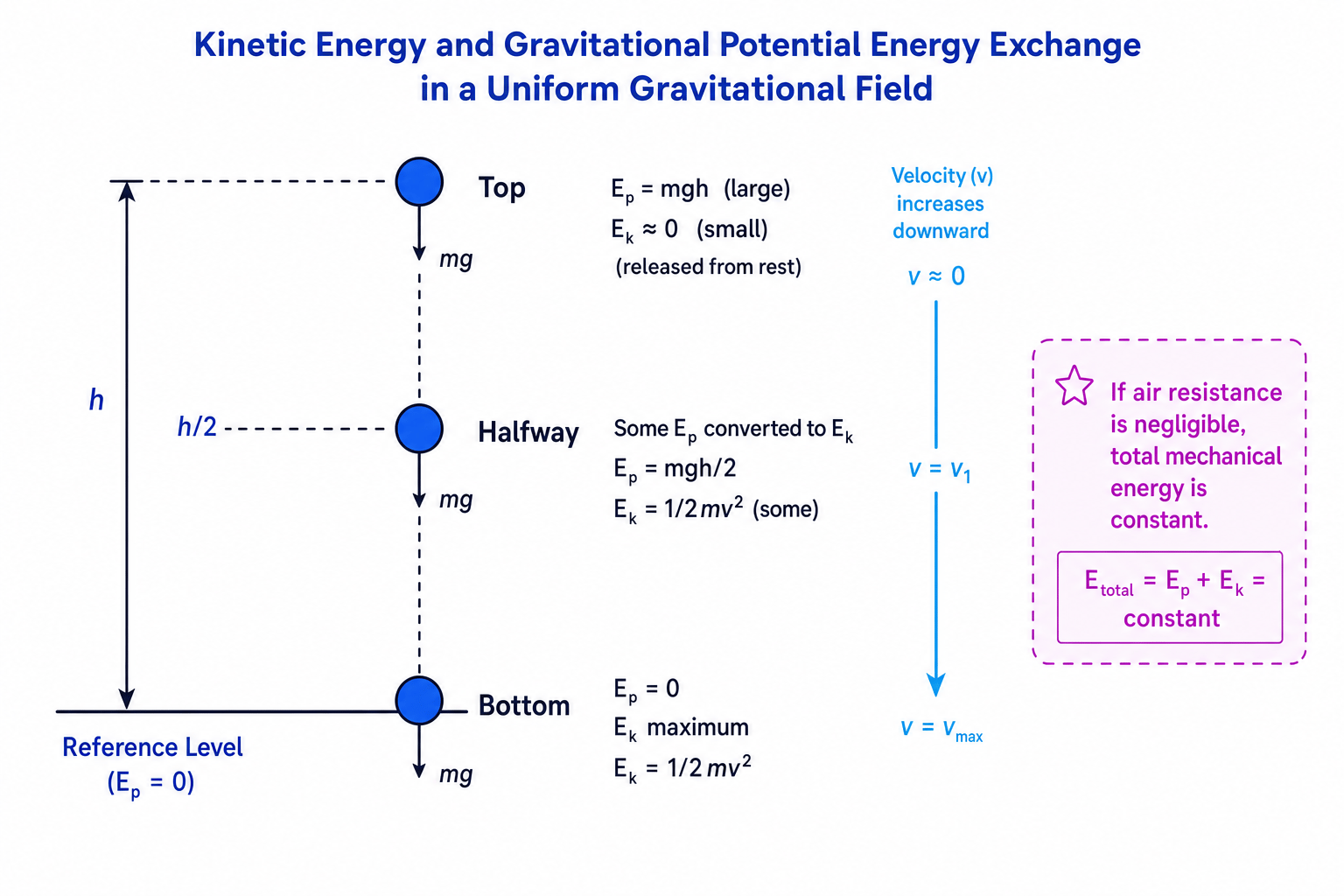
If air resistance is negligible, the object’s total mechanical energy remains constant:
Ek+Ep=constantE_k + E_p = \text{constant}Ek+Ep=constantSo when an object falls:
- EpE_pEp decreases because height decreases
- EkE_kEk increases because speed increases
- the loss of EpE_pEp equals the gain in EkE_kEk
For an object released from rest from height hhh, with negligible air resistance:
mgh=12mv2mgh = \frac{1}{2}mv^2mgh=21mv2The mass cancels:
gh=12v2gh = \frac{1}{2}v^2gh=21v2So:
v=2ghv = \sqrt{2gh}v=2ghThis means that, neglecting air resistance, objects dropped from the same height reach the same speed, regardless of mass.
Mechanical energy is not always constant
If air resistance or friction is significant, some mechanical energy is transferred to internal energy of the surroundings and the object. Total energy is still conserved, but Ek+EpE_k + E_pEk+Ep decreases.
Finding speed from a fall height
A stone is dropped from rest from a height of 12 m. Calculate its speed just before reaching the ground. Ignore air resistance and use g=9.81 m s−2g = 9.81\,\text{m s}^{-2}g=9.81m s−2.
-
Identify the energy transfer: the stone loses gravitational potential energy and gains kinetic energy.
mgh=12mv2mgh = \frac{1}{2}mv^2mgh=21mv2 -
Cancel the mass, because it appears on both sides:
gh=12v2gh = \frac{1}{2}v^2gh=21v2 -
Rearrange for vvv:
v=2ghv = \sqrt{2gh}v=2gh -
Substitute the values:
v=2×9.81 m s−2×12 mv = \sqrt{2 \times 9.81\,\text{m s}^{-2} \times 12\,\text{m}}v=2×9.81m s−2×12m -
Calculate the speed:
v=235.44 m2s−2=15.3 m s−1v = \sqrt{235.44\,\text{m}^2\text{s}^{-2}} = 15.3\,\text{m s}^{-1}v=235.44m2s−2=15.3m s−1
Finding maximum height from launch speed
A ball is thrown vertically upwards at 18 m s−1^{-1}−1. Ignore air resistance. Calculate the maximum height reached above the launch point.
-
At launch, the ball has kinetic energy. At maximum height, its speed is zero, so its kinetic energy is zero.
-
Set initial kinetic energy equal to the gain in gravitational potential energy:
12mv2=mgh\frac{1}{2}mv^2 = mgh21mv2=mgh -
Cancel the mass and rearrange for height:
h=v22gh = \frac{v^2}{2g}h=2gv2 -
Substitute the values:
h=(18 m s−1)22×9.81 m s−2h = \frac{\left(18\,\text{m s}^{-1}\right)^2}{2 \times 9.81\,\text{m s}^{-2}}h=2×9.81m s−2(18m s−1)2 -
Calculate:
h=32419.62 m=16.5 mh = \frac{324}{19.62}\,\text{m} = 16.5\,\text{m}h=19.62324m=16.5m
Energy methods versus SUVAT
Many vertical motion problems can be solved using either energy equations or constant-acceleration equations. Energy is often quicker when the question asks about speeds and height changes but does not ask about time.
For example, the energy result:
v=2ghv = \sqrt{2gh}v=2ghmatches the SUVAT equation v2=u2+2asv^2 = u^2 + 2asv2=u2+2as for a drop from rest, where u=0u = 0u=0, a=ga = ga=g, and s=hs = hs=h.
Energy focuses on start and finish
Energy methods compare states: initial height and speed against final height and speed. They often avoid needing the time taken.
Choosing the right equation
Use Ek=12mv2E_k = \frac{1}{2}mv^2Ek=21mv2 when motion and speed are central.
Use Ep=mghE_p = mghEp=mgh when height in a uniform gravitational field is central.
Use conservation of mechanical energy when energy is being exchanged and resistive forces are negligible:
loss in Ep=gain in Ek\text{loss in } E_p = \text{gain in } E_kloss in Ep=gain in Ekor
Ek,initial+Ep,initial=Ek,final+Ep,finalE_{k,\text{initial}} + E_{p,\text{initial}} = E_{k,\text{final}} + E_{p,\text{final}}Ek,initial+Ep,initial=Ek,final+Ep,finalIn the exam
- Check whether the question is about speed, height, or an energy transfer, then choose Ek=12mv2E_k = \frac{1}{2}mv^2Ek=21mv2, Ep=mghE_p = mghEp=mgh, or conservation of mechanical energy.
- Keep units in SI: mass in kilograms, speed in metres per second, height in metres, and energy in joules.
- If using energy conservation, state the assumption: air resistance and friction are negligible, so mechanical energy is conserved.
Check yourself
- Why does doubling an object’s speed make its kinetic energy four times larger?
- In Ep=mghE_p = mghEp=mgh, why must hhh be a vertical height change rather than distance along a slope?
- A ball falls from rest with negligible air resistance. What happens to EpE_pEp, EkE_kEk, and total mechanical energy as it falls?
