

What you'll learn
- What work done means in physics, and why it is measured in joules.
- How to use W=FxcosθW = Fx\cos\thetaW=Fxcosθ when a force is at an angle to the motion.
- How work done links directly to energy transfer.
- How to apply the principle of conservation of energy to simple energy budgets.
The starting point: force, displacement and energy
A force is a push or pull on an object, measured in newtons (N). A displacement is a change in position in a particular direction, measured in metres (m).
Energy is measured in joules (J). In this topic, you should think of energy as something that can be transferred between objects or between different forms. One important way energy is transferred is by a force causing movement.
Work done
Work done by a force is the energy transferred when the force causes a displacement of its point of application. The unit of work done is the joule (J), where one joule is one newton metre:
1 J=1 N m1\ \text{J} = 1\ \text{N m}1 J=1 N m
If the force and displacement are in the same direction, the work done is simply:
W=FxW = FxW=Fxwhere WWW is work done in joules (J), FFF is force in newtons (N), and xxx is displacement in metres (m).
Calculating work in a straight line
A crate is pushed with a constant horizontal force of 35 N. It moves 4.0 m horizontally. Calculate the work done by the push.
- The force and displacement are in the same direction, so the full force contributes to the work done.
- Use W=FxW = FxW=Fx: W=35 N×4.0 m=1.4×10² JW = 35\ \text{N} \times 4.0\ \text{m} = 1.4 \times 10^2\ \text{J}W=35 N×4.0 m=1.4×10² J.
- The push transfers 1.4×10² J1.4 \times 10^2\ \text{J}1.4×10² J of energy to the crate.
Force without displacement
A force does not automatically mean work is done. If you hold a heavy bag still, your hand exerts a force, but the bag has no displacement, so the mechanical work done on the bag is zero.
Work done by a force at an angle
Often the force is not exactly in the direction of motion. For example, you might pull a sledge with a rope angled upwards.
Only the component of the force parallel to the displacement does work. If the angle between the force and the displacement is θ\thetaθ, the parallel component is FcosθF\cos\thetaFcosθ.
The full equation is:
W=FxcosθW = Fx\cos\thetaW=Fxcosθwhere θ\thetaθ is the angle between the force and the displacement.
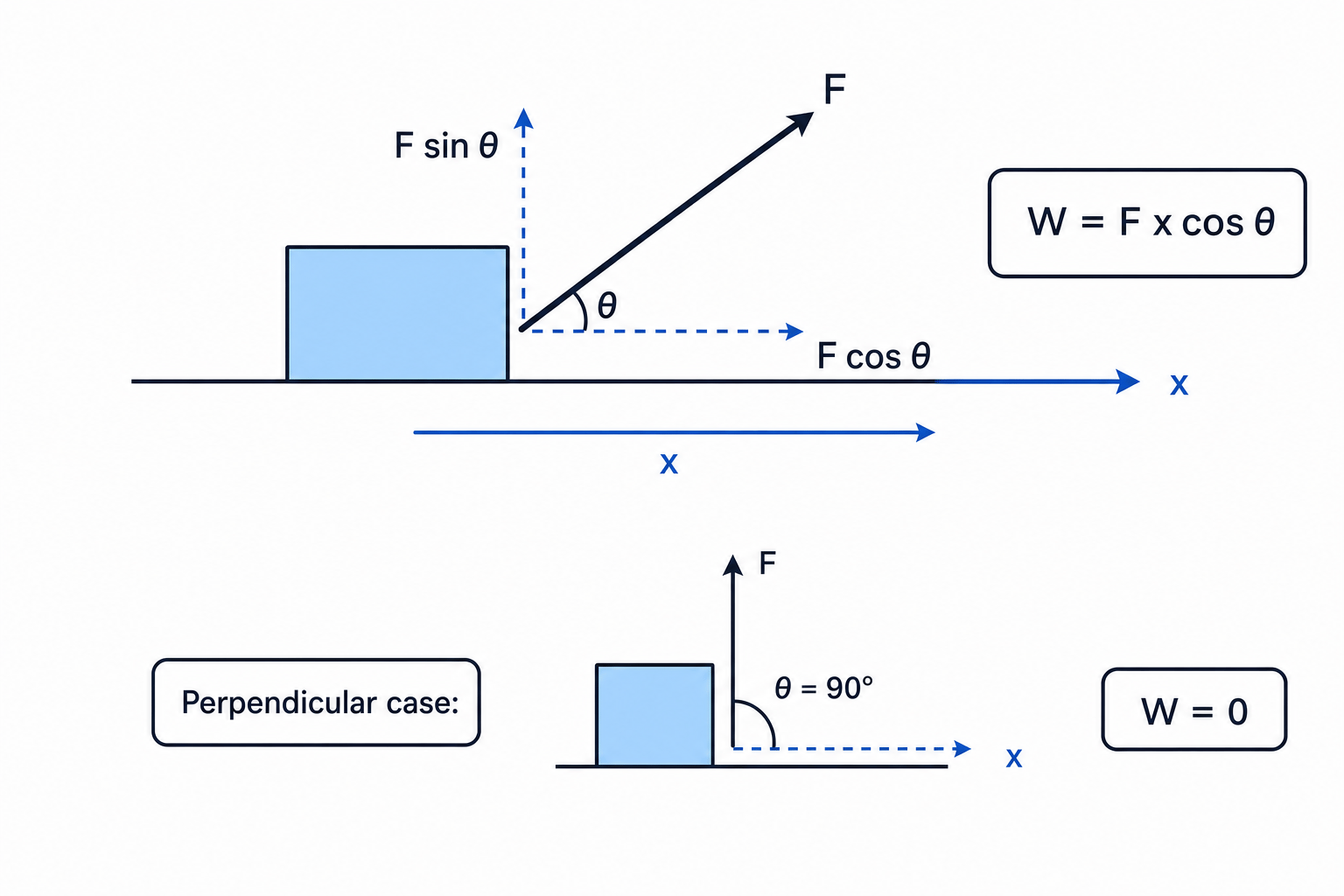
Only the parallel component matters
Work done depends on the component of the force in the direction of displacement. A perpendicular force does no work because cos90∘=0\cos 90^\circ = 0cos90∘=0.
Positive, zero and negative work
The sign of work done tells you the direction of energy transfer.
- If the force has a component in the direction of motion, work done is positive.
- If the force is perpendicular to the motion, work done is zero.
- If the force acts opposite to the motion, work done is negative.
For example, friction usually does negative work on a moving object because it acts opposite to the displacement.
Pulling with an angled force
A student pulls a sledge with a force of 80 N at 35 degrees above the horizontal. The sledge moves 12 m horizontally. Calculate the work done by the pulling force.
- The displacement is horizontal, so use the horizontal component of the force: FcosθF\cos\thetaFcosθ.
- Substitute into W=FxcosθW = Fx\cos\thetaW=Fxcosθ: W=80 N×12 m×cos35∘W = 80\ \text{N} \times 12\ \text{m} \times \cos 35^\circW=80 N×12 m×cos35∘.
- Calculate: W=7.9×10² JW = 7.9 \times 10^2\ \text{J}W=7.9×10² J to two significant figures.
- The pulling force transfers about 7.9×10² J7.9 \times 10^2\ \text{J}7.9×10² J of energy to the sledge.
Work done by friction
A resistive force of 250 N acts on a box as it slides 6.0 m along the floor. The resistive force acts directly opposite to the displacement. Calculate the work done by the resistive force.
- The angle between the resistive force and the displacement is 180 degrees, so cos180∘=−1\cos 180^\circ = -1cos180∘=−1.
- Substitute into W=FxcosθW = Fx\cos\thetaW=Fxcosθ: W=250 N×6.0 m×(−1)W = 250\ \text{N} \times 6.0\ \text{m} \times (-1)W=250 N×6.0 m×(−1).
- This gives W=−1.5×10³ JW = -1.5 \times 10^3\ \text{J}W=−1.5×10³ J.
- The negative sign means energy is transferred away from the moving box, mainly to internal energy of the box, floor and surroundings.
When the equation applies
W=FxcosθW = Fx\cos\thetaW=Fxcosθ assumes the force and angle stay constant over the displacement. If the force changes, do not just multiply by the initial force unless the question justifies using an average value.
Energy in different forms
Energy can be found in different forms. You do not need a new unit for each form: all energy is measured in joules.
Important forms include:
- Kinetic energy: energy of a moving object.
- Gravitational potential energy: energy due to position in a gravitational field.
- Elastic potential energy: energy stored when an object is stretched or compressed.
- Internal energy: energy associated with the particles inside a material, often increasing when temperature rises.
- Chemical energy: energy associated with chemical bonds, such as in fuels or food.
- Electrical energy: energy transferred by moving charges in a circuit.
- Radiation and sound: energy transferred by waves.
Energy transfer by work done
When a force does work, energy is transferred. The amount of energy transferred mechanically is equal to the work done by the force:
Etransferred=WE_{\text{transferred}} = WEtransferred=W
For example, when a motor lifts a load, the motor does work on the load. Energy is transferred from the motor’s electrical supply to the load’s gravitational potential energy store, with some energy often transferred to the surroundings by heating and sound.
Conservation of energy
The principle of conservation of energy is one of the most important ideas in physics.
Principle of conservation of energy
Energy cannot be created or destroyed. It can only be transferred from one object to another, or changed from one form to another. The total energy of a closed system remains constant.
A closed system is a system where no energy is transferred in or out across the boundary you have chosen. In real experiments, it is often difficult to make a perfectly closed system, because energy may be transferred to the surroundings by heating, sound or radiation.
When energy spreads out into less useful forms, we say it has been dissipated. Dissipated energy has not disappeared; it is just harder to use for doing useful work.
Energy accounting
If an energy calculation seems not to balance, do not assume energy has been lost. Look for energy transferred to the surroundings, especially by heating or sound.
This is also how physicists use conservation as a scientific principle: if measurements suggest energy has appeared or vanished, you should question the model, the chosen system, or the experimental uncertainties.
Using conservation in an energy budget
A winch uses 7.0 × 10² J of electrical energy to lift a load. The upward force exerted by the winch is 320 N and the load rises through 1.8 m. Calculate the energy dissipated to the surroundings.
- Calculate the useful work done on the load using W=FxW = FxW=Fx: W=320 N×1.8 m=5.76×10² JW = 320\ \text{N} \times 1.8\ \text{m} = 5.76 \times 10^2\ \text{J}W=320 N×1.8 m=5.76×10² J.
- Interpret this as useful energy transferred to the load: useful energy transferred is 5.76×10² J5.76 \times 10^2\ \text{J}5.76×10² J.
- Apply conservation of energy: input energy equals useful energy plus dissipated energy.
- Calculate the dissipated energy: 7.0×10² J−5.76×10² J=1.24×10² J7.0 \times 10^2\ \text{J} - 5.76 \times 10^2\ \text{J} = 1.24 \times 10^2\ \text{J}7.0×10² J−5.76×10² J=1.24×10² J.
- To two significant figures, the energy dissipated is 1.2×10² J1.2 \times 10^2\ \text{J}1.2×10² J.
A quick check on work calculations
Check the angle before calculating. Same direction gives maximum positive work, perpendicular gives zero work, and opposite direction gives negative work.
A reliable method for work and energy questions
When you see a work-energy question, slow down and identify the energy transfer clearly.
- Identify the force doing the work.
- Identify the displacement of the point where the force acts.
- Find the angle between the force and the displacement.
- Use W=FxcosθW = Fx\cos\thetaW=Fxcosθ.
- Interpret the sign of WWW as an energy transfer into or out of the object.
- Use conservation of energy to account for useful and dissipated transfers.
In the exam
- Always state or use the angle between the force and displacement, not just the angle shown somewhere in the diagram.
- Carry units through calculations: newton metre is joule, so your final answer should be in J.
- If energy seems “lost”, describe where it is transferred, usually to internal energy of the object and surroundings.
Check yourself
- A force acts on an object, but the object moves at right angles to the force. What is the work done by that force?
- Why can friction do negative work on a moving object?
- In an energy budget, what does it mean if useful energy output is less than energy input?
