

Welcome to the study notes on Density and pressure (section 3.2.4). These foundational concepts are essential for understanding how forces act throughout materials, whether you are analyzing the structural integrity of a solid block, the depths of the ocean, or the lift acting on a hot-air balloon.
What you'll learn:
- How to define and calculate density and pressure in different physical contexts.
- How to derive and apply the equation for hydrostatic pressure in a column of liquid.
- How to explain the origin of upthrust and use Archimedes' principle to solve fluid mechanics problems.
1. Density (ρ\rhoρ)
Density is a fundamental characteristic property of a material, describing how closely its mass is packed into a given volume.
Density
Density (ρ\rhoρ) is defined as mass per unit volume of a substance.
ρ=mV \rho = \frac{m}{V} ρ=VmWhere:
- ρ\rhoρ is the density in kilograms per cubic metre (kg m−3\text{kg}\,\text{m}^{-3}kgm−3)
- mmm is the mass in kilograms (kg\text{kg}kg)
- VVV is the volume in cubic metres (m3\text{m}^3m3)
The standard SI unit for density is kilograms per cubic metre (kg m−3\text{kg}\,\text{m}^{-3}kgm−3), but you will often see it given in grams per cubic centimetre (g cm−3\text{g}\,\text{cm}^{-3}gcm−3).
Unit Conversions
Be careful when converting units of density! Volume conversions are scaled in three dimensions:
- 1 cm=10−2 m1\text{ cm} = 10^{-2}\text{ m}1 cm=10−2 m
- 1 cm3=(10−2 m)3=10−6 m31\text{ cm}^3 = (10^{-2}\text{ m})^3 = 10^{-6}\text{ m}^31 cm3=(10−2 m)3=10−6 m3
Therefore, to convert from g cm−3\text{g}\,\text{cm}^{-3}gcm−3 to kg m−3\text{kg}\,\text{m}^{-3}kgm−3, you must multiply by 100010001000. For example, water has a density of 1.0 g cm−31.0\text{ g}\,\text{cm}^{-3}1.0 gcm−3, which is equal to 1000 kg m−31000\text{ kg}\,\text{m}^{-3}1000 kgm−3.
Determining Density Practicals
In practical work (linked to PAG 1), you are expected to determine the density of both regularly and irregularly shaped objects:
- Regular solids: Measure mass using a digital balance. Measure dimensions using a micrometer screw gauge or vernier calipers to calculate volume.
- Irregular solids: Measure mass using a digital balance. Find the volume by completely submerging the object in water inside a displacement (Eureka) can and measuring the volume of water displaced using a measuring cylinder.
Calculating the density of a brass alloy sphere
A solid sphere of a brass alloy is measured to have a diameter of 5.40 cm5.40\text{ cm}5.40 cm and a mass of 695 g695\text{ g}695 g. Calculate the density of the brass alloy in kg m−3\text{kg}\,\text{m}^{-3}kgm−3 to three significant figures.
- Convert the given quantities into SI base units: The radius rrr is half of the diameter:
The mass mmm in kilograms is:
m=695 g=0.695 kg m = 695\text{ g} = 0.695\text{ kg} m=695 g=0.695 kg- Calculate the volume of the sphere: Use the volume formula for a sphere, V=43πr3V = \frac{4}{3}\pi r^3V=34πr3:
- Calculate the density: Substitute the mass and calculated volume into the density formula:
2. Pressure (ppp)
Pressure is a measure of how concentrated a force is over a surface area.
Pressure
Pressure (ppp) is defined as the normal force exerted per unit cross-sectional area.
p=FA p = \frac{F}{A} p=AFWhere:
- ppp is the pressure in Pascals (Pa\text{Pa}Pa) or Newtons per square metre (N m−2\text{N}\,\text{m}^{-2}Nm−2)
- FFF is the normal force (acting perpendicular to the surface) in Newtons (N\text{N}N)
- AAA is the cross-sectional area in square metres (m2\text{m}^2m2)
The SI unit of pressure is the Pascal (Pa\text{Pa}Pa), where 1 Pa=1 N m−21\text{ Pa} = 1\text{ N}\,\text{m}^{-2}1 Pa=1 Nm−2. Pressure applies to solids, liquids, and gases:
- Solids: A solid block resting on a table exerts downward pressure due to its weight distributed over its contact area.
- Liquids and Gases (Fluids): Pressure acts in all directions. Fluid particles are in constant, random motion, colliding with the walls of their container and exerting a cumulative normal force over the contact area.
Using the wrong force component
The force FFF in the pressure equation must be perpendicular to the surface. If a force is applied at an angle θ\thetaθ to the normal of the surface, you must first resolve the force to find its perpendicular component, F⊥=FcosθF_{\perp} = F\cos\thetaF⊥=Fcosθ, before calculating the pressure.
3. Pressure in Fluids (p=hρgp = h\rho gp=hρg)
The pressure at any point in a fluid depends on the depth below the surface. This is because the fluid at a deeper point has to support the weight of all the fluid sitting directly above it.
Deriving p=hρgp = h\rho gp=hρg
Consider a vertical column of fluid with a constant density ρ\rhoρ and a horizontal cross-sectional area AAA. The column has a height hhh.
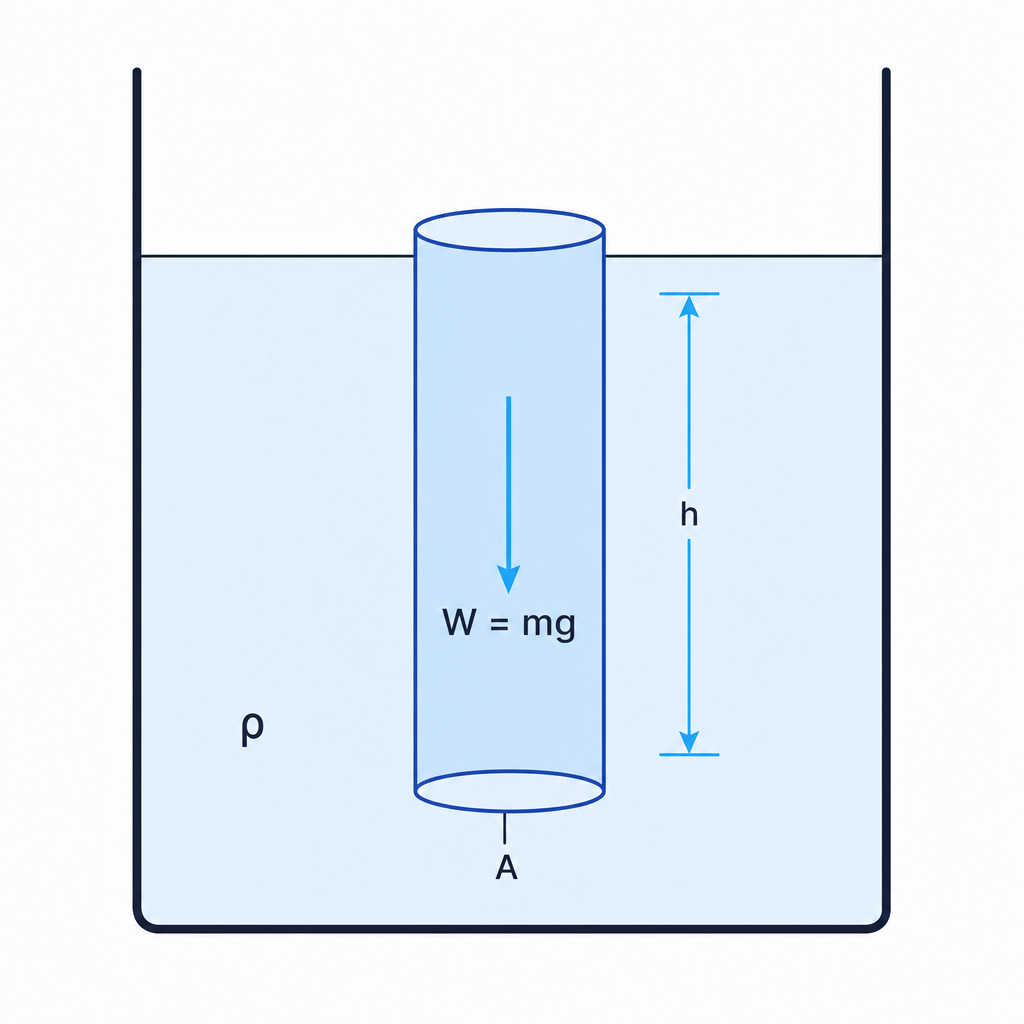
Let's derive the pressure exerted at the base of this column step-by-step:
- Volume of the fluid column:
- Mass of the fluid column: Using the mass-density relation (m=ρVm = \rho Vm=ρV):
- Weight of the fluid column: The weight WWW represents the downward force FFF exerted by the fluid column on its base:
- Pressure at the base: Since pressure is force divided by area:
The area AAA cancels out, leaving:
p=hρg p = h\rho g p=hρgHydrostatic Pressure Formula
The pressure ppp due to a fluid column of depth hhh is given by:
p=hρg p = h\rho g p=hρgThis formula shows that fluid pressure depends only on depth, fluid density, and gravitational field strength. It is independent of the shape of the container or the surface area of the base.
Total vs. Hydrostatic Pressure
The equation p=hρgp = h\rho gp=hρg calculates the pressure due to the fluid itself. If a container or pool is open to the atmosphere, the total pressure at depth hhh is the sum of the hydrostatic pressure and atmospheric pressure (patmp_{\text{atm}}patm):
ptotal=patm+hρg p_{\text{total}} = p_{\text{atm}} + h\rho g ptotal=patm+hρgAtmospheric pressure at sea level is approximately 101 kPa101\text{ kPa}101 kPa (1.01×10⁵ Pa1.01 \times 10^5\text{ Pa}1.01×10⁵ Pa).
Calculating pressure at the bottom of a diving pool
A diving pool has a depth of 5.00 m5.00\text{ m}5.00 m. The density of the fresh water is 1.00×10³ kg m−31.00 \times 10^3\text{ kg}\,\text{m}^{-3}1.00×10³ kgm−3, and atmospheric pressure is 1.01×10⁵ Pa1.01 \times 10^5\text{ Pa}1.01×10⁵ Pa. Calculate the total pressure experienced by a diver at the bottom of the pool. Use g=9.81 m s−2g = 9.81\text{ m s}^{-2}g=9.81 m s−2.
- Calculate the hydrostatic pressure of the water:
- Add the atmospheric pressure to find the total pressure:
- Round to a sensible number of significant figures: Since the input values are given to three significant figures, we quote the final answer as:
4. Upthrust and Archimedes' Principle
Have you ever wondered why a heavy steel ship can float, while a small steel coin sinks? The answer lies in upthrust and pressure differences.
The Origin of Upthrust
When an object is submerged in a fluid, its upper surface is at a shallower depth than its lower surface.
Because pressure increases with depth (p=hρgp = h\rho gp=hρg), the fluid pressure acting upwards on the bottom of the object is greater than the pressure acting downwards on the top of the object. This pressure difference creates a net upward force, which we call upthrust.
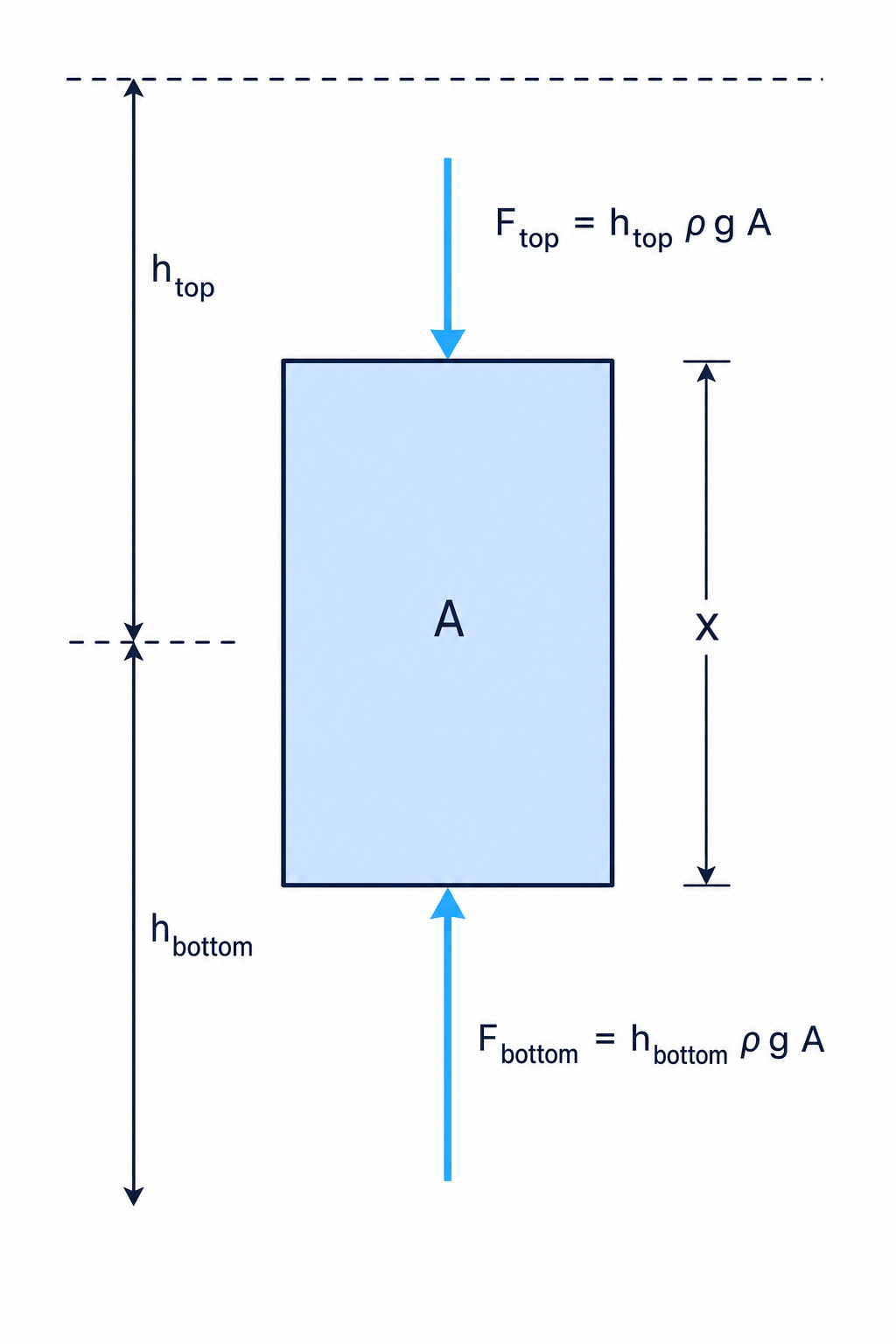
Let's derive the expression for this upward force:
- Downward force on the top surface:
- Upward force on the bottom surface:
- Net upward force (Upthrust, UUU):
- Relating to volume: The difference in depth (hbottom−htop)(h_{\text{bottom}} - h_{\text{top}})(hbottom−htop) is simply the height xxx of the block. The volume of the block is V=AxV = A xV=Ax.
Since VρV\rhoVρ is the mass mfluidm_{\text{fluid}}mfluid of the fluid that has been pushed aside (displaced) by the block, VρgV\rho gVρg is equal to the weight of that displaced fluid. This brings us directly to Archimedes' principle.
Archimedes' Principle
Archimedes' Principle states that:
An object submerged or floating in a fluid experiences an upward upthrust force equal to the weight of the fluid it displaces.
U=Vsubρfluidg U = V_{\text{sub}} \rho_{\text{fluid}} g U=VsubρfluidgWhere:
- UUU is the upthrust force in Newtons (N\text{N}N)
- VsubV_{\text{sub}}Vsub is the volume of the object submerged in the fluid in cubic metres (m3\text{m}^3m3)
- ρfluid\rho_{\text{fluid}}ρfluid is the density of the fluid in kilograms per cubic metre (kg m−3\text{kg}\,\text{m}^{-3}kgm−3)
- ggg is the acceleration of free fall (9.81 m s−29.81\text{ m s}^{-2}9.81 m s−2)
Sinking vs. Floating
- An object sinks if its weight is greater than the maximum upthrust (which occurs when the object is fully submerged). This happens if the average density of the object is greater than the density of the fluid (ρobject>ρfluid\rho_{\text{object}} > \rho_{\text{fluid}}ρobject>ρfluid).
- An object floats in equilibrium if its weight is equal to the upthrust. In this state, it only needs to displace a volume of fluid whose weight matches the object's total weight.
Calculating the submerged volume of a floating ice block
An ice block of mass 450 kg450\text{ kg}450 kg floats in freshwater of density 1.00×10³ kg m−31.00 \times 10^3\text{ kg}\,\text{m}^{-3}1.00×10³ kgm−3. Calculate the volume of the ice block that is submerged below the water level.
- State the condition for floating: For a floating object in equilibrium, the upward upthrust UUU must balance the downward weight of the object WWW:
- Calculate the weight of the ice block:
- Set up Archimedes' principle equation for upthrust:
Since U=WU = WU=W:
Vsubρwaterg=mg V_{\text{sub}} \rho_{\text{water}} g = mg Vsubρwaterg=mgNotice that ggg cancels out from both sides:
Vsubρwater=m V_{\text{sub}} \rho_{\text{water}} = m Vsubρwater=m- Rearrange and solve for the submerged volume (VsubV_{\text{sub}}Vsub):
In the exam
- Always check your units: Ensure volume is in m3\text{m}^3m3 (not cm3\text{cm}^3cm3 or litres) and density is in kg m−3\text{kg}\,\text{m}^{-3}kgm−3 before carrying out substitutions.
- Memorize the p=hρgp = h\rho gp=hρg derivation: This is a classic 3-to-4 mark exam question. Practice writing down the algebraic steps clearly, defining what each letter represents.
- Use free-body diagrams for upthrust questions: Draw the forces acting on the submerged object (Weight downwards, Upthrust upwards, and sometimes Tension in a string or Drag if the object is moving). Set up your equilibrium equations (Fnet=0F_{\text{net}} = 0Fnet=0) from the diagram.
- Be precise with vocabulary: Use the term "fluid" rather than just "liquid" when discussing pressure and upthrust, as these principles apply equally to gases (like balloons floating in air).
Check yourself
- A metal cylinder has a radius of 1.5 cm1.5\text{ cm}1.5 cm and a height of 12 cm12\text{ cm}12 cm. If its mass is 0.72 kg0.72\text{ kg}0.72 kg, what is its density in kg m−3\text{kg}\,\text{m}^{-3}kgm−3?
- Explain why the pressure equation p=hρgp = h\rho gp=hρg proves that a thin, tall cylinder of water exerts the same pressure on its base as a wide, tall tank filled to the same height.
- A fully submerged concrete block experiences an upthrust of 250 N250\text{ N}250 N in seawater. If the density of the seawater is 1025 kg m−31025\text{ kg}\,\text{m}^{-3}1025 kgm−3, what is the volume of the block?
