What you'll learn
- Why diffraction is strong evidence for wave behaviour.
- How electron diffraction through thin polycrystalline graphite works.
- Why the spacing between graphite atoms matters.
- How to use the de Broglie equation λ=h/p\lambda = h/pλ=h/p in calculations.
Prerequisite ideas: waves and particles
Waves can diffract
A wavelength λ\lambdaλ is the distance from one point on a wave to the equivalent point on the next wave, for example crest to crest. It is measured in metres, m.
When waves meet an obstacle, gap, or regular structure, they can spread out and interfere. This is especially noticeable when the wavelength is similar to the size of the gap or spacing.
Diffraction
Diffraction is the spreading of waves when they pass through a gap or around an obstacle. A diffraction pattern with bright and dark regions is produced when diffracted waves interfere with each other.
In a crystal, atoms are arranged in a regular pattern. The distance between repeated atoms or atomic planes can act like the spacing in a diffraction grating, but on a much smaller scale.
Judging whether diffraction is likely
A wave has wavelength λ=2.0×10⁻¹⁰ m\lambda = 2.0 \times 10^{-10}\ \text{m}λ=2.0×10⁻¹⁰ m and meets a regular atomic spacing d=3.0×10⁻¹⁰ md = 3.0 \times 10^{-10}\ \text{m}d=3.0×10⁻¹⁰ m. Decide whether diffraction could be noticeable.
- Compare the two length scales:
-
Since the wavelength and spacing are the same order of magnitude, the wave can be diffracted through noticeable angles.
-
If the wavelength were instead many powers of ten smaller than the spacing, the diffraction angles would be extremely small and the pattern would be much harder to observe.
Particles have momentum
A particle is usually thought of as a localised object with mass and momentum. The momentum ppp of a non-relativistic particle is
p=mv p = mv p=mvwhere mmm is mass in kilograms, kg, and vvv is velocity in metres per second, m s−1^{-1}−1. Momentum has unit kg m s−1^{-1}−1.
Electrons are clearly particle-like in many ways: they have charge, mass, and can arrive at a screen in localised impacts.
What wave–particle duality means
Wave–particle duality
Wave–particle duality is the idea that quantum objects can show both particle-like and wave-like behaviour, depending on the experiment used to observe them.
For this section, the key surprise is not that light can behave like particles — you meet that in the photoelectric effect — but that electrons, which are particles, can behave like waves.
The big message
Electron diffraction shows that moving electrons have a wavelength. This is evidence for wave-like behaviour of particles.
Electron diffraction: the experimental evidence
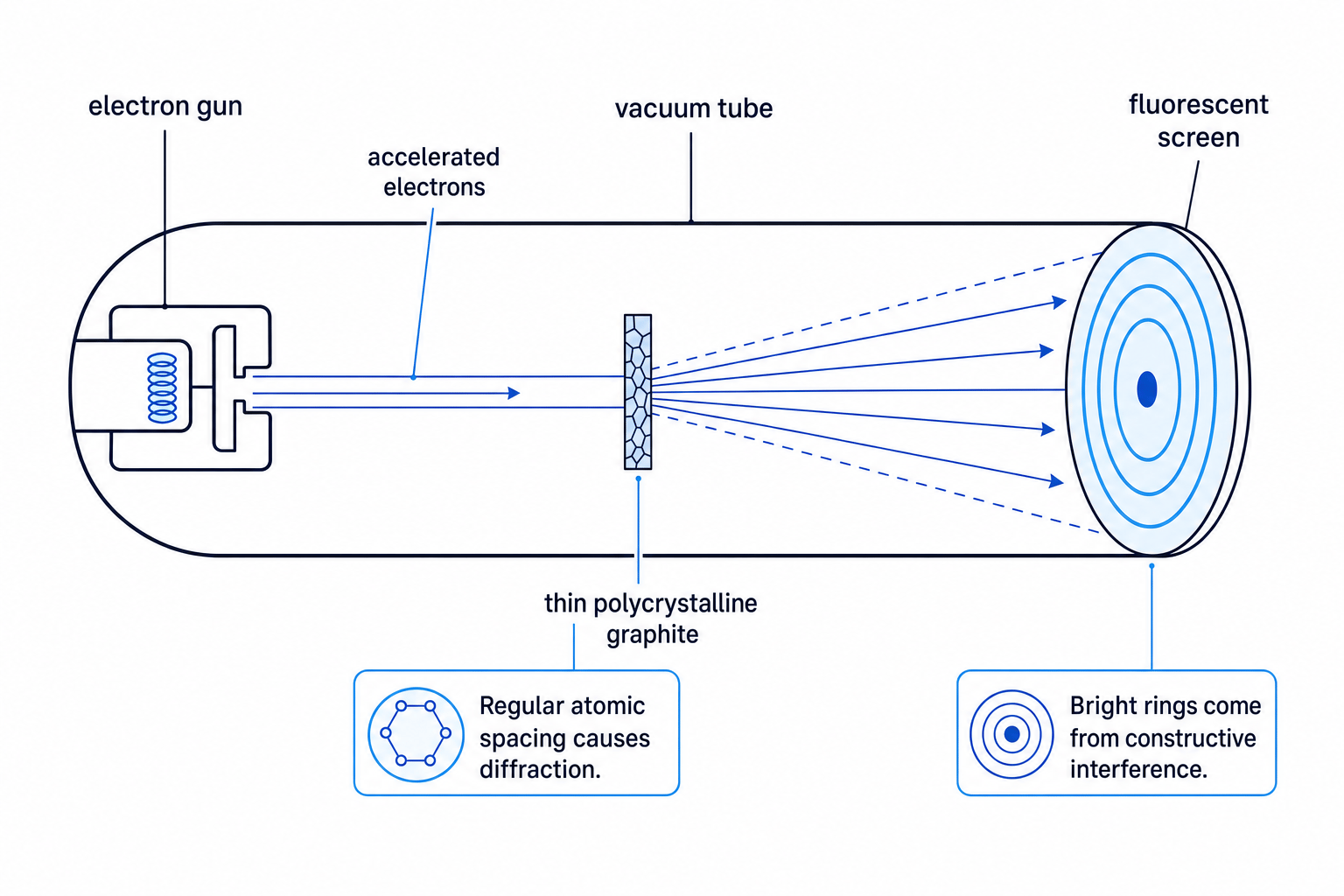
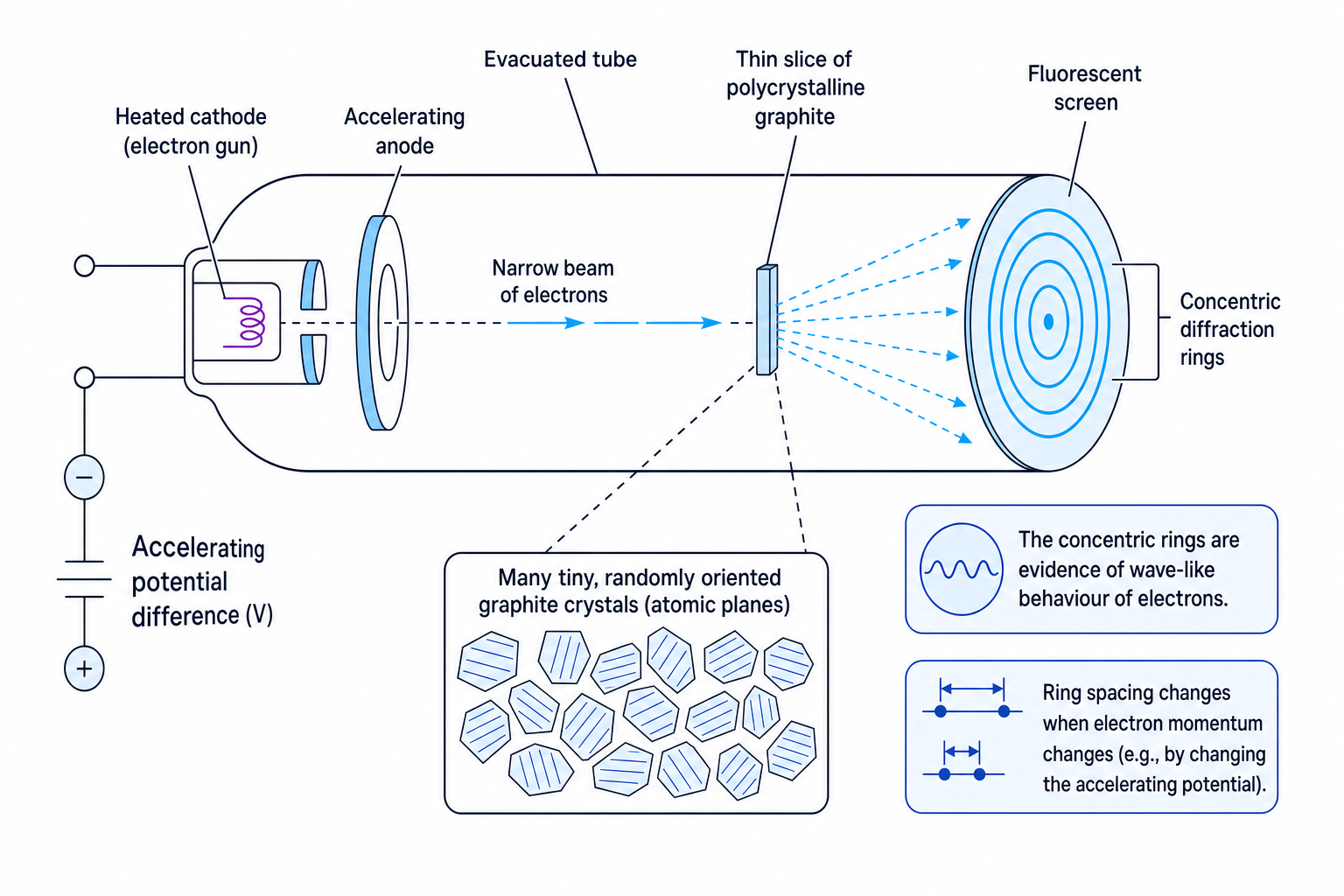
In an electron diffraction tube, electrons are produced by an electron gun and accelerated through a potential difference. The beam travels through an evacuated tube, so the electrons do not collide with air molecules. The electrons then pass through a thin slice of polycrystalline graphite, and the pattern is viewed on a fluorescent screen.
A fluorescent screen emits visible light when struck by electrons. Instead of just one bright spot, the screen shows concentric rings: bright circular rings separated by darker regions.
Why graphite is used
Graphite is a form of carbon with atoms arranged in regular layers. Polycrystalline means the sample is made from many tiny crystals, called crystallites, pointing in many different directions.
A thin slice of polycrystalline graphite is useful because:
- the regular atomic spacings diffract the electron waves;
- the slice is thin enough for many electrons to pass through;
- the many crystal orientations produce rings rather than just isolated spots.
Why rings appear
The electrons are scattered by the atoms of graphite. In some directions, the scattered electron waves reinforce each other, giving bright regions. In other directions, they cancel more, giving darker regions.
Because the graphite contains many tiny crystals in random orientations, the allowed diffraction directions form cones. When these cones hit the flat fluorescent screen, they appear as circular rings.
Explaining the graphite diffraction rings
A narrow electron beam passes through thin polycrystalline graphite and produces concentric bright rings on a fluorescent screen. Explain why this is evidence for wave-like behaviour.
-
Electrons are particle-like because they have charge and mass, and they are detected as localised impacts on the screen.
-
A pattern of bright and dark rings is characteristic of diffraction and interference, which are wave behaviours.
-
The regular spacing between graphite atoms provides the length scale needed to diffract the electron waves.
-
Therefore the ring pattern shows that the moving electrons have wave-like behaviour, even though they are also detected as particles.
Calling graphite a set of slits
Do not say the electrons pass through “slits” in the graphite. The diffraction is caused by scattering from the regular spacing of atoms and atomic planes in the graphite lattice.
The de Broglie equation
The wavelength associated with a moving particle is called its de Broglie wavelength.
de Broglie wavelength
The de Broglie wavelength λ\lambdaλ of a particle is given by λ=h/p\lambda = h/pλ=h/p, where hhh is the Planck constant and ppp is the momentum of the particle.
The OCR equation is
λ=hp \lambda = \frac{h}{p} λ=phwhere:
- λ\lambdaλ is wavelength in metres, m;
- h=6.63×10⁻³⁴ J sh = 6.63 \times 10^{-34}\ \text{J s}h=6.63×10⁻³⁴ J s is the Planck constant;
- ppp is momentum in kg m s−1^{-1}−1.
The equation tells you that wavelength and momentum are inversely proportional. A larger momentum means a smaller de Broglie wavelength.
Getting the trend backwards
If the electrons are accelerated more, their momentum increases, so their de Broglie wavelength decreases. Higher momentum does not mean larger wavelength.
Connecting voltage, momentum and diffraction
In an electron diffraction tube, increasing the accelerating potential difference gives the electrons more kinetic energy. That increases their momentum, so their de Broglie wavelength decreases. The diffraction angles become smaller, so the rings move closer to the centre of the screen.
If an electron starts from rest and is accelerated through a potential difference VVV, the energy transferred is eVeVeV, where e=1.60×10⁻¹⁹ Ce = 1.60 \times 10^{-19}\ \text{C}e=1.60×10⁻¹⁹ C is the elementary charge.
Finding wavelength from accelerating voltage
Electrons are accelerated from rest through a potential difference of 2.5 kV. Calculate their de Broglie wavelength. Use me=9.11×10⁻³¹ kgm_e = 9.11 \times 10^{-31}\ \text{kg}me=9.11×10⁻³¹ kg.
- Convert the potential difference into volts and calculate the kinetic energy gained:
- Use the kinetic energy to find the momentum. Since Ek=p2/(2me)E_k = p^2/(2m_e)Ek=p2/(2me),
- Apply the de Broglie equation:
- Quote the result sensibly:
This is small, but it is close enough to atomic spacings in crystals for electron diffraction to be observed.
When the simple energy link breaks down
At very high accelerating voltages, electrons may become relativistic, so Ek=p2/(2me)E_k = p^2/(2m_e)Ek=p2/(2me) is no longer accurate. For this topic, use λ=h/p\lambda = h/pλ=h/p directly whenever momentum is given.
Why this matters
The electron diffraction experiment links the observations and the equation neatly:
- electrons are sent as a beam of particles;
- the graphite atoms act as a regular diffracting structure;
- the screen shows a wave-like diffraction pattern;
- changing the electron momentum changes the pattern as predicted by λ=h/p\lambda = h/pλ=h/p.
That is the core evidence for wave-like behaviour of particles.
A quick sanity check
For electron diffraction, your calculated wavelength should usually be extremely small, often around 10−11 m10^{-11}\ \text{m}10−11 m to 10−10 m10^{-10}\ \text{m}10−10 m. If you get a visible-light wavelength, something has gone wrong with units or powers of ten.
In the exam
-
For evidence questions, name the observation: electrons passing through thin polycrystalline graphite produce concentric diffraction rings.
-
Link the observation to the physics: diffraction and interference are wave behaviours, so the electrons must have wave-like properties.
-
For calculations, convert all quantities to SI units, find ppp if needed, then use λ=h/p\lambda = h/pλ=h/p.
-
State the inverse relationship clearly: increasing momentum decreases de Broglie wavelength and reduces the diffraction angle.
Check yourself
- Why does a ring pattern provide stronger evidence than just saying “the electrons were deflected”?
- What role does the spacing between graphite atoms play in electron diffraction?
- If the accelerating potential difference is increased, what happens to the electron wavelength?