

What you'll learn
- What thermal equilibrium means and how it predicts the direction of energy transfer.
- Why the kelvin scale is an absolute, thermodynamic temperature scale.
- How to measure and state temperature in degrees Celsius and kelvin.
- How to use T(K)≈θ(∘C)+273T(\text{K}) \approx \theta(^{\circ}\text{C}) + 273T(K)≈θ(∘C)+273 without common conversion mistakes.
Starting point: what is temperature?
Temperature is a measure of how hot or cold an object is. More usefully in physics, temperature tells you the direction of energy transfer when two objects are put in thermal contact.
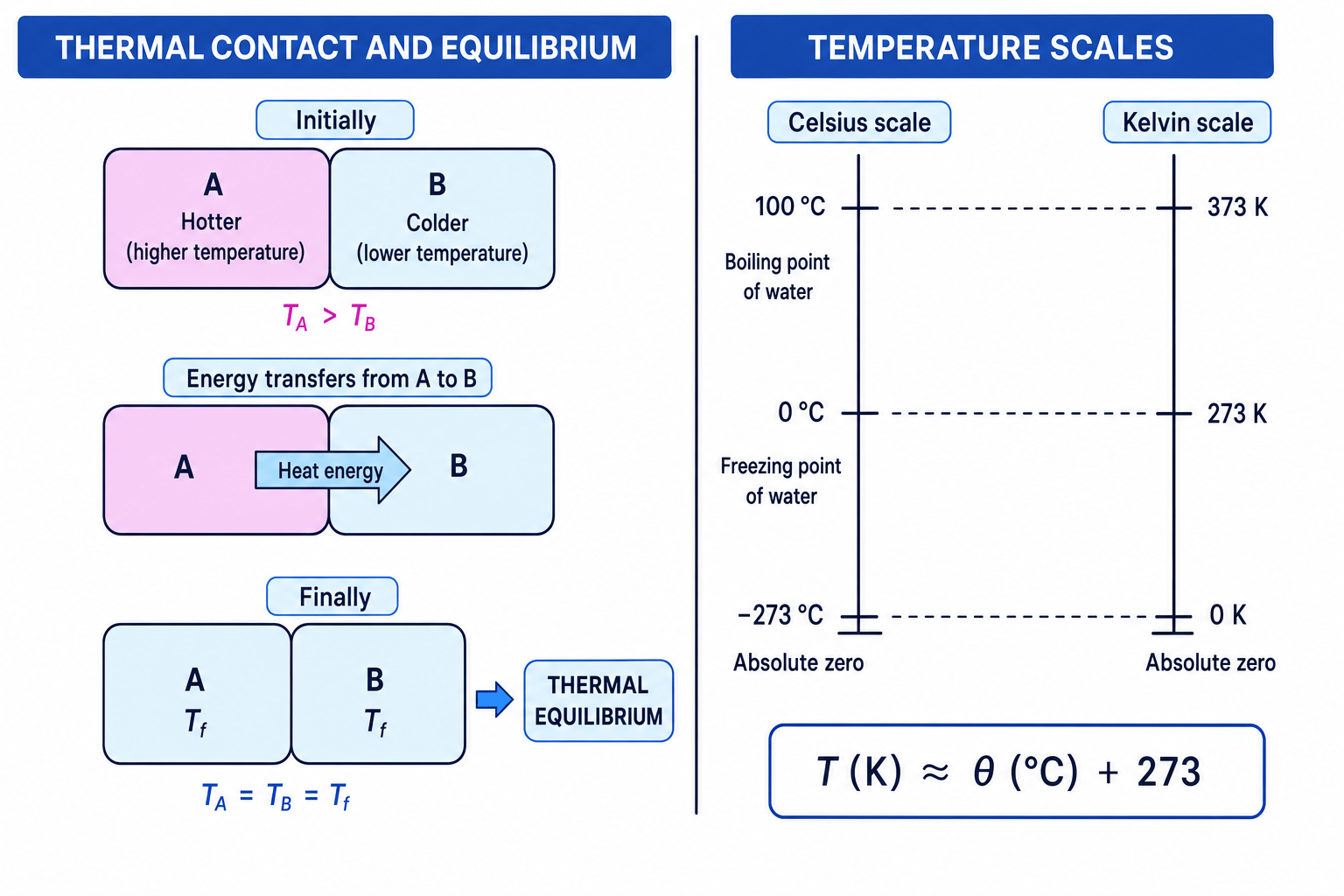
If two objects are at different temperatures, energy transfers from the hotter object to the colder object. This transfer continues until there is no net transfer of energy between them.
Thermal contact
Two objects are in thermal contact if energy can transfer between them because of a temperature difference. They do not necessarily have to be touching directly; energy may also transfer through a wall or container.
Thermal equilibrium
Thermal equilibrium
Two objects are in thermal equilibrium when they are at the same temperature, so there is no net transfer of thermal energy between them.
The word net matters. At the particle level, energy transfers may still happen in both directions, but the overall transfer one way is zero when the temperatures are equal.
For A-Level thermal physics, you should be able to reason like this:
- If object A is hotter than object B, energy transfers from A to B.
- If object A and object B have the same temperature, they are in thermal equilibrium.
- If an object is in thermal equilibrium with its surroundings, its temperature is the same as the surroundings.
Temperature decides direction
Thermal energy transfers from a region of higher temperature to a region of lower temperature until thermal equilibrium is reached.
Deciding whether thermal equilibrium has been reached
A metal block at 80 °C is placed on a bench at 20 °C. The block is left for a long time in a room that stays at 20 °C. Explain what happens.
-
Compare the temperatures: the block starts at a higher temperature than the bench and the surrounding air, so energy transfers from the block to its surroundings.
-
As the block loses energy, its temperature decreases. The surroundings are much larger, so their temperature can be treated as staying approximately 20 °C.
-
After a long time, the block reaches 20 °C. It is then in thermal equilibrium with the room because there is no net energy transfer due to a temperature difference.
Assuming equilibrium means no energy transfer at all
Thermal equilibrium means no net transfer of energy due to temperature difference. It does not mean particles have stopped moving or that microscopic energy exchanges have completely stopped.
Temperature scales
A temperature scale gives a numerical value to temperature. You meet two scales in this topic:
- degrees Celsius, symbol °C
- kelvin, symbol K
The Celsius scale is convenient in everyday life. Water freezes at about 0 °C and boils at about 100 °C at normal atmospheric pressure.
The kelvin scale is the important one for thermal physics because it is an absolute scale.
Absolute temperature scale
An absolute temperature scale has its zero at absolute zero, the lowest possible thermodynamic temperature. The SI unit of absolute temperature is the kelvin, symbol K.
Notice the unit style:
- You write 20 °C as “20 degrees Celsius”.
- You write 293 K as “293 kelvin”, not “293 degrees kelvin”.
Unit wording
Use the degree symbol for Celsius, °C. Do not use a degree symbol with kelvin: write K, not °K.
The thermodynamic temperature scale
The kelvin scale is also called the thermodynamic temperature scale. It does not depend on the property of any particular substance.
That idea is more important than it may first look. Many thermometers work because some physical property changes with temperature, such as:
- the length of a liquid column in a glass thermometer
- the electrical resistance of a thermistor
- the pressure of a fixed volume of gas
- the voltage from a thermocouple
These are useful practical methods, but the measured value can depend slightly on the substance or sensor used. A truly fundamental scale should not depend on choosing mercury, alcohol, a metal wire, or any other particular material.
Why kelvin is fundamental
The thermodynamic scale is designed to be independent of the chosen thermometer substance. This makes kelvin the natural unit for theoretical thermal physics.
This is a good example of how physics develops: scientists move from convenient empirical scales based on observations to definitions that are more universal and reproducible.
Celsius and kelvin: the conversion
OCR gives the relationship:
T(K)≈θ(∘C)+273T(\text{K}) \approx \theta(^{\circ}\text{C}) + 273T(K)≈θ(∘C)+273Here:
- TTT is the thermodynamic temperature in kelvin.
- θ\thetaθ is the temperature in degrees Celsius.
- The symbol ≈\approx≈ means “is approximately equal to”.
So:
- 0 °C is approximately 273 K.
- 100 °C is approximately 373 K.
- -273 °C is approximately 0 K.
For most A-Level calculations, use 273 rather than 273.15 unless a question specifically gives extra precision.
Converting Celsius to kelvin
A laboratory thermometer reads 22 °C. Convert this temperature into kelvin.
-
Choose the correct conversion because the starting temperature is in degrees Celsius:
T(K)≈θ(∘C)+273T(\text{K}) \approx \theta(^{\circ}\text{C}) + 273T(K)≈θ(∘C)+273 -
Substitute θ=22 ∘C\theta = 22\ ^{\circ}\text{C}θ=22 ∘C:
T≈22+273=295 KT \approx 22 + 273 = 295\ \text{K}T≈22+273=295 K -
The kelvin value should be larger than the Celsius value by about 273, so 295 K is sensible.
Converting kelvin to Celsius
A sample of gas has a temperature of 310 K. Find its temperature in degrees Celsius.
-
Rearrange the conversion equation to make θ\thetaθ the subject:
θ(∘C)≈T(K)−273\theta(^{\circ}\text{C}) \approx T(\text{K}) - 273θ(∘C)≈T(K)−273 -
Substitute T=310 KT = 310\ \text{K}T=310 K:
θ≈310−273=37 ∘C\theta \approx 310 - 273 = 37\ ^{\circ}\text{C}θ≈310−273=37 ∘C -
This is close to human body temperature, so the result is physically reasonable.
Adding 273 the wrong way
Only add 273 when converting from degrees Celsius to kelvin. When converting from kelvin to degrees Celsius, subtract 273.
Temperature changes: Celsius intervals and kelvin intervals
A temperature value must be converted carefully between °C and K. However, a temperature change has the same numerical size in degrees Celsius and kelvin.
For example, warming by 10 °C is the same temperature interval as warming by 10 K.
This is because the Celsius and kelvin scales have the same step size; they are just offset by about 273.
Finding a temperature change
A liquid is heated from 18 °C to 75 °C. Find the temperature increase in kelvin.
-
Calculate the change using final temperature minus initial temperature:
Δθ=75−18=57 ∘C\Delta \theta = 75 - 18 = 57\ ^{\circ}\text{C}Δθ=75−18=57 ∘C -
A change of one degree Celsius has the same size as a change of one kelvin, so:
ΔT=57 K\Delta T = 57\ \text{K}ΔT=57 K -
Do not add 273 to the change. Adding 273 is for converting a temperature reading, not a temperature interval.
Quick check for changes
If the question asks for a temperature change, the numerical value is the same in °C and K. If it asks for an absolute temperature, use kelvin.
Absolute zero
Absolute zero is 0 K, which is approximately -273 °C. It is the zero point of the thermodynamic temperature scale.
You do not need a detailed microscopic model here, but you should know that absolute zero is not just “very cold”. It is the reference point for absolute temperature, so kelvin temperatures are measured upwards from 0 K.
Negative kelvin in A-Level physics
For this specification, ordinary thermodynamic temperatures should not be negative in kelvin. If your conversion gives a negative kelvin temperature, check your arithmetic or units.
Choosing the right temperature unit
In this short section, you mainly need to be fluent with both scales. Later in thermal physics, equations involving absolute temperature normally require kelvin, especially when temperature appears in proportional relationships.
As a habit:
- Use °C when reporting everyday measured temperatures if the question uses °C.
- Use K when a formula needs thermodynamic temperature.
- Convert to K before using an absolute temperature in a physics equation.
In the exam
-
Identify whether the question gives a temperature value or a temperature change; values may need converting, changes usually do not.
-
Write kelvin units as K, never °K, and remember that 0 °C is about 273 K.
-
For conversions, use T(K)≈θ(∘C)+273T(\text{K}) \approx \theta(^{\circ}\text{C}) + 273T(K)≈θ(∘C)+273 and reverse it by subtracting 273.
Check yourself
- What condition must be met for two objects to be in thermal equilibrium?
- Why is the kelvin scale described as an absolute scale?
- A room is at 19 °C. What is this temperature in kelvin?
