

At the end of the nineteenth century, physicists believed they had light completely figured out. Under classical wave theory, light was understood to be a continuous electromagnetic wave. However, a series of experimental discoveries shook this foundation and forced the birth of quantum physics.
The primary catalyst for this revolution was the photoelectric effect.
What you'll learn
- How the photoelectric effect provides undeniable evidence for the particle-like behavior of electromagnetic radiation.
- How the gold-leaf electroscope is used to demonstrate this phenomenon experimentally.
- How to use and apply Einstein's photoelectric equation to calculate work functions, threshold frequencies, and kinetic energies.
- The physical distinction between the effects of radiation intensity and frequency.
1. The Classical Physics Crisis
In classical physics, electromagnetic waves carry continuous energy. If you shine light onto a metal surface, the electric field of the wave should continuously transfer energy to the free electrons in the metal.
Under this wave theory, physicists predicted that:
- Any frequency of light should eventually liberate electrons, provided the light is bright enough (high intensity). High-intensity light has larger amplitude waves, which carry more energy per second.
- A time delay should occur when using very dim (low-intensity) light, as electrons would need time to absorb and accumulate enough energy from the continuous wave front to break free.
When experiments were conducted, both of these predictions failed completely. Instead, physicists observed that:
- Below a certain critical frequency, no electrons are emitted, no matter how intense or bright the light is.
- Above this critical frequency, electrons are emitted almost instantly, even if the light is extremely dim.
This conflict could not be resolved using classical wave theory. It required a radically new model of light.
2. Demonstrating the Photoelectric Effect
The standard laboratory demonstration of the photoelectric effect uses a gold-leaf electroscope fitted with a clean zinc plate.
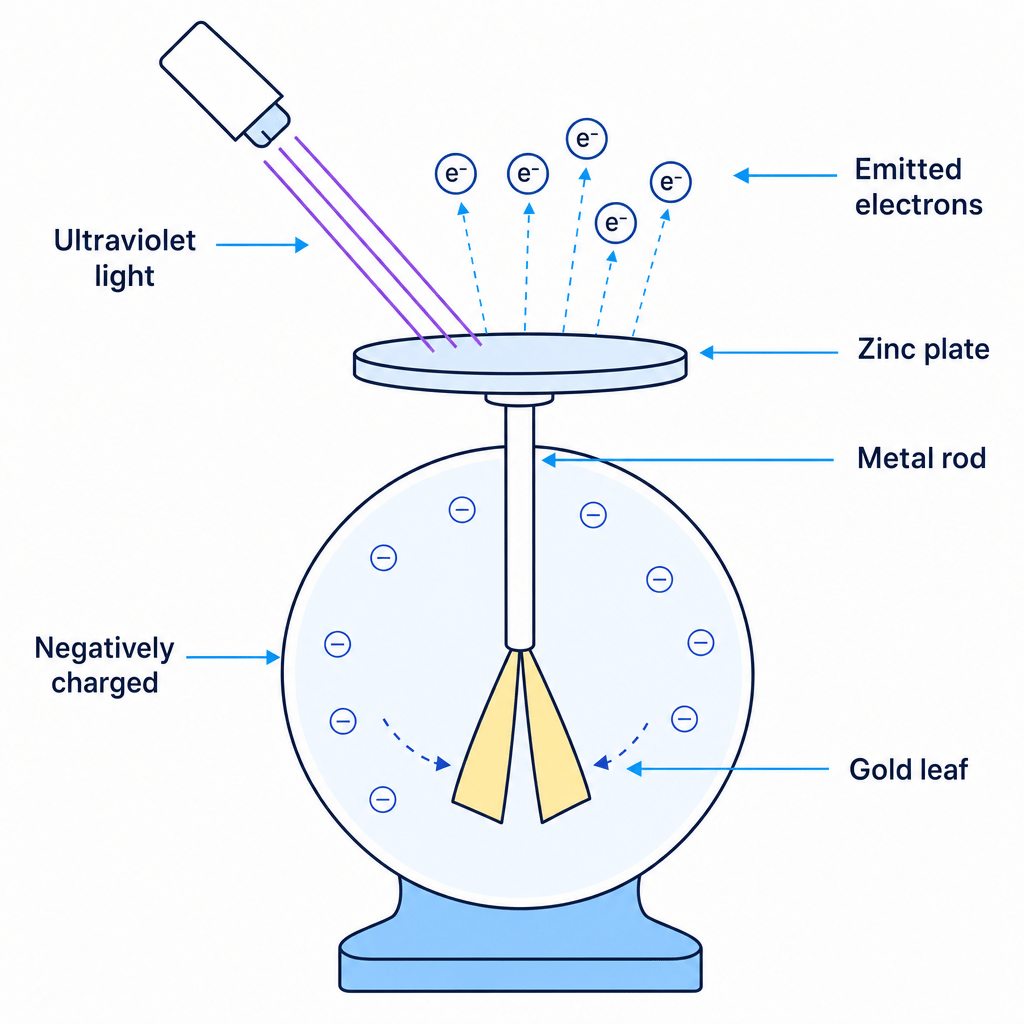
The Experimental Procedure
- Preparation: The surface of a zinc plate is rubbed with emery paper to remove any oxide layer (which acts as an insulator and blocks electron escape).
- Charging: The zinc plate and electroscope are given a negative charge (usually by induction or touch with a charged rod). The gold leaf rises because the negative charge on the gold leaf and the central metal stem repel each other.
- Illumination with UV light: An ultraviolet lamp is shone onto the zinc plate.
- Observation: The gold leaf instantly falls back down. This indicates that the electroscope has lost its negative charge because electrons have been ejected from the zinc plate's surface.
- Illumination with Visible light: The experiment is repeated using high-intensity visible light.
- Observation: The gold leaf remains raised. No electrons are emitted, regardless of how bright or close the visible light source is.
- Positive Charging: The electroscope is charged positively, and ultraviolet light is shone on it.
- Observation: The gold leaf does not fall.
Why positive charge fails to discharge
When the electroscope is charged positively, the zinc plate has a deficit of electrons. If UV light is shone on it, the photons still have enough energy to liberate surface electrons. However, because the plate is strongly positively charged, the liberated electrons are immediately attracted back to the plate. Consequently, no net charge is lost, and the leaf does not fall.
3. The Photon Model and One-to-One Interactions
To explain these observations, Albert Einstein proposed that electromagnetic radiation is not a continuous wave, but rather consists of discrete packets of energy called photons.
Photon
A photon is a quantum (or discrete packet) of electromagnetic radiation. The energy EEE of a photon is directly proportional to its frequency fff, defined by:
E=hf E = hf E=hfwhere hhh is Planck's constant (6.63×10⁻³⁴ J s6.63 \times 10^{-34}\text{ J s}6.63×10⁻³⁴ J s).
Einstein's key insight was that the photoelectric effect is a one-to-one interaction between a single incident photon and a single conduction electron on the metal surface.
The One-to-One Rule
One photon interacts with exactly one electron.
- A photon transfers all of its energy to a single electron, or none of it.
- Energy cannot be accumulated over time from multiple low-energy photons.
This one-to-one rule perfectly explains why there is no time delay: if an individual photon has enough energy, the electron is ejected instantly. If it does not, the electron merely gains thermal energy (it collides with other metal ions and loses this energy as heat), and no emission occurs.
4. Work Function and Threshold Frequency
For an electron to escape the surface of a metal, it must overcome the electrostatic forces holding it within the positive lattice.
Work Function (φ)
The work function (ϕ\phiϕ) of a metal is the minimum energy required to liberate an electron from the surface of the metal. It is measured in Joules (J) or electronvolts (eV).
Threshold Frequency (f₀)
The threshold frequency (f0f_0f0) is the minimum frequency of incident electromagnetic radiation required to liberate an electron from the surface of a metal.
Because the energy of a photon is E=hfE = hfE=hf, the threshold frequency corresponds directly to the work function:
ϕ=hf0 \phi = hf_0 ϕ=hf0If the frequency of the incident photon fff is less than f0f_0f0, its energy is less than ϕ\phiϕ, and no photoelectric emission can take place.
The vending machine
Think of the work function as the cost of an item in a vending machine (e.g., £1.50). The machine only accepts single coins (one-to-one interaction).
- If you insert a £1.00 coin (a low-energy photon), you cannot buy the item, and you cannot leave the coin there to add to another one later—the machine immediately rejects it.
- If you insert a £2.00 coin, you get the item instantly, and you get £0.50 change (the remaining kinetic energy of the electron).
5. Einstein's Photoelectric Equation
When a photon with energy hfhfhf (greater than the work function ϕ\phiϕ) strikes a surface electron, the energy is split:
- A portion of the energy (ϕ\phiϕ) is used to free the electron from the surface.
- The remaining energy becomes the kinetic energy of the newly liberated electron.
This conservation of energy is expressed as Einstein's photoelectric equation:
hf=ϕ+KEmax hf = \phi + KE_{max} hf=ϕ+KEmaxwhere:
- hhh is Planck's constant (6.63×10⁻³⁴ J s6.63 \times 10^{-34}\text{ J s}6.63×10⁻³⁴ J s)
- fff is the frequency of the incident electromagnetic radiation (Hz\text{Hz}Hz)
- ϕ\phiϕ is the work function of the metal (J\text{J}J)
- KEmaxKE_{max}KEmax is the maximum kinetic energy of the emitted photoelectrons (J\text{J}J)
Why 'maximum' kinetic energy?
The work function ϕ\phiϕ is the minimum energy required to release an electron from the surface. Most electrons sit deeper within the metal structure. If a photon interacts with a deeper electron, some energy is lost in collisions with metal ions as the electron makes its way to the surface. Therefore, these electrons emerge with less kinetic energy than KEmaxKE_{max}KEmax. Only electrons right at the surface emerge with KEmaxKE_{max}KEmax.
Graphical Representation of Einstein's Equation
If we rearrange Einstein’s equation to make KEmaxKE_{max}KEmax the subject:
KEmax=hf−ϕ KE_{max} = hf - \phi KEmax=hf−ϕThis equation has the linear form y=mx+cy = mx + cy=mx+c, where:
- The yyy-axis variable is KEmaxKE_{max}KEmax
- The xxx-axis variable is fff
- The gradient (mmm) is Planck's constant hhh
- The yyy-intercept (ccc) is negative work function (−ϕ-\phi−ϕ)
- The xxx-intercept is the threshold frequency f0f_0f0
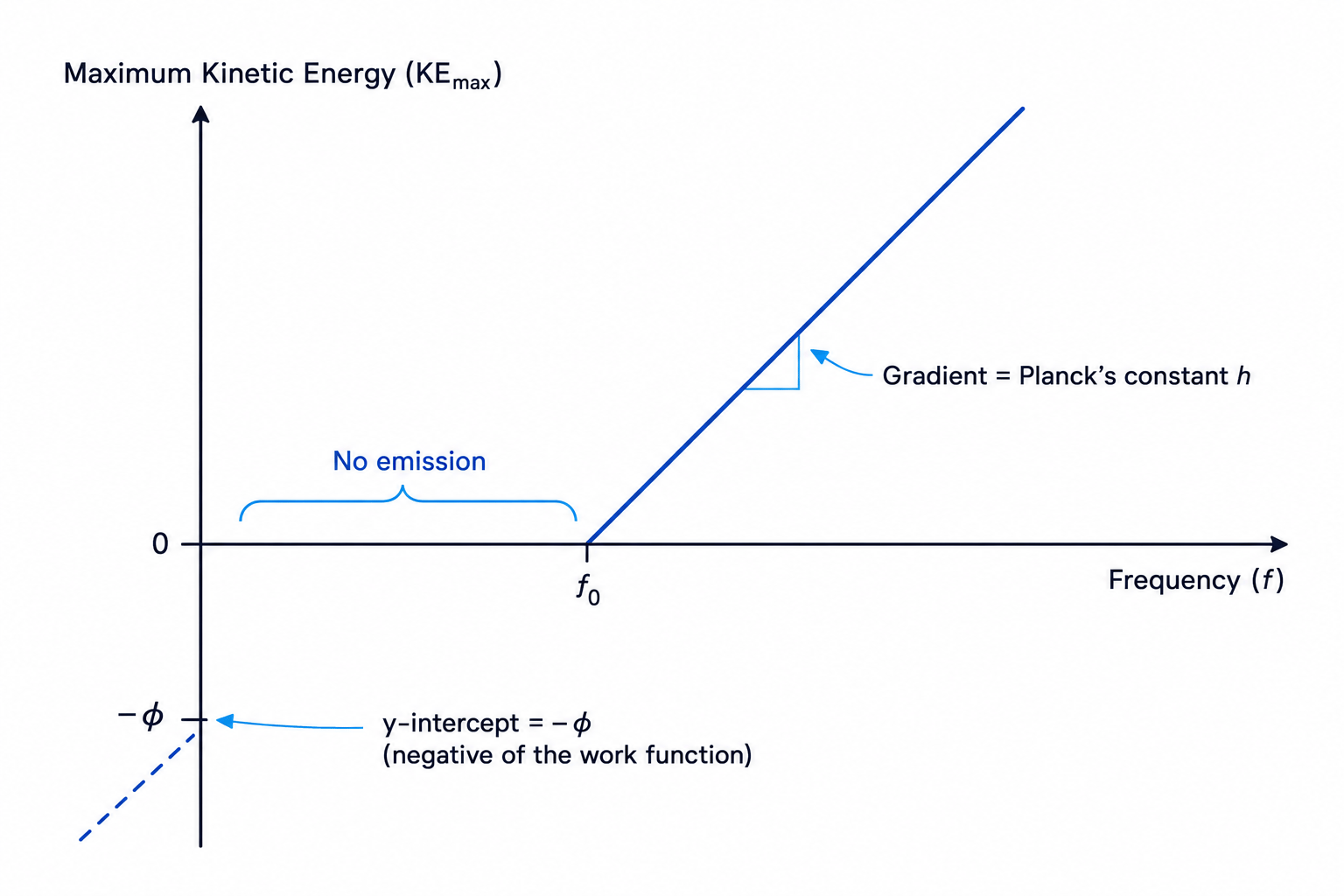
If you change the metal used in the experiment:
- The line shifts to the right (larger f0f_0f0 and more negative yyy-intercept, because ϕ\phiϕ is larger).
- The gradient remains exactly the same, as hhh is a fundamental constant of the universe.
6. Photoelectric Relationships: Intensity vs Frequency
To secure high marks in OCR exams, you must be able to explain the distinct roles of wave intensity and frequency.
Effect of Intensity
- Intensity is a measure of the energy arriving per unit area per second. For a constant frequency, higher intensity simply means a higher rate of photons hitting the metal surface.
- Since the interaction is one-to-one, a higher intensity results in a higher rate of emission of photoelectrons (more electrons emitted per second), provided the frequency is above the threshold (f>f0f > f_0f>f0).
- Changing the intensity has absolutely no effect on the maximum kinetic energy (KEmaxKE_{max}KEmax) of the photoelectrons.
Effect of Frequency
- Frequency determines the energy of each individual photon (E=hfE = hfE=hf).
- Increasing the frequency increases the energy of the incident photons, which in turn increases the maximum kinetic energy (KEmaxKE_{max}KEmax) of the emitted photoelectrons.
- Changing the frequency does not affect the number of photons arriving per second (for a fixed intensity), so it does not directly increase the rate of emission.
Confusing intensity with photon energy
Many students write that "increasing the intensity of the light increases the kinetic energy of the electrons." This is incorrect. Intensity only increases the quantity of photons, not their individual quality (energy).
7. Worked Example
Calculating kinetic energy and threshold frequency
Ultraviolet light of wavelength 2.50×10⁻⁷ m2.50 \times 10^{-7}\text{ m}2.50×10⁻⁷ m is shone onto a zinc plate. The work function of zinc is 4.30 eV4.30\text{ eV}4.30 eV.
Calculate:
- The work function of zinc in Joules.
- The threshold frequency of zinc.
- The maximum kinetic energy of the emitted photoelectrons.
Step-by-step solution:
- Convert the work function from electronvolts to Joules.
To convert electronvolts (eV\text{eV}eV) to Joules (J\text{J}J), multiply by the elementary charge e=1.60×10⁻¹⁹ Ce = 1.60 \times 10^{-19}\text{ C}e=1.60×10⁻¹⁹ C.
- Calculate the threshold frequency f0f_0f0.
Use the relation ϕ=hf0\phi = h f_0ϕ=hf0 and rearrange to solve for f0f_0f0:
Substitute the values:
f0=6.88×10⁻¹⁹ J6.63×10−34 J s=1.04×10¹⁵ Hz f_0 = \frac{6.88 \times 10^{-19}\text{ J}}{6.63 \times 10^{-34}\text{ J s}} = 1.04 \times 10^{15}\text{ Hz} f0=6.63×10⁻³⁴ J s6.88×10−19 J=1.04×10¹⁵ Hz- Calculate the energy of the incident UV photons.
Use the wave equation c=fλc = f\lambdac=fλ to express photon energy as E=hcλE = \frac{hc}{\lambda}E=λhc:
- Calculate the maximum kinetic energy of the photoelectrons.
Apply Einstein's photoelectric equation hf=ϕ+KEmaxhf = \phi + KE_{max}hf=ϕ+KEmax:
In the exam
- Never forget unit conversions: Work functions are often given in eV\text{eV}eV. You must convert them to Joules before using them in Einstein's equation alongside Planck's constant.
- Quote the "one-to-one" rule: When asked to explain why there is a threshold frequency, explicitly state: "There is a one-to-one interaction between a photon and a surface electron. Emission is instantaneous if the photon energy is greater than the work function."
- Graph shifts: If you are asked to draw a graph for a metal with a higher work function, make sure the new line is strictly parallel to the original line, shifted to a higher threshold frequency on the x-axis.
Check yourself
- Why does the gold-leaf electroscope experiment fail to discharge when visible light of extremely high intensity is used?
- Explain why the maximum kinetic energy of emitted photoelectrons is independent of the intensity of the incident radiation.
- If the work function of a metal is 3.20 eV3.20\text{ eV}3.20 eV, what is the maximum wavelength of light that can cause photoelectric emission?
