What you'll learn
- What a progressive wave is, and how transverse and longitudinal waves differ.
- How to use displacement, amplitude, wavelength, period, frequency, phase difference and wave speed.
- How to determine frequency using an oscilloscope and demonstrate wave effects using a ripple tank.
- How reflection, refraction, diffraction, polarisation and intensity apply to progressive waves.
Progressive waves
A wave is a disturbance that transfers energy from one place to another. In a mechanical wave, particles of the medium oscillate about fixed equilibrium positions, but the medium as a whole does not travel along with the wave.
Progressive wave
A progressive wave is a wave that transfers energy from one point to another, without transferring matter overall.
For example, in a sound wave travelling through air, air molecules vibrate backwards and forwards, but they do not travel all the way from the speaker to your ear.
Energy moves, matter oscillates
In a progressive wave, the wave pattern and energy move through space; the particles only oscillate about their equilibrium positions.
Transverse and longitudinal waves
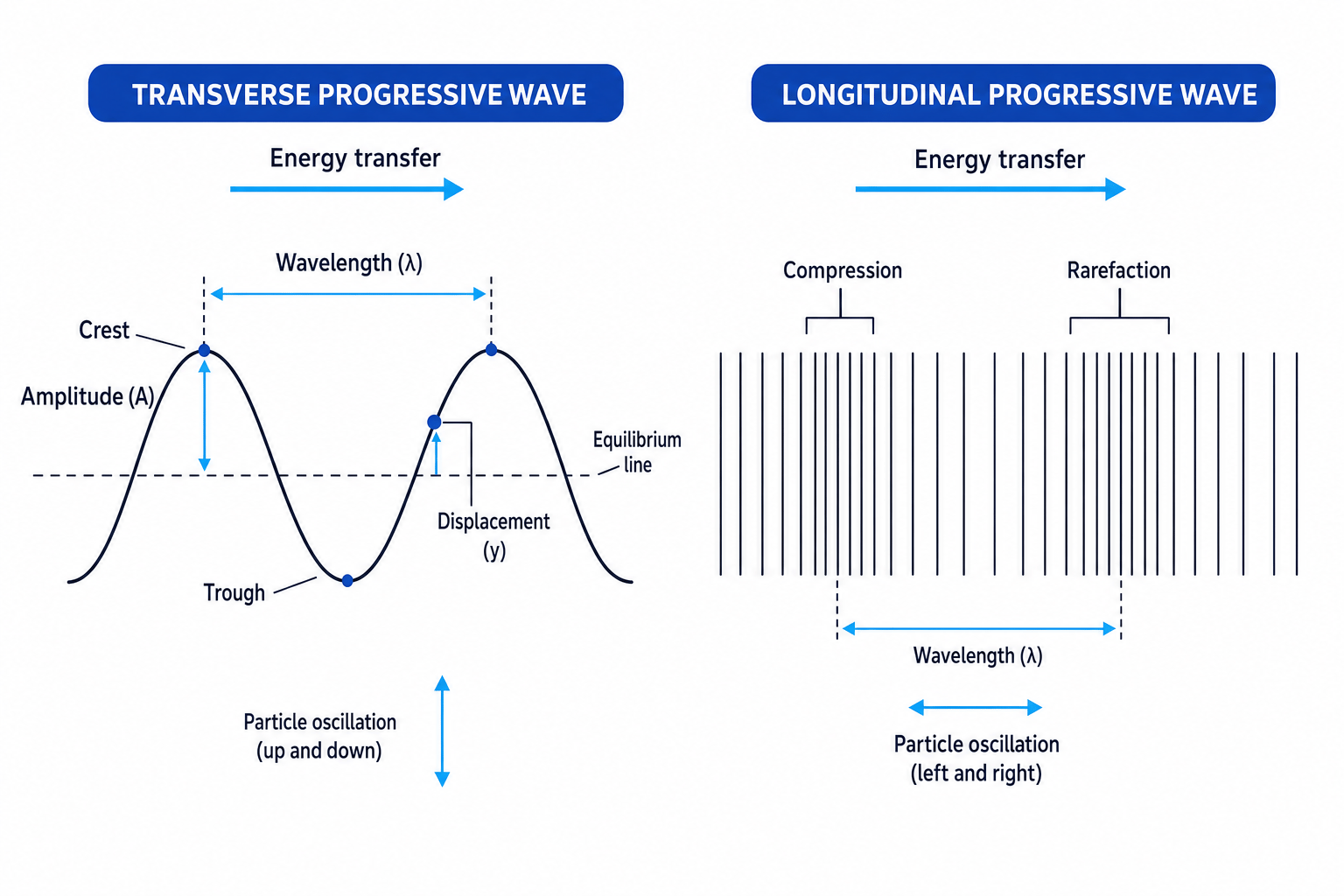
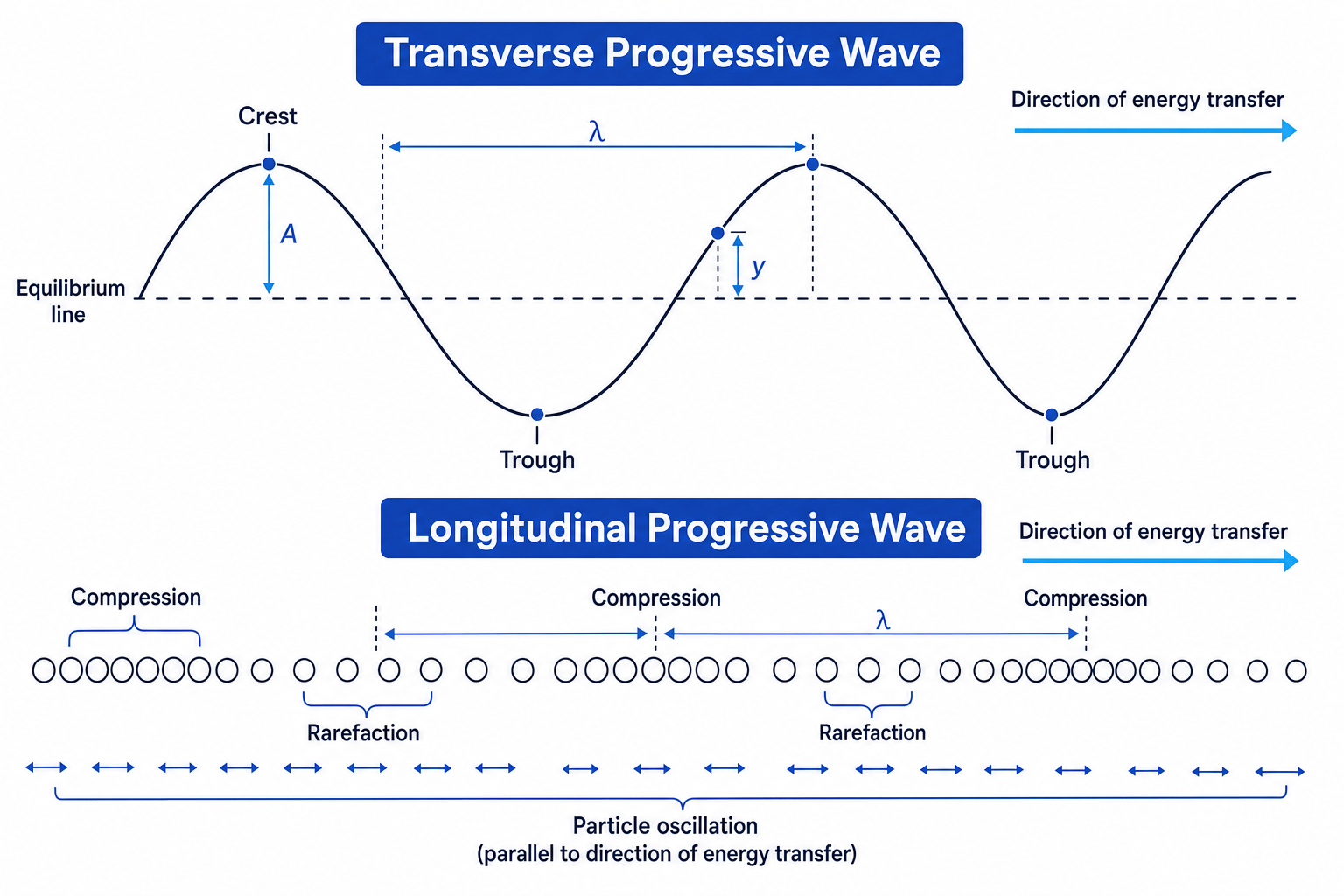
A transverse wave has oscillations perpendicular to the direction of energy transfer. Electromagnetic waves, including light and microwaves, are transverse.
A longitudinal wave has oscillations parallel to the direction of energy transfer. Sound waves in air are longitudinal. Longitudinal waves contain regions of high pressure called compressions and regions of low pressure called rarefactions.
Classifying a wave from particle motion
A wave travels from left to right. The particles of the medium vibrate left and right about their equilibrium positions.
- The direction of energy transfer is left to right.
- The particle oscillations are also left to right, so the oscillations are parallel to the energy transfer.
- Therefore the wave is longitudinal.
Describing a wave quantitatively
Displacement and amplitude
Displacement is the distance and direction of a point on the wave from its equilibrium position. It is often given the symbol yyy and is measured in metres.
Amplitude is the maximum displacement from equilibrium. A larger amplitude usually means the wave is carrying more energy.
Wavelength
Wavelength, symbol λ\lambdaλ, is the distance between two adjacent points that are in phase. On a transverse wave, this could be crest to crest or trough to trough. On a longitudinal wave, it could be compression to compression or rarefaction to rarefaction.
Period and frequency
The period, symbol TTT, is the time taken for one complete oscillation, measured in seconds.
The frequency, symbol fff, is the number of complete oscillations per second, measured in hertz, Hz.
The relationship is:
f=1Tf = \frac{1}{T}f=T1Since one hertz is one oscillation per second, Hz is equivalent to s−1\text{s}^{-1}s−1.
Finding frequency from period
A vibrating source completes 25 oscillations in 10.0 s. Find its frequency.
-
First find the period, the time for one oscillation:
T=10.0 s25=0.400 sT = \frac{10.0\,\text{s}}{25} = 0.400\,\text{s}T=2510.0s=0.400s -
Use f=1Tf = \frac{1}{T}f=T1:
f=10.400 s=2.50 Hzf = \frac{1}{0.400\,\text{s}} = 2.50\,\text{Hz}f=0.400s1=2.50Hz -
The frequency is 2.50 Hz.
Phase difference
Phase difference describes how far through the cycle one oscillation is compared with another. It can be measured in degrees, radians, or fractions of a cycle.
Two points are in phase if they are at the same stage of oscillation. They have phase difference zero, 360∘360^\circ360∘, or 2π rad2\pi\,\text{rad}2πrad. Two points are in antiphase if they are half a cycle apart, with phase difference 180∘180^\circ180∘ or π rad\pi\,\text{rad}πrad.
Finding phase difference
Two points on a progressive wave are separated by 0.75 m. The wavelength is 2.0 m. Find their phase difference in degrees.
-
Write the separation as a fraction of a wavelength:
0.75 m2.0 m=0.375\frac{0.75\,\text{m}}{2.0\,\text{m}} = 0.3752.0m0.75m=0.375 -
One complete wavelength corresponds to 360∘360^\circ360∘, so:
phase difference=0.375×360∘=135∘\text{phase difference} = 0.375 \times 360^\circ = 135^\circphase difference=0.375×360∘=135∘ -
The points are neither in phase nor in antiphase; their phase difference is 135∘135^\circ135∘.
Confusing wave graphs
A displacement–distance graph is a snapshot of the whole wave at one instant. A displacement–time graph shows the motion of one point as time passes. Both can be sinusoidal, but they do not show the same thing.
Wave speed and the wave equation
The speed of a wave, symbol vvv, is the speed at which the wavefront or energy travels through the medium.
For all waves:
v=fλv = f\lambdav=fλwhere vvv is in metres per second, fff is in hertz, and λ\lambdaλ is in metres.
Calculating wavelength from wave speed
A sound wave in air has frequency 2.0 kHz. Take the speed of sound in air as 340 m s^-1. Find the wavelength.
-
Convert the frequency into hertz:
2.0 kHz=2.0×10³ Hz2.0\,\text{kHz} = 2.0 \times 10^3\,\text{Hz}2.0kHz=2.0×10³Hz -
Rearrange v=fλv = f\lambdav=fλ:
λ=vf\lambda = \frac{v}{f}λ=fv -
Substitute the values:
λ=340 m s−12.0×10³ Hz=0.17 m\lambda = \frac{340\,\text{m s}^{-1}}{2.0 \times 10^3\,\text{Hz}} = 0.17\,\text{m}λ=2.0×10³Hz340m s−1=0.17m
Frequency is set by the source
When a wave crosses a boundary into a new medium, its speed and wavelength may change, but its frequency stays the same because the source is still oscillating at the same rate.
Using an oscilloscope to determine frequency
An oscilloscope displays voltage against time. If a microphone or signal generator produces a periodic electrical signal, the oscilloscope trace can be used to measure the period.
A typical procedure is:
- Connect the signal to the oscilloscope input.
- Adjust the time-base so several complete cycles are visible.
- Measure the horizontal length of several cycles using the grid divisions.
- Multiply by the time-base setting to find the total time.
- Divide by the number of cycles to find TTT.
- Use f=1Tf = \frac{1}{T}f=T1.
Measuring several cycles reduces the percentage uncertainty in reading the screen.
Finding frequency from an oscilloscope trace
An oscilloscope time-base is set to 0.50 ms per division. Five complete cycles occupy 12.5 divisions. Find the frequency.
-
Find the time for five cycles:
12.5×0.50 ms=6.25 ms12.5 \times 0.50\,\text{ms} = 6.25\,\text{ms}12.5×0.50ms=6.25ms -
Find the period:
T=6.25 ms5=1.25 ms=1.25×10⁻³ sT = \frac{6.25\,\text{ms}}{5} = 1.25\,\text{ms} = 1.25 \times 10^{-3}\,\text{s}T=56.25ms=1.25ms=1.25×10⁻³s -
Use f=1Tf = \frac{1}{T}f=T1:
f=11.25×10⁻³ s=800 Hzf = \frac{1}{1.25 \times 10^{-3}\,\text{s}} = 800\,\text{Hz}f=1.25×10⁻³s1=800Hz
Wave effects
Reflection, refraction, diffraction and polarisation are important behaviours that show waves are not just moving objects — they are spreading disturbances.
Reflection
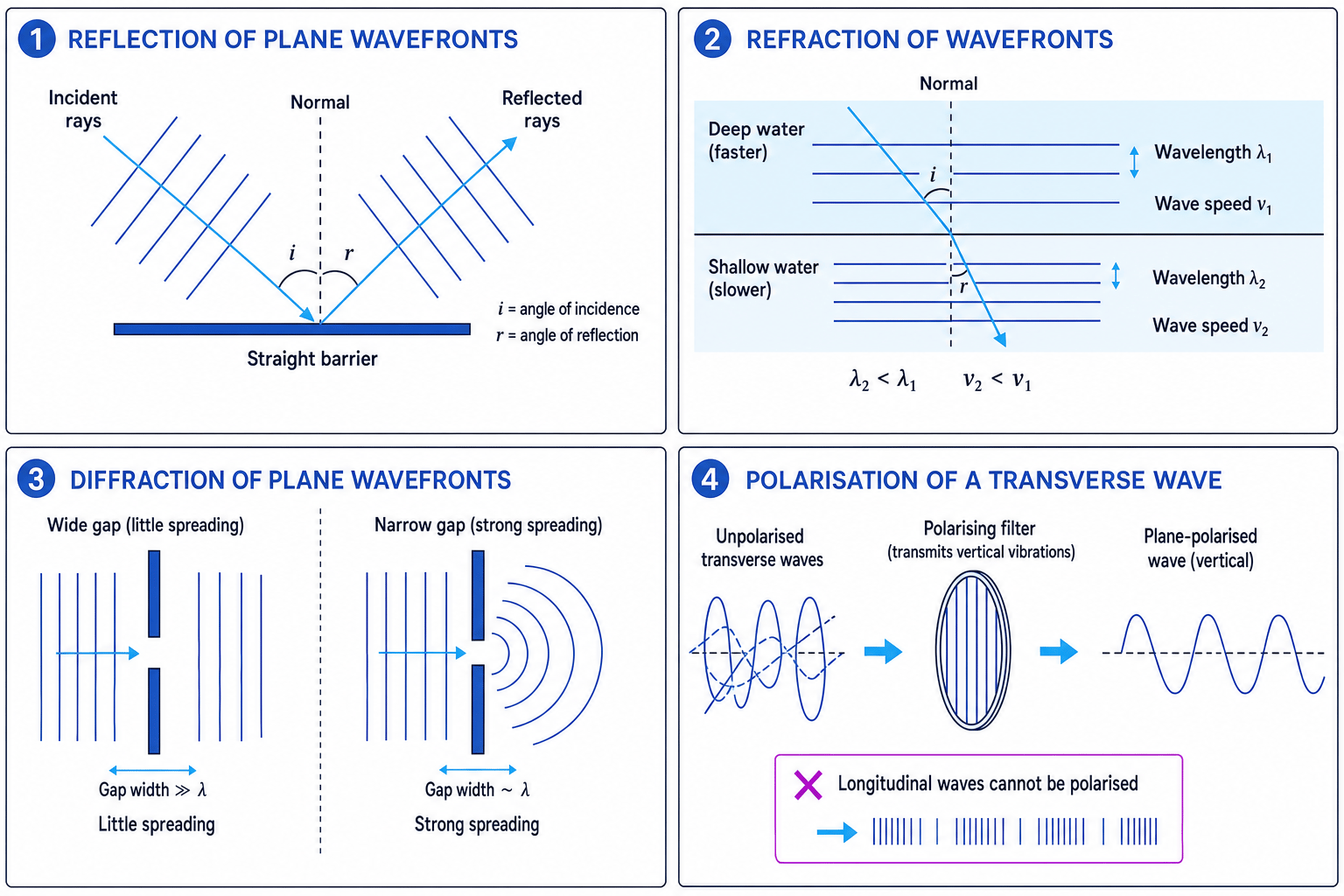
Reflection occurs when a wave bounces back from a boundary. The angle of incidence equals the angle of reflection, measured from the normal.
Refraction
Refraction occurs when a wave changes speed as it enters a different medium. If it enters at an angle, the change in speed causes a change in direction.
In a ripple tank, water waves slow down in shallower water, so their wavelength decreases. The frequency remains unchanged.
Diffraction
Diffraction is the spreading of waves when they pass through a gap or around an obstacle.
Diffraction effects become significant when the wavelength is comparable to the gap width. If the gap is much larger than the wavelength, there is much less spreading.
Predicting diffraction at a gap
Microwaves of wavelength 3.0 cm pass through two different gaps: one of width 30 cm and one of width 4.0 cm. Predict which gap gives stronger diffraction.
-
Compare each gap width with the wavelength. For the 30 cm gap:
30 cm3.0 cm=10\frac{30\,\text{cm}}{3.0\,\text{cm}} = 103.0cm30cm=10so the gap is much wider than the wavelength.
-
For the 4.0 cm gap, the width is close to the wavelength, since 4.0 cm is comparable with 3.0 cm.
-
The 4.0 cm gap gives much stronger diffraction.
Polarisation
Polarisation occurs when the oscillations of a transverse wave are restricted to one plane. Longitudinal waves cannot be polarised because their oscillations are already along the direction of travel.
Light can be polarised using polarising filters. If two filters are placed one after the other and the second is rotated, the transmitted intensity changes. At 90 degrees between their transmission axes, very little light gets through.
Microwaves can also show polarisation. A microwave transmitter and receiver can be used with a metal grille. Rotating the grille changes the received signal, showing that the microwave oscillations have a particular direction.
Polarisation is not for longitudinal waves
If a question asks which wave effect proves a wave is transverse, the answer is polarisation, not diffraction or refraction.
Demonstrating wave effects with a ripple tank
A ripple tank uses shallow water to make water waves visible. A vibrating dipper creates waves, and a lamp projects the wave pattern onto a screen.
You can demonstrate:
- reflection using a straight barrier;
- refraction using a shallow region, often made with a transparent plate;
- diffraction using gaps of different widths;
- wavelength by measuring spacing between adjacent wavefronts.
Good practical technique includes keeping the tank level, using a steady frequency, damping unwanted reflections at the edges, and measuring across several wavelengths to reduce percentage uncertainty.
Intensity of a progressive wave
Intensity, symbol III, is the power transferred per unit area perpendicular to the direction of wave travel.
I=PAI = \frac{P}{A}I=APwhere PPP is power in watts and AAA is area in square metres. Intensity is measured in watts per square metre, W m^-2.
For a progressive wave in the same medium:
I∝(amplitude)2I \propto (\text{amplitude})^2I∝(amplitude)2So doubling the amplitude makes the intensity four times larger.
Area and amplitude use similar symbols
In I=PAI = \frac{P}{A}I=AP, the symbol AAA means area, not amplitude. Be clear from the context.
Calculating intensity and amplitude change
A laser beam has power 2.0 mW and cross-sectional area 4.0 mm^2. Find its intensity. Then state the new intensity if the amplitude is halved.
-
Convert to SI units:
P=2.0×10⁻³ WP = 2.0 \times 10^{-3}\,\text{W}P=2.0×10⁻³W A=4.0×10⁻⁶ m2A = 4.0 \times 10^{-6}\,\text{m}^2A=4.0×10⁻⁶m2 -
Use I=PAI = \frac{P}{A}I=AP:
I=2.0×10⁻³ W4.0×10−6 m2=5.0×10² W m−2I = \frac{2.0 \times 10^{-3}\,\text{W}}{4.0 \times 10^{-6}\,\text{m}^2} = 5.0 \times 10^2\,\text{W m}^{-2}I=4.0×10⁻⁶m22.0×10−3W=5.0×10²W m−2 -
If the amplitude is halved, intensity is multiplied by (12)2=14\left(\frac{1}{2}\right)^2 = \frac{1}{4}(21)2=41:
Inew=5.0×10² W m−24=1.25×10² W m−2I_{\text{new}} = \frac{5.0 \times 10^2\,\text{W m}^{-2}}{4} = 1.25 \times 10^2\,\text{W m}^{-2}Inew=45.0×10²W m−2=1.25×10²W m−2
In the exam
- Check whether the graph is against distance or time before reading λ\lambdaλ or TTT.
- Convert units before substituting: kHz to Hz, ms to s, mm^2 to m^2.
- For diffraction, compare the wavelength with the gap width; strongest spreading occurs when they are comparable.
Check yourself
- How would you tell from particle motion whether a wave is transverse or longitudinal?
- What stays the same when a wave refracts at a boundary: speed, wavelength, or frequency?
- If the amplitude of a wave is tripled, what happens to its intensity?