

What you'll learn
- What all electromagnetic waves have in common, and how the spectrum is ordered.
- The approximate wavelength sizes of radio waves through to gamma rays.
- How polarisation works for light and microwaves.
- How to use refractive index, Snell’s law, and the critical angle for total internal reflection.
Electromagnetic waves: the essentials
An electromagnetic wave is a wave made from oscillating electric and magnetic fields. The fields are at right angles to each other, and both are at right angles to the direction of travel.
A transverse wave is a wave where the oscillations are perpendicular to the direction of energy transfer. Electromagnetic waves are transverse, which is why they can be polarised.
Electromagnetic wave
An electromagnetic wave is a transverse wave consisting of oscillating electric and magnetic fields that can travel through a vacuum.
In a vacuum, all electromagnetic waves travel at the same speed:
c=3.00×10⁸ m s−1c = 3.00 \times 10^8\ \text{m s}^{-1}c=3.00×10⁸ m s−1They also obey the wave equation:
v=fλv = f\lambdav=fλwhere vvv is wave speed in metres per second, fff is frequency in hertz, and λ\lambdaλ is wavelength in metres.
Same wave type, different wavelengths
Radio waves, microwaves, infrared, visible light, ultraviolet, X-rays, and gamma rays are all electromagnetic waves. The difference between them is mainly their wavelength and frequency.
The electromagnetic spectrum
The electromagnetic spectrum is the continuous range of electromagnetic waves, arranged by wavelength or frequency.
An order of magnitude means a power-of-ten size. For this topic, you should know the rough wavelength ranges, not exact boundary values.
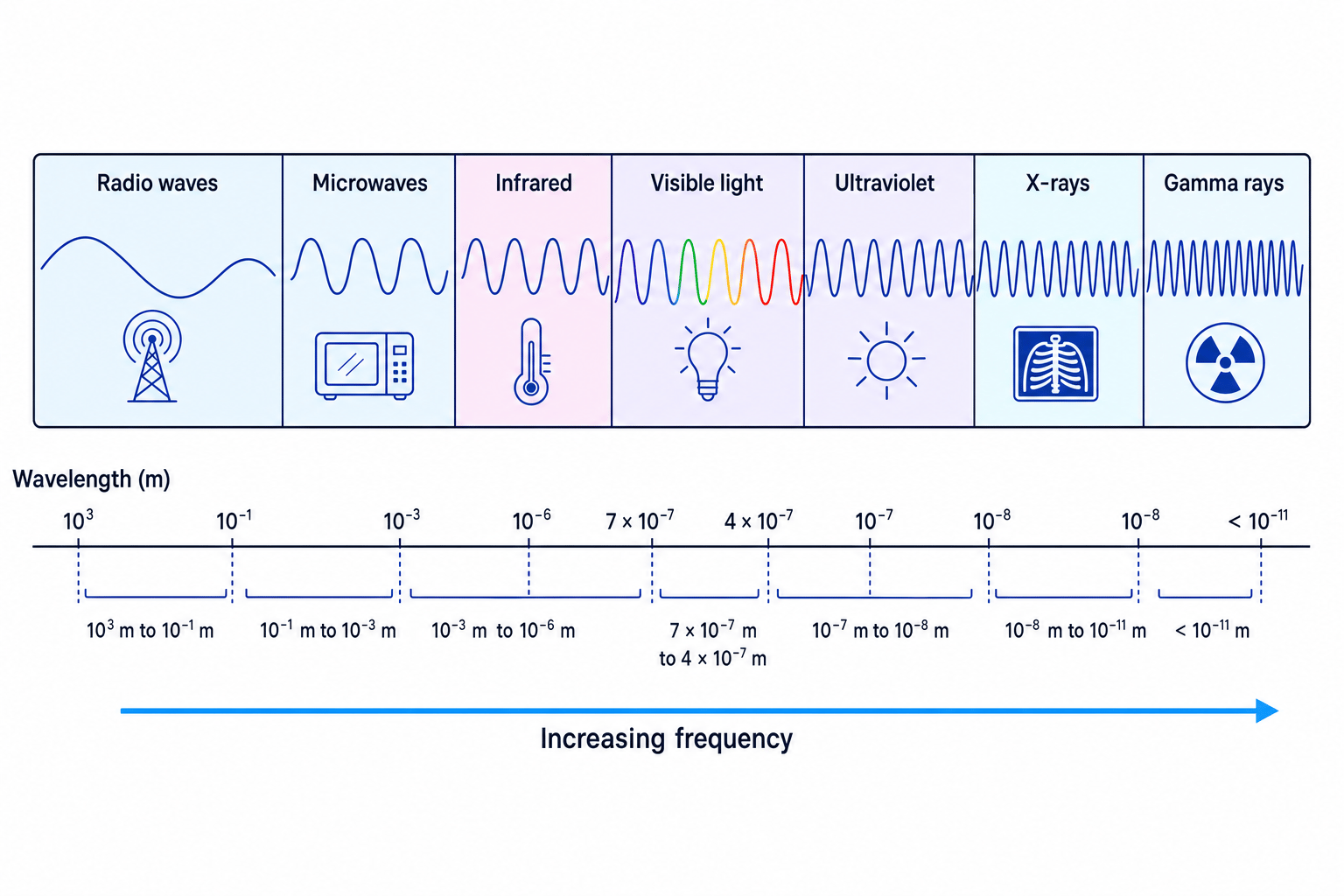
From longest wavelength to shortest wavelength:
- Radio waves: about 103 m10^3\ \text{m}103 m to 10−1 m10^{-1}\ \text{m}10−1 m
- Microwaves: about 10−1 m10^{-1}\ \text{m}10−1 m to 10−3 m10^{-3}\ \text{m}10−3 m
- Infrared: about 10−3 m10^{-3}\ \text{m}10−3 m to 10−6 m10^{-6}\ \text{m}10−6 m
- Visible light: about 7×10⁻⁷ m7 \times 10^{-7}\ \text{m}7×10⁻⁷ m to 4×10⁻⁷ m4 \times 10^{-7}\ \text{m}4×10⁻⁷ m
- Ultraviolet: about 10−7 m10^{-7}\ \text{m}10−7 m to 10−8 m10^{-8}\ \text{m}10−8 m
- X-rays: about 10−8 m10^{-8}\ \text{m}10−8 m to 10−11 m10^{-11}\ \text{m}10−11 m
- Gamma rays: less than about 10−11 m10^{-11}\ \text{m}10−11 m
As wavelength decreases, frequency increases, because in a vacuum c=fλc = f\lambdac=fλ.
Spectrum order
A common memory order is: Radio, Microwave, Infrared, Visible, Ultraviolet, X-ray, Gamma. Radio waves are the longest; gamma rays are the shortest.
Plane polarisation
A wave is plane polarised if its oscillations are restricted to one plane only.
Unpolarised light has electric field oscillations in many different planes perpendicular to its direction of travel. A polarising filter only transmits the component of the electric field in one particular plane, so the emerging light is plane polarised.
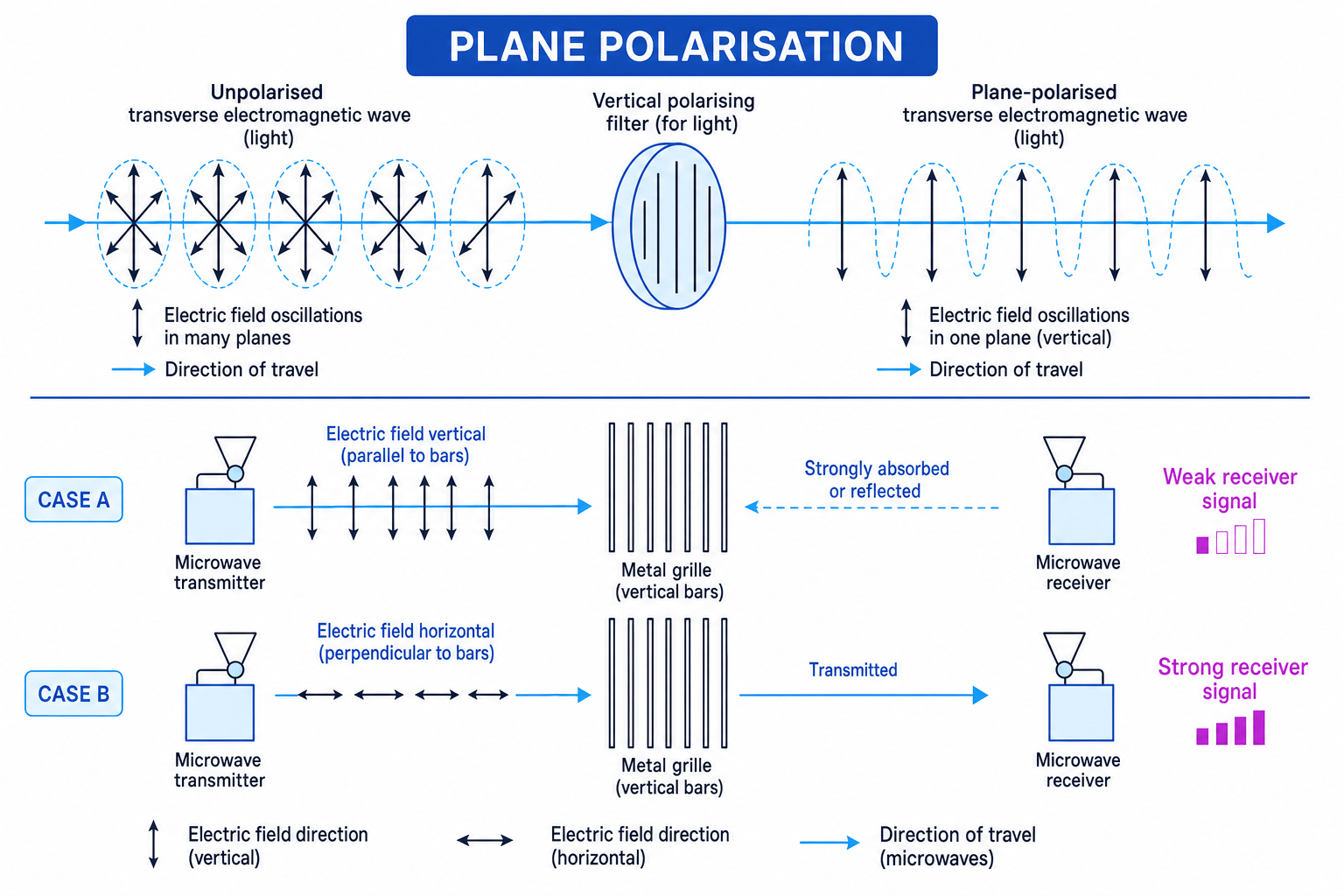
Polarisation is important evidence that electromagnetic waves are transverse. Longitudinal waves cannot be plane polarised because their oscillations are along the direction of travel, not in different sideways planes.
For microwaves, a metal grille can demonstrate polarisation. If the microwave electric field is parallel to the metal bars, electrons in the bars are driven into oscillation, so the wave is strongly absorbed or reflected. If the electric field is perpendicular to the bars, more of the wave is transmitted.
Predicting microwave transmission through a grille
A microwave transmitter produces vertically polarised microwaves. A metal grille has vertical bars.
- The microwave electric field is vertical, so it is parallel to the vertical metal bars.
- Electrons in the bars are driven up and down by the electric field, so energy is transferred to the grille.
- The receiver signal is weak because the microwaves are strongly absorbed or reflected.
- If the grille is rotated by 90°, the bars become horizontal, so the vertical electric field is perpendicular to the bars and the received signal becomes stronger.
Polarisation wording
Do not say “the whole wave is vertical” or “the light travels vertically”. The oscillation direction of the electric field is vertical; the wave still travels forwards.
Refraction and refractive index
Refraction is the change in direction of a wave when it crosses a boundary between two media because its speed changes.
A medium is a material through which a wave travels, such as air, glass, or water. The normal is an imaginary line drawn at 90° to the boundary. Angles in refraction are always measured to the normal.
Refractive index
The refractive index nnn of a medium is defined by:
n=cvn = \frac{c}{v}n=vcwhere ccc is the speed of light in a vacuum and vvv is the speed of light in the medium.
Refractive index has no unit. Since light travels slower in materials than in a vacuum, most materials have n>1n > 1n>1.
Finding the speed of light in glass
A type of glass has refractive index n=1.50n = 1.50n=1.50. Find the speed of light in the glass.
-
Start with the definition of refractive index and rearrange it:
n=cv⇒v=cnn = \frac{c}{v} \quad \Rightarrow \quad v = \frac{c}{n}n=vc⇒v=nc -
Substitute the values:
v=3.00×10⁸ m s−11.50v = \frac{3.00 \times 10^8\ \text{m s}^{-1}}{1.50}v=1.503.00×108 m s−1 -
Calculate the speed:
v=2.00×10⁸ m s−1v = 2.00 \times 10^8\ \text{m s}^{-1}v=2.00×10⁸ m s−1
At a boundary, the quantity nsinθn\sin\thetansinθ is constant, where θ\thetaθ is the angle to the normal:
nsinθ=constantn \sin \theta = \text{constant}nsinθ=constantFor two media:
n1sinθ1=n2sinθ2n_1 \sin \theta_1 = n_2 \sin \theta_2n1sinθ1=n2sinθ2This is often called Snell’s law.
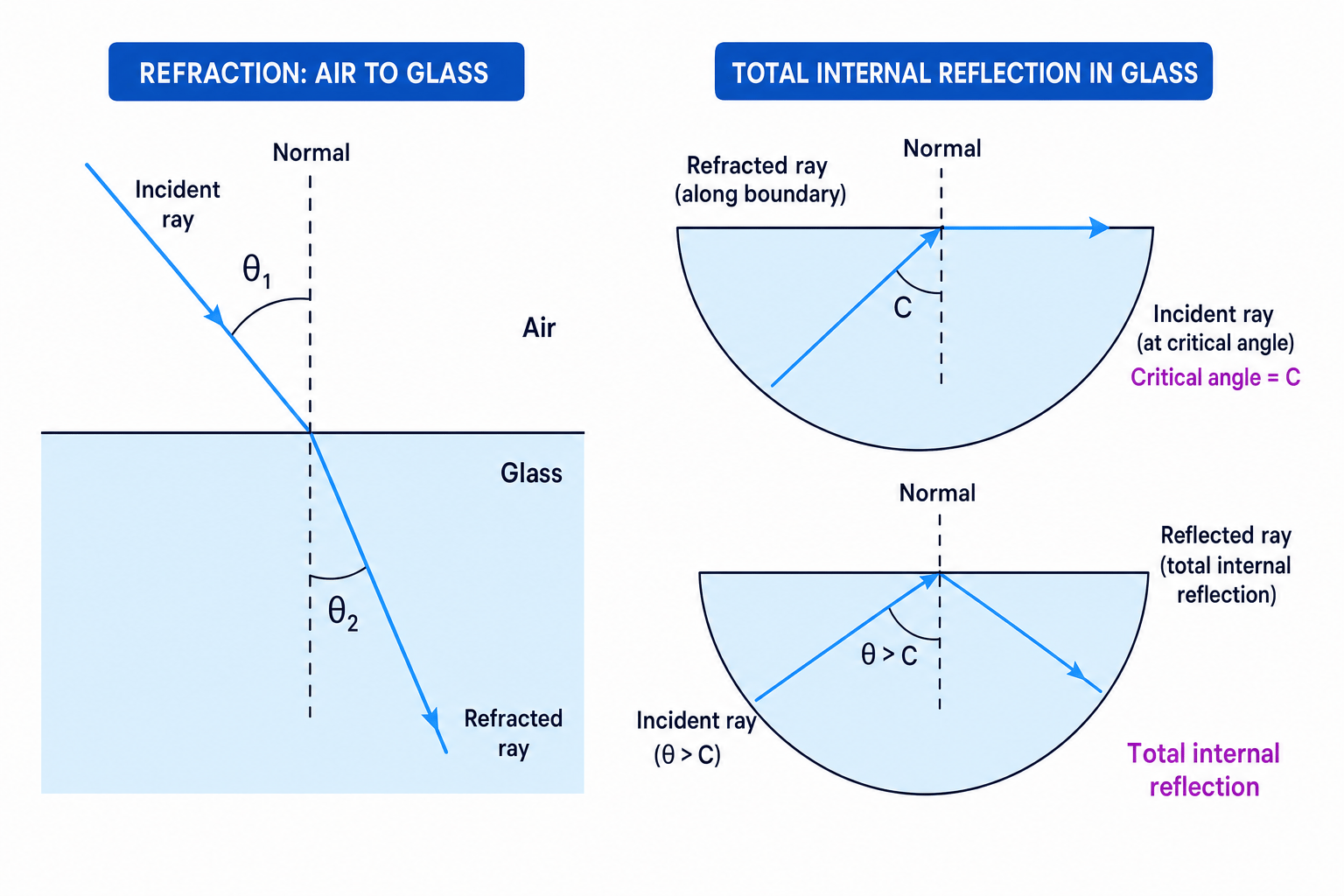
When light enters a medium with a higher refractive index, it slows down and bends towards the normal. When it enters a medium with a lower refractive index, it speeds up and bends away from the normal.
Calculating an angle of refraction
Light travels from air into glass. The angle of incidence in air is 40.0∘40.0^\circ40.0∘, nair=1.00n_{\text{air}} = 1.00nair=1.00, and nglass=1.50n_{\text{glass}} = 1.50nglass=1.50. Find the angle in the glass.
-
Apply Snell’s law:
n1sinθ1=n2sinθ2n_1 \sin \theta_1 = n_2 \sin \theta_2n1sinθ1=n2sinθ2 -
Rearrange and substitute:
sinθ2=1.00sin40.0∘1.50\sin \theta_2 = \frac{1.00 \sin 40.0^\circ}{1.50}sinθ2=1.501.00sin40.0∘ -
Calculate:
sinθ2=0.4285\sin \theta_2 = 0.4285sinθ2=0.4285 θ2=sin−1(0.4285)=25.4∘\theta_2 = \sin^{-1}(0.4285) = 25.4^\circθ2=sin−1(0.4285)=25.4∘ -
The ray bends towards the normal, which makes sense because glass has the higher refractive index.
Measuring from the surface
Angles in refraction are measured from the normal, not from the surface of the block. Measuring from the surface gives the complementary angle and usually loses the mark.
Investigating refraction with a ray box
A ray box produces a narrow beam of light so you can trace rays through transparent blocks.
For a rectangular glass or plastic block:
- Place the block on paper and draw around it.
- Shine a narrow ray at one face of the block.
- Mark the incident and emergent rays with pencil dots.
- Remove the block and join the dots to trace the ray inside.
- Draw the normal at the point where the ray enters.
- Measure the angles of incidence and refraction with a protractor.
- Repeat for several angles.
To find the refractive index graphically, you can plot sini\sin isini against sinr\sin rsinr. For light going from air into the block, nair≈1.00n_{\text{air}} \approx 1.00nair≈1.00, so:
sini=nblocksinr\sin i = n_{\text{block}}\sin rsini=nblocksinrA graph of sini\sin isini on the vertical axis against sinr\sin rsinr on the horizontal axis has gradient nblockn_{\text{block}}nblock.
Practical accuracy
Use a narrow ray, mark points far apart, draw thin pencil lines, and repeat readings. These reduce percentage uncertainty in the measured angles.
For a semicircular block, aim the ray at the centre of the curved face. The ray enters along the radius, so it meets the curved surface normally and does not refract there. This lets you study refraction, critical angle, and total internal reflection at the flat face only.
Critical angle and total internal reflection
The critical angle is the angle of incidence in the higher-refractive-index medium for which the refracted ray travels along the boundary, so the angle of refraction is 90∘90^\circ90∘.
Critical angle
For light travelling from a material of refractive index nnn into air:
sinC=1n\sin C = \frac{1}{n}sinC=n1where CCC is the critical angle.
Total internal reflection happens when:
- light is travelling from a higher refractive index medium to a lower refractive index medium, and
- the angle of incidence is greater than the critical angle.
Then no refracted ray leaves the material; all the light is reflected inside.
Calculating a critical angle
Light travels from glass of refractive index n=1.52n = 1.52n=1.52 into air. Find the critical angle.
-
The light is going from glass to air, so the formula sinC=1/n\sin C = 1/nsinC=1/n applies.
-
Substitute the refractive index:
sinC=11.52=0.658\sin C = \frac{1}{1.52} = 0.658sinC=1.521=0.658 -
Find the angle:
C=sin−1(0.658)=41.1∘C = \sin^{-1}(0.658) = 41.1^\circC=sin−1(0.658)=41.1∘ -
If the angle of incidence in the glass is greater than 41.1∘41.1^\circ41.1∘, total internal reflection occurs.
When the critical angle formula applies
The equation sinC=1/n\sin C = 1/nsinC=1/n is for light going from a material into air, taking the refractive index of air as approximately 1.00. Total internal reflection cannot occur when light goes from air into glass.
In the exam
- Always state that electromagnetic waves are transverse and can travel through a vacuum.
- For refraction diagrams, draw the normal first and measure every angle from the normal.
- For total internal reflection, check both conditions: higher to lower refractive index, and angle of incidence greater than CCC.
- Quote wavelength ranges as orders of magnitude; exact spectrum boundaries are not usually the point.
Check yourself
- Which region of the electromagnetic spectrum has wavelengths of about 10−3 m10^{-3}\ \text{m}10−3 m to 10−1 m10^{-1}\ \text{m}10−1 m?
- Why does polarisation show that electromagnetic waves are transverse?
- A ray goes from glass into air at an angle larger than the critical angle. What happens to the ray?

