

What you'll learn
- What a uniform electric field is and how to use E=V/dE = V/dE=V/d.
- How a parallel plate capacitor depends on plate area, separation and permittivity.
- How to calculate the force, acceleration and motion of charged particles in a uniform electric field.
- How to choose between a force method and an energy method in exam questions.
Prerequisites: charge, potential difference and field strength
A charge is a property of a particle or object that causes it to experience an electric force. Charge is measured in coulombs (C). The symbol for charge is usually QQQ.
A potential difference is the energy transferred per unit charge between two points. It is measured in volts (V). If a charge moves through a potential difference, the energy transferred is:
W=QVW = QVW=QVwhere WWW is work done or energy transferred in joules (J).
Electric field strength
The electric field strength, EEE, at a point is the force per unit positive charge placed at that point: E=F/QE = F/QE=F/Q. Its unit is newtons per coulomb, N C−1\text{N C}^{-1}N C−1.
This means a charge in an electric field experiences a force:
F=QEF = QEF=QEFor a positive charge, the force is in the direction of the electric field. For a negative charge, the force is in the opposite direction.
What makes a field uniform?
A uniform electric field has the same electric field strength and direction at every point in the region being considered.
The clearest A-Level example is the central region between two large, parallel conducting plates connected to a power supply. Field lines are straight, parallel and equally spaced.
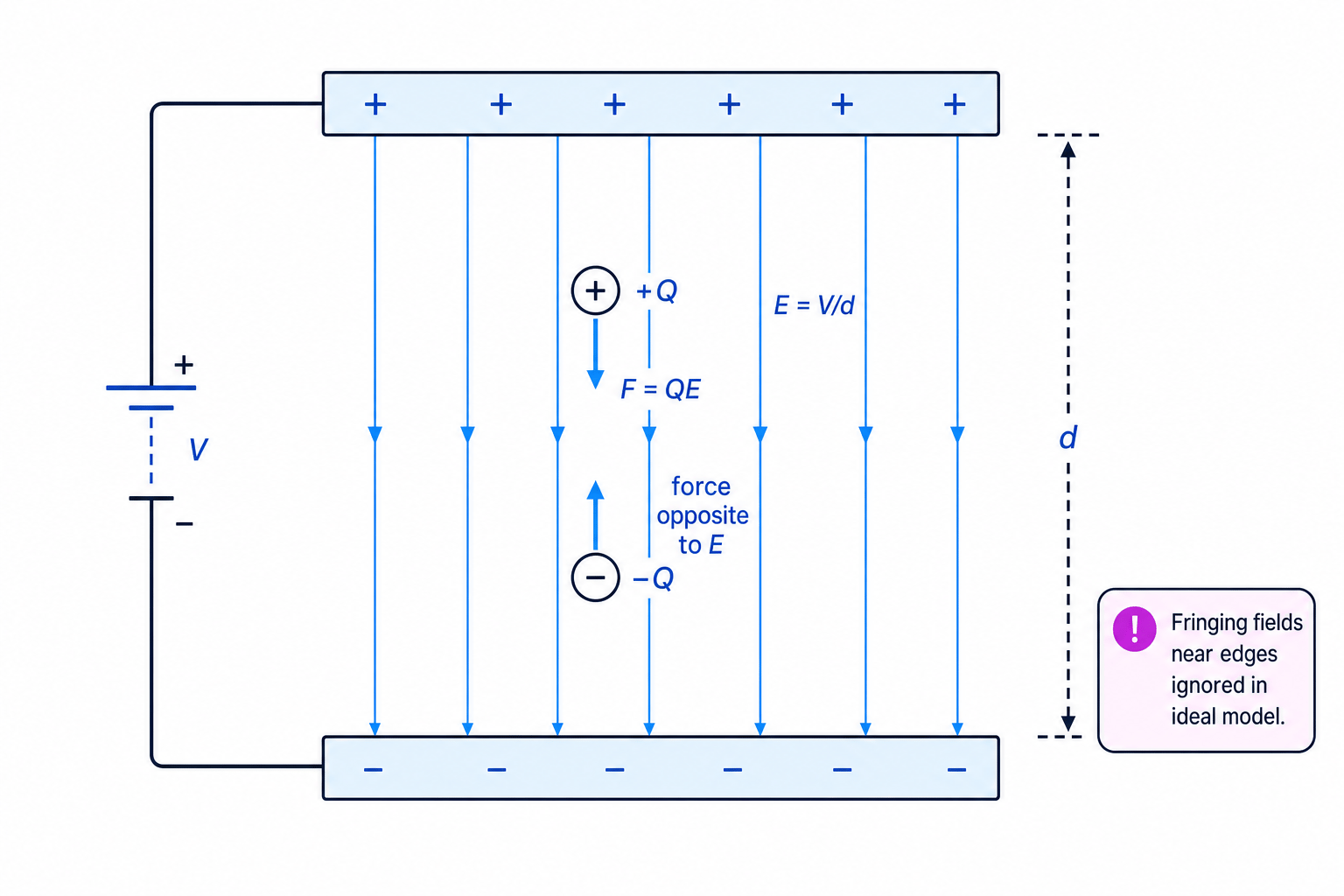
Uniform electric field
A uniform electric field is an electric field in which EEE is constant in magnitude and direction throughout the region.
Between parallel plates, the field points from the positive plate to the negative plate. Ignoring edge effects, its magnitude is:
E=VdE = \frac{V}{d}E=dVwhere VVV is the potential difference between the plates in volts (V), and ddd is the plate separation in metres (m).
Potential gradient
In a uniform field, the electric field strength is the potential difference per metre: E=V/dE = V/dE=V/d. The unit V m−1\text{V m}^{-1}V m−1 is therefore equivalent to N C−1\text{N C}^{-1}N C−1.
You can also understand this from work done. Moving a charge QQQ across the plates transfers energy QVQVQV. The electric force is QEQEQE, and over distance ddd the work done is QEdQEdQEd. Equating these gives QV=QEdQV = QEdQV=QEd, so E=V/dE = V/dE=V/d.
Finding the field strength between plates
Two parallel plates are separated by 6.0 mm and have a potential difference of 480 V across them. A small positive charge of 2.0 nC is placed between the plates. Find the electric field strength and the force on the charge.
-
Convert the separation into metres: d=6.0×10⁻³ md = 6.0 \times 10^{-3}\ \text{m}d=6.0×10⁻³ m.
-
Use the uniform-field equation:
E=Vd=480 V6.0×10−3 m=8.0×10⁴ V m−1E = \frac{V}{d} = \frac{480\ \text{V}}{6.0 \times 10^{-3}\ \text{m}} = 8.0 \times 10^{4}\ \text{V m}^{-1}E=dV=6.0×10⁻³ m480 V=8.0×10⁴ V m−1 -
Use F=QEF = QEF=QE, with Q=2.0×10⁻⁹ CQ = 2.0 \times 10^{-9}\ \text{C}Q=2.0×10⁻⁹ C:
F=(2.0×10⁻⁹ C)(8.0×10⁴ N C−1)=1.6×10⁻⁴ NF = (2.0 \times 10^{-9}\ \text{C})(8.0 \times 10^{4}\ \text{N C}^{-1}) = 1.6 \times 10^{-4}\ \text{N}F=(2.0×10⁻⁹ C)(8.0×10⁴ N C−1)=1.6×10⁻⁴ N -
Since the charge is positive, the force is in the direction of the field: from the positive plate towards the negative plate.
Forgetting to convert the gap
The distance ddd in E=V/dE = V/dE=V/d must be in metres. Millimetres and centimetres left unconverted are a very common source of answers that are too large or too small by factors of 1000 or 100.
Fringing fields
The equation E=V/dE = V/dE=V/d assumes the field is uniform, which is a good model in the central region between large parallel plates. Near the edges, field lines curve outwards, so the field is no longer perfectly uniform.
Parallel plate capacitors
A capacitor is a component that stores charge and energy. In its simplest form, it consists of two conducting plates separated by an insulator.
When a potential difference is applied, one plate gains charge +Q+Q+Q and the other gains charge −Q-Q−Q. The capacitance tells you how much charge is stored per volt:
C=QVC = \frac{Q}{V}C=VQCapacitance is measured in farads (F).
Parallel plate capacitor
A parallel plate capacitor is made from two parallel conducting plates separated by an insulating material. For large plates with small separation, the field between them is approximately uniform.
For a parallel plate capacitor with vacuum, or approximately air, between the plates:
C=ϵ0AdC = \frac{\epsilon_0 A}{d}C=dϵ0Awhere AAA is the overlapping plate area in square metres, ddd is the separation in metres, and ϵ0\epsilon_0ϵ0 is the permittivity of free space:
ϵ0=8.85×10⁻¹² F m−1\epsilon_0 = 8.85 \times 10^{-12}\ \text{F m}^{-1}ϵ0=8.85×10⁻¹² F m−1Permittivity and dielectrics
A dielectric is an insulating material placed between the plates of a capacitor. Examples include plastic, oil, glass or ceramic.
Permittivity
The permittivity, ϵ\epsilonϵ, of a material describes how the material affects the electric field and capacitance. It has unit farads per metre, F m−1\text{F m}^{-1}F m−1.
For a material between the plates:
C=ϵAdC = \frac{\epsilon A}{d}C=dϵAThe permittivity of the material is related to its relative permittivity, ϵr\epsilon_rϵr, by:
ϵ=ϵrϵ0\epsilon = \epsilon_r \epsilon_0ϵ=ϵrϵ0Relative permittivity has no unit. You are expected to use this relationship, but you are not expected to explain why ϵr≥1\epsilon_r \ge 1ϵr≥1.
How to change capacitance
For a parallel plate capacitor, capacitance increases if the plate area AAA increases, the separation ddd decreases, or a material with larger permittivity ϵ\epsilonϵ is inserted.
Calculating capacitance with a dielectric
A parallel plate capacitor has plate area 0.020 m² and plate separation 0.50 mm. A dielectric of relative permittivity 2.3 fills the gap. Calculate the capacitance.
-
Convert the separation into metres and find the material permittivity:
d=0.50 mm=5.0×10⁻⁴ md = 0.50\ \text{mm} = 5.0 \times 10^{-4}\ \text{m}d=0.50 mm=5.0×10⁻⁴ m ϵ=ϵrϵ0=(2.3)(8.85×10⁻¹² F m−1)=2.04×10⁻¹¹ F m−1\epsilon = \epsilon_r \epsilon_0 = (2.3)(8.85 \times 10^{-12}\ \text{F m}^{-1}) = 2.04 \times 10^{-11}\ \text{F m}^{-1}ϵ=ϵrϵ0=(2.3)(8.85×10⁻¹² F m−1)=2.04×10⁻¹¹ F m−1 -
Substitute into C=ϵA/dC = \epsilon A/dC=ϵA/d:
C=(2.04×10⁻¹¹ F m−1)(0.020 m2)5.0×10⁻⁴ mC = \frac{(2.04 \times 10^{-11}\ \text{F m}^{-1})(0.020\ \text{m}^{2})}{5.0 \times 10^{-4}\ \text{m}}C=5.0×10⁻⁴ m(2.04×10⁻¹¹ F m−1)(0.020 m2) -
Calculate and quote to a sensible number of significant figures:
C=8.1×10⁻¹⁰ FC = 8.1 \times 10^{-10}\ \text{F}C=8.1×10⁻¹⁰ FThis is 0.81 nF.
Quick proportional checks
For C=ϵA/dC = \epsilon A/dC=ϵA/d, doubling AAA doubles CCC, doubling ϵ\epsilonϵ doubles CCC, but doubling ddd halves CCC.
Motion of charged particles in a uniform electric field
A charged particle in a uniform electric field experiences a constant force, provided its charge remains constant and the field is uniform.
Using:
F=QEF = QEF=QEand Newton’s second law:
F=maF = maF=mathe acceleration is:
a=QEma = \frac{QE}{m}a=mQEwhere mmm is the mass of the particle in kilograms.
For a negative particle, such as an electron, QQQ is negative, so the acceleration is opposite to the electric field direction. In many calculations, you use the magnitude of the charge to find the size of the acceleration, then state the direction separately.
Motion parallel to the field: energy method
If a charged particle starts from rest and is accelerated through a potential difference, an energy method is often quickest.
If electrical energy becomes kinetic energy:
QV=12mv2QV = \frac{1}{2}mv^2QV=21mv2using the magnitude of the charge for energy gained.
Speed after acceleration through a potential difference
An electron is accelerated from rest through a potential difference of 1.5 kV. Calculate its speed. Use e=1.60×10⁻¹⁹ Ce = 1.60 \times 10^{-19}\ \text{C}e=1.60×10⁻¹⁹ C and me=9.11×10⁻³¹ kgm_e = 9.11 \times 10^{-31}\ \text{kg}me=9.11×10⁻³¹ kg.
-
Convert the potential difference: V=1.5×10³ VV = 1.5 \times 10^{3}\ \text{V}V=1.5×10³ V.
-
Use energy transfer to kinetic energy:
eV=12mev2eV = \frac{1}{2}m_ev^2eV=21mev2Rearranging gives:
v=2eVmev = \sqrt{\frac{2eV}{m_e}}v=me2eV -
Substitute values:
v=2(1.60×10⁻¹⁹ C)(1.5×10³ V)9.11×10⁻³¹ kgv = \sqrt{\frac{2(1.60 \times 10^{-19}\ \text{C})(1.5 \times 10^{3}\ \text{V})}{9.11 \times 10^{-31}\ \text{kg}}}v=9.11×10⁻³¹ kg2(1.60×10⁻¹⁹ C)(1.5×10³ V) -
Calculate:
v=2.3×10⁷ m s−1v = 2.3 \times 10^{7}\ \text{m s}^{-1}v=2.3×10⁷ m s−1
Confusing energy direction with force direction
For an electron, the force is opposite to the electric field. But when calculating energy gained from an accelerating potential difference, use the magnitude of the charge and decide the direction from the force separately.
Motion perpendicular to the field: projectile-style method
If a charged particle enters a uniform electric field with velocity perpendicular to the field, treat the motion like projectile motion:
- horizontal motion: constant velocity, if there is no horizontal electric force;
- vertical motion: constant acceleration due to the electric force;
- the path is a parabola while the particle is inside the uniform field.
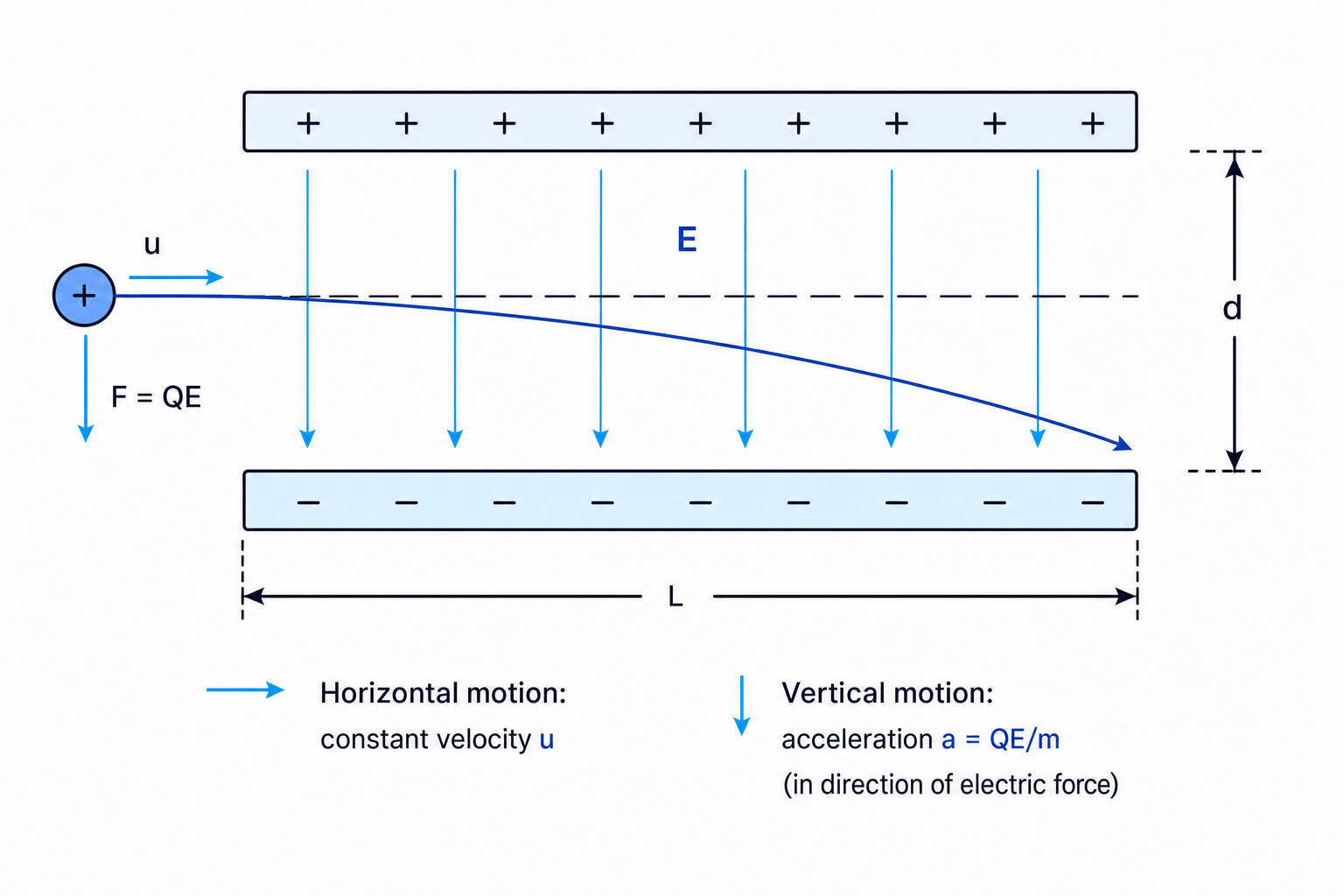
Deflection between charged plates
An alpha particle enters horizontally midway between two plates. The plates are 20 mm apart with a potential difference of 200 V. The field region is 30 mm long. The alpha particle has charge +3.20×10⁻¹⁹ C+3.20 \times 10^{-19}\ \text{C}+3.20×10⁻¹⁹ C, mass 6.64×10⁻²⁷ kg6.64 \times 10^{-27}\ \text{kg}6.64×10⁻²⁷ kg, and initial horizontal speed 4.0×10⁵ m s−14.0 \times 10^{5}\ \text{m s}^{-1}4.0×10⁵ m s−1. Find its vertical deflection as it leaves the plates.
-
Calculate the electric field strength:
E=Vd=200 V0.020 m=1.0×10⁴ V m−1E = \frac{V}{d} = \frac{200\ \text{V}}{0.020\ \text{m}} = 1.0 \times 10^{4}\ \text{V m}^{-1}E=dV=0.020 m200 V=1.0×10⁴ V m−1 -
Calculate the vertical acceleration:
a=QEm=(3.20×10⁻¹⁹ C)(1.0×10⁴ N C−1)6.64×10⁻²⁷ kga = \frac{QE}{m} = \frac{(3.20 \times 10^{-19}\ \text{C})(1.0 \times 10^{4}\ \text{N C}^{-1})}{6.64 \times 10^{-27}\ \text{kg}}a=mQE=6.64×10⁻²⁷ kg(3.20×10⁻¹⁹ C)(1.0×10⁴ N C−1) a=4.82×10¹¹ m s−2a = 4.82 \times 10^{11}\ \text{m s}^{-2}a=4.82×10¹¹ m s−2 -
Calculate the time spent between the plates using horizontal motion:
t=Lu=0.030 m4.0×105 m s−1=7.5×10⁻⁸ st = \frac{L}{u} = \frac{0.030\ \text{m}}{4.0 \times 10^{5}\ \text{m s}^{-1}} = 7.5 \times 10^{-8}\ \text{s}t=uL=4.0×10⁵ m s−10.030 m=7.5×10⁻⁸ s -
Use vertical constant-acceleration motion with initial vertical velocity zero:
s=12at2s = \frac{1}{2}at^2s=21at2 s=12(4.82×10¹¹ m s−2)(7.5×10⁻⁸ s)2s = \frac{1}{2}(4.82 \times 10^{11}\ \text{m s}^{-2})(7.5 \times 10^{-8}\ \text{s})^2s=21(4.82×10¹¹ m s−2)(7.5×10⁻⁸ s)2 -
Calculate the deflection:
s=1.4×10⁻³ ms = 1.4 \times 10^{-3}\ \text{m}s=1.4×10⁻³ mThe alpha particle is deflected 1.4 mm in the direction of the electric field.
Choose the method from the motion
If the particle moves along the field, energy is often fastest: QV=12mv2QV = \frac{1}{2}mv^2QV=21mv2. If it enters across the field, use force and acceleration: F=QEF = QEF=QE, F=maF = maF=ma, then SUVAT.
In the exam
-
Always convert distances into metres before using E=V/dE = V/dE=V/d or C=ϵA/dC = \epsilon A/dC=ϵA/d.
-
Decide whether the question is about a field, a capacitor, or particle motion before choosing the equation.
-
For charged-particle motion, separate direction from magnitude: calculate the size using F=QEF = QEF=QE or QVQVQV, then use the sign of the charge to state the direction.
Check yourself
- Why are the field lines between ideal parallel plates drawn straight, parallel and equally spaced?
- What happens to the capacitance of a parallel plate capacitor if the plate separation is halved?
- A negative particle enters a downward electric field moving horizontally. Which way does it accelerate?
