What you'll learn
- What electric potential means, and why it is zero at infinity.
- How to calculate potential near a point charge using V=Q4πε0rV = \frac{Q}{4\pi\varepsilon_0 r}V=4πε0rQ.
- How electric potential leads to the capacitance of an isolated sphere, C=4πε0RC = 4\pi\varepsilon_0 RC=4πε0R.
- How force–distance graphs link to work done and electric potential energy.
Starting point: work, charge and energy
You already know that work done is energy transferred when a force moves through a distance. In electric fields, charges can gain or lose energy because electric forces act on them.
A positive test charge is a small positive charge used to explore an electric field. “Small” means it does not significantly disturb the field produced by the source charge.
Electric potential
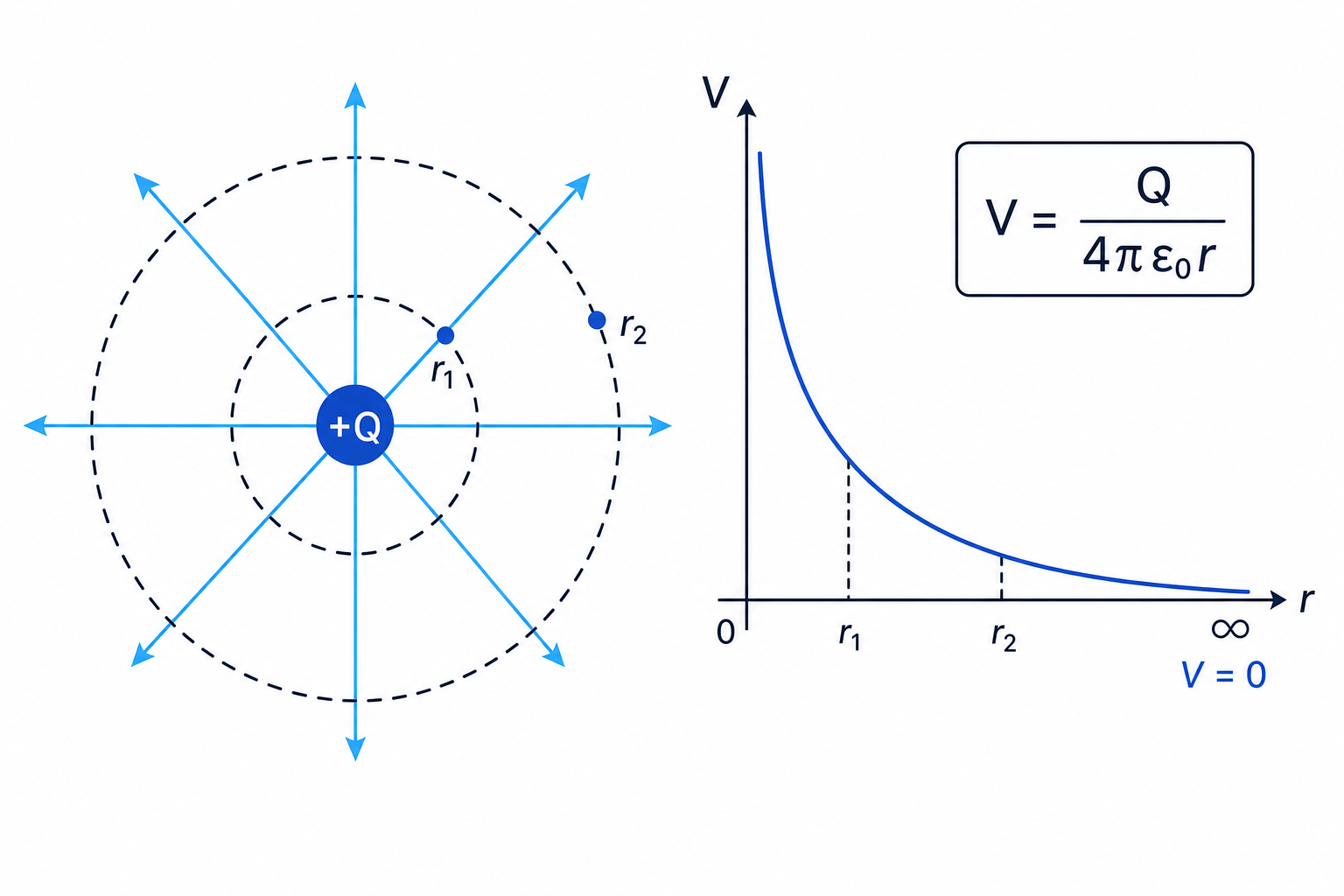
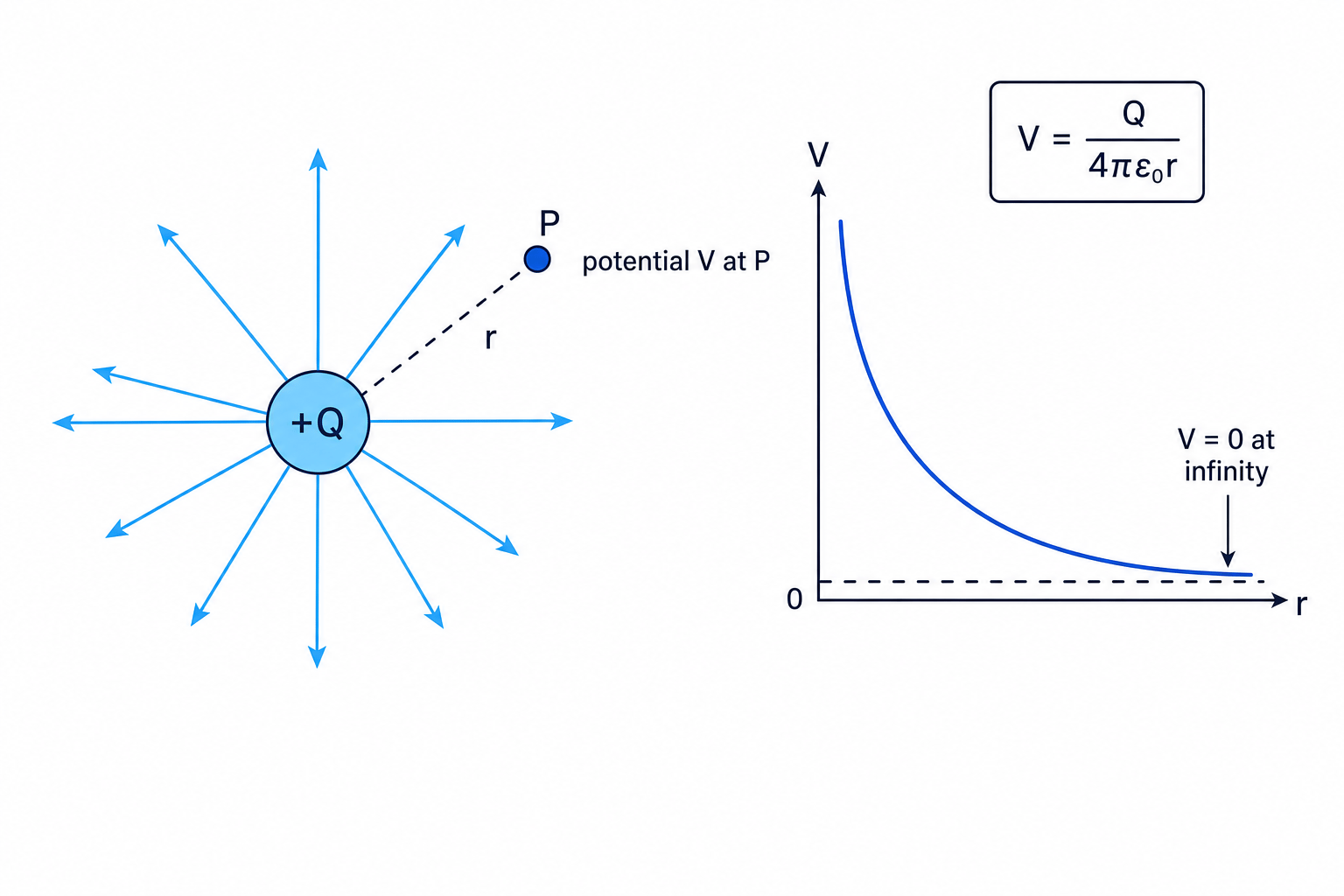
The electric potential at a point is the work done per unit positive charge in bringing a small positive test charge from infinity to that point. Electric potential is zero at infinity.
Electric potential has unit volt, V. Since it is energy per charge:
1 V=1 J C−11\ \text{V} = 1\ \text{J C}^{-1}1 V=1 J C−1So a point at 20 V means it takes 20 J of work per coulomb of positive charge to bring the charge there from infinity.
Potential is energy per charge
Electric potential tells you about the field itself. Electric potential energy depends on both the field and the charge you place in it.
Finding potential from work done
A small positive charge of 3.0×10⁻⁹ C3.0 \times 10^{-9}\ \text{C}3.0×10⁻⁹ C is brought from infinity to a point. The work done is 1.2×10⁻⁶ J1.2 \times 10^{-6}\ \text{J}1.2×10⁻⁶ J. Calculate the electric potential at the point.
-
Use the definition of potential as work done per unit charge:
V=WqV = \frac{W}{q}V=qW -
Substitute the values, keeping units with the calculation:
V=1.2×10⁻⁶ J3.0×10−9 CV = \frac{1.2 \times 10^{-6}\ \text{J}}{3.0 \times 10^{-9}\ \text{C}}V=3.0×10⁻⁹ C1.2×10−6 J -
Calculate the value and convert joules per coulomb into volts:
V=4.0×10² J C−1=400 VV = 4.0 \times 10^{2}\ \text{J C}^{-1} = 400\ \text{V}V=4.0×10² J C−1=400 V
Potential near a point charge
A point charge is an idealised charge treated as if all its charge is concentrated at one point. For a source charge QQQ, the electric potential at distance rrr from it is:
V=Q4πε0rV = \frac{Q}{4\pi\varepsilon_0 r}V=4πε0rQwhere ε0\varepsilon_0ε0 is the permittivity of free space, with value approximately:
ε0=8.85×10⁻¹² F m−1\varepsilon_0 = 8.85 \times 10^{-12}\ \text{F m}^{-1}ε0=8.85×10⁻¹² F m−1For calculation, it is often useful to know:
14πε0=8.99×10⁹ N m2C−2\frac{1}{4\pi\varepsilon_0} = 8.99 \times 10^9\ \text{N m}^2\text{C}^{-2}4πε01=8.99×10⁹ N m2C−2A positive source charge gives a positive potential. A negative source charge gives a negative potential. Potential is a scalar, so it has no direction.
Changes in electric potential
A change in electric potential between two points is:
ΔV=V2−V1\Delta V = V_2 - V_1ΔV=V2−V1This matters because moving a charge through a potential change changes its electric potential energy.
Sign check
For a positive source charge, VVV is larger closer to the charge and tends towards zero as rrr increases. For a negative source charge, VVV is more negative closer to the charge and tends towards zero from below.
Calculating a change in potential
A point charge Q=+6.0×10⁻⁹ CQ = +6.0 \times 10^{-9}\ \text{C}Q=+6.0×10⁻⁹ C produces an electric field. Calculate the change in potential when moving from r1=0.20 mr_1 = 0.20\ \text{m}r1=0.20 m to r2=0.50 mr_2 = 0.50\ \text{m}r2=0.50 m.
-
Calculate the potential at r1r_1r1:
V1=Q4πε0r1=(8.99×10⁹)(6.0×10⁻⁹ C)0.20 m=270 VV_1 = \frac{Q}{4\pi\varepsilon_0 r_1} = \frac{(8.99 \times 10^9)(6.0 \times 10^{-9}\ \text{C})}{0.20\ \text{m}} = 270\ \text{V}V1=4πε0r1Q=0.20 m(8.99×10⁹)(6.0×10⁻⁹ C)=270 V -
Calculate the potential at r2r_2r2:
V2=Q4πε0r2=(8.99×10⁹)(6.0×10⁻⁹ C)0.50 m=108 VV_2 = \frac{Q}{4\pi\varepsilon_0 r_2} = \frac{(8.99 \times 10^9)(6.0 \times 10^{-9}\ \text{C})}{0.50\ \text{m}} = 108\ \text{V}V2=4πε0r2Q=0.50 m(8.99×10⁹)(6.0×10⁻⁹ C)=108 V -
Find the change in potential:
ΔV=V2−V1=108 V−270 V=−162 V\Delta V = V_2 - V_1 = 108\ \text{V} - 270\ \text{V} = -162\ \text{V}ΔV=V2−V1=108 V−270 V=−162 V
Forgetting that infinity is the zero point
For electric potential around isolated point charges, the reference is V=0V = 0V=0 at infinity. Do not assume the zero potential point is the surface of the charge or the centre of the diagram.
Capacitance of an isolated sphere
Capacitance tells you how much charge is stored per unit potential. It is defined by:
C=QVC = \frac{Q}{V}C=VQwhere CCC is capacitance in farads, F, QQQ is charge in coulombs, C, and VVV is potential in volts, V.
For an isolated conducting sphere of radius RRR, the charge spreads over the surface. The surface potential is found by treating the sphere, from outside, like a point charge at its centre:
V=Q4πε0RV = \frac{Q}{4\pi\varepsilon_0 R}V=4πε0RQSubstitute this into C=QVC = \frac{Q}{V}C=VQ:
C=QQ4πε0R=4πε0RC = \frac{Q}{\frac{Q}{4\pi\varepsilon_0 R}} = 4\pi\varepsilon_0 RC=4πε0RQQ=4πε0RSo the capacitance of an isolated sphere is:
C=4πε0RC = 4\pi\varepsilon_0 RC=4πε0R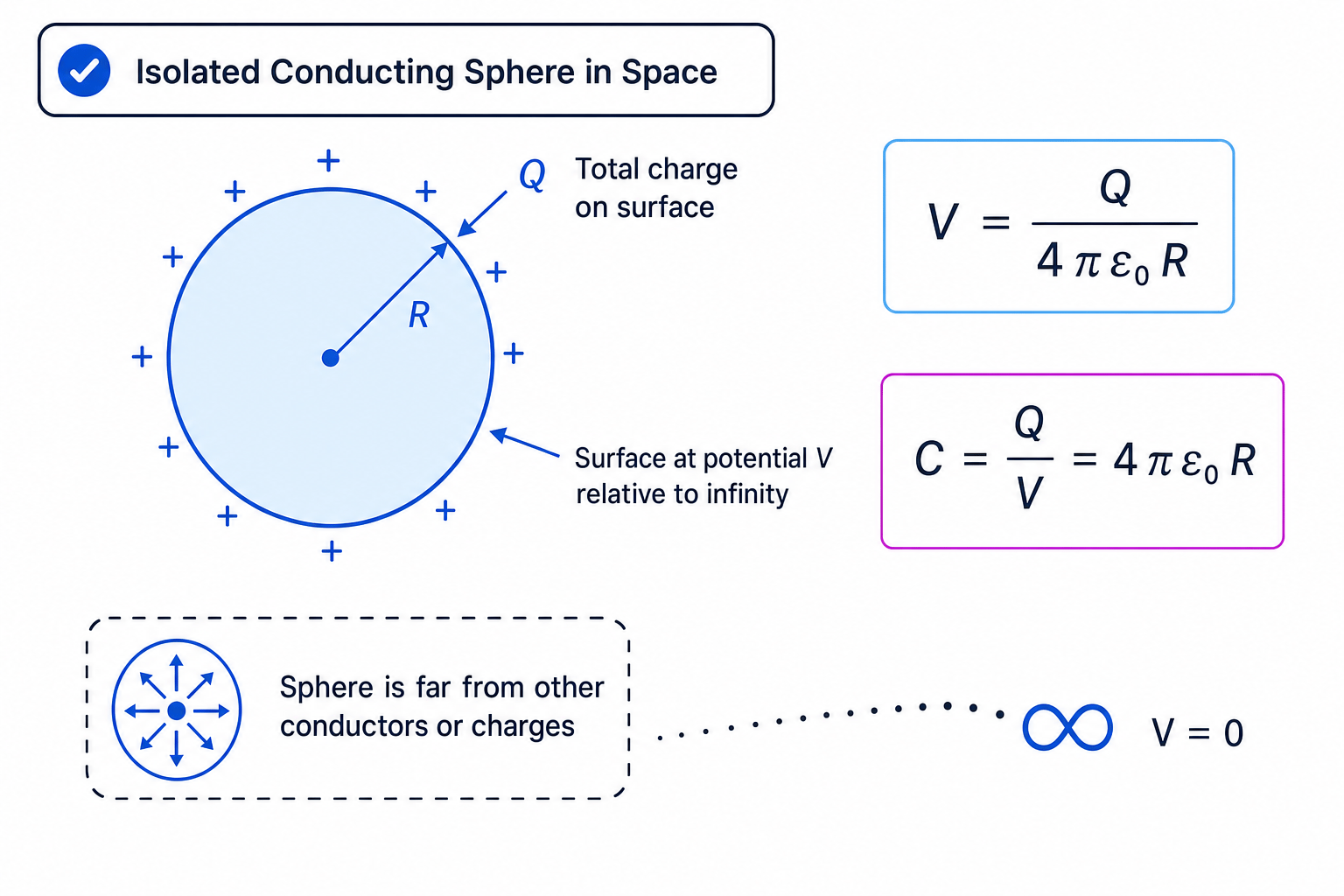
Bigger isolated spheres store more charge
For an isolated sphere, capacitance is directly proportional to radius: doubling RRR doubles CCC.
Calculating the capacitance of an isolated sphere
Calculate the capacitance of an isolated conducting sphere of radius 0.15 m0.15\ \text{m}0.15 m.
-
Choose the isolated sphere equation:
C=4πε0RC = 4\pi\varepsilon_0 RC=4πε0R -
Substitute ε0=8.85×10⁻¹² F m−1\varepsilon_0 = 8.85 \times 10^{-12}\ \text{F m}^{-1}ε0=8.85×10⁻¹² F m−1 and R=0.15 mR = 0.15\ \text{m}R=0.15 m:
C=4π(8.85×10⁻¹² F m−1)(0.15 m)C = 4\pi(8.85 \times 10^{-12}\ \text{F m}^{-1})(0.15\ \text{m})C=4π(8.85×10⁻¹² F m−1)(0.15 m) -
Calculate and quote the result sensibly:
C=1.7×10⁻¹¹ FC = 1.7 \times 10^{-11}\ \text{F}C=1.7×10⁻¹¹ FThis is about 17 pF.
Isolated really matters
The formula C=4πε0RC = 4\pi\varepsilon_0 RC=4πε0R is for a sphere far from other conductors or charges. Nearby objects would change the electric field and therefore the capacitance.
Force–distance graphs and work done
For two point charges, the electric force follows an inverse-square relationship:
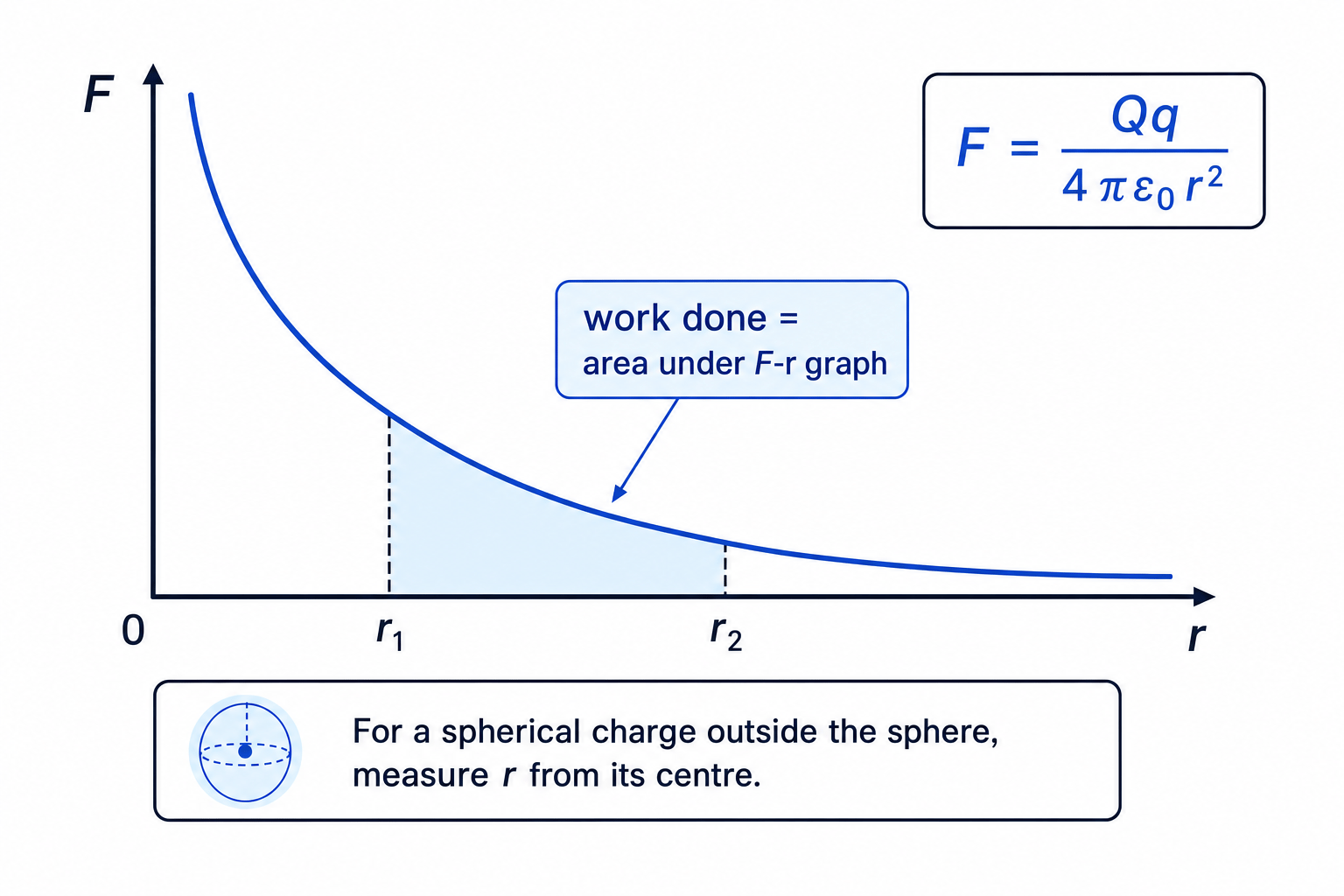
F=Qq4πε0r2F = \frac{Qq}{4\pi\varepsilon_0 r^2}F=4πε0r2QqA force–distance graph plots force FFF against separation rrr. The work done by a force is the area under the force–distance graph in the direction of motion.
For a spherical charge, outside the sphere, measure rrr from the centre of the sphere.
Area means energy transfer
On an FFF–rrr graph, area has units N m\text{N m}N m, which is joules. That area represents work done, so it represents energy transferred.
Estimating work from a force-distance graph
A force–distance graph gives these force values during a movement from 0.20 m0.20\ \text{m}0.20 m to 0.40 m0.40\ \text{m}0.40 m: F=3.6 NF = 3.6\ \text{N}F=3.6 N at 0.20 m0.20\ \text{m}0.20 m, F=1.6 NF = 1.6\ \text{N}F=1.6 N at 0.30 m0.30\ \text{m}0.30 m, and F=0.90 NF = 0.90\ \text{N}F=0.90 N at 0.40 m0.40\ \text{m}0.40 m. Estimate the work done using two trapezia.
-
Split the area into two intervals, each of width 0.10 m0.10\ \text{m}0.10 m:
Δr=0.10 m\Delta r = 0.10\ \text{m}Δr=0.10 m -
Calculate the two trapezium areas:
W1=12(3.6 N+1.6 N)(0.10 m)=0.26 JW2=12(1.6 N+0.90 N)(0.10 m)=0.125 J\begin{aligned} W_1 &= \frac{1}{2}(3.6\ \text{N} + 1.6\ \text{N})(0.10\ \text{m}) = 0.26\ \text{J} \\ W_2 &= \frac{1}{2}(1.6\ \text{N} + 0.90\ \text{N})(0.10\ \text{m}) = 0.125\ \text{J} \end{aligned}W1W2=21(3.6 N+1.6 N)(0.10 m)=0.26 J=21(1.6 N+0.90 N)(0.10 m)=0.125 J -
Add the areas to estimate the work done:
W=0.26 J+0.125 J=0.385 J≈0.39 JW = 0.26\ \text{J} + 0.125\ \text{J} = 0.385\ \text{J} \approx 0.39\ \text{J}W=0.26 J+0.125 J=0.385 J≈0.39 J
Area is not just force times final distance
For a changing force, you cannot use W=FrW = FrW=Fr with just one force value unless the force is constant. Use the area under the graph.
Electric potential energy
The electric potential energy of a charge qqq placed at a point with electric potential VVV is:
Ep=VqE_p = VqEp=VqNear a point charge QQQ, substitute V=Q4πε0rV = \frac{Q}{4\pi\varepsilon_0 r}V=4πε0rQ:
Ep=Qq4πε0rE_p = \frac{Qq}{4\pi\varepsilon_0 r}Ep=4πε0rQqThis is the electric potential energy of the two-charge system when their separation is rrr, taking zero energy at infinity.
If QQQ and qqq have the same sign, EpE_pEp is positive. If they have opposite signs, EpE_pEp is negative.
Calculating electric potential energy
A charge q=+2.0×10⁻⁹ Cq = +2.0 \times 10^{-9}\ \text{C}q=+2.0×10⁻⁹ C is placed 0.30 m0.30\ \text{m}0.30 m from a source charge Q=+5.0×10⁻⁹ CQ = +5.0 \times 10^{-9}\ \text{C}Q=+5.0×10⁻⁹ C. Calculate the electric potential energy.
-
Use the point-charge potential energy equation:
Ep=Qq4πε0rE_p = \frac{Qq}{4\pi\varepsilon_0 r}Ep=4πε0rQq -
Substitute the values:
Ep=(8.99×10⁹)(5.0×10⁻⁹ C)(2.0×10⁻⁹ C)0.30 mE_p = \frac{(8.99 \times 10^9)(5.0 \times 10^{-9}\ \text{C})(2.0 \times 10^{-9}\ \text{C})}{0.30\ \text{m}}Ep=0.30 m(8.99×10⁹)(5.0×10⁻⁹ C)(2.0×10⁻⁹ C) -
Calculate the energy:
Ep=3.0×10⁻⁷ JE_p = 3.0 \times 10^{-7}\ \text{J}Ep=3.0×10⁻⁷ JThe value is positive because the charges have the same sign.
Mixing up potential and potential energy
Electric potential VVV is measured in volts and depends on the source charge and position. Electric potential energy EpE_pEp is measured in joules and also depends on the charge qqq placed there.
In the exam
- Define electric potential carefully: work done per unit positive charge in bringing it from infinity to the point.
- For point charges, keep the sign of QQQ and qqq in the calculation unless the question asks only for magnitude.
- When you see a force–distance graph, think “area = work done”, and check whether the question asks for work done by the field or against the field.
Check yourself
- Why is electric potential taken as zero at infinity for an isolated point charge?
- How would the potential change if the source charge QQQ were negative?
- What does the area under a force–distance graph represent, and what are its units?