

What you'll learn
- How to use Coulomb’s law for the force between two point charges.
- How electric field strength around a point charge depends on charge and distance.
- How to choose the direction of electric forces and fields.
- How electric point fields compare with gravitational point fields.
The prerequisites: charge, force and fields
Electric charge
Electric charge is a property of matter that causes electrical forces. Charge can be positive or negative, and it is measured in coulombs (C).
Like charges repel. Unlike charges attract.
Point charge
A point charge is a charged object whose size is negligible compared with the distance from it. You treat all its charge as being concentrated at one point.
This “point” idea matters because Coulomb’s law is an idealised model. It is very useful, but only when the charged objects are small compared with their separation.
What is a field?
A field is a region of space where an object experiences a non-contact force because it has a particular property.
For example:
- a mass experiences a force in a gravitational field;
- a charge experiences a force in an electric field;
- a moving charge or current-carrying wire can experience a force in a magnetic field.
Fields explain forces without contact
An electric charge creates an electric field around itself. Another charge placed in that field experiences a force.
Coulomb’s law
Coulomb’s law gives the force between two point charges.
For point charges QQQ and qqq separated by distance rrr:
F=Qq4πε0r2F = \frac{Qq}{4\pi\varepsilon_0 r^2}F=4πε0r2Qqwhere:
- FFF is the electrostatic force in newtons (N);
- QQQ and qqq are the charges in coulombs (C);
- rrr is the separation between the charges in metres (m);
- ε0\varepsilon_0ε0 is the permittivity of free space, with value 8.85×10⁻¹² F m−18.85 \times 10^{-12}\ \text{F m}^{-1}8.85×10⁻¹² F m−1.
The force acts along the straight line joining the two charges.
The diagram shows the force direction for like charges, and the electric field directions around positive and negative point charges.
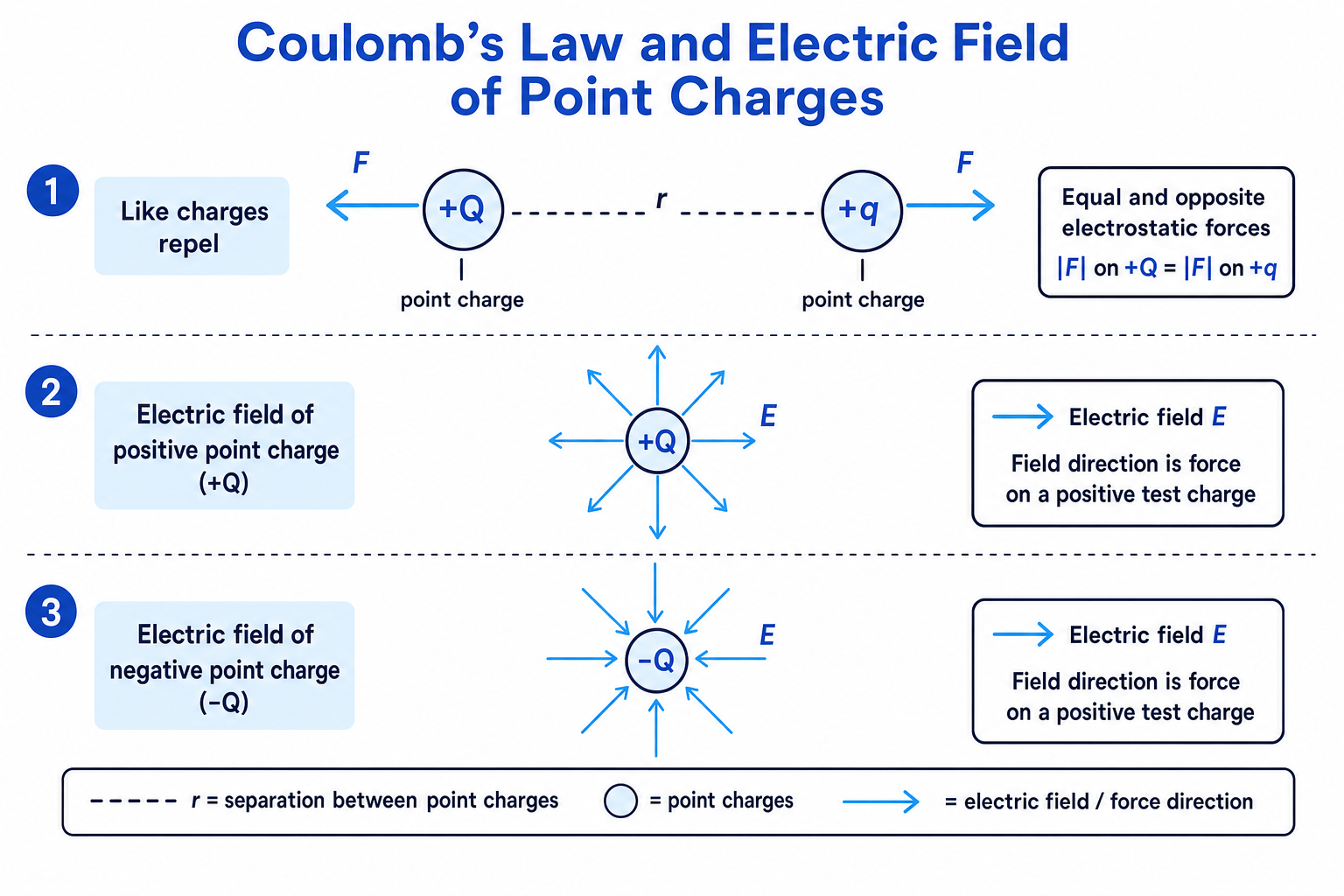
Direction of the force
Coulomb’s law is an inverse-square law: the force is proportional to 1/r21/r^21/r2. If the separation doubles, the force becomes one quarter as large.
In many A-Level calculations, it is safest to calculate the magnitude of the force using the sizes of the charges, then decide the direction separately:
- like charges repel;
- unlike charges attract.
The two charges always exert equal and opposite forces on each other, in line with Newton’s third law.
Calculating electrostatic force
Two point charges, +3.0 nC and -2.0 nC, are separated by 4.0 cm in air. Calculate the magnitude and direction of the force on each charge.
-
Convert all quantities into SI units:
Q=3.0×10⁻⁹ C,q=2.0×10⁻⁹ C,r=4.0×10⁻² mQ = 3.0 \times 10^{-9}\ \text{C}, \quad q = 2.0 \times 10^{-9}\ \text{C}, \quad r = 4.0 \times 10^{-2}\ \text{m}Q=3.0×10⁻⁹ C,q=2.0×10⁻⁹ C,r=4.0×10⁻² m -
Substitute the magnitudes into Coulomb’s law:
∣F∣=(3.0×10⁻⁹)(2.0×10⁻⁹)4π(8.85×10⁻¹²)(4.0×10⁻²)2|F| = \frac{(3.0 \times 10^{-9})(2.0 \times 10^{-9})}{4\pi(8.85 \times 10^{-12})(4.0 \times 10^{-2})^2}∣F∣=4π(8.85×10⁻¹²)(4.0×10⁻²)2(3.0×10⁻⁹)(2.0×10⁻⁹) -
Calculate the force:
∣F∣=3.37×10⁻⁵ N|F| = 3.37 \times 10^{-5}\ \text{N}∣F∣=3.37×10⁻⁵ NTo two significant figures:
∣F∣=3.4×10⁻⁵ N|F| = 3.4 \times 10^{-5}\ \text{N}∣F∣=3.4×10⁻⁵ N -
Decide the direction. The charges are unlike, so they attract. Each charge experiences a force of 3.4×10⁻⁵ N3.4 \times 10^{-5}\ \text{N}3.4×10⁻⁵ N towards the other charge.
Forgetting the square on distance
The separation is r2r^2r2, not just rrr. Also, centimetres must be converted to metres before substituting into the equation.
When Coulomb’s law applies
This form of Coulomb’s law is for point charges in free space. It is a good approximation when the charged objects are much smaller than their separation.
Electric field strength
Electric field strength tells you how strong an electric field is at a point.
Electric field strength
The electric field strength EEE at a point is the force per unit positive charge placed at that point.
E=FqE = \frac{F}{q}E=qFIts unit is newtons per coulomb (N C^-1), equivalent to volts per metre (V m^-1).
The phrase “positive charge” is important. The direction of an electric field is defined as the direction of the force on a positive test charge.
So:
- around a positive point charge, electric field lines point outwards;
- around a negative point charge, electric field lines point inwards.
Field strength around a point charge
For a point charge QQQ, the electric field strength at distance rrr is:
E=Q4πε0r2E = \frac{Q}{4\pi\varepsilon_0 r^2}E=4πε0r2QThis equation comes from combining Coulomb’s law with E=F/qE = F/qE=F/q. The charge QQQ is the source charge creating the field.
The test charge is not in the point-field equation
The field at a point depends on the source charge QQQ and the distance rrr, not on the charge you later place there to test the field.
Calculating a point-charge electric field
A +4.0 µC point charge creates an electric field. Calculate the field strength 0.25 m from the charge, then find the force on a -2.0 nC charge placed at that point.
-
Convert the source charge into coulombs:
Q=4.0×10⁻⁶ CQ = 4.0 \times 10^{-6}\ \text{C}Q=4.0×10⁻⁶ C -
Substitute into the point-charge field equation:
E=4.0×10−64π(8.85×10⁻¹²)(0.25)2E = \frac{4.0 \times 10^{-6}}{4\pi(8.85 \times 10^{-12})(0.25)^2}E=4π(8.85×10⁻¹²)(0.25)24.0×10⁻⁶ -
Calculate the field strength:
E=5.75×10⁵ N C−1E = 5.75 \times 10^5\ \text{N C}^{-1}E=5.75×10⁵ N C−1To two significant figures:
E=5.8×10⁵ N C−1E = 5.8 \times 10^5\ \text{N C}^{-1}E=5.8×10⁵ N C−1 -
Decide the field direction. The source charge is positive, so the field points away from the charge.
-
Use F=qEF = qEF=qE to find the force on the -2.0 nC charge:
∣F∣=(2.0×10⁻⁹)(5.75×10⁵)=1.15×10⁻³ N|F| = (2.0 \times 10^{-9})(5.75 \times 10^5) = 1.15 \times 10^{-3}\ \text{N}∣F∣=(2.0×10⁻⁹)(5.75×10⁵)=1.15×10⁻³ NThe charge is negative, so its force is opposite to the electric field direction: towards the positive source charge.
Mixing up source charge and test charge
In E=Q/(4πε0r2)E = Q/(4\pi\varepsilon_0 r^2)E=Q/(4πε0r2), QQQ is the charge creating the field. The charge placed in the field is only needed if you then calculate force using F=qEF = qEF=qE.
Electric fields as one type of force field
Electric fields are one example of a field that gives rise to a force. The field exists whether or not you place a second charge there.
A useful way to think about it is:
- A source charge creates an electric field in the space around it.
- A second charge placed in that field experiences a force.
- The force depends on both the field strength and the charge placed there.
For a charge in a uniform or non-uniform electric field:
F=qEF = qEF=qEFor a positive charge, the force is in the same direction as the electric field. For a negative charge, the force is in the opposite direction.
Comparing electric and gravitational point fields
Electric and gravitational fields are closely related ideas in A-Level Physics.
For two point masses, the gravitational force is:
F=GMmr2F = \frac{GMm}{r^2}F=r2GMmFor two point charges, the electric force is:
F=Qq4πε0r2F = \frac{Qq}{4\pi\varepsilon_0 r^2}F=4πε0r2QqBoth are inverse-square laws. In both cases, the field strength due to a point source depends on the source and on 1/r21/r^21/r2.
For a point mass:
g=GMr2g = \frac{GM}{r^2}g=r2GMFor a point charge:
E=Q4πε0r2E = \frac{Q}{4\pi\varepsilon_0 r^2}E=4πε0r2QSimilarities
- Both fields are radial around a point source.
- Both follow an inverse-square relationship with distance.
- Both can cause non-contact forces.
- Both field strengths are defined as force per unit “test object”: force per unit mass for ggg, force per unit positive charge for EEE.
Differences
- Gravitational forces are always attractive because mass is always positive.
- Electric forces can be attractive or repulsive because charge can be positive or negative.
- Gravitational field lines around a point mass point inwards.
- Electric field lines point away from positive charges and towards negative charges.
- Electric forces between particles are often vastly stronger than gravitational forces.
Comparing electric and gravitational forces
Compare the electric and gravitational forces between two protons at the same separation. Use e=1.60×10⁻¹⁹ Ce = 1.60 \times 10^{-19}\ \text{C}e=1.60×10⁻¹⁹ C, mp=1.67×10⁻²⁷ kgm_p = 1.67 \times 10^{-27}\ \text{kg}mp=1.67×10⁻²⁷ kg and G=6.67×10⁻¹¹ N m2kg−2G = 6.67 \times 10^{-11}\ \text{N m}^2\text{kg}^{-2}G=6.67×10⁻¹¹ N m2kg−2.
-
Write the ratio so the common separation cancels:
FEFG=e2/(4πε0r2)Gmp2/r2=e24πε0Gmp2\frac{F_E}{F_G} = \frac{e^2/(4\pi\varepsilon_0 r^2)}{Gm_p^2/r^2} = \frac{e^2}{4\pi\varepsilon_0 Gm_p^2}FGFE=Gmp2/r2e2/(4πε0r2)=4πε0Gmp2e2 -
Use 1/(4πε0)=8.99×109 N m2C−21/(4\pi\varepsilon_0) = 8.99 \times 10^9\ \text{N m}^2\text{C}^{-2}1/(4πε0)=8.99×109 N m2C−2:
FEFG=(8.99×10⁹)(1.60×10⁻¹⁹)2(6.67×10⁻¹¹)(1.67×10⁻²⁷)2\frac{F_E}{F_G} = \frac{(8.99 \times 10^9)(1.60 \times 10^{-19})^2}{(6.67 \times 10^{-11})(1.67 \times 10^{-27})^2}FGFE=(6.67×10⁻¹¹)(1.67×10⁻²⁷)2(8.99×10⁹)(1.60×10⁻¹⁹)2 -
Calculate the ratio:
FEFG≈1.2×1036\frac{F_E}{F_G} \approx 1.2 \times 10^{36}FGFE≈1.2×1036The electric force is about 1.2×10361.2 \times 10^{36}1.2×1036 times larger than the gravitational force. For two protons, the electric force is repulsive, while the gravitational force is attractive.
Quick direction check
Electric field direction is defined using a positive test charge. So if the charge placed in the field is negative, its force is opposite to the field direction.
In the exam
- Convert prefixes carefully: nC means 10−9 C10^{-9}\ \text{C}10−9 C, µC means 10−6 C10^{-6}\ \text{C}10−6 C, and cm must become m.
- Use the magnitude of Coulomb’s law first, then state the direction using like charges repel and unlike charges attract.
- Draw a line joining the charges; the Coulomb force always acts along this line.
- For electric field questions, identify the source charge QQQ before using E=Q/(4πε0r2)E = Q/(4\pi\varepsilon_0 r^2)E=Q/(4πε0r2).
- Check inverse-square changes: doubling rrr makes FFF and EEE four times smaller.
Check yourself
- If the separation between two point charges triples, what happens to the force between them?
- Which way does the electric field point around a negative point charge?
- Why can electric forces be attractive or repulsive, while gravitational forces are only attractive?
