

When you add thermal energy to a substance, two things can happen: its temperature can rise, or it can change its physical state (such as melting or boiling). In this section of thermal physics, we will quantify these processes and look closely at the exact experimental procedures required for your OCR A-Level Physics practical assessments.
What you'll learn
- How to define and calculate specific heat capacity using E=mcΔθE = mc\Delta\thetaE=mcΔθ.
- The key experimental methods (including the method of mixtures and electrical calorimetry) to measure specific heat capacity.
- The molecular difference between temperature changes and changes of state.
- How to define and experimentally determine the specific latent heats of fusion and vaporisation.
Specific Heat Capacity
When we heat a substance, we transfer thermal energy to it, increasing the average kinetic energy of its particles. The resulting temperature rise depends on three things: the mass of the substance, the amount of energy supplied, and the nature of the material itself.
Specific Heat Capacity
The specific heat capacity ccc of a substance is the energy required per unit mass to raise the temperature of that substance by one kelvin (or one degree Celsius) without a change of state.
Unit of c:J kg−1K−1(or J kg−1 ∘C−1) \text{Unit of } c: \text{J kg}^{-1}\text{K}^{-1} \quad (\text{or } \text{J kg}^{-1}\text{ }^\circ\text{C}^{-1}) Unit of c:J kg−1K−1(or J kg−1 ∘C−1)This definition is represented mathematically by the equation:
E=mcΔθ E = mc\Delta\theta E=mcΔθWhere:
- EEE is the thermal energy transferred to the substance (in joules, J\text{J}J)
- mmm is the mass of the substance (in kilograms, kg\text{kg}kg)
- ccc is the specific heat capacity of the substance (in J kg−1K−1\text{J kg}^{-1}\text{K}^{-1}J kg−1K−1)
- Δθ\Delta\thetaΔθ is the change in temperature (in K\text{K}K or ∘C^\circ\text{C}∘C)
Temperature Intervals
Because a temperature interval of one kelvin (1 K1\text{ K}1 K) is exactly equal in size to an interval of one degree Celsius (1 ∘C1\text{ }^\circ\text{C}1 ∘C), a change in temperature Δθ\Delta\thetaΔθ has the same numerical value in both Celsius and Kelvin. You do not need to convert temperatures to Kelvin when calculating Δθ\Delta\thetaΔθ.
The Method of Mixtures
This is a classic non-electrical method to estimate specific heat capacity (referenced in HSW4). A heated substance of known mass and temperature is mixed with or placed into a liquid of known mass, temperature, and specific heat capacity (usually water).
Assuming no heat is lost to the surroundings:
Energy lost by hot substance=Energy gained by cold water and container \text{Energy lost by hot substance} = \text{Energy gained by cold water and container} Energy lost by hot substance=Energy gained by cold water and containerLet's look at how this principle is applied in a quantitative calculation.
Calculating equilibrium temperature using the method of mixtures
A block of copper of mass 0.250 kg0.250\text{ kg}0.250 kg is heated to a temperature of 95.0 ∘C95.0\text{ }^\circ\text{C}95.0 ∘C. It is then quickly transferred into an insulated copper calorimeter cup of mass 0.080 kg0.080\text{ kg}0.080 kg containing 0.150 kg0.150\text{ kg}0.150 kg of water. The initial temperature of the water and the calorimeter is 18.0 ∘C18.0\text{ }^\circ\text{C}18.0 ∘C.
Calculate the final thermal equilibrium temperature θf\theta_fθf of the mixture. (Take the specific heat capacity of copper as ccu=385 J kg−1K−1c_{\text{cu}} = 385\text{ J kg}^{-1}\text{K}^{-1}ccu=385 J kg−1K−1 and water as cw=4180 J kg−1K−1c_{\text{w}} = 4180\text{ J kg}^{-1}\text{K}^{-1}cw=4180 J kg−1K−1)
- Write down the expressions for the heat lost by the hot copper block and gained by the cold water and copper cup. Let the final temperature be θf\theta_fθf.
- Equate the thermal energy lost to the total thermal energy gained, assuming a perfectly insulated system.
- Substitute the known physical values into the equation.
- Expand the brackets and solve the algebraic equation for θf\theta_fθf.
Experimental Determination of ccc (Electrical Methods)
For your practical endorsement (PAG 11.1), you must understand how to measure the specific heat capacity of both solid metal blocks and liquids using electrical heaters.
1. Determining the Specific Heat Capacity of a Metal Block
To measure the specific heat capacity of a metal (such as aluminium, copper, or steel), we use a block with two pre-bored holes—one for an electrical immersion heater and one for a thermometer.
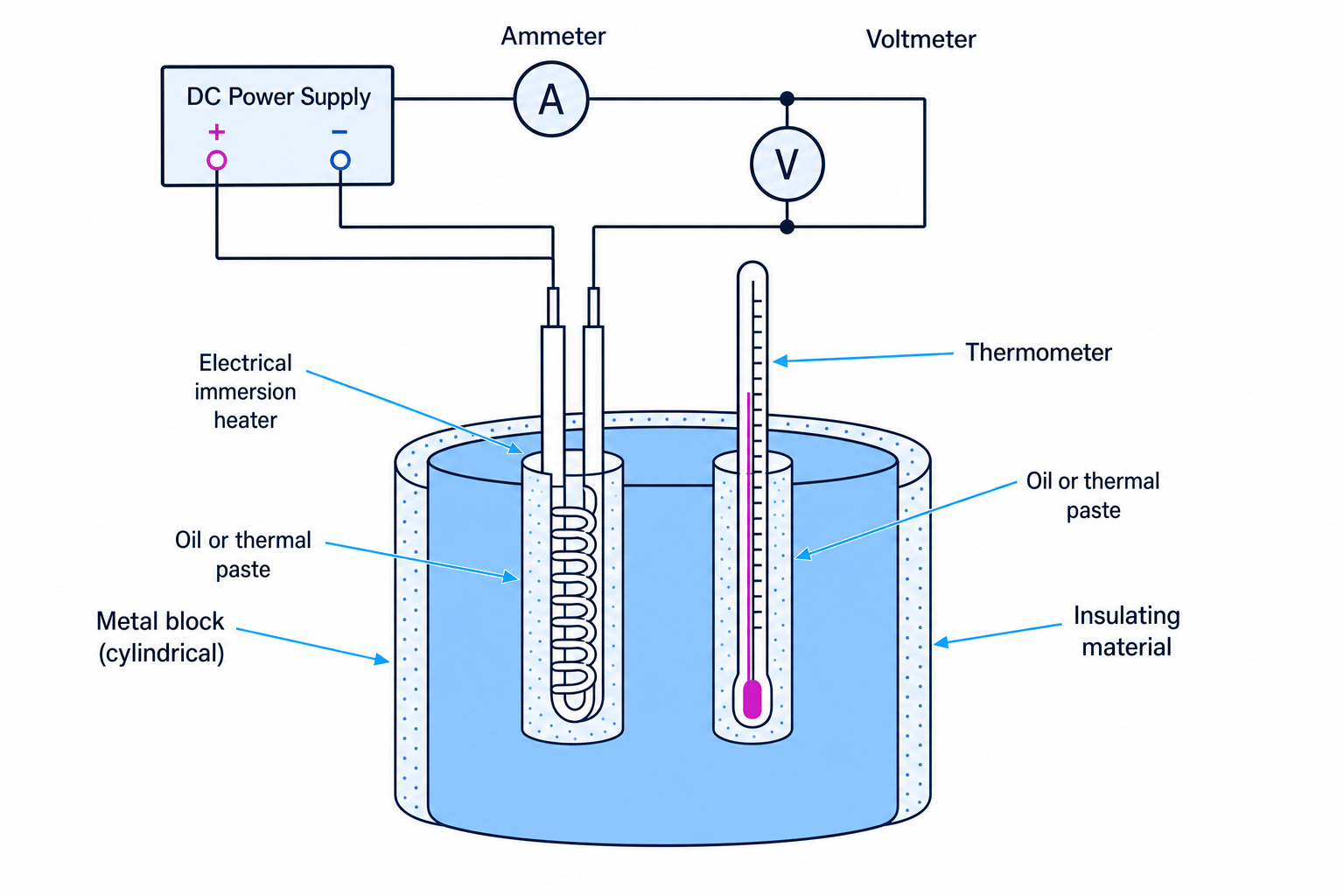
Procedure:
- Measure the mass mmm of the metal block using a balance.
- Wrap the block in a thick layer of insulating material (like bubble wrap or foam) to minimise heat loss to the surroundings.
- Place a few drops of oil or thermal paste into the thermometer hole to ensure excellent thermal contact between the block and the thermometer bulb.
- Insert the electrical immersion heater into the other hole and set up the electrical circuit containing a DC power supply, an ammeter in series, and a voltmeter in parallel across the heater.
- Record the initial temperature θ0\theta_0θ0 of the block.
- Switch on the power supply and start a stopwatch simultaneously.
- Record the current III and voltage VVV. Keep these constant using the variable power supply if necessary.
- After a set time ttt (e.g., 10 minutes), switch off the heater.
- Monitor the thermometer and record the maximum temperature reached θmax\theta_{\text{max}}θmax. This is critical because thermal energy takes time to conduct from the heater to the thermometer. Calculate Δθ=θmax−θ0\Delta\theta = \theta_{\text{max}} - \theta_0Δθ=θmax−θ0.
Calculation and Graph Analysis:
The electrical energy supplied by the heater is given by:
E=VIt E = VIt E=VItAssuming no heat loss to the surroundings:
VIt=mcΔθ ⟹ c=VItmΔθ VIt = mc\Delta\theta \implies c = \frac{VIt}{m\Delta\theta} VIt=mcΔθ⟹c=mΔθVItAlternatively, to improve precision and reduce random error, you can record the temperature at regular intervals (e.g., every 30 seconds) while the heater is running and plot a graph of temperature θ\thetaθ against time ttt.
Graphical analysis of specific heat capacity
During the heating phase, the power delivered is constant: P=VIP = VIP=VI. The rate of heat supply is:
ΔEΔt=mcΔθΔt ⟹ P=mc×(gradient of θ-t graph) \frac{\Delta E}{\Delta t} = mc \frac{\Delta \theta}{\Delta t} \implies P = mc \times (\text{gradient of } \theta \text{-} t \text{ graph}) ΔtΔE=mcΔtΔθ⟹P=mc×(gradient of θ-t graph)Therefore, the specific heat capacity is:
c=Pm×gradient c = \frac{P}{m \times \text{gradient}} c=m×gradientPUsing the gradient of the linear region of the graph reduces the impact of initial non-linear heating and heat losses.
2. Determining the Specific Heat Capacity of a Liquid
The setup for a liquid is highly similar, but the liquid must be held in a container (a calorimeter).
- You must measure the mass of the liquid by weighing the calorimeter empty, and then weighing it containing the liquid.
- The calculation must account for the thermal energy absorbed by the calorimeter vessel itself:
Systematic underestimation of specific heat capacity
In basic school laboratory setups, some heat is inevitably lost to the surroundings despite insulation. This means the actual thermal energy absorbed by the block or liquid is less than the calculated electrical energy (VItVItVIt).
Since cmeasured=VItmΔθc_{\text{measured}} = \frac{VIt}{m\Delta\theta}cmeasured=mΔθVIt, using an inflated value for electrical energy causes the calculated specific heat capacity to be higher than the true literature value.
Specific Latent Heat
When a substance changes state, its temperature remains completely constant. To understand why, we must look at the internal energy of the substance at a particle level.
Internal Energy
The internal energy of a system is the sum of the random distribution of kinetic and potential energies associated with its molecules.
- Temperature is directly proportional to the average kinetic energy of the particles.
- Potential energy is determined by the separation of the particles and the strength of the intermolecular bonds holding them together.
During heating, the kinetic energy of the particles increases, causing the temperature to rise. During a phase change, the supplied thermal energy is used exclusively to do work against the electrostatic forces of attraction, breaking or weakening the intermolecular bonds. Consequently, the potential energy increases while the kinetic energy—and therefore the temperature—remains constant.
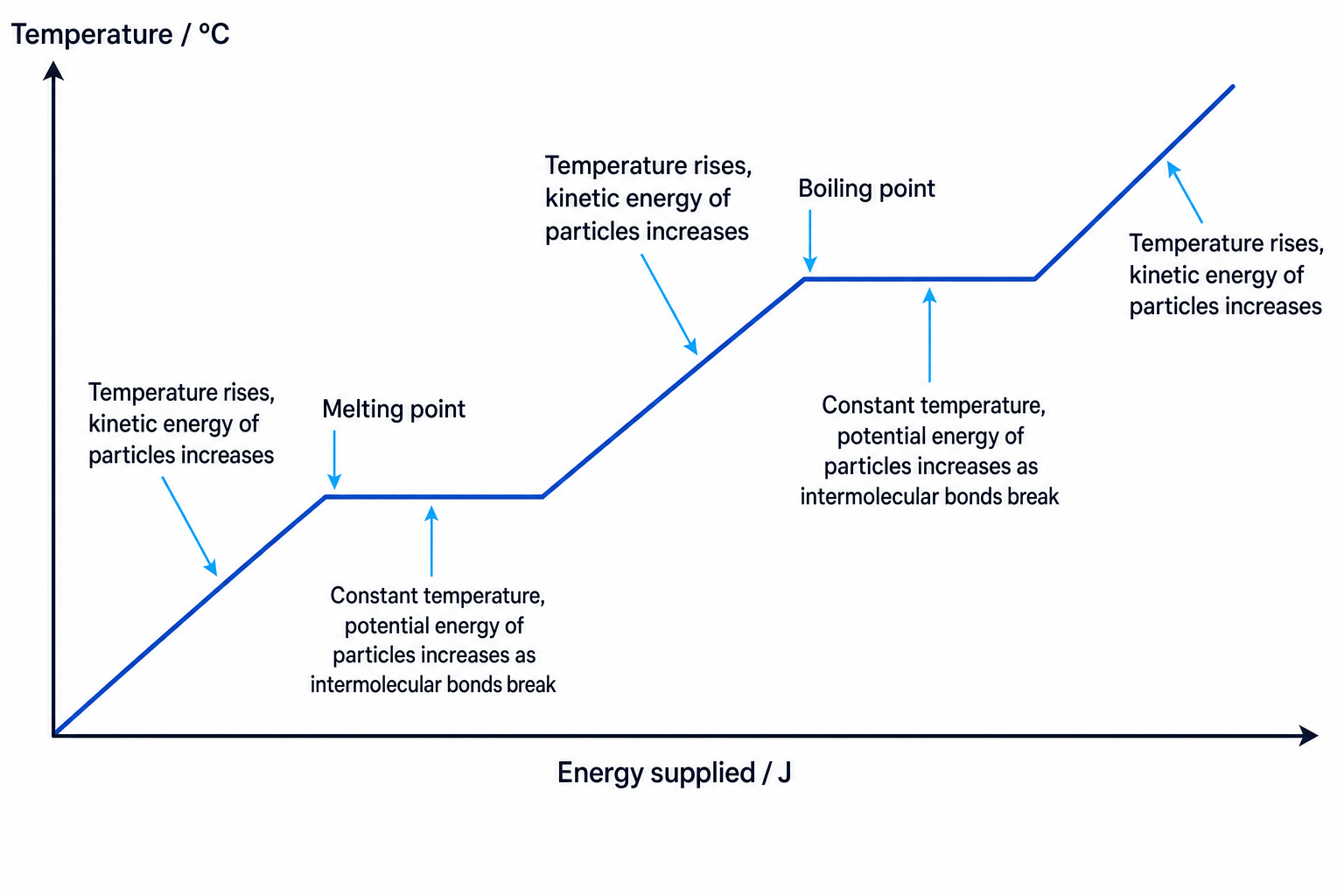
Specific Latent Heat
The specific latent heat LLL of a substance is the energy required per unit mass to change the state of the substance at a constant temperature.
E=mL ⟹ L=Em E = mL \implies L = \frac{E}{m} E=mL⟹L=mE Unit of L:J kg−1 \text{Unit of } L: \text{J kg}^{-1} Unit of L:J kg−1There are two distinct specific latent heats for any substance:
- Specific Latent Heat of Fusion (LfL_fLf): The energy required per unit mass to change a substance from the solid to the liquid state at its melting point.
- Specific Latent Heat of Vaporisation (LvL_vLv): The energy required per unit mass to change a substance from the liquid to the gaseous state at its boiling point.
Comparing L_f and L_v
For any substance, LvL_vLv is significantly larger than LfL_fLf.
- In fusion, energy is only needed to slightly weaken the solid lattice bonds to allow molecules to slide past one another.
- In vaporisation, energy must be supplied to completely break all intermolecular bonds and do work against the external atmosphere as the gas expands.
Experimental Determination of LLL (Electrical Methods)
1. Specific Latent Heat of Fusion (LfL_fLf) for Ice
To find LfL_fLf for water, we measure the energy needed to melt a known mass of ice. However, ice melts at room temperature anyway. To eliminate this systematic error, we must use a control experiment.
Procedure:
- Set up two identical funnels containing crushed ice, each draining into its own beaker on a digital balance.
- Place an electrical immersion heater into the ice of both funnels, but only connect one heater to an active electrical circuit (V,I,tV, I, tV,I,t). The other setup acts as a control to measure how much ice melts purely due to room temperature.
- Turn on the heater in the active setup for a measured time ttt.
- At the end of the time, record the mass of water collected in both beakers: mheatedm_{\text{heated}}mheated and mcontrolm_{\text{control}}mcontrol.
- The mass of ice melted solely by the electrical heater is:
- Calculate LfL_fLf using:
2. Specific Latent Heat of Vaporisation (LvL_vLv) for a Liquid
To determine LvL_vLv, a liquid is heated to its boiling point using an electrical heater. Once boiling, we measure the rate of mass loss due to vaporisation.
To eliminate errors due to heat loss to the surroundings, we can use a clever two-power method.
Procedure:
- Heat a flask of liquid to its boiling point using an immersion heater.
- Adjust the power supply to a low power setting, P1=V1I1P_1 = V_1 I_1P1=V1I1. Once the liquid is boiling steadily, measure the mass of vapour condensed or the mass lost by the flask m1m_1m1 over a set time ttt.
- Change the power supply to a higher power setting, P2=V2I2P_2 = V_2 I_2P2=V2I2. Once boiling steadily again, measure the mass of vapour condensed m2m_2m2 over the same time interval ttt.
- Since the liquid is at its boiling point in both runs, the heat loss rate QlossQ_{\text{loss}}Qloss to the surroundings is identical.
For each run:
P1t=m1Lv+Qloss P_1 t = m_1 L_v + Q_{\text{loss}} P1t=m1Lv+Qloss P2t=m2Lv+Qloss P_2 t = m_2 L_v + Q_{\text{loss}} P2t=m2Lv+QlossBy subtracting the two equations, QlossQ_{\text{loss}}Qloss is eliminated:
(P2−P1)t=(m2−m1)Lv (P_2 - P_1)t = (m_2 - m_1) L_v (P2−P1)t=(m2−m1)Lv Lv=(P2−P1)tm2−m1 L_v = \frac{(P_2 - P_1)t}{m_2 - m_1} Lv=m2−m1(P2−P1)tThis double-run technique is a fantastic example of high-level experimental physics, isolating the variable of interest from systematic environmental errors.
Determining Specific Latent Heat of Vaporisation using the two-power method
In an experiment to determine the specific latent heat of vaporisation of water, a student heats water to its boiling point.
- In the first run, with a power input of P1=50.0 WP_1 = 50.0\text{ W}P1=50.0 W, the mass of water vaporised in 300 s300\text{ s}300 s is 6.10 g6.10\text{ g}6.10 g.
- In the second run, with a power input of P2=80.0 WP_2 = 80.0\text{ W}P2=80.0 W, the mass of water vaporised in 300 s300\text{ s}300 s is 10.10 g10.10\text{ g}10.10 g.
Calculate the specific latent heat of vaporisation LvL_vLv of water.
- Write down the masses in SI units (kg\text{kg}kg):
- Calculate the difference in power input and the difference in mass vaporised:
- Substitute these values into the eliminated-loss formula:
In the exam
- Be rigorous with mass units: Mass is almost always measured in grams (g\text{g}g) in lab experiments, but you must convert it to kilograms (kg\text{kg}kg) to remain consistent with standard SI units in formulas.
- Explain phase changes using potential energy: If asked about what happens to internal energy when ice melts or water boils, specify that the kinetic energy of molecules remains constant (because temperature is constant) and that the potential energy increases because work is being done to break intermolecular bonds.
- Appreciate the control setup: If a question asks why a second non-powered funnel of ice is used when finding LfL_fLf, always state that it measures the mass of ice melted by the surroundings, which must be subtracted from the heated setup to isolate the electrical energy's effect.
Check yourself
- Explain why the specific latent heat of vaporisation of water is much greater than its specific latent heat of fusion.
- A heater of power 45 W45\text{ W}45 W is placed in a 0.50 kg0.50\text{ kg}0.50 kg block of metal. If the temperature rises by 12 ∘C12\text{ }^\circ\text{C}12 ∘C in 5.0 minutes5.0\text{ minutes}5.0 minutes, what is the calculated specific heat capacity of the metal?
- Why does the temperature of a boiling liquid not rise even though thermal energy is continuously being supplied by a burner?
