What you'll learn
- How solids, liquids and gases differ in particle spacing, ordering and motion.
- How the simple kinetic model explains everyday properties of matter.
- Why Brownian motion is evidence for particles in continuous random motion.
- How internal energy changes with temperature and during changes of phase.
The particle idea
Matter is made from tiny particles. In this topic, “particles” means atoms or molecules, depending on the substance.
Atom and molecule
An atom is the smallest unit of an element. A molecule is a group of atoms bonded together. In thermal physics, we often use the word particle to mean either one.
The key A-Level idea is that the large-scale properties you observe — shape, volume, flowing, compressibility, temperature — come from the microscopic arrangement and motion of particles.
Solids, liquids and gases
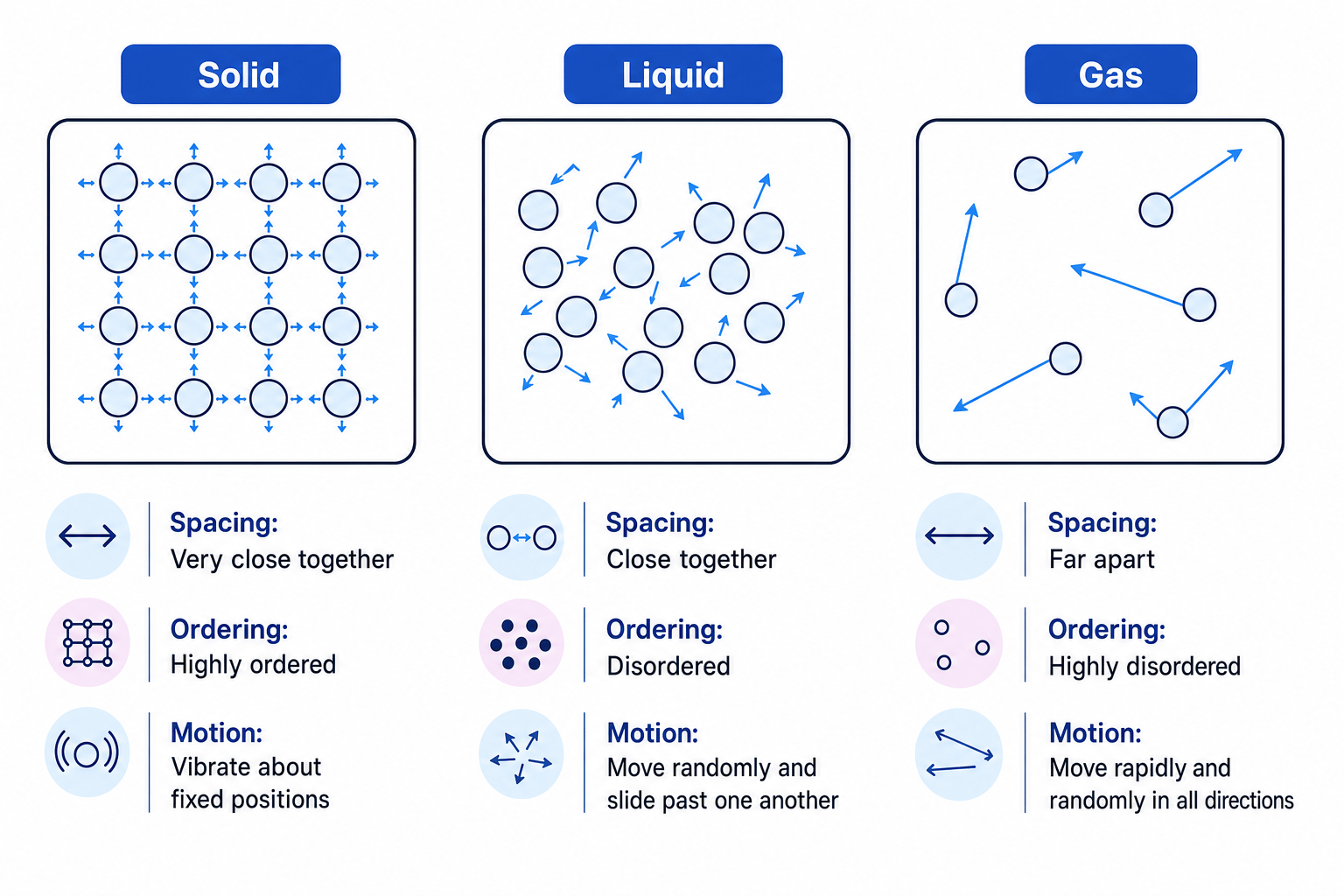
The three states of matter differ in three main ways:
- spacing: how far apart the particles are
- ordering: whether the particles form a regular pattern
- motion: how the particles move
Solids
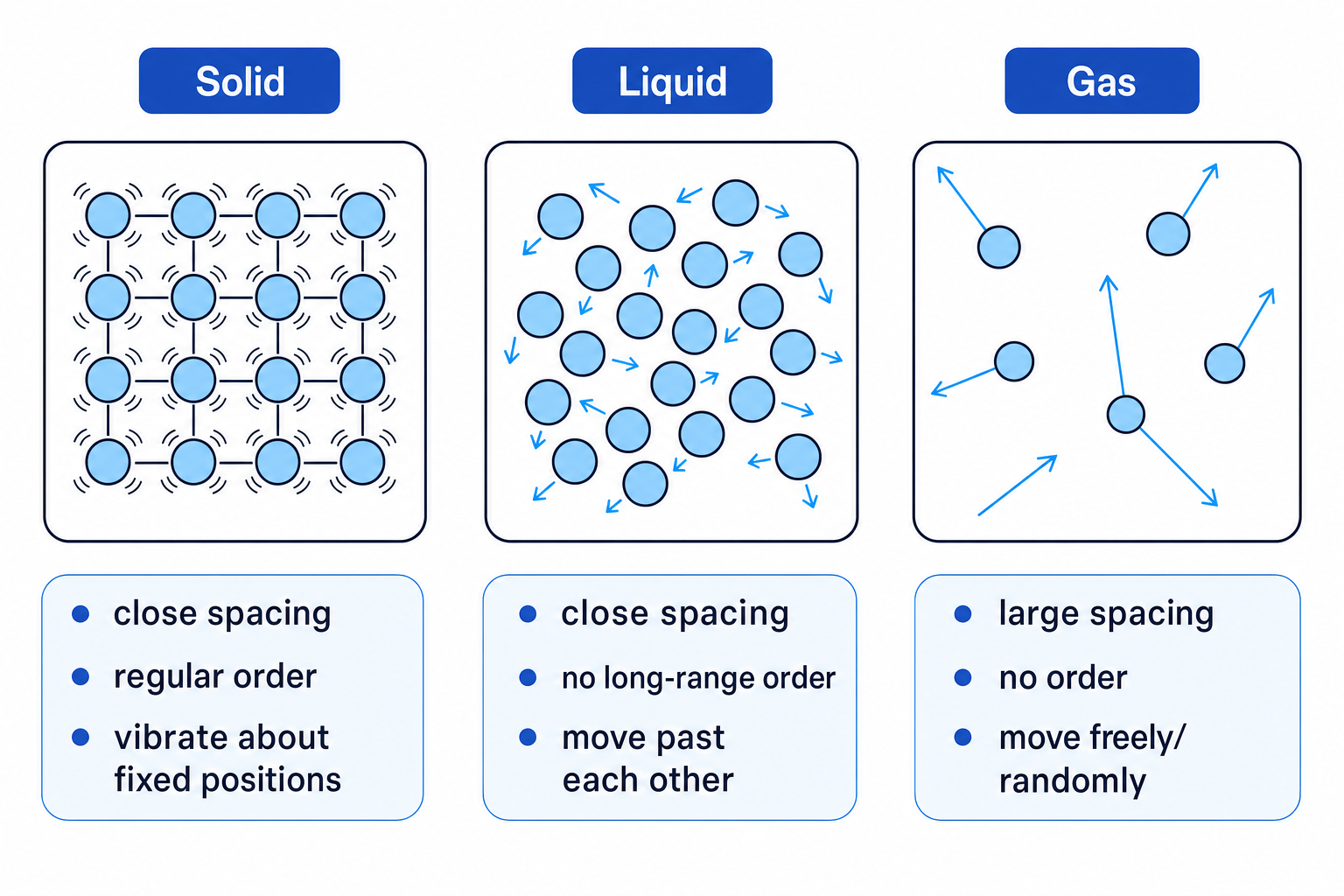
In a solid, particles are very close together and usually arranged in a regular pattern. They cannot move freely from place to place, but they do vibrate about fixed positions.
This explains why solids have a fixed shape and a fixed volume.
Liquids
In a liquid, particles are still close together, but they are not arranged in a long-range regular pattern. They move randomly and can slide past each other.
This explains why liquids have a fixed volume but take the shape of their container.
Gases
In a gas, particles are far apart compared with their own size. They move rapidly and randomly, travelling in straight lines between collisions.
This explains why gases fill their container and are much easier to compress than solids or liquids.
Liquids are not widely spaced
A liquid is not “halfway between a solid and a gas” in terms of spacing. Liquid particles are still close together; the big increase in separation happens when a substance becomes a gas.
Using particle descriptions to identify a state
A substance has particles that are close together, arranged randomly, and able to move past one another. Identify the state.
- Close spacing means it is unlikely to be a gas, because gas particles are far apart.
- Random arrangement means it is not a typical solid lattice, because solids usually have regular order.
- Particles moving past one another is the key behaviour of a liquid, so the substance is a liquid.
The simple kinetic model
Kinetic model of matter
The kinetic model describes matter as a large number of tiny particles in continuous random motion. The particles collide with each other and, in gases, with the walls of their container.
The word kinetic means “to do with motion”. So the kinetic model links particle motion to the observed behaviour of solids, liquids and gases.
How the model explains each state
In a solid, particles are held near fixed positions by forces between neighbouring particles. They vibrate, but do not flow past each other.
In a liquid, particles remain close enough to be attracted to neighbours, but they are not locked into fixed positions. This allows liquids to flow.
In a gas, particles are much further apart. The forces between particles are usually negligible except during collisions, so particles move freely until they collide.
Macroscopic properties come from microscopic motion
The state of a substance depends on how its particles are arranged and how they move. Temperature, flow, compressibility and changes of state all make more sense when you think at particle level.
Brownian motion
Brownian motion is one of the classic pieces of evidence for the kinetic model.
Brownian motion
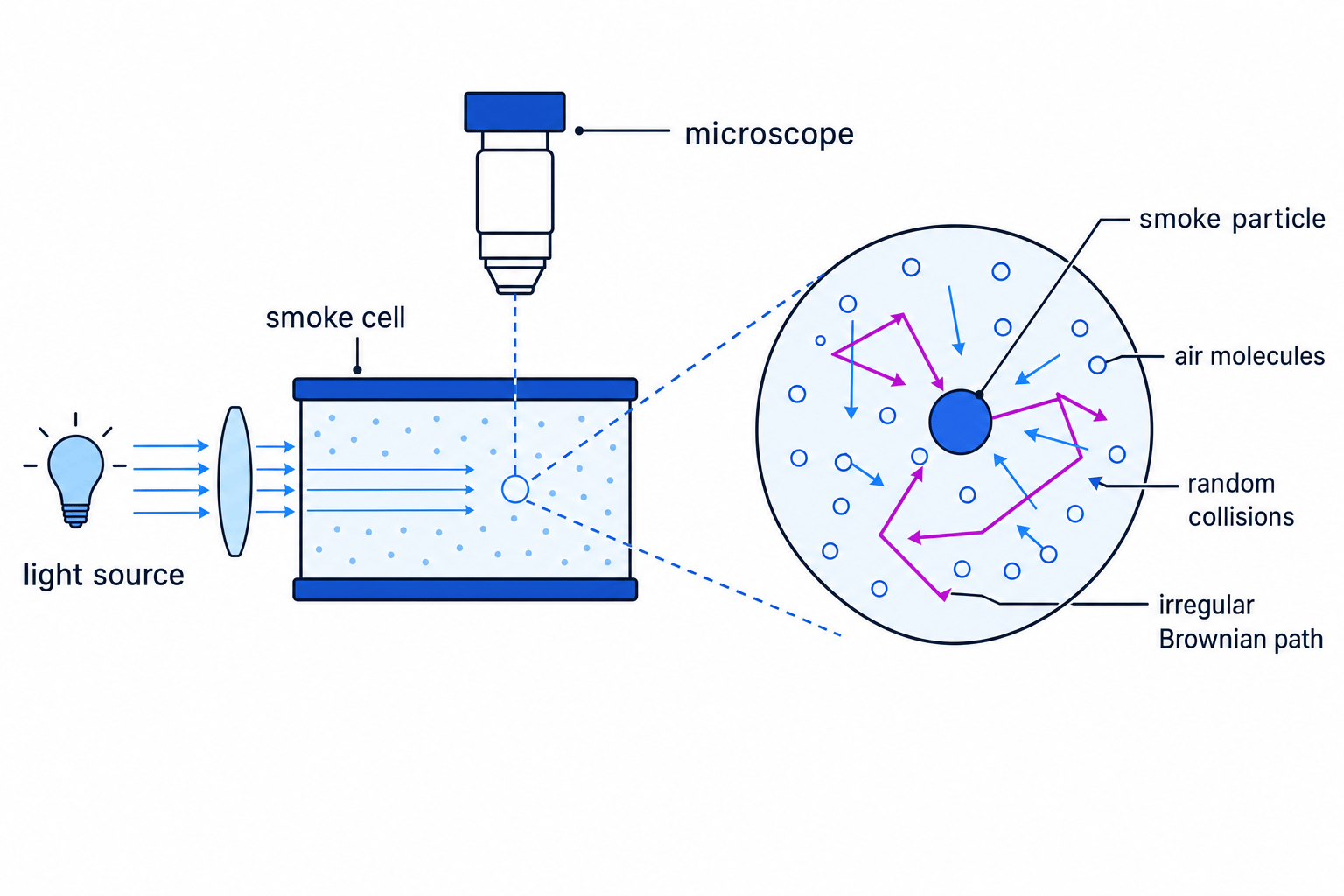
Brownian motion is the random, irregular motion of small visible particles suspended in a fluid, caused by collisions with much smaller, invisible molecules moving randomly.
A standard demonstration uses smoke particles suspended in air. The smoke particles are placed in a smoke cell, illuminated from the side, and viewed through a microscope.
You do not see the air molecules directly. You see tiny smoke particles moving in a jerky, random way because air molecules collide with them from different directions.
Why the smoke particles move randomly
Air molecules are moving rapidly and randomly. They collide with a smoke particle from all sides.
At any instant, the collisions are not perfectly balanced. There may be slightly more collisions from one side than another, so the smoke particle is pushed in a particular direction. A moment later, the imbalance changes, so the direction changes again.
This produces the observed zig-zag path.
Explaining smoke-particle Brownian motion
A student observes bright specks moving randomly in a smoke cell. Explain what this shows.
- The bright specks are smoke particles, which are large enough to scatter light and be seen through the microscope.
- Air molecules are much smaller and cannot be seen directly, but they are moving continuously and randomly.
- Unequal collisions from air molecules give each smoke particle a constantly changing resultant force, so the smoke particles follow irregular paths. This supports the kinetic model of matter.
Do not say the air molecules are being observed
In the smoke-cell demonstration, the visible moving specks are smoke particles, not air molecules. The air molecules are too small to see directly.
Internal energy
Internal energy
The internal energy of a system is the sum of the randomly distributed kinetic energies and potential energies of its molecules.
There are two parts to this definition.
Random kinetic energy
The particles in a substance are always moving randomly. In solids, this mainly means vibrating about fixed positions. In liquids and gases, particles also move from place to place.
The energy due to this random motion is random kinetic energy.
Molecular potential energy
Particles exert forces on one another. The energy associated with their separation and arrangement is molecular potential energy.
This becomes especially important during changes of phase, such as melting and boiling.
Internal energy is microscopic
Internal energy is about the random motion and separation of particles. It is not the same as the kinetic energy of the whole object moving across the room.
Separating internal energy from bulk motion
A sealed bottle of water is carried steadily across a room. Its temperature does not change. Explain what happens to its internal energy.
- The bottle has kinetic energy as a whole because it is moving across the room.
- Internal energy only includes random microscopic kinetic energy and molecular potential energy, not the organised motion of the whole bottle.
- Since the temperature and state of the water are unchanged, its internal energy is unchanged.
Temperature and absolute zero
Temperature is linked to the average random kinetic energy of the particles in a substance. A higher temperature means the particles have greater random kinetic energy on average.
In A-Level Physics, temperature should usually be measured in kelvin, symbol K.
Absolute zero
Absolute zero, 0 K, is the lowest possible temperature. It is the temperature at which a substance has minimum internal energy.
The Kelvin scale starts at absolute zero. A temperature of 0 K is equal to about minus 273 degrees Celsius.
Minimum does not mean ordinary zero
At 0 K, a substance has minimum internal energy. Do not simply write “all energy is zero” unless the question specifically guides you there.
Converting Celsius temperature to kelvin
A metal sample is heated from 20.0 degrees Celsius to 75.0 degrees Celsius. Convert both temperatures to kelvin and find the temperature change.
- Use T=θ+273.15T = \theta + 273.15T=θ+273.15, where TTT is temperature in kelvin and θ\thetaθ is temperature in degrees Celsius:
Ti=20.0+273.15=293.15 KT_i = 20.0 + 273.15 = 293.15\ \text{K}Ti=20.0+273.15=293.15 K. - Convert the final temperature in the same way:
Tf=75.0+273.15=348.15 KT_f = 75.0 + 273.15 = 348.15\ \text{K}Tf=75.0+273.15=348.15 K. - Find the change:
ΔT=348.15 K−293.15 K=55.0 K\Delta T = 348.15\ \text{K} - 293.15\ \text{K} = 55.0\ \text{K}ΔT=348.15 K−293.15 K=55.0 K. The size of a temperature change is the same in kelvin as in degrees Celsius.
Heating a substance: temperature rises
When a body is heated and its temperature rises, its internal energy increases.
For a substance staying in the same state, the main change is that the particles have greater random kinetic energy:
- in a solid, particles vibrate more vigorously
- in a liquid, particles move around more rapidly
- in a gas, particles move faster between collisions
Temperature is not total internal energy
Temperature is linked to average random kinetic energy per particle. Internal energy is a total energy, so it also depends on how much substance is present and on molecular potential energy.
Changes of phase
A change of phase is a change of state, such as:
- melting: solid to liquid
- freezing: liquid to solid
- boiling or evaporating: liquid to gas
- condensing: gas to liquid
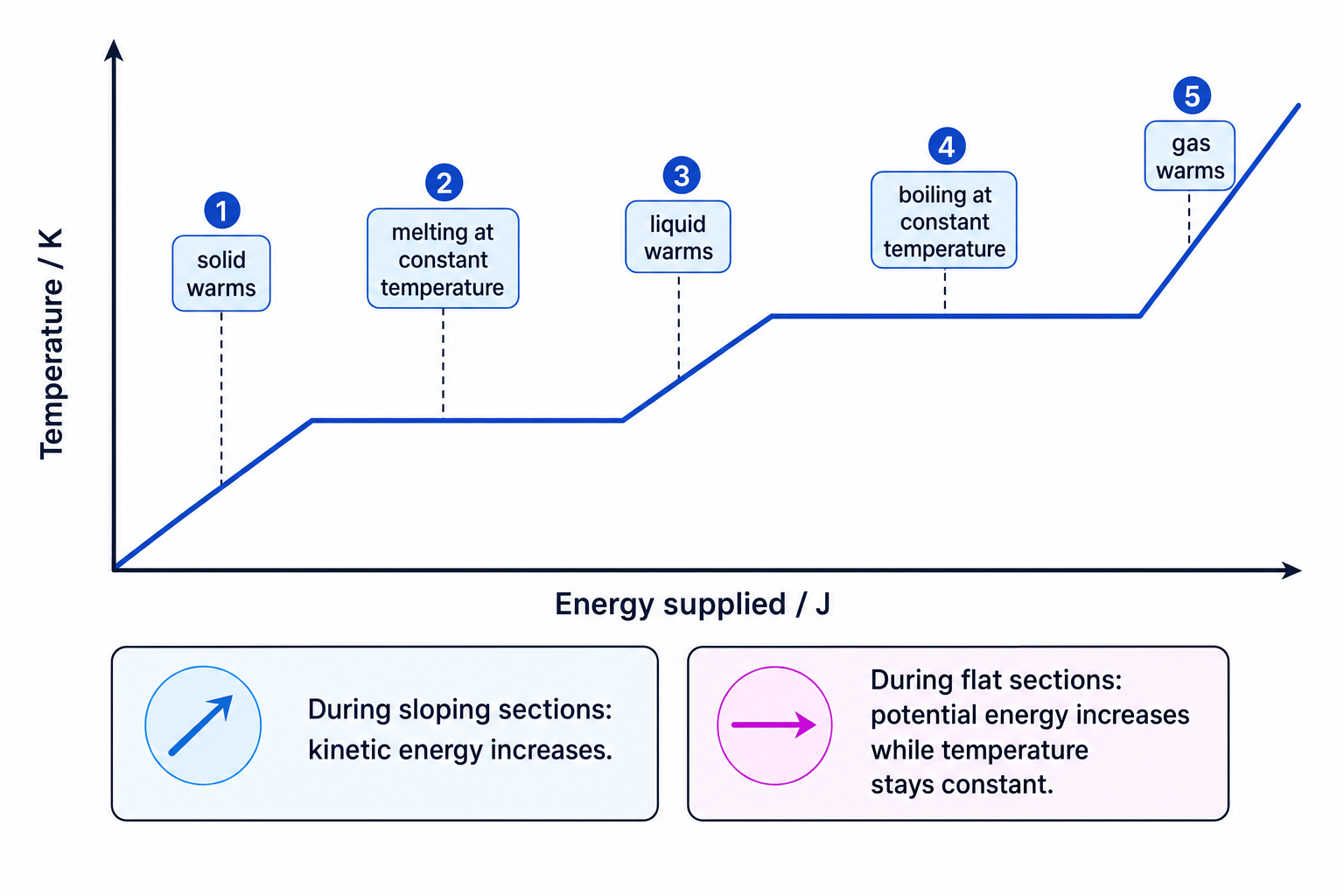
During a change of phase of a pure substance, the temperature remains constant even though energy is being supplied or removed.
What happens to internal energy during melting or boiling?
During melting or boiling, energy is supplied. The temperature stays constant, so the average random kinetic energy of the particles does not increase.
Instead, the internal energy increases because the molecular potential energy increases. The particles are being rearranged or separated against attractive forces.
For boiling, the separation between molecules increases greatly as a liquid becomes a gas.
What happens during freezing or condensing?
During freezing or condensing, energy is removed from the substance. The temperature remains constant during the phase change.
The internal energy decreases because the molecular potential energy decreases as particles become closer together or more ordered.
Flat sections still mean energy transfer
On a heating curve, a flat section does not mean “nothing is happening”. It means temperature is constant while internal energy changes through molecular potential energy.
Interpreting a heating curve plateau
A pure liquid is heated at a steady rate. Its temperature remains constant while it boils. Explain what is happening to its internal energy.
- Constant temperature means the average random kinetic energy of the molecules is not increasing.
- Energy is still being supplied, so the internal energy of the substance must be increasing.
- During boiling, the supplied energy increases molecular potential energy as molecules become much further apart in the gas phase.
In the exam
- When describing states, always mention spacing, ordering and motion of particles.
- For Brownian motion, state that visible smoke particles move randomly because of collisions with invisible, randomly moving air molecules.
- For phase changes, separate the ideas clearly: temperature constant means average kinetic energy constant, but internal energy can still change through molecular potential energy.
Check yourself
- Why are gases much more compressible than liquids?
- In the smoke-cell demonstration, what exactly is visible through the microscope?
- During boiling, why can internal energy increase while temperature stays constant?