What you'll learn
- How amount of substance in moles links to the number of particles.
- How the kinetic theory model explains gas pressure using Newton’s laws.
- How to use pV=nRTpV = nRTpV=nRT, pV=NkTpV = NkTpV=NkT, and pV=13Nmc2‾pV = \frac{1}{3}Nm\overline{c^2}pV=31Nmc2.
- How temperature connects to molecular kinetic energy and the internal energy of an ideal gas.
Starting point: what is an ideal gas?
A gas is made from a huge number of particles — atoms or molecules — moving around randomly. In this topic, you model those particles using a simplified picture called kinetic theory.
An ideal gas is not a perfectly real gas. It is a model that works very well when a gas is at low density, not too close to liquefying, and the particles are far apart compared with their own size.
Ideal gas
An ideal gas is a gas that obeys the equation of state pV=nRTpV = nRTpV=nRT and fits the kinetic theory assumptions closely.
Amount of substance: moles and particles
In A-Level Physics, you often need to move between a macroscopic amount of gas, measured in moles, and a microscopic number of particles.
Mole and Avogadro constant
One mole of any substance contains NA=6.02×10²³ mol−1N_A = 6.02 \times 10^{23}\ \text{mol}^{-1}NA=6.02×10²³ mol−1 particles. The number of particles is
N=nNAN = nN_AN=nNAwhere NNN is the number of particles and nnn is the amount of substance in moles.
For a gas, the “particles” might be single atoms, such as helium atoms, or molecules, such as nitrogen molecules.
Converting moles to particles
A sample contains 0.250 mol of helium. Find the number of helium atoms.
-
Use the relationship between amount of substance and particle number:
N=nNAN = nN_AN=nNA -
Substitute the values, keeping the mole units visible:
N=(0.250 mol)(6.02×10²³ mol−1)N = (0.250\ \text{mol})(6.02 \times 10^{23}\ \text{mol}^{-1})N=(0.250 mol)(6.02×10²³ mol−1) -
The mole units cancel, giving
N=1.505×10²³≈1.51×10²³ atomsN = 1.505 \times 10^{23} \approx 1.51 \times 10^{23}\ \text{atoms}N=1.505×10²³≈1.51×10²³ atoms
The kinetic theory model of gases
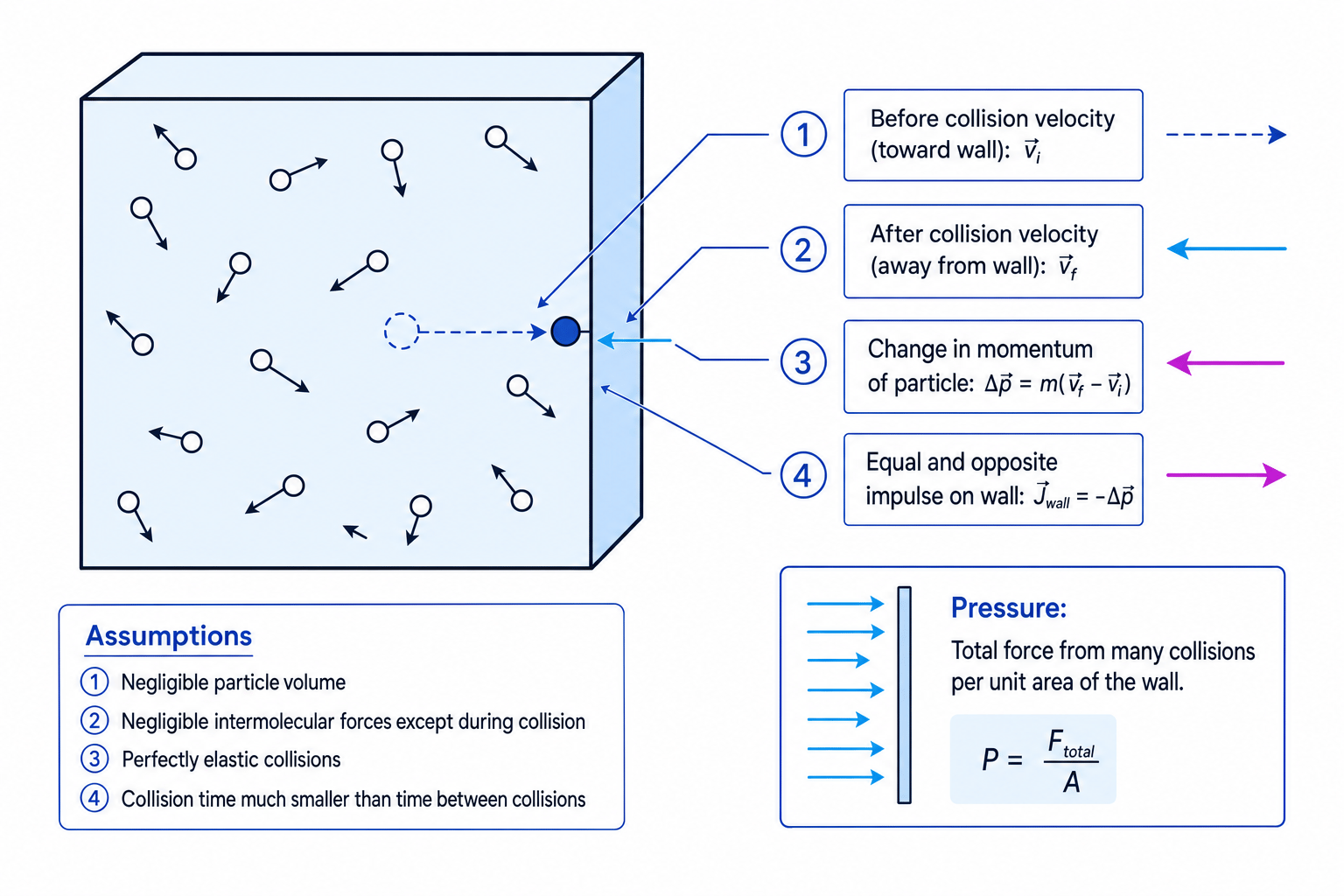
Kinetic theory explains gas behaviour using moving particles and Newtonian mechanics.
The model assumes:
- there is a large number of particles in random, rapid motion
- the particles occupy negligible volume compared with the volume of the gas
- collisions are perfectly elastic, so kinetic energy is conserved in collisions
- the time taken for a collision is negligible compared with the time between collisions
- there are negligible forces between particles except during collisions
This model is powerful because it connects things you can measure, such as pressure and temperature, to the motion of particles you cannot see directly.
Pressure comes from collisions
Gas pressure is caused by particles repeatedly colliding with the container walls and transferring momentum to them.
Explaining pressure using Newton’s laws
When a gas particle hits a wall, its velocity component perpendicular to the wall changes direction. That means its momentum changes.
By Newton’s second law, a change in momentum over time means a force has acted. By Newton’s third law, the wall exerts a force on the particle and the particle exerts an equal and opposite force on the wall.
For many particles, there are huge numbers of collisions every second. The total force from these collisions spread over the wall area gives the pressure:
p=FAp = \frac{F}{A}p=AFExplaining why compression increases pressure
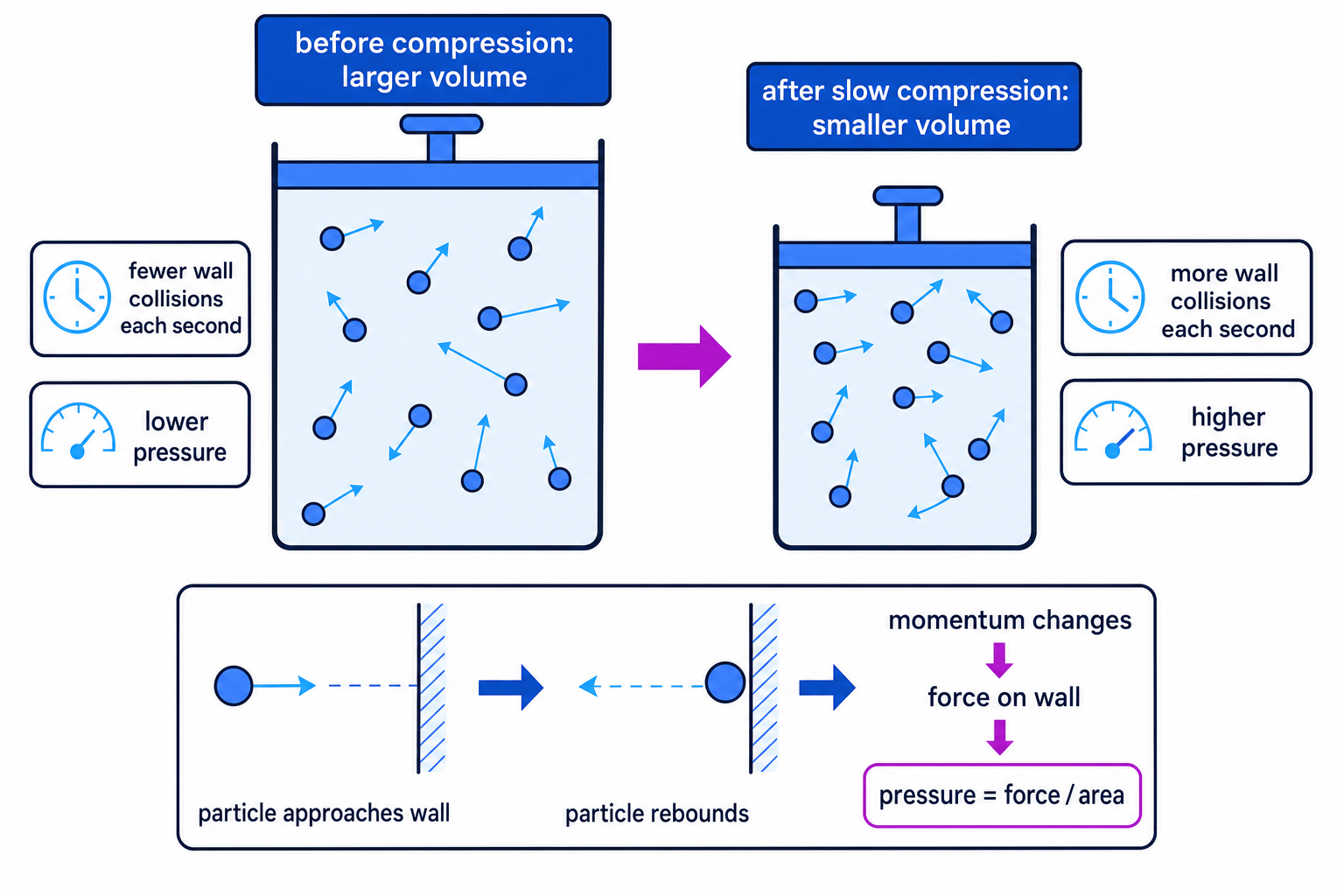
A fixed amount of gas is compressed slowly at constant temperature. Explain why the pressure increases.
-
At constant temperature, the average kinetic energy of the gas particles stays the same, so their typical speeds do not increase.
-
Reducing the volume means the particles have less distance to travel before hitting a wall, so collisions with the walls happen more frequently.
-
More frequent collisions mean a greater rate of momentum transfer to the walls, so the average force on the walls increases.
-
Since p=FAp = \frac{F}{A}p=AF, a larger force per unit area means the pressure increases.
The equation of state: pV=nRTpV = nRTpV=nRT
For an ideal gas:
pV=nRTpV = nRTpV=nRTwhere:
- ppp is pressure in pascals, Pa
- VVV is volume in cubic metres, m³
- nnn is amount of substance in moles, mol
- TTT is thermodynamic temperature in kelvin, K
- RRR is the molar gas constant, R=8.31 J mol−1K−1R = 8.31\ \text{J mol}^{-1}\text{K}^{-1}R=8.31 J mol−1K−1
Kelvin temperatures
Gas equations require temperature in kelvin. Convert using: temperature in K = temperature in °C + 273.15.
Using degrees Celsius in
Never substitute a temperature in degrees Celsius into pV=nRTpV = nRTpV=nRT or pV=NkTpV = NkTpV=NkT. A temperature of 0 °C is not zero thermal energy; it is 273.15 K.
Using the ideal gas equation
A gas sample contains 0.0400 mol and occupies 2.50×10⁻³ m32.50 \times 10^{-3}\ \text{m}^32.50×10⁻³ m3 at 300 K. Find its pressure.
-
Choose the ideal gas equation because nnn, VVV, and TTT are given:
pV=nRTpV = nRTpV=nRT -
Rearrange for pressure:
p=nRTVp = \frac{nRT}{V}p=VnRT -
Substitute values with units:
p=(0.0400 mol)(8.31 J mol−1K−1)(300 K)2.50×10⁻³ m3p = \frac{(0.0400\ \text{mol})(8.31\ \text{J mol}^{-1}\text{K}^{-1})(300\ \text{K})}{2.50 \times 10^{-3}\ \text{m}^3}p=2.50×10⁻³ m3(0.0400 mol)(8.31 J mol−1K−1)(300 K) -
Calculate:
p=3.99×10⁴ Pap = 3.99 \times 10^{4}\ \text{Pa}p=3.99×10⁴ Pa
Gas-law investigations
For a fixed amount of gas, nnn is constant, so the ideal gas equation can be rearranged as:
pVT=constant\frac{pV}{T} = \text{constant}TpV=constantThis gives two important experimental relationships.
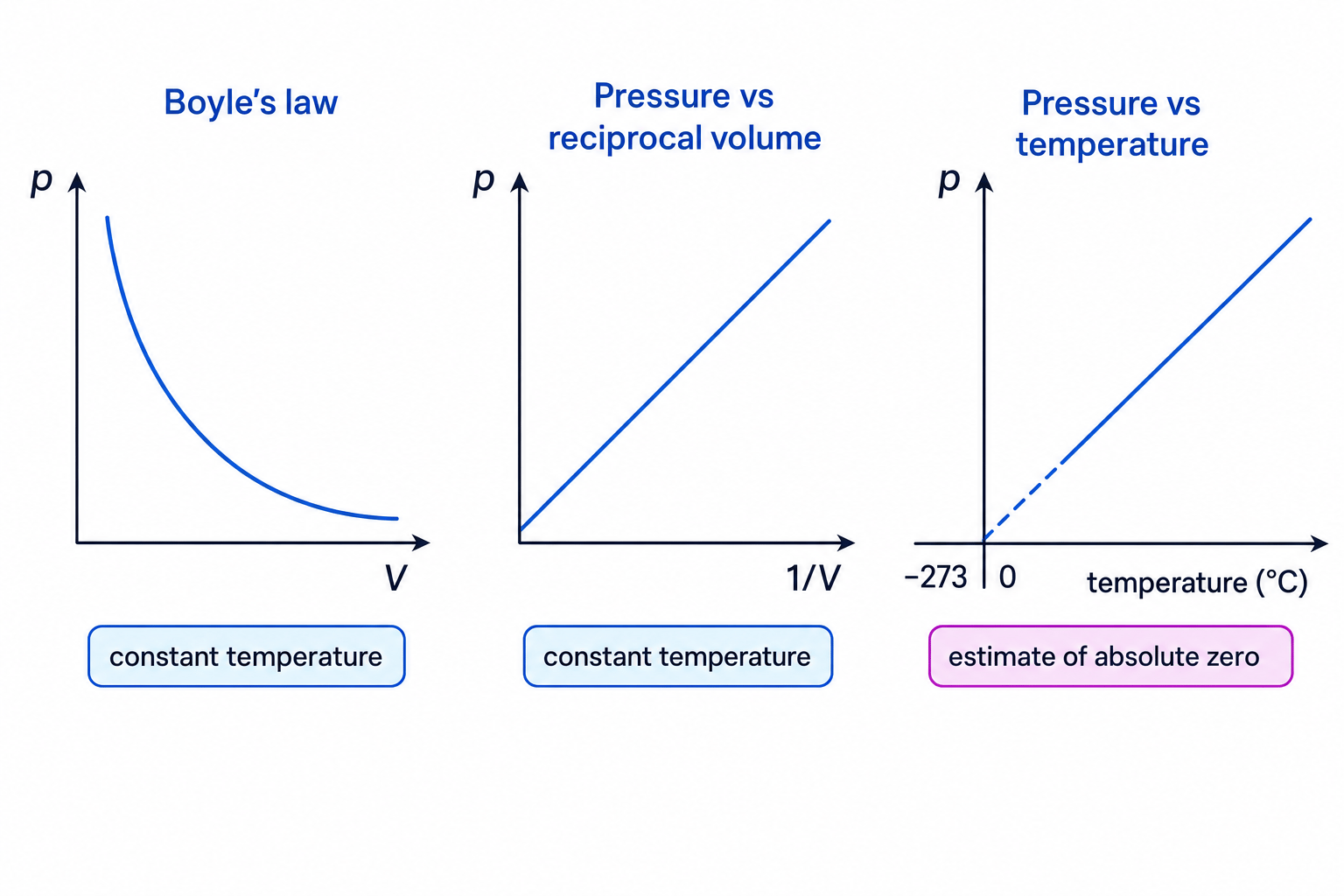
Boyle’s law: pV=constantpV = \text{constant}pV=constant
If temperature is constant, then:
pV=constantpV = \text{constant}pV=constantSo pressure is inversely proportional to volume:
p∝1Vp \propto \frac{1}{V}p∝V1In a practical investigation, you might trap air in a sealed syringe or Boyle’s law apparatus. You change the volume, measure the pressure, and keep the temperature constant by making changes slowly and allowing the gas to return to room temperature.
A graph of ppp against VVV is a curve, but a graph of ppp against 1V\frac{1}{V}V1 should be a straight line through the origin.
Pressure law: pT=constant\frac{p}{T} = \text{constant}Tp=constant
If volume is constant, then:
pT=constant\frac{p}{T} = \text{constant}Tp=constantSo pressure is directly proportional to kelvin temperature:
p∝Tp \propto Tp∝TIn a practical setup, a fixed volume of gas can be heated in a water bath while a pressure sensor records the pressure. If you plot pressure against temperature in degrees Celsius, the straight line can be extrapolated back to where pressure would be zero. This gives an estimate of absolute zero.
Absolute zero
Absolute zero is 0 K, equal to approximately -273.15 °C. It is the temperature at which an ideal gas would extrapolate to zero pressure at constant volume.
Estimating absolute zero
At constant volume, a gas has pressure 101 kPa at 0 °C and 138 kPa at 100 °C. Estimate absolute zero from these data.
-
Find the gradient of the pressure-temperature graph:
gradient=138 kPa−101 kPa100 ∘C−0 ∘C=0.370 kPa ∘C−1\text{gradient} = \frac{138\ \text{kPa} - 101\ \text{kPa}}{100\ ^\circ\text{C} - 0\ ^\circ\text{C}} = 0.370\ \text{kPa}\ ^\circ\text{C}^{-1}gradient=100 ∘C−0 ∘C138 kPa−101 kPa=0.370 kPa ∘C−1 -
At 0 °C, the pressure is 101 kPa, so the straight-line model is:
p=(0.370 kPa ∘C−1)θ+101 kPap = (0.370\ \text{kPa}\ ^\circ\text{C}^{-1})\theta + 101\ \text{kPa}p=(0.370 kPa ∘C−1)θ+101 kPa -
Set p=0p = 0p=0 and solve for the Celsius temperature θ\thetaθ:
θ=−101 kPa0.370 kPa ∘C−1=−273 ∘C\theta = -\frac{101\ \text{kPa}}{0.370\ \text{kPa}\ ^\circ\text{C}^{-1}} = -273\ ^\circ\text{C}θ=−0.370 kPa ∘C−1101 kPa=−273 ∘C
Extrapolation, not direct measurement
A real gas may liquefy before reaching very low temperatures, so the absolute-zero experiment estimates by extrapolating the straight-line trend.
Kinetic theory equation for pressure
The OCR equation linking pressure to molecular motion is:
pV=13Nmc2‾pV = \frac{1}{3}Nm\overline{c^2}pV=31Nmc2where:
- NNN is the number of particles
- mmm is the mass of one particle in kilograms, kg
- c2‾\overline{c^2}c2 is the mean square speed, in m² s⁻²
You do not need to derive this equation, but you do need to know how to use it and what it means physically.
Mean square speed and r.m.s. speed
The mean square speed is the average value of the squared speeds of the particles. The root mean square speed is
crms=c2‾c_\text{rms} = \sqrt{\overline{c^2}}crms=c2Squaring the mean speed
c2‾\overline{c^2}c2 is not the same as the mean speed squared. You square each particle’s speed first, then take the average.
Finding root mean square speed
A box contains 5.00×10225.00 \times 10^{22}5.00×10²² helium atoms. Each atom has mass 6.64×10⁻²⁷ kg6.64 \times 10^{-27}\ \text{kg}6.64×10⁻²⁷ kg. The gas pressure is 1.01×10⁵ Pa1.01 \times 10^{5}\ \text{Pa}1.01×10⁵ Pa and the volume is 2.00×10⁻³ m32.00 \times 10^{-3}\ \text{m}^32.00×10⁻³ m3. Find crmsc_\text{rms}crms.
-
Rearrange the kinetic theory equation:
pV=13Nmc2‾⇒c2‾=3pVNmpV = \frac{1}{3}Nm\overline{c^2} \Rightarrow \overline{c^2} = \frac{3pV}{Nm}pV=31Nmc2⇒c2=Nm3pV -
Substitute the values:
c2‾=3(1.01×10⁵ Pa)(2.00×10⁻³ m3)(5.00×10²²)(6.64×10⁻²⁷ kg)=1.83×10⁶ m2s−2\overline{c^2} = \frac{3(1.01 \times 10^{5}\ \text{Pa})(2.00 \times 10^{-3}\ \text{m}^3)} {(5.00 \times 10^{22})(6.64 \times 10^{-27}\ \text{kg})} = 1.83 \times 10^{6}\ \text{m}^2\text{s}^{-2}c2=(5.00×10²²)(6.64×10⁻²⁷ kg)3(1.01×10⁵ Pa)(2.00×10⁻³ m3)=1.83×10⁶ m2s−2 -
Take the square root:
crms=1.83×10⁶ m2s−2=1.35×10³ m s−1c_\text{rms} = \sqrt{1.83 \times 10^{6}\ \text{m}^2\text{s}^{-2}} = 1.35 \times 10^{3}\ \text{m s}^{-1}crms=1.83×10⁶ m2s−2=1.35×10³ m s−1
Maxwell-Boltzmann distribution
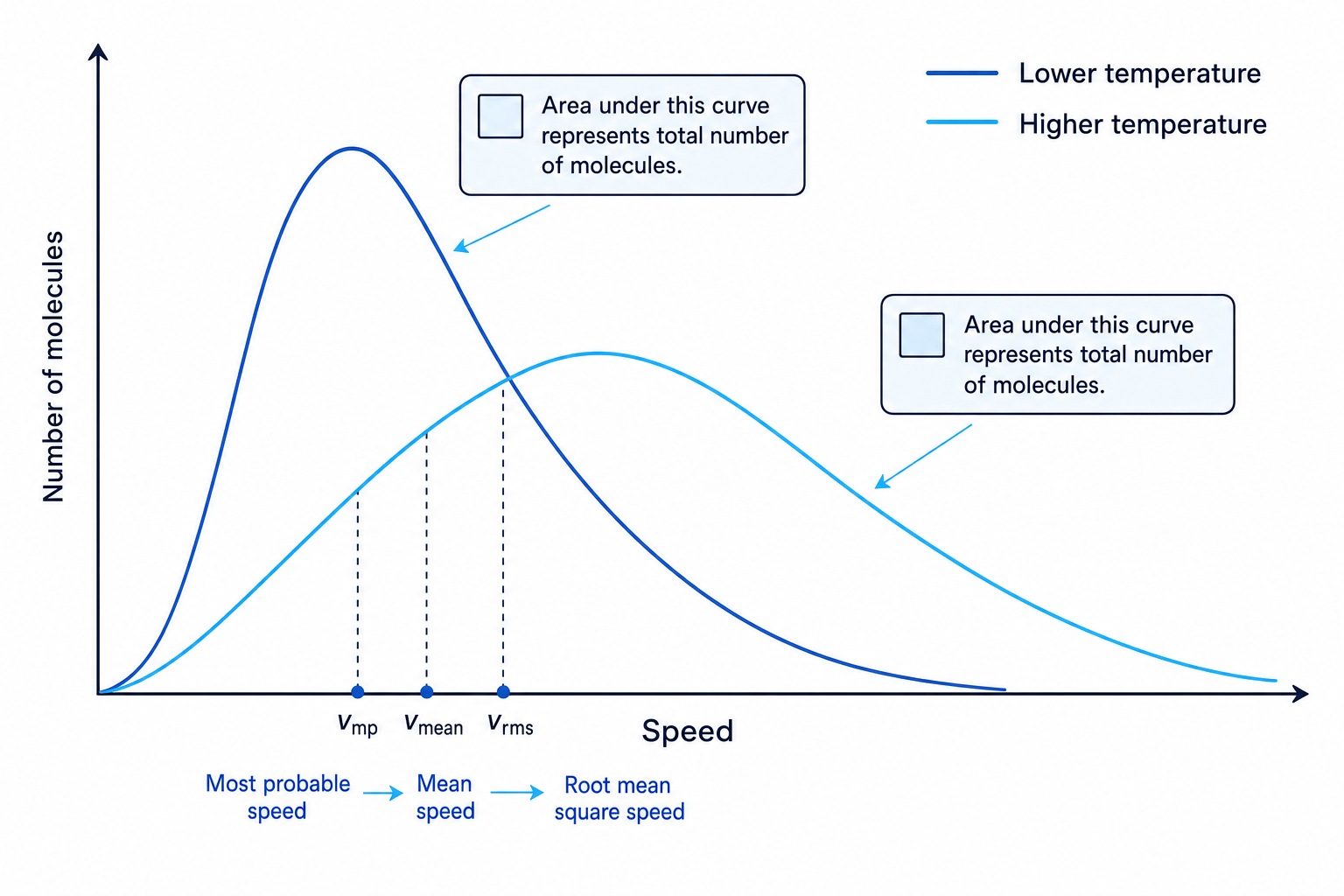
In a gas, particles do not all travel at the same speed. Random collisions produce a spread of speeds called a Maxwell-Boltzmann distribution.
The curve starts near zero at zero speed, rises to a peak, then has a long tail at high speeds. Increasing temperature makes the distribution broader and shifts it towards higher speeds. The area under the curve represents the total number of particles, so for the same amount of gas the area stays the same.
Temperature changes the distribution
At a higher temperature, more particles have high speeds, the peak is lower and further to the right, and crmsc_\text{rms}crms increases.
Boltzmann constant and the particle form of the gas equation
The Boltzmann constant connects temperature to energy per particle.
Boltzmann constant
The Boltzmann constant is
k=RNAk = \frac{R}{N_A}k=NARwith value k=1.38×10⁻²³ J K−1k = 1.38 \times 10^{-23}\ \text{J K}^{-1}k=1.38×10⁻²³ J K−1.
Since n=NNAn = \frac{N}{N_A}n=NAN and k=RNAk = \frac{R}{N_A}k=NAR, the ideal gas equation can be written as:
pV=NkTpV = NkTpV=NkTThis version is useful when you are working with individual particles rather than moles.
Finding the number of gas particles
A gas at pressure 1.20×10⁵ Pa1.20 \times 10^{5}\ \text{Pa}1.20×10⁵ Pa fills a volume of 3.00×10⁻³ m33.00 \times 10^{-3}\ \text{m}^33.00×10⁻³ m3 at 290 K. Find the number of particles.
-
Use the particle form because the question asks for NNN:
pV=NkTpV = NkTpV=NkT -
Rearrange and substitute:
N=pVkT=(1.20×10⁵ Pa)(3.00×10⁻³ m3)(1.38×10⁻²³ J K−1)(290 K)N = \frac{pV}{kT} = \frac{(1.20 \times 10^{5}\ \text{Pa})(3.00 \times 10^{-3}\ \text{m}^3)} {(1.38 \times 10^{-23}\ \text{J K}^{-1})(290\ \text{K})}N=kTpV=(1.38×10⁻²³ J K−1)(290 K)(1.20×10⁵ Pa)(3.00×10⁻³ m3) -
Calculate, noting that Pa m3\text{Pa m}^3Pa m3 is equivalent to joules:
N=8.99×10²² particlesN = 8.99 \times 10^{22}\ \text{particles}N=8.99×10²² particles
Mean kinetic energy of a gas particle
You must know how to derive the key energy result by combining:
pV=13Nmc2‾pV = \frac{1}{3}Nm\overline{c^2}pV=31Nmc2and
pV=NkTpV = NkTpV=NkTDeriving mean kinetic energy
-
Set the two expressions for pVpVpV equal to each other:
13Nmc2‾=NkT\frac{1}{3}Nm\overline{c^2} = NkT31Nmc2=NkT -
Cancel NNN from both sides:
13mc2‾=kT\frac{1}{3}m\overline{c^2} = kT31mc2=kT -
Multiply both sides by 32\frac{3}{2}23:
12mc2‾=32kT\frac{1}{2}m\overline{c^2} = \frac{3}{2}kT21mc2=23kT -
Recognise the left-hand side as the mean translational kinetic energy of one particle:
Ek=32kTE_k = \frac{3}{2}kTEk=23kT
Temperature measures average kinetic energy
For an ideal gas, the mean translational kinetic energy of a particle depends only on the absolute temperature, not on the type of gas.
Internal energy of an ideal gas
The internal energy of a system is the total energy stored microscopically in its particles. In general, this includes random kinetic energy and potential energy.
For the ideal gas model, intermolecular forces are negligible except during collisions, so there is no stored intermolecular potential energy. The internal energy is therefore the total random kinetic energy of the particles.
For a monatomic ideal gas:
U=32NkT=32nRTU = \frac{3}{2}NkT = \frac{3}{2}nRTU=23NkT=23nRTCalculating internal energy
A sample of helium contains 0.500 mol at 300 K. Estimate its internal energy.
-
Helium is monatomic, so use the ideal-gas internal energy equation:
U=32nRTU = \frac{3}{2}nRTU=23nRT -
Substitute the values:
U=32(0.500 mol)(8.31 J mol−1K−1)(300 K)U = \frac{3}{2}(0.500\ \text{mol})(8.31\ \text{J mol}^{-1}\text{K}^{-1})(300\ \text{K})U=23(0.500 mol)(8.31 J mol−1K−1)(300 K) -
Calculate:
U=1.87×10³ JU = 1.87 \times 10^{3}\ \text{J}U=1.87×10³ J
In the exam
- Check whether the question gives moles or particles: use pV=nRTpV = nRTpV=nRT for moles and pV=NkTpV = NkTpV=NkT for particles.
- Always convert temperature to kelvin before substituting into gas equations.
- For explanation questions, link particle collisions to momentum change, rate of momentum transfer, force, then pressure.
- For experiments, state what is kept constant: constant temperature for Boyle’s law, constant volume for p∝Tp \propto Tp∝T.
- Quote graph conclusions carefully: ppp against 1V\frac{1}{V}V1 is linear for Boyle’s law; ppp against Celsius temperature can be extrapolated to estimate absolute zero.
Check yourself
- Why does compressing a gas at constant temperature increase its pressure?
- What is the difference between mean square speed and root mean square speed?
- How do you derive 12mc2‾=32kT\frac{1}{2}m\overline{c^2} = \frac{3}{2}kT21mc2=23kT from the two pressure equations?