

What you'll learn
- How the photon model describes electromagnetic radiation as particle-like packets.
- How to calculate photon energy using E=hfE = hfE=hf and E=hcλE = \frac{hc}{\lambda}E=λhc.
- What the electronvolt means and how to convert it to joules.
- How LEDs can be used to estimate the Planck constant hhh.
Starting point: electromagnetic radiation as waves
Electromagnetic radiation is energy carried by oscillating electric and magnetic fields. It includes radio waves, microwaves, infrared, visible light, ultraviolet, X-rays and gamma rays.
From the waves topic, you already know that a wave can be described using:
- frequency fff: how many wave cycles pass a point per second, measured in hertz (Hz)
- wavelength λ\lambdaλ: the distance between matching points on neighbouring waves, measured in metres (m)
- wave speed ccc: for electromagnetic radiation in a vacuum, c=3.00×10⁸ m s−1c = 3.00 \times 10^8\ \text{m s}^{-1}c=3.00×10⁸ m s−1
These are linked by:
c=fλc = f\lambdac=fλFor photons, this wave relationship is still useful because photon energy depends on frequency and wavelength.
The photon model
In classical wave ideas, light can spread out continuously like a ripple. In quantum physics, electromagnetic radiation also has a particulate nature: it can be emitted, absorbed and detected in separate packets.
Photon
A photon is a discrete particle-like packet of electromagnetic radiation. It is one quantum of electromagnetic energy: energy is transferred in whole photons, not in fractions of a photon.
This does not mean you should forget the wave model. A-Level physics uses both models: wave behaviour is needed for interference and diffraction, while the photon model is needed for energy transfer in quantum physics.
Colour changes energy; brightness changes photon rate
For light of a fixed frequency, a brighter beam usually means more photons arriving each second, not more energy per photon. To increase the energy of each photon, increase the frequency or decrease the wavelength.
Energy of a photon
The energy of a photon is proportional to its frequency:
E=hfE = hfE=hfwhere:
- EEE is the photon energy in joules (J)
- hhh is the Planck constant, h=6.63×10⁻³⁴ J sh = 6.63 \times 10^{-34}\ \text{J s}h=6.63×10⁻³⁴ J s
- fff is the frequency in hertz (Hz)
Using c=fλc = f\lambdac=fλ, you can also write the photon energy as:
E=hcλE = \frac{hc}{\lambda}E=λhcThis form is especially useful when the wavelength is given, as it often is for visible light and LEDs.
Calculating photon energy from wavelength
-
Convert the wavelength from nanometres to metres: 450 nm=450×10−9 m=4.50×10⁻⁷ m450\ \text{nm} = 450 \times 10^{-9}\ \text{m} = 4.50 \times 10^{-7}\ \text{m}450 nm=450×10−9 m=4.50×10⁻⁷ m.
-
Wavelength is given, so choose E=hcλE = \frac{hc}{\lambda}E=λhc and substitute: E=(6.63×10⁻³⁴ J s)(3.00×10⁸ m s−1)4.50×10⁻⁷ mE = \frac{(6.63 \times 10^{-34}\ \text{J s})(3.00 \times 10^8\ \text{m s}^{-1})}{4.50 \times 10^{-7}\ \text{m}}E=4.50×10⁻⁷ m(6.63×10⁻³⁴ J s)(3.00×10⁸ m s−1).
-
Evaluate the expression: E=4.42×10⁻¹⁹ JE = 4.42 \times 10^{-19}\ \text{J}E=4.42×10⁻¹⁹ J. The numerator has units of J m, so dividing by metres leaves joules.
Forgetting the wavelength conversion
Nanometres are not SI base units. Always convert nm to m before using E=hcλE = \frac{hc}{\lambda}E=λhc. A wavelength of 450 nm is 4.50×10⁻⁷ m4.50 \times 10^{-7}\ \text{m}4.50×10⁻⁷ m, not 450 m.
The electronvolt
Photon energies are often very small in joules. For quantum physics, it is convenient to use the electronvolt.
Electronvolt
An electronvolt (eV) is the energy transferred to an electron when it moves through a potential difference of 1 volt. Numerically, 1 eV=1.60×10⁻¹⁹ J1\ \text{eV} = 1.60 \times 10^{-19}\ \text{J}1 eV=1.60×10⁻¹⁹ J.
So to convert from joules to electronvolts, divide by 1.60×10⁻¹⁹ J1.60 \times 10^{-19}\ \text{J}1.60×10⁻¹⁹ J.
Converting photon energy to electronvolts
-
Start with the photon energy from the previous calculation: E=4.42×10⁻¹⁹ JE = 4.42 \times 10^{-19}\ \text{J}E=4.42×10⁻¹⁹ J.
-
Divide by the energy of one electronvolt: E=4.42×10⁻¹⁹ J1.60×10−19 J eV−1E = \frac{4.42 \times 10^{-19}\ \text{J}}{1.60 \times 10^{-19}\ \text{J eV}^{-1}}E=1.60×10⁻¹⁹ J eV−14.42×10⁻¹⁹ J.
-
Calculate the value: E=2.76 eVE = 2.76\ \text{eV}E=2.76 eV. This is a sensible energy for a visible blue photon.
eV is not a voltage
The symbol eV can mean the unit electronvolt, but in the LED equation eV=hcλeV = \frac{hc}{\lambda}eV=λhc, eee is the elementary charge and VVV is the potential difference. Their product is an energy in joules.
Using LEDs to estimate the Planck constant
A light-emitting diode, or LED, emits light when electrical energy is transferred into photons. You do not need semiconductor theory for this topic. Treat the LED as a device where the electrical energy supplied to each electron is approximately converted into photon energy.
Threshold voltage
For this practical, the threshold voltage is the potential difference across the LED when it just begins to emit visible light.
The usual school setup uses a variable DC supply, a protective series resistor to limit current, and a voltmeter connected across the LED. Different coloured LEDs are used because they emit photons with different wavelengths.
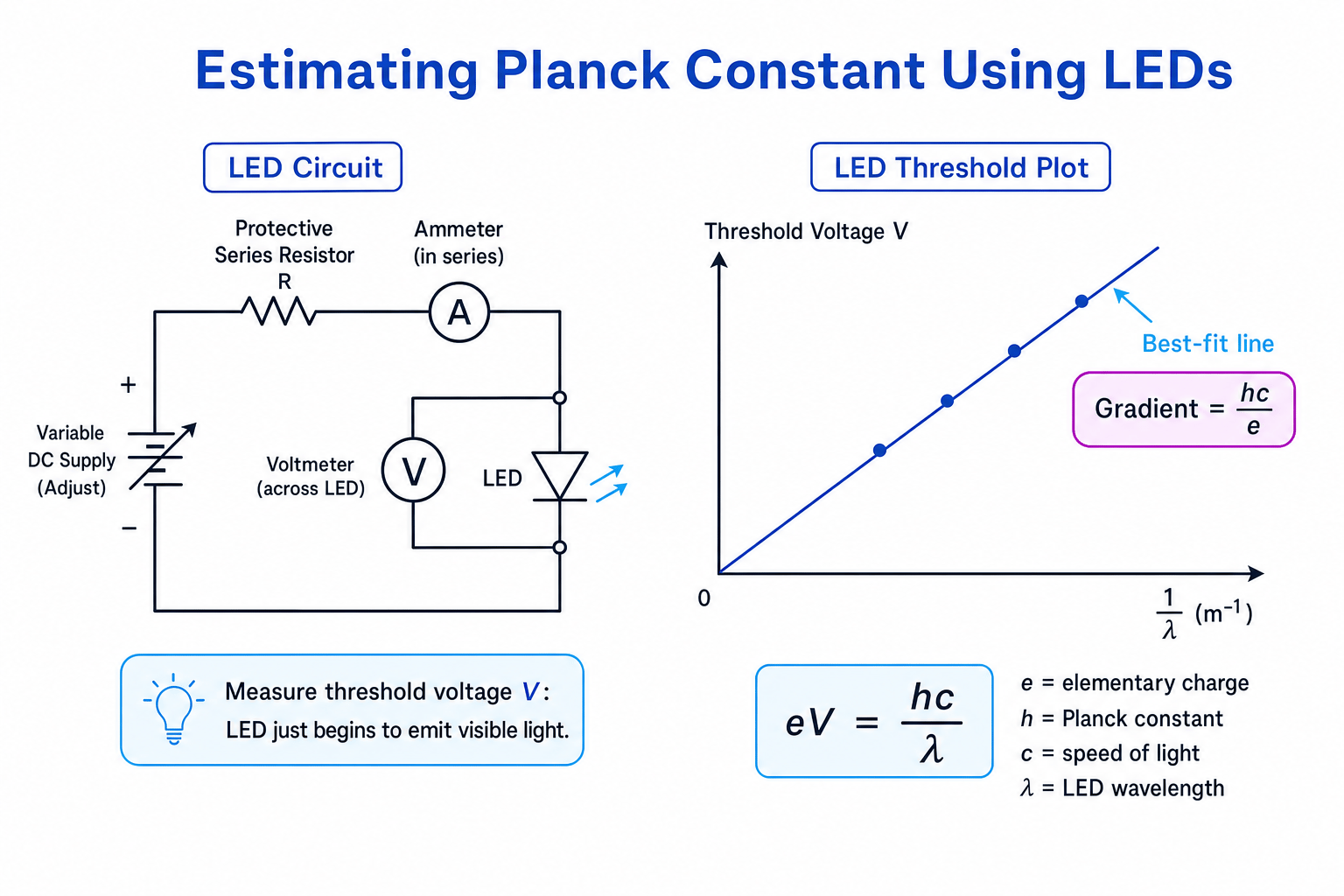
At the threshold voltage, the energy transferred to one electron is approximately eVeVeV, where e=1.60×10⁻¹⁹ Ce = 1.60 \times 10^{-19}\ \text{C}e=1.60×10⁻¹⁹ C. If the emitted photon has wavelength λ\lambdaλ, then:
eV=hcλeV = \frac{hc}{\lambda}eV=λhcThis is the key LED equation for this practical.
With one LED, you can rearrange to estimate:
h=eVλch = \frac{eV\lambda}{c}h=ceVλWith several different coloured LEDs, it is better to use a graph. Rearranging gives:
V=hce1λV = \frac{hc}{e}\frac{1}{\lambda}V=ehcλ1So a graph of threshold voltage VVV against 1λ\frac{1}{\lambda}λ1 should be approximately a straight line. Its gradient is:
gradient=hce\text{gradient} = \frac{hc}{e}gradient=ehcTherefore:
h=gradient×ech = \frac{\text{gradient} \times e}{c}h=cgradient×ePractical method with different coloured LEDs
- Choose several LEDs of different colours, such as red, yellow, green and blue.
- Find or measure the wavelength λ\lambdaλ for each LED, then convert it to metres.
- For each LED, slowly increase the supply voltage until the LED just begins to glow.
- Record the threshold voltage VVV across the LED.
- Calculate 1λ\frac{1}{\lambda}λ1 for each LED and plot VVV against 1λ\frac{1}{\lambda}λ1.
- Draw a best-fit line and use its gradient to calculate hhh.
Finding Planck constant from an LED graph
-
Compare the graph equation with the straight-line form. For a graph of VVV against 1λ\frac{1}{\lambda}λ1, V=hce1λV = \frac{hc}{e}\frac{1}{\lambda}V=ehcλ1, so the gradient m=hcem = \frac{hc}{e}m=ehc.
-
Rearrange for the Planck constant: h=mech = \frac{me}{c}h=cme.
-
Substitute a measured best-fit gradient, for example m=1.24×10⁻⁶ V mm = 1.24 \times 10^{-6}\ \text{V m}m=1.24×10⁻⁶ V m: h=(1.24×10⁻⁶ V m)(1.60×10⁻¹⁹ C)3.00×10⁸ m s−1h = \frac{(1.24 \times 10^{-6}\ \text{V m})(1.60 \times 10^{-19}\ \text{C})}{3.00 \times 10^8\ \text{m s}^{-1}}h=3.00×10⁸ m s−1(1.24×10⁻⁶ V m)(1.60×10⁻¹⁹ C).
-
Calculate and check the units: h=6.61×10⁻³⁴ J sh = 6.61 \times 10^{-34}\ \text{J s}h=6.61×10⁻³⁴ J s, since V C=J\text{V C} = \text{J}V C=J. This is close to the accepted value 6.63×10⁻³⁴ J s6.63 \times 10^{-34}\ \text{J s}6.63×10⁻³⁴ J s.
Improving the LED estimate
Use several colours over a wide wavelength range, repeat threshold readings in dim conditions, and use a best-fit line rather than calculating hhh separately for each LED and averaging without checking the spread.
Using nanometres on the graph
If λ\lambdaλ is left in nm, the values of 1λ\frac{1}{\lambda}λ1 have the wrong scale. Convert wavelengths to metres first, so the horizontal axis has units of m^-1.
The value from this practical is usually only an estimate. LEDs do not switch on at one perfectly sharp voltage, and they emit a small range of wavelengths rather than one exact wavelength. That is why graphing several LEDs is more reliable than relying on a single reading.
In the exam
- Check whether the question gives frequency or wavelength: use E=hfE = hfE=hf for frequency, and E=hcλE = \frac{hc}{\lambda}E=λhc for wavelength.
- Convert wavelengths to metres and energies to joules unless the question explicitly asks for eV.
- For LED questions, start from eV=hcλeV = \frac{hc}{\lambda}eV=λhc and be clear that eee is charge while VVV is potential difference.
- If a graph of VVV against 1λ\frac{1}{\lambda}λ1 is used, identify the gradient as hce\frac{hc}{e}ehc before rearranging for hhh.
Check yourself
- If two beams of red light have the same frequency but one is brighter, what has changed: photon energy or number of photons per second?
- Which photon has more energy: one with wavelength 700 nm or one with wavelength 400 nm?
- For a graph of LED threshold voltage VVV against 1λ\frac{1}{\lambda}λ1, how would you find hhh from the gradient?
