

What you'll learn
- How a stationary wave is formed from two progressive waves.
- How to identify nodes, antinodes, harmonics and the fundamental mode.
- How stationary-wave patterns fit on strings and in open/closed air columns.
- How a resonance tube can be used to measure the speed of sound in air.
Starting point: progressive waves
A progressive wave is a wave that transfers energy from one place to another. For example, a sound wave travelling through air or a wave travelling along a rope carries energy in the direction of travel.
For any progressive wave:
v=fλv = f\lambdav=fλwhere vvv is wave speed in metres per second, fff is frequency in hertz, and λ\lambdaλ is wavelength in metres.
What is a stationary wave?
A stationary wave, also called a standing wave, is a wave pattern that appears not to travel along the medium.
It is formed when two progressive waves:
- have the same frequency,
- have the same wavelength,
- have similar amplitudes,
- travel in opposite directions,
- superpose.
This often happens when a wave reflects back on itself, such as a wave on a string fixed at both ends, sound in an air column, or microwaves reflecting from a metal plate.
Stationary wave
A stationary wave is the fixed pattern formed by the superposition of two progressive waves of the same frequency and wavelength travelling in opposite directions.
The big difference
A progressive wave transfers energy along the wave. A stationary wave has no net energy transfer along the wave pattern; instead, energy is stored in the oscillations between fixed points.
Nodes and antinodes
A node is a point on a stationary wave that has zero displacement at all times. It does not oscillate.
An antinode is a point on a stationary wave with maximum amplitude. It oscillates with the largest possible displacement.
Nodes and antinodes
A node is a point of zero amplitude. An antinode is a point of maximum amplitude.
The separation between adjacent nodes is:
λ2\frac{\lambda}{2}2λThe separation between adjacent antinodes is also:
λ2\frac{\lambda}{2}2λHere, λ\lambdaλ is the wavelength of the progressive waves that formed the stationary wave.
Finding wavelength from node spacing
A stationary wave has adjacent nodes separated by 0.18 m. Find the wavelength of the progressive wave that formed it.
- Use the stationary-wave spacing rule: adjacent nodes are separated by λ2\frac{\lambda}{2}2λ.
- Substitute the measured spacing: λ2=0.18 m\frac{\lambda}{2} = 0.18\ \text{m}2λ=0.18 m.
- Rearrange: λ=2×0.18 m=0.36 m\lambda = 2 \times 0.18\ \text{m} = 0.36\ \text{m}λ=2×0.18 m=0.36 m.
Graphical representations of stationary waves
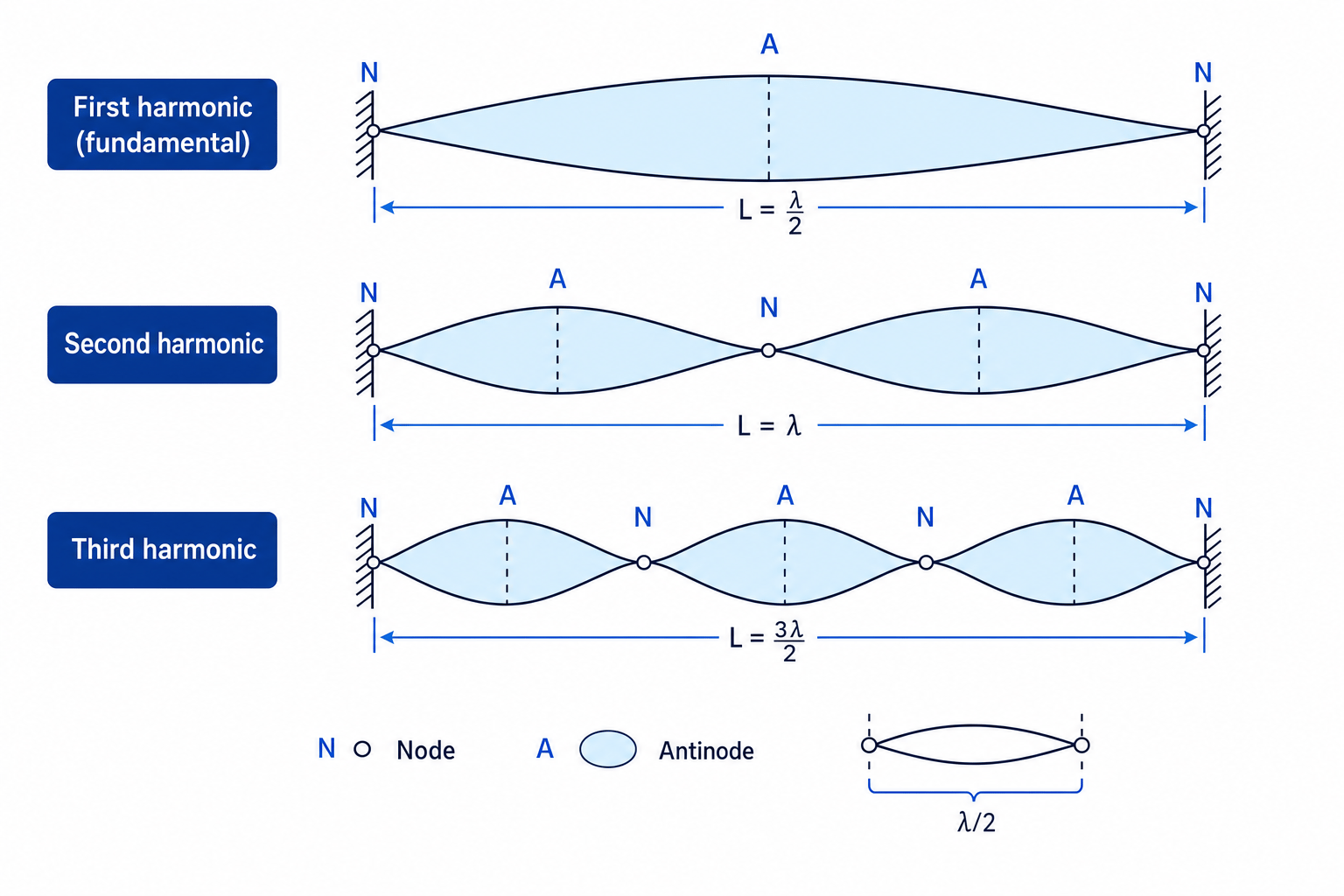
A stationary wave is usually drawn as a displacement-position graph at an instant in time.
The key features are:
- Nodes stay fixed at zero displacement.
- Antinodes reach the greatest positive and negative displacement.
- The drawn curve often shows two extreme positions of the wave.
- Points between the same pair of adjacent nodes oscillate in phase.
- Points in neighbouring loops oscillate in antiphase, meaning they move in opposite directions at the same time.
Misreading the drawn curve
The shape drawn for a stationary wave is not a travelling snapshot moving sideways. The nodes stay fixed, and each point simply oscillates up and down with its own amplitude.
Stationary waves on a stretched string
A stretched string fixed at both ends must have nodes at both ends because the ends cannot move.
Only certain wavelengths fit on the string. These are called modes of vibration.
The lowest possible frequency is the fundamental mode, also called the first harmonic.
Fundamental and harmonics
The fundamental mode is the lowest-frequency stationary wave pattern. Harmonics are higher-frequency modes that fit the boundary conditions of the system.
For a string of length LLL fixed at both ends:
First harmonic:
L=λ2L = \frac{\lambda}{2}L=2λSecond harmonic:
L=λL = \lambdaL=λThird harmonic:
L=3λ2L = \frac{3\lambda}{2}L=23λIn general:
L=nλn2L = \frac{n\lambda_n}{2}L=2nλnso:
λn=2Ln\lambda_n = \frac{2L}{n}λn=n2Lwhere nnn is the harmonic number.
Using v=fλv = f\lambdav=fλ:
fn=nv2Lf_n = \frac{nv}{2L}fn=2LnvSo the second harmonic has twice the fundamental frequency, the third harmonic has three times the fundamental frequency, and so on.
Harmonics on a stretched string
A string of length 0.80 m supports waves travelling at 64 m s⁻¹. Find the frequency of the third harmonic.
- For a string fixed at both ends, use λn=2Ln\lambda_n = \frac{2L}{n}λn=n2L.
- Substitute L=0.80 mL = 0.80\ \text{m}L=0.80 m and n=3n = 3n=3:
λ3=2×0.80 m3=0.533 m\lambda_3 = \frac{2 \times 0.80\ \text{m}}{3} = 0.533\ \text{m}λ3=32×0.80 m=0.533 m. - Use v=fλv = f\lambdav=fλ, so f=vλf = \frac{v}{\lambda}f=λv.
- Substitute: f=64 m s−10.533 m=120 Hzf = \frac{64\ \text{m s}^{-1}}{0.533\ \text{m}} = 120\ \text{Hz}f=0.533 m64 m s−1=120 Hz to two significant figures.
Stationary waves in air columns
Sound waves in air columns are longitudinal, but we often draw them using displacement amplitude patterns.
The boundary conditions depend on whether the end is open or closed.
Open end
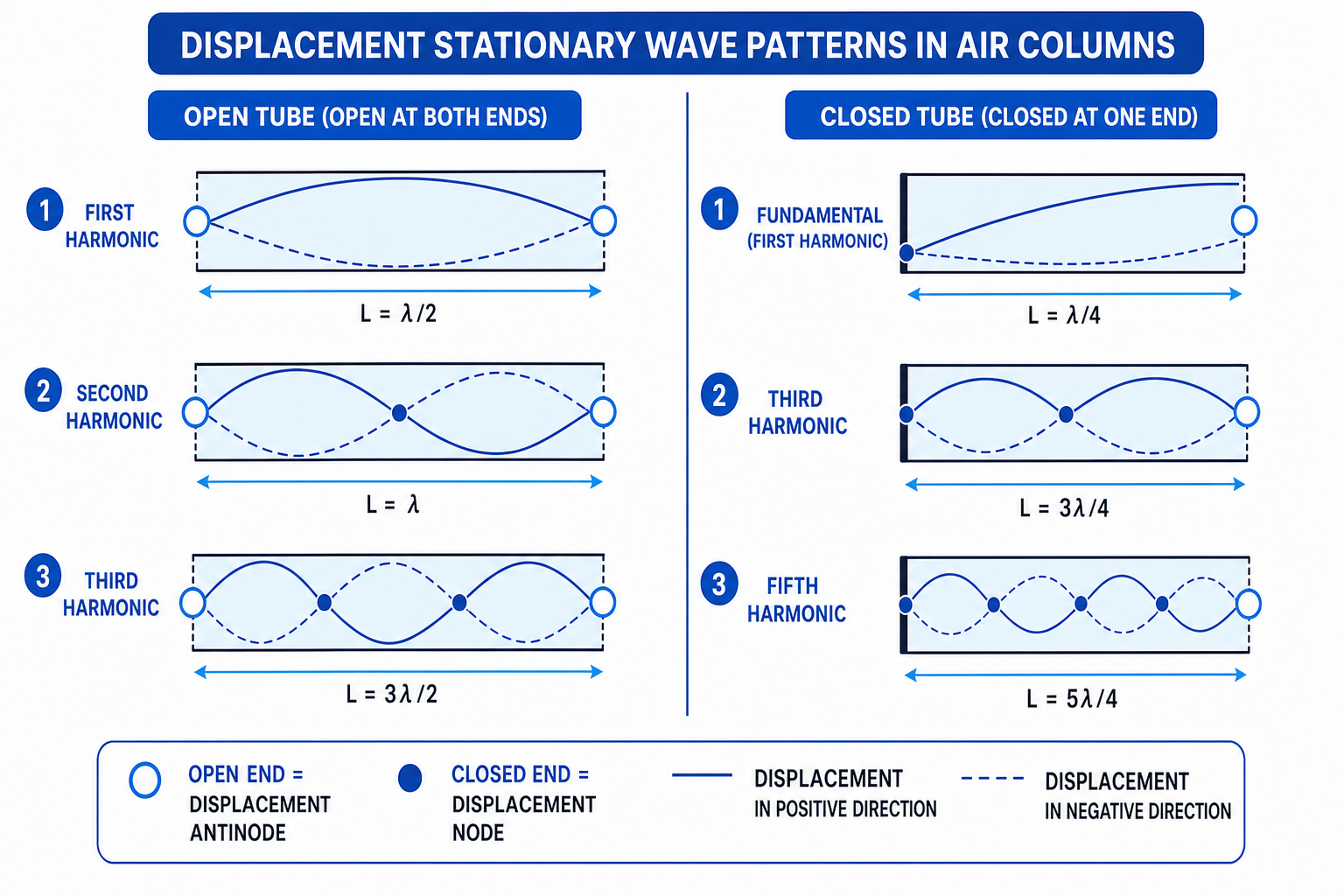
At an open end, air molecules can move freely, so there is a displacement antinode.
Closed end
At a closed end, air molecules cannot move through the wall, so there is a displacement node.
For a tube open at both ends, both ends are displacement antinodes. The allowed patterns are like a string fixed at both ends, but with antinodes instead of nodes at the boundaries:
L=nλn2L = \frac{n\lambda_n}{2}L=2nλnFor a tube closed at one end and open at the other, one end is a node and the other is an antinode. The allowed lengths are:
L=λ4, 3λ4, 5λ4,…L = \frac{\lambda}{4},\ \frac{3\lambda}{4},\ \frac{5\lambda}{4},\ldotsL=4λ, 43λ, 45λ,…So a closed tube supports only odd harmonics: first, third, fifth, and so on.
Open and closed ends
For displacement graphs: open end means antinode, closed end means node.
Microwaves, strings and air columns
Stationary waves can be demonstrated in several ways.
Microwaves
A microwave transmitter sends waves towards a metal reflector. The reflected wave overlaps with the incoming wave, forming a stationary wave. A detector moved between transmitter and reflector finds alternating maxima and minima in signal strength.
- Maxima correspond to antinodes.
- Minima correspond to nodes.
- Adjacent maxima or adjacent minima are separated by λ2\frac{\lambda}{2}2λ.
Stretched strings
A vibration generator drives a string at a chosen frequency. By adjusting the tension or frequency, stationary waves appear when the driving frequency matches an allowed mode.
Air columns
A tuning fork or loudspeaker drives sound waves in a tube. At resonant lengths, the reflected sound wave forms a stationary wave and the sound becomes louder.
Measuring the speed of sound using a resonance tube
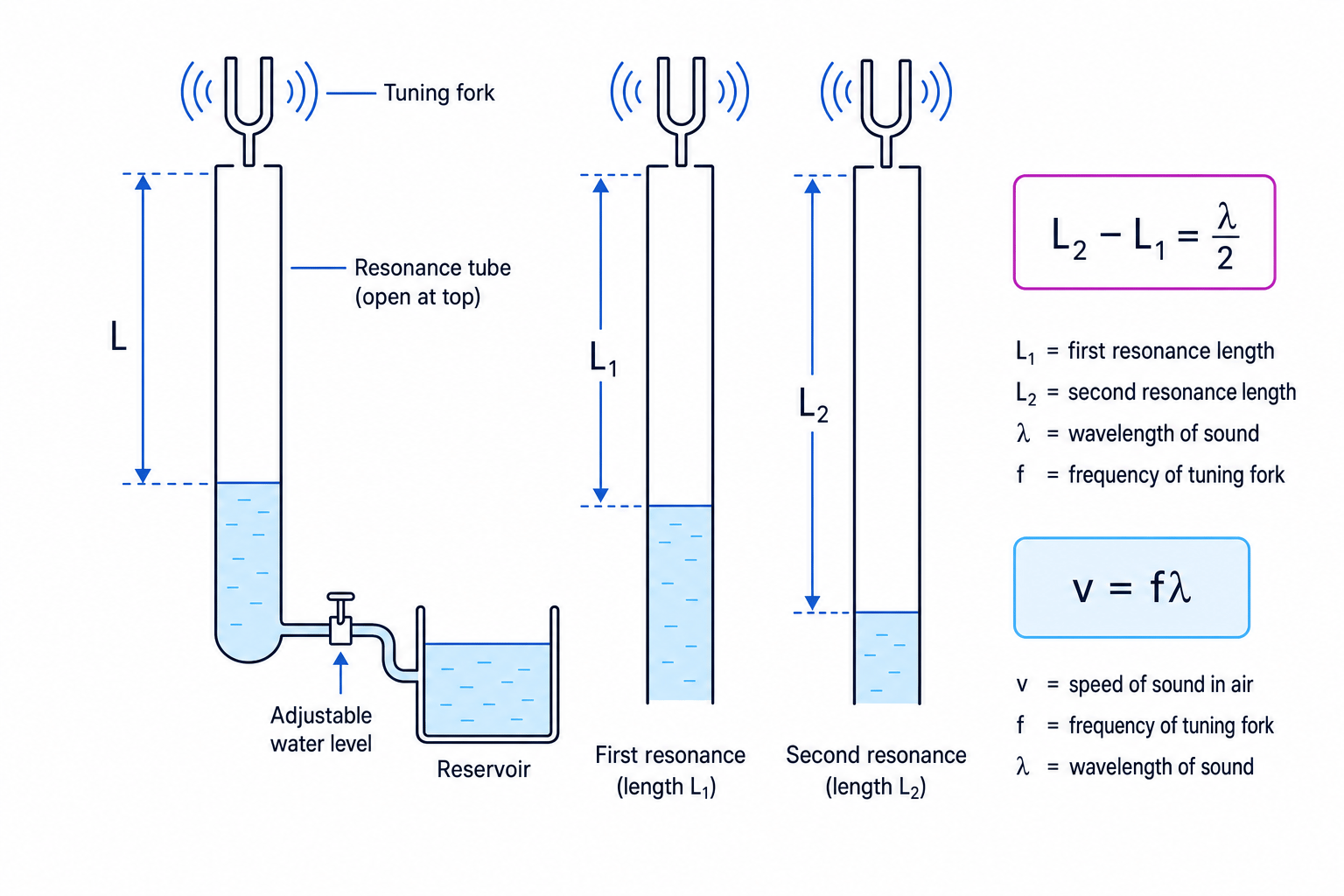
A resonance tube is usually a vertical tube with water inside it. The air column above the water acts like a tube closed at one end and open at the other.
The water surface is the closed end, so it is a displacement node. The open top is approximately a displacement antinode.
A practical method:
- Hold a vibrating tuning fork of known frequency fff above the open end.
- Adjust the water level until the sound is loudest.
- Measure the first resonance length L1L_1L1.
- Lower the water level until the next loud resonance is found.
- Measure the second resonance length L2L_2L2.
- Use the fact that successive resonances are separated by half a wavelength:
so:
λ=2(L2−L1)\lambda = 2(L_2 - L_1)λ=2(L2−L1)Then calculate the speed of sound using:
v=fλv = f\lambdav=fλMeasuring the speed of sound
A tuning fork of frequency 512 Hz gives resonances at 0.160 m and 0.494 m in a resonance tube. Calculate the speed of sound in air.
- Find the separation between successive resonance lengths:
L2−L1=0.494 m−0.160 m=0.334 mL_2 - L_1 = 0.494\ \text{m} - 0.160\ \text{m} = 0.334\ \text{m}L2−L1=0.494 m−0.160 m=0.334 m. - Use L2−L1=λ2L_2 - L_1 = \frac{\lambda}{2}L2−L1=2λ, so λ=2×0.334 m=0.668 m\lambda = 2 \times 0.334\ \text{m} = 0.668\ \text{m}λ=2×0.334 m=0.668 m.
- Use v=fλv = f\lambdav=fλ with f=512 Hzf = 512\ \text{Hz}f=512 Hz:
v=512 Hz×0.668 m=342 m s−1v = 512\ \text{Hz} \times 0.668\ \text{m} = 342\ \text{m s}^{-1}v=512 Hz×0.668 m=342 m s−1.
End correction
The displacement antinode at an open end is slightly outside the tube, not exactly at the rim. Using L2−L1L_2 - L_1L2−L1 is better than using the first resonance alone because this end correction cancels out.
Stationary waves compared with progressive waves
Both stationary and progressive waves involve oscillations, frequency, wavelength and amplitude. But their behaviour is very different.
For a progressive wave:
- the waveform travels through space,
- energy is transferred along the direction of travel,
- all points with the same amplitude behave similarly,
- there are no fixed nodes and antinodes.
For a stationary wave:
- the overall pattern does not travel,
- there is no net energy transfer along the pattern,
- amplitude depends on position,
- nodes and antinodes remain fixed,
- points between adjacent nodes are in phase,
- points in neighbouring loops are in antiphase.
Using the wrong wavelength
In stationary waves, the distance between adjacent nodes is not one full wavelength. It is λ2\frac{\lambda}{2}2λ.
In the exam
- Always identify the boundary conditions first: fixed end or closed end gives a displacement node; open end gives a displacement antinode.
- Use adjacent nodes or adjacent antinodes to get λ2\frac{\lambda}{2}2λ, then use v=fλv = f\lambdav=fλ.
- For tubes closed at one end, remember that only odd harmonics fit: first, third, fifth, and so on.
Check yourself
- Why must a stretched string fixed at both ends have nodes at both ends?
- A resonance tube has successive loud lengths separated by 0.17 m. What is the wavelength?
- What is the key difference in energy transfer between a progressive wave and a stationary wave?
