

What you'll learn
- The basic “address book” of space: planets, satellites, comets, solar systems, galaxies and the Universe.
- How stars form from dust and gas, then become stable main-sequence stars.
- How low-mass and massive stars evolve differently.
- How to read a Hertzsprung–Russell diagram to identify types of stars.
The scale of space
Before we talk about stars, it helps to get the main astronomy words straight. OCR expects you to use these terms accurately.
Objects and structures in space
- A planet is a large body orbiting a star. It does not produce its own light by fusion.
- A planetary satellite is a natural body orbiting a planet, such as the Moon orbiting Earth.
- A comet is a small icy body in orbit around a star, often with a highly elliptical orbit. Near the star, heating can produce a glowing coma and tail.
- A solar system is a star and all the objects gravitationally bound to it, including planets, satellites, asteroids and comets.
- A galaxy is a huge gravitationally bound collection of stars, gas and dust. Our Solar System is in the Milky Way galaxy.
- The Universe is everything: all space, matter, energy and galaxies.
Capital letters matter
Use the Solar System for our Sun’s system. Use a solar system for any star with orbiting objects.
How a star forms
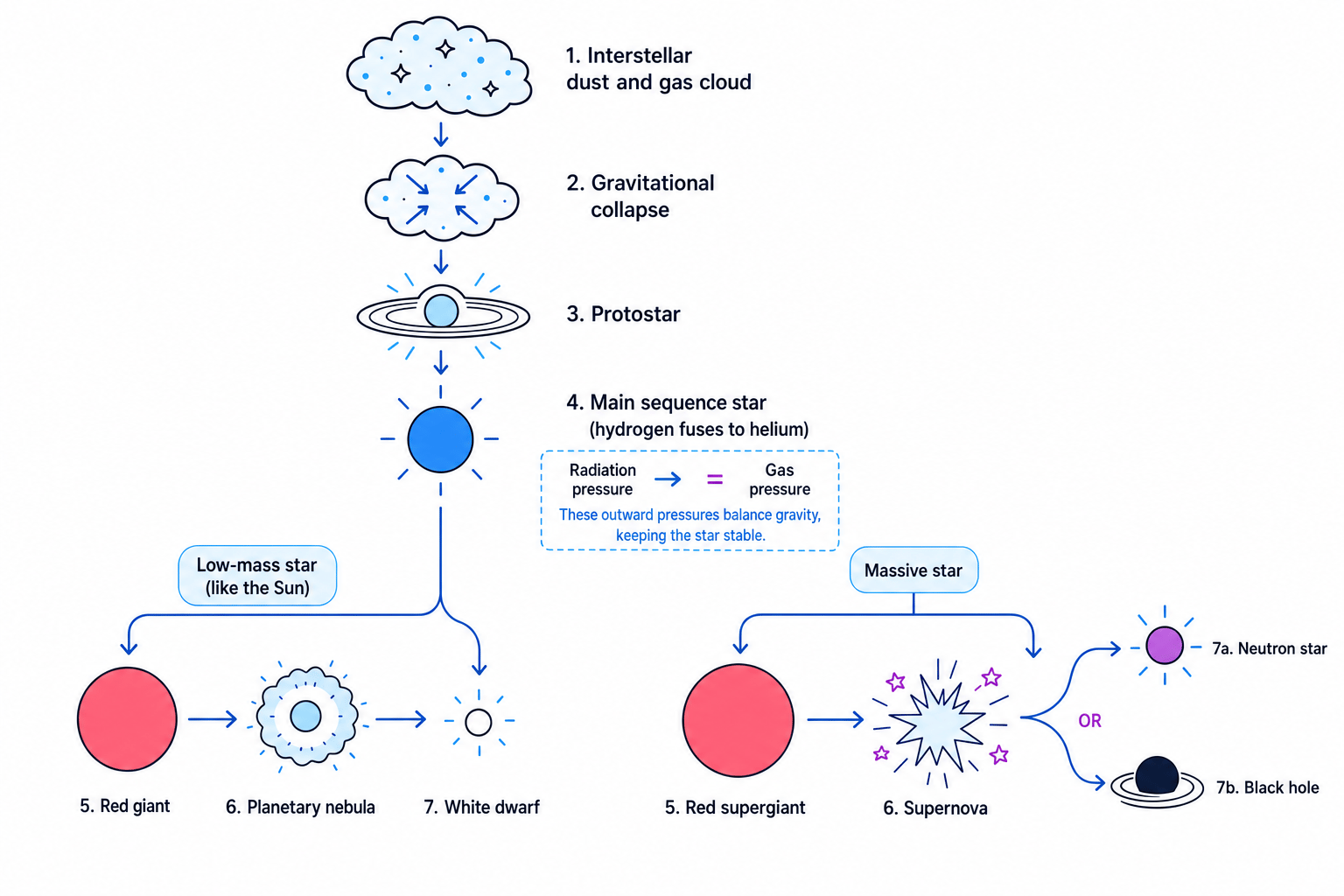
Stars begin in enormous clouds of interstellar dust and gas. Interstellar means “between stars”. These clouds are mostly hydrogen, with some helium and tiny amounts of heavier elements.
If a region of the cloud becomes slightly denser than its surroundings, gravity pulls more material inwards. This is called gravitational collapse.
As the cloud collapses:
- gravitational potential energy is transferred into internal energy;
- the temperature of the gas rises;
- the central region becomes denser and hotter;
- a protostar forms.
Protostar
A protostar is a young forming star before stable hydrogen fusion has begun in its core.
When the core becomes hot and dense enough, nuclear fusion begins. In this stage, hydrogen nuclei fuse to form helium. Fusion releases energy, which is carried outwards as radiation and by the hot gas.
The star becomes stable when the inward pull of gravity is balanced by outward pressure from the hot gas and radiation.
Main sequence star
A main sequence star is a stable star that is fusing hydrogen into helium in its core.
Stable stars are balanced
During the main sequence stage, gravity pulls the star inwards, while gas pressure and radiation pressure act outwards. A star is stable when these effects balance.
Explaining why a main-sequence star is stable
-
During gravitational collapse, the cloud becomes hotter and denser because gravitational potential energy is transferred into internal energy.
-
Once the core is hot and dense enough, hydrogen fusion begins. This releases energy, producing radiation and increasing the pressure of the hot gas.
-
If the outward gas pressure and radiation pressure balance the inward gravitational pull, the star does not keep collapsing or expanding overall. It is then a stable main-sequence star.
The life cycle depends on mass
A star’s future is mainly controlled by its mass. Low-mass stars, like the Sun, end their lives very differently from massive stars.
Astronomers cannot watch one star evolve from birth to death in real time because stellar lifetimes are far longer than human lifetimes. Instead, the life cycle is built from evidence: observing many stars at different stages and using physical models of gravity, pressure and fusion.
Low-mass stars: Sun-like evolution
A low-mass star spends most of its lifetime on the main sequence. The Sun is currently in this stage.
Eventually, the hydrogen fuel in the core becomes depleted. The core contracts and heats up, while the outer layers expand and cool. The star becomes a red giant.
Red giant
A red giant is a later stage of a low-mass star in which the outer layers have expanded greatly and the surface is cooler, giving the star a reddish appearance.
After the red giant stage, the star loses its outer layers into space. These expanding outer layers form a planetary nebula.
Planetary nebula
A planetary nebula is the glowing shell of gas ejected from a dying low-mass star. It is not made of planets.
The remaining hot, dense core becomes a white dwarf.
Planetary nebula does not mean planets
The name is historical: through early telescopes, some planetary nebulae looked a bit like planetary discs. They are actually shells of gas from dying stars.
White dwarfs
A white dwarf is the compact remnant left after a low-mass star has lost its outer layers. It is very dense, hot at first, and roughly Earth-sized, but it has a much lower luminosity than a main-sequence star because its surface area is small.
White dwarfs no longer produce energy by hydrogen fusion. They slowly cool and fade over very long timescales.
Electron degeneracy pressure
Electron degeneracy pressure is the pressure that prevents further collapse in a white dwarf. It comes from the behaviour of electrons when matter is compressed to extremely high density.
There is a maximum mass that electron degeneracy pressure can support.
Chandrasekhar limit
The Chandrasekhar limit is the maximum mass of a stable white dwarf, about 1.4 times the mass of the Sun. Above this, electron degeneracy pressure cannot prevent further collapse.
White dwarf summary
A white dwarf is hot, small, dense and no longer fusing hydrogen. It is supported against collapse by electron degeneracy pressure, but only if its mass is below the Chandrasekhar limit.
Massive stars: red supergiants and supernovae
A massive star also spends most of its life on the main sequence, fusing hydrogen into helium. Because it has a much larger mass, its core is hotter and fusion happens at a much faster rate. So massive stars have shorter lifetimes than lower-mass stars.
When a massive star leaves the main sequence, it expands into a red supergiant.
Red supergiant
A red supergiant is a very large, luminous late stage of a massive star, with a cool reddish surface and enormous radius.
Eventually, the core of a massive star collapses very rapidly. The outer layers are thrown off in a huge explosion called a supernova.
Supernova
A supernova is an extremely energetic stellar explosion that occurs at the end of the life of a massive star, ejecting outer layers into space and leaving a compact core remnant.
The core remnant becomes either:
- a neutron star, if the remaining core is not massive enough to form a black hole;
- a black hole, if the remaining core is massive enough that collapse continues.
Massive star pathway
A massive star evolves from main sequence star to red supergiant, then undergoes a supernova, leaving either a neutron star or a black hole.
Neutron stars and black holes
A neutron star is an incredibly dense compact remnant of a massive star. It has a very small radius compared with ordinary stars, but a mass comparable to that of the Sun. Its matter is compressed so strongly that it is mainly neutrons.
Neutron star
A neutron star is a very small, extremely dense stellar remnant formed after some supernovae.
A black hole forms when the remaining core is so massive that no known pressure can stop its collapse.
Black hole
A black hole is a region of space where gravity is so strong that not even light can escape from within the event horizon.
The event horizon is the boundary around a black hole beyond which escape is impossible.
Black holes are not cosmic vacuum cleaners
A black hole only traps objects that cross its event horizon. From far away, its gravitational effect depends on its mass, just like any other object.
The Hertzsprung–Russell diagram
The Hertzsprung–Russell diagram, usually called the HR diagram, is one of the most important diagrams in astrophysics.
HR diagram
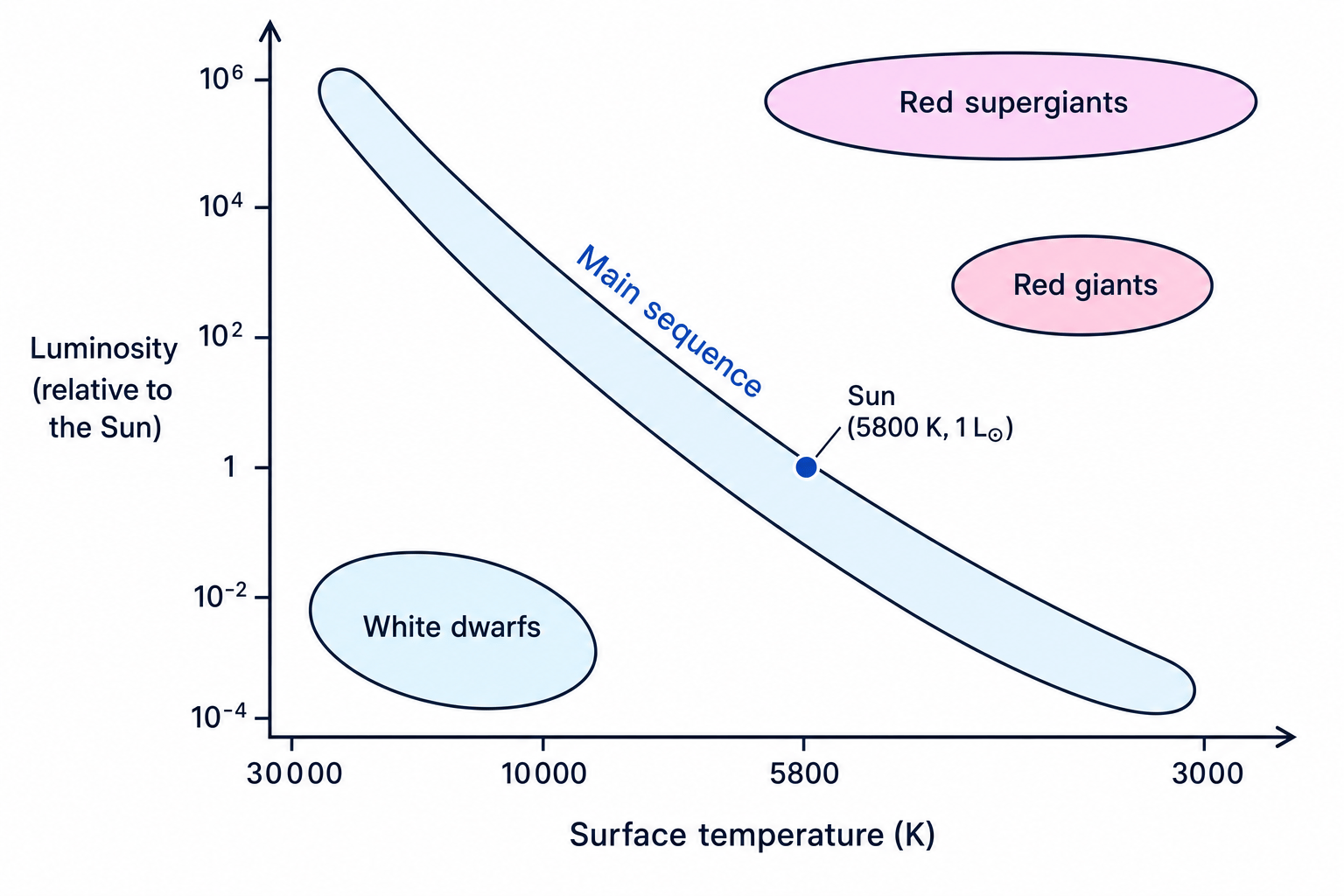
An HR diagram is a plot of stellar luminosity against surface temperature.
Luminosity means the total power output of a star. It is measured in watts, W, although HR diagrams often show luminosity relative to the Sun.
The vertical axis shows luminosity, increasing upwards. The horizontal axis shows surface temperature in kelvin, K. A key detail is that temperature usually decreases from left to right: hot stars are on the left, cool stars are on the right.
Main sequence
Most stars lie on the main sequence, a diagonal band from hot, luminous stars at the upper left to cool, dim stars at the lower right.
The Sun is a main-sequence star, with surface temperature about 5800 K and luminosity equal to one solar luminosity.
Red giants and red supergiants
Red giants and red supergiants are in the upper right of the HR diagram. They have relatively cool surfaces but high luminosities.
That combination tells you they must be very large: even though each square metre of surface is not especially hot, the total surface area is enormous.
White dwarfs
White dwarfs are in the lower left of the HR diagram. They have high surface temperatures but low luminosities.
That combination tells you they must be small: their surfaces are hot, but the total emitting area is tiny compared with a normal star.
Classifying stars on an HR diagram
A star has surface temperature 18 000 K and luminosity 0.01 times the Sun’s luminosity. Another star has surface temperature 3500 K and luminosity 1000 times the Sun’s luminosity.
-
The first star is hot because its temperature is far above the Sun’s 5800 K, so it would be plotted on the left of the HR diagram.
-
Its luminosity is much less than the Sun’s, so it would be plotted low down. Hot but dim means it lies in the white dwarf region.
-
The second star is cool because 3500 K is on the right-hand side of the HR diagram, but it is very luminous, so it is high up. Cool but very luminous means it lies in the red giant or red supergiant region.
Reading an HR diagram
Do not read the temperature axis like an ordinary increasing scale. On most HR diagrams, temperature is highest on the left and lowest on the right.
Putting the whole story together
Stars form by gravitational collapse from interstellar gas and dust. When hydrogen fusion begins, outward gas pressure and radiation pressure can balance gravity, producing a stable main-sequence star.
After the main sequence:
- a low-mass star like the Sun becomes a red giant, forms a planetary nebula, and leaves a white dwarf;
- a massive star becomes a red supergiant, undergoes a supernova, and leaves a neutron star or black hole.
The HR diagram lets you connect a star’s luminosity and temperature to its stage of evolution.
In the exam
-
Use the correct sequence words: interstellar cloud → protostar → main sequence before splitting into low-mass and massive pathways.
-
For stability, always mention both sides of the balance: inward gravity and outward gas/radiation pressure.
-
On HR diagrams, classify using both axes together: temperature alone is not enough, and remember that temperature usually decreases left to right.
Check yourself
- Why does a main-sequence star not collapse under its own gravity?
- What is the difference between the final stages of a Sun-like star and a massive star?
- Where would you find white dwarfs, red giants and main-sequence stars on an HR diagram?
