

What you'll learn
- What gravitational potential means, and why it is negative near a mass.
- How to use Vg=−GM/rV_g = -GM/rVg=−GM/r and calculate changes in gravitational potential.
- How a force–distance graph links to work done and gravitational potential energy.
- How energy conservation gives escape velocity, including for atoms in atmospheres.
The starting point: force, work and the “zero” point
You already know that two masses attract with gravitational force:
F=GMmr2F = \frac{GMm}{r^2}F=r2GMmwhere MMM is the mass creating the field, mmm is the test mass, rrr is the separation of their centres, and GGG is the gravitational constant.
For a constant force, work done is force multiplied by distance moved in the direction of the force. In a gravitational field, the force changes with distance, so we often use energy and graphs instead.
The key convention in this topic is:
gravitational potential is zero at infinity.
That means we choose a point infinitely far from the mass as the place where the gravitational effect has “run out”.
Gravitational potential
Gravitational potential
The gravitational potential, VgV_gVg, at a point is the work done per unit mass in bringing a small test mass from infinity to that point, without changing its kinetic energy. Its unit is joules per kilogram, J kg⁻¹.
Because gravity is attractive, an object released from infinity would naturally fall inwards and gain kinetic energy. To bring it in slowly, an external agent would have to hold it back, so the work done by that external agent is negative.
That is why gravitational potential near a mass is negative.
Zero at infinity
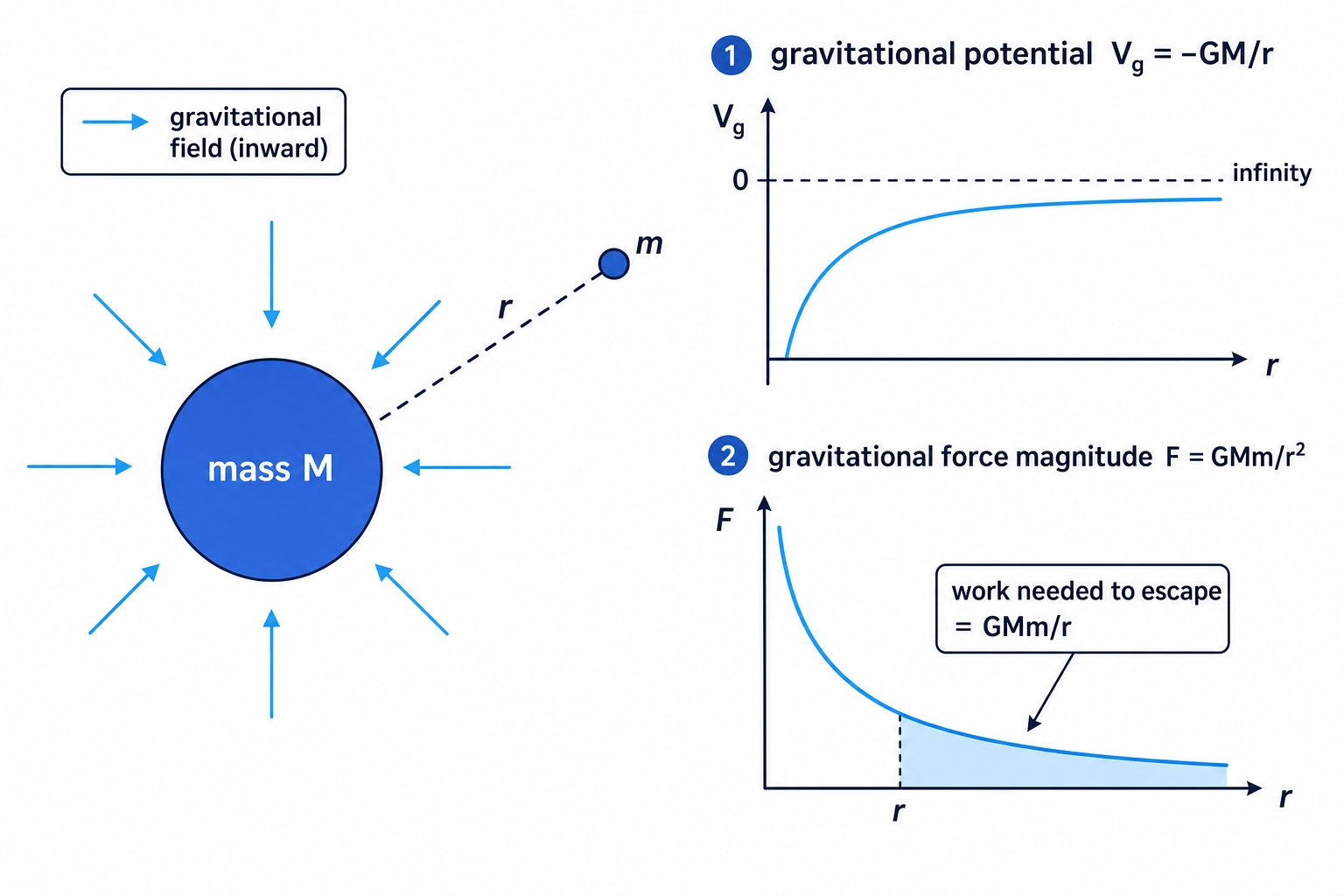
Gravitational potential is zero at infinity. Near an isolated mass, VgV_gVg is negative, and as you move further away it increases towards zero.
Potential around a point or spherical mass
For a point mass, or for a point outside a spherical mass, the gravitational potential at distance rrr from the centre is:
Vg=−GMrV_g = -\frac{GM}{r}Vg=−rGMwhere:
- VgV_gVg is gravitational potential in J kg⁻¹
- G=6.67×10⁻¹¹ N m2 kg−2G = 6.67 \times 10^{-11}\ \text{N m}^2\text{ kg}^{-2}G=6.67×10⁻¹¹ N m2 kg−2
- MMM is the mass producing the field in kg
- rrr is the distance from the centre of the mass in m
For a spherical planet or star, you can treat the mass as if it were concentrated at its centre, provided you are outside the object.
Where the formula applies
Use Vg=−GM/rV_g = -GM/rVg=−GM/r for a point mass, or outside a spherical mass with rrr measured from its centre. Do not use it for points inside a planet or star.
Changes in gravitational potential
A change in potential is found from:
ΔVg=Vg,2−Vg,1\Delta V_g = V_{g,2} - V_{g,1}ΔVg=Vg,2−Vg,1Using Vg=−GM/rV_g = -GM/rVg=−GM/r:
ΔVg=−GMr2−(−GMr1)\Delta V_g = -\frac{GM}{r_2} - \left(-\frac{GM}{r_1}\right)ΔVg=−r2GM−(−r1GM)so:
ΔVg=GM(1r1−1r2)\Delta V_g = GM\left(\frac{1}{r_1} - \frac{1}{r_2}\right)ΔVg=GM(r11−r21)If an object moves outwards, then r2>r1r_2 > r_1r2>r1, so ΔVg\Delta V_gΔVg is positive. The potential becomes less negative.
Calculating a change in gravitational potential
A satellite moves from r1=7.00×10⁶ mr_1 = 7.00 \times 10^6\ \text{m}r1=7.00×10⁶ m to r2=4.20×10⁷ mr_2 = 4.20 \times 10^7\ \text{m}r2=4.20×10⁷ m from Earth’s centre. Take Earth’s mass as M=5.97×1024 kgM = 5.97 \times 10^{24}\ \text{kg}M=5.97×1024 kg. Calculate the change in gravitational potential.
-
Use the change in potential equation:
ΔVg=GM(1r1−1r2)\Delta V_g = GM\left(\frac{1}{r_1} - \frac{1}{r_2}\right)ΔVg=GM(r11−r21) -
Substitute the values:
ΔVg=(6.67×10⁻¹¹)(5.97×1024)(17.00×10⁶−14.20×10⁷)\Delta V_g = (6.67 \times 10^{-11})(5.97 \times 10^{24}) \left(\frac{1}{7.00 \times 10^6} - \frac{1}{4.20 \times 10^7}\right)ΔVg=(6.67×10⁻¹¹)(5.97×1024)(7.00×1061−4.20×1071) -
Calculate the result:
ΔVg=4.74×10⁷ J kg−1\Delta V_g = 4.74 \times 10^7\ \text{J kg}^{-1}ΔVg=4.74×10⁷ J kg−1The positive sign means the satellite has moved to a higher gravitational potential, closer to zero.
Using height instead of radius
In Vg=−GM/rV_g = -GM/rVg=−GM/r, rrr is measured from the centre of the planet, not from the surface. If the object is at height hhh above a planet of radius RRR, then r=R+hr = R + hr=R+h.
Force–distance graphs and work done
A graph of gravitational force against distance is not a straight line, because:
F=GMmr2F = \frac{GMm}{r^2}F=r2GMmThe force gets much larger at small distances and weaker as distance increases.
For any force–distance graph, the area under the graph gives the work done. This is the graphical version of work done.
For gravity, if you plot the magnitude of the attractive force against rrr, the area under the graph from r1r_1r1 to r2r_2r2 represents the work needed to move the mass slowly outwards between those distances.
If the final distance is infinity, the area from rrr to infinity is the energy needed to escape from that position:
area=GMmr\text{area} = \frac{GMm}{r}area=rGMmGraph sign convention
Exam diagrams often show force magnitude as positive. If instead the gravitational force is drawn as negative because it acts inwards, the signed area will be negative for an outward displacement. Be clear whether the graph is showing force magnitude or signed force.
Finding work from the force-distance graph
A 500 kg satellite is moved slowly outwards from r1=7.00×10⁶ mr_1 = 7.00 \times 10^6\ \text{m}r1=7.00×10⁶ m to r2=4.20×10⁷ mr_2 = 4.20 \times 10^7\ \text{m}r2=4.20×10⁷ m from Earth’s centre. Use the area under the force–distance graph to find the work done.
-
The area under the gravitational force–distance graph equals the increase in gravitational potential energy:
W=mΔVgW = m\Delta V_gW=mΔVg -
Use the change in potential found from the same two radii:
ΔVg=4.74×10⁷ J kg−1\Delta V_g = 4.74 \times 10^7\ \text{J kg}^{-1}ΔVg=4.74×10⁷ J kg−1 -
Multiply by the satellite mass:
W=500×4.74×107=2.37×10¹⁰ JW = 500 \times 4.74 \times 10^7 = 2.37 \times 10^{10}\ \text{J}W=500×4.74×107=2.37×10¹⁰ JSo the external work done is 2.37×10¹⁰ J2.37 \times 10^{10}\ \text{J}2.37×10¹⁰ J.
Gravitational potential energy
Gravitational potential energy
The gravitational potential energy, EEE, of a mass mmm at a point is the energy it has because of its position in a gravitational field.
Since gravitational potential is energy per unit mass:
E=mVgE = mV_gE=mVgUsing Vg=−GM/rV_g = -GM/rVg=−GM/r:
E=−GMmrE = -\frac{GMm}{r}E=−rGMmThe unit is the joule, J.
Like gravitational potential, gravitational potential energy is negative near an isolated mass because zero is defined at infinity.
The change in gravitational potential energy is:
ΔE=mΔVg\Delta E = m\Delta V_gΔE=mΔVgor, between two distances:
ΔE=GMm(1r1−1r2)\Delta E = GMm\left(\frac{1}{r_1} - \frac{1}{r_2}\right)ΔE=GMm(r11−r21)for an outward move from r1r_1r1 to r2r_2r2.
Calculating gravitational potential energy
Calculate the gravitational potential energy of a 2.00 kg mass at a distance r=6.37×10⁶ mr = 6.37 \times 10^6\ \text{m}r=6.37×10⁶ m from Earth’s centre. Use M=5.97×1024 kgM = 5.97 \times 10^{24}\ \text{kg}M=5.97×1024 kg.
-
Use the gravitational potential energy equation:
E=−GMmrE = -\frac{GMm}{r}E=−rGMm -
Substitute the values:
E=−(6.67×10⁻¹¹)(5.97×1024)(2.00)6.37×10⁶E = -\frac{(6.67 \times 10^{-11})(5.97 \times 10^{24})(2.00)} {6.37 \times 10^6}E=−6.37×10⁶(6.67×10⁻¹¹)(5.97×1024)(2.00) -
Calculate and interpret:
E=−1.25×10⁸ JE = -1.25 \times 10^8\ \text{J}E=−1.25×10⁸ JThe negative sign means the mass is bound to Earth’s gravitational field. It would need an energy increase of 1.25×10⁸ J1.25 \times 10^8\ \text{J}1.25×10⁸ J to reach infinity with zero kinetic energy.
Escape velocity
Escape velocity
The escape velocity is the minimum speed an object must have at a given distance from a mass so that it can reach infinity with zero kinetic energy remaining.
To escape, the object must have enough kinetic energy to raise its gravitational potential energy from a negative value to zero.
At distance rrr from mass MMM:
12mvesc2=GMmr\frac{1}{2}mv_{\text{esc}}^2 = \frac{GMm}{r}21mvesc2=rGMmThe mass mmm of the escaping object cancels:
vesc=2GMrv_{\text{esc}} = \sqrt{\frac{2GM}{r}}vesc=r2GMAt the surface of a planet, use r=Rr = Rr=R, where RRR is the planet’s radius:
vesc=2GMRv_{\text{esc}} = \sqrt{\frac{2GM}{R}}vesc=R2GMEscape speed does not depend on the escaping mass
A hydrogen atom, an oxygen molecule and a spacecraft all have the same escape velocity from the same position in the same gravitational field. However, lighter atoms are more likely to reach high speeds in a hot atmosphere.
This idea helps scientists predict whether planets can keep atmospheres. If atoms or molecules in the upper atmosphere often have speeds comparable to the escape velocity, some can escape into space over time.
Predicting whether an atom can escape
Mars has mass M=6.42×10²³ kgM = 6.42 \times 10^{23}\ \text{kg}M=6.42×10²³ kg and radius R=3.39×10⁶ mR = 3.39 \times 10^6\ \text{m}R=3.39×10⁶ m. A hydrogen atom in the upper atmosphere has speed 6.0×10³ m s−16.0 \times 10^3\ \text{m s}^{-1}6.0×10³ m s−1. Use a simple escape-velocity model to decide whether it could escape.
-
Calculate the escape velocity at the surface:
vesc=2GMRv_{\text{esc}} = \sqrt{\frac{2GM}{R}}vesc=R2GM -
Substitute Mars’s mass and radius:
vesc=2(6.67×10⁻¹¹)(6.42×10²³)3.39×10⁶v_{\text{esc}} = \sqrt{\frac{2(6.67 \times 10^{-11})(6.42 \times 10^{23})} {3.39 \times 10^6}}vesc=3.39×1062(6.67×10⁻¹¹)(6.42×10²³) -
Evaluate and compare:
vesc=5.03×10³ m s−1v_{\text{esc}} = 5.03 \times 10^3\ \text{m s}^{-1}vesc=5.03×10³ m s−1Since 6.0×10³ m s−16.0 \times 10^3\ \text{m s}^{-1}6.0×10³ m s−1 is greater than 5.03×10³ m s−15.03 \times 10^3\ \text{m s}^{-1}5.03×10³ m s−1, the atom could escape in this simplified model, provided it avoids further collisions.
Forgetting the final kinetic energy condition
Escape velocity is the minimum speed for reaching infinity with zero kinetic energy left. If the object reaches infinity still moving, its starting speed was greater than escape velocity.
In the exam
- Always check whether the question asks for potential VgV_gVg in J kg⁻¹ or energy EEE in J; use E=mVgE = mV_gE=mVg to connect them.
- Keep the negative signs for VgV_gVg and EEE, but for “energy needed to escape” give a positive energy input.
- Use distance from the centre of the spherical mass, not height above the surface, unless you have first added the planet’s radius.
Check yourself
- Why is gravitational potential defined as zero at infinity rather than at a planet’s surface?
- A satellite moves to a larger orbital radius. Does its gravitational potential increase or decrease?
- Why does escape velocity not depend on the mass of the escaping object?
