Electromagnetic radiation from stars
What you'll learn
- Why atoms emit and absorb only certain wavelengths of light.
- How spectral lines can identify elements in stars.
- How a transmission diffraction grating is used to measure wavelength.
- How Wien’s displacement law and Stefan’s law let you estimate a star’s surface temperature and radius.
The key prerequisite: photons
Electromagnetic radiation can be described as a wave, with speed ccc, frequency fff, and wavelength λ\lambdaλ linked by:
c=fλc = f\lambdac=fλIt can also be described as travelling in photons, which are discrete packets of energy. A photon of frequency fff has energy:
E=hfE = hfE=hfCombining this with c=fλc = f\lambdac=fλ gives:
E=hcλE = \frac{hc}{\lambda}E=λhcwhere hhh is the Planck constant and ccc is the speed of light in a vacuum.
Energy levels in isolated gas atoms
An isolated gas atom is an atom whose interactions with neighbouring atoms are negligible. This is a good model for low-density gases, where atoms behave almost independently.
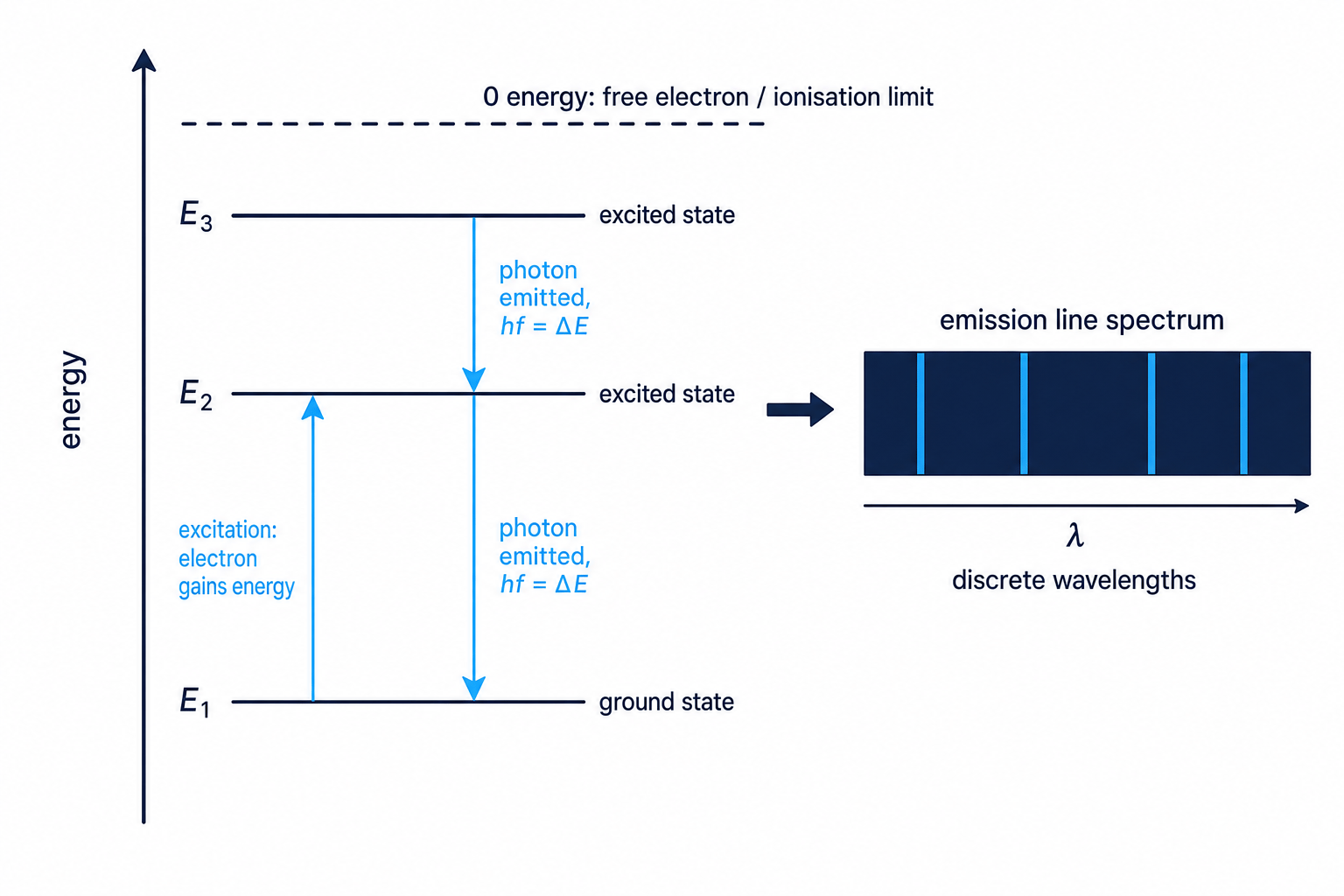
Electrons in atoms cannot have any random energy. They can only occupy certain allowed energies called energy levels.
Discrete energy levels
An electron energy level is an allowed energy that an electron can have inside an atom. The levels are discrete, meaning only particular values are allowed, rather than a continuous range.
The lowest energy level is called the ground state. Higher allowed levels are called excited states. An electron can move to a higher level if it gains exactly the right amount of energy.
Why the energy levels are negative
For atoms, the zero of energy is usually chosen to be the energy of a free electron that is completely separated from the atom. An electron inside the atom is bound to the positive nucleus, so it has less energy than a free electron. Therefore its energy is negative.
Negative energy means bound
An electron in an atom has negative energy because energy must be supplied to remove it from the atom. Higher levels are less negative; ionisation corresponds to reaching zero energy.
For example, an electron at −2.18×10⁻¹⁸ J-2.18 \times 10^{-18}\ \text{J}−2.18×10⁻¹⁸ J needs 2.18×10⁻¹⁸ J2.18 \times 10^{-18}\ \text{J}2.18×10⁻¹⁸ J to reach zero energy and become free.
Emission of photons from hot gases
In a hot gas, atoms collide and electrons can be excited to higher energy levels. The electron is unstable in the excited state, so it may drop back down to a lower energy level.
When it does this, the atom emits a photon. The photon energy equals the energy difference between the two levels:
hf=ΔEhf = \Delta Ehf=ΔEand since c=fλc = f\lambdac=fλ:
hcλ=ΔE\frac{hc}{\lambda} = \Delta Eλhc=ΔEFor emission, use the positive size of the energy drop:
ΔE=Eupper−Elower\Delta E = E_{\text{upper}} - E_{\text{lower}}ΔE=Eupper−Elowerbecause EupperE_{\text{upper}}Eupper is less negative than ElowerE_{\text{lower}}Elower.
Finding the wavelength of an emitted photon
An electron falls from an energy level of −5.45×10⁻¹⁹ J-5.45 \times 10^{-19}\ \text{J}−5.45×10⁻¹⁹ J to −2.18×10⁻¹⁸ J-2.18 \times 10^{-18}\ \text{J}−2.18×10⁻¹⁸ J. Find the wavelength of the emitted photon.
-
Calculate the positive energy difference between the upper and lower levels:
ΔE=(−5.45×10⁻¹⁹)−(−2.18×10⁻¹⁸)\Delta E = (-5.45 \times 10^{-19}) - (-2.18 \times 10^{-18})ΔE=(−5.45×10⁻¹⁹)−(−2.18×10⁻¹⁸) ΔE=1.64×10⁻¹⁸ J\Delta E = 1.64 \times 10^{-18}\ \text{J}ΔE=1.64×10⁻¹⁸ J -
Use hcλ=ΔE\frac{hc}{\lambda} = \Delta Eλhc=ΔE and rearrange for wavelength:
λ=hcΔE\lambda = \frac{hc}{\Delta E}λ=ΔEhc -
Substitute h=6.63×10⁻³⁴ J sh = 6.63 \times 10^{-34}\ \text{J s}h=6.63×10⁻³⁴ J s and c=3.00×10⁸ m s−1c = 3.00 \times 10^8\ \text{m s}^{-1}c=3.00×10⁸ m s−1:
λ=(6.63×10⁻³⁴)(3.00×10⁸)1.64×10⁻¹⁸\lambda = \frac{(6.63 \times 10^{-34})(3.00 \times 10^8)}{1.64 \times 10^{-18}}λ=1.64×10⁻¹⁸(6.63×10⁻³⁴)(3.00×10⁸) λ=1.21×10⁻⁷ m\lambda = 1.21 \times 10^{-7}\ \text{m}λ=1.21×10⁻⁷ mThis is about 121 nm, in the ultraviolet region.
Subtracting negative energy levels wrongly
Do not ignore the minus signs. A transition from −5.45×10⁻¹⁹ J-5.45 \times 10^{-19}\ \text{J}−5.45×10⁻¹⁹ J to −2.18×10⁻¹⁸ J-2.18 \times 10^{-18}\ \text{J}−2.18×10⁻¹⁸ J releases energy, even though both levels are negative.
Spectra from stars
A spectrum shows how the intensity of radiation varies with wavelength.
Continuous spectrum
A continuous spectrum contains all wavelengths across a range. A hot dense object, such as the visible surface of a star, produces an approximately continuous black-body spectrum.
Emission line spectrum
An emission line spectrum consists of bright lines at particular wavelengths on a dark background. It is produced by a hot, low-density gas. Each line corresponds to an electron transition between two energy levels.
Absorption line spectrum
An absorption line spectrum consists of dark lines within a continuous spectrum. It is produced when light from a hot dense source passes through a cooler gas. Atoms in the cooler gas absorb photons with energies exactly matching their electron energy gaps.
Atoms have spectral fingerprints
Different elements have different electron energy levels, so they produce and absorb different sets of spectral lines. Matching the pattern of lines in starlight to laboratory spectra lets astronomers identify elements in stars.
Identifying an element from absorption lines
A star’s spectrum contains dark lines at the same wavelengths as bright emission lines measured from hydrogen in the laboratory.
-
The dark lines show that specific wavelengths have been absorbed by cooler gas in the star’s outer layers.
-
The matching laboratory hydrogen wavelengths show that hydrogen atoms have the same energy gaps as the absorbing atoms in the star.
-
Therefore, hydrogen is present in the star’s atmosphere.
Measuring wavelength with a transmission diffraction grating
A transmission diffraction grating is a transparent plate with many equally spaced slits or lines. It diffracts light and produces bright maxima at particular angles.
The grating spacing ddd is the distance between adjacent slits. If the grating has NNN lines per metre, then:
d=1Nd = \frac{1}{N}d=N1For bright maxima:
dsinθ=nλd\sin\theta = n\lambdadsinθ=nλwhere:
- ddd is the grating spacing in metres.
- θ\thetaθ is the angle from the central maximum to the chosen maximum.
- nnn is the order number, such as 1, 2, or 3.
- λ\lambdaλ is the wavelength in metres.
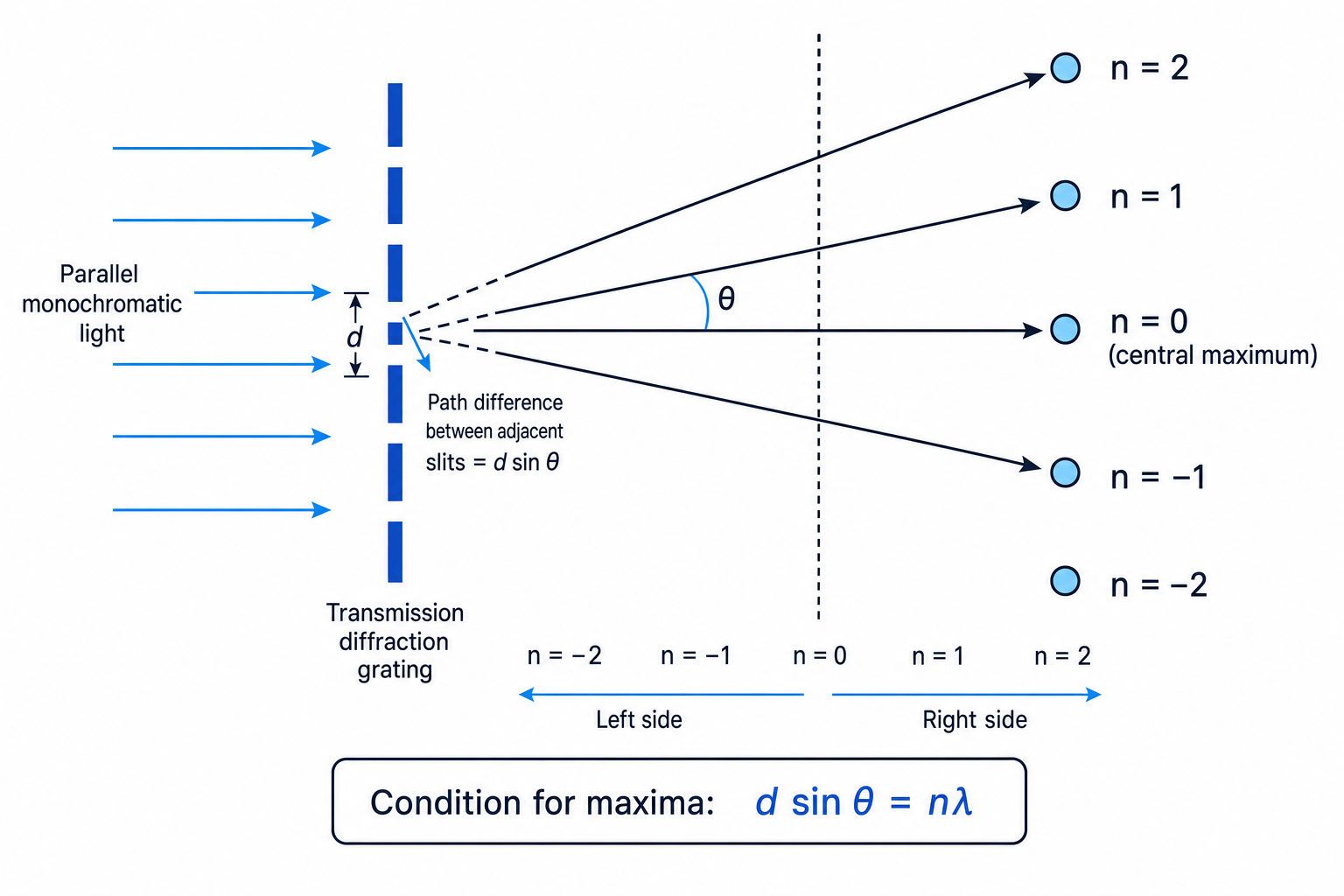
In a practical setup, you can shine light through a grating and measure the angle to a bright line. The structure and detailed use of an optical spectrometer are not required here, but you should understand that measuring θ\thetaθ allows λ\lambdaλ to be calculated.
Calculating wavelength using a diffraction grating
A transmission grating has 600 lines per millimetre. The first-order maximum is observed at an angle of 17.0° from the central maximum. Find the wavelength of the light.
-
Convert the line density into lines per metre:
600 mm−1=600×103 m−1=6.00×10⁵ m−1600\ \text{mm}^{-1} = 600 \times 10^3\ \text{m}^{-1} = 6.00 \times 10^5\ \text{m}^{-1}600 mm−1=600×103 m−1=6.00×10⁵ m−1 -
Calculate the grating spacing:
d=16.00×105=1.67×10⁻⁶ md = \frac{1}{6.00 \times 10^5} = 1.67 \times 10^{-6}\ \text{m}d=6.00×1051=1.67×10⁻⁶ m -
Use dsinθ=nλd\sin\theta = n\lambdadsinθ=nλ with n=1n = 1n=1:
λ=dsinθn\lambda = \frac{d\sin\theta}{n}λ=ndsinθ λ=(1.67×10⁻⁶)sin(17.0∘)1\lambda = \frac{(1.67 \times 10^{-6})\sin(17.0^\circ)}{1}λ=1(1.67×10⁻⁶)sin(17.0∘) λ=4.87×10⁻⁷ m\lambda = 4.87 \times 10^{-7}\ \text{m}λ=4.87×10⁻⁷ mSo the wavelength is about 487 nm.
Using the wrong angle
In dsinθ=nλd\sin\theta = n\lambdadsinθ=nλ, θ\thetaθ is measured from the central maximum to one diffracted maximum, not the angle between the two first-order maxima. If you measure the angle between the left and right first-order lines, halve it first.
Wien’s displacement law: estimating surface temperature
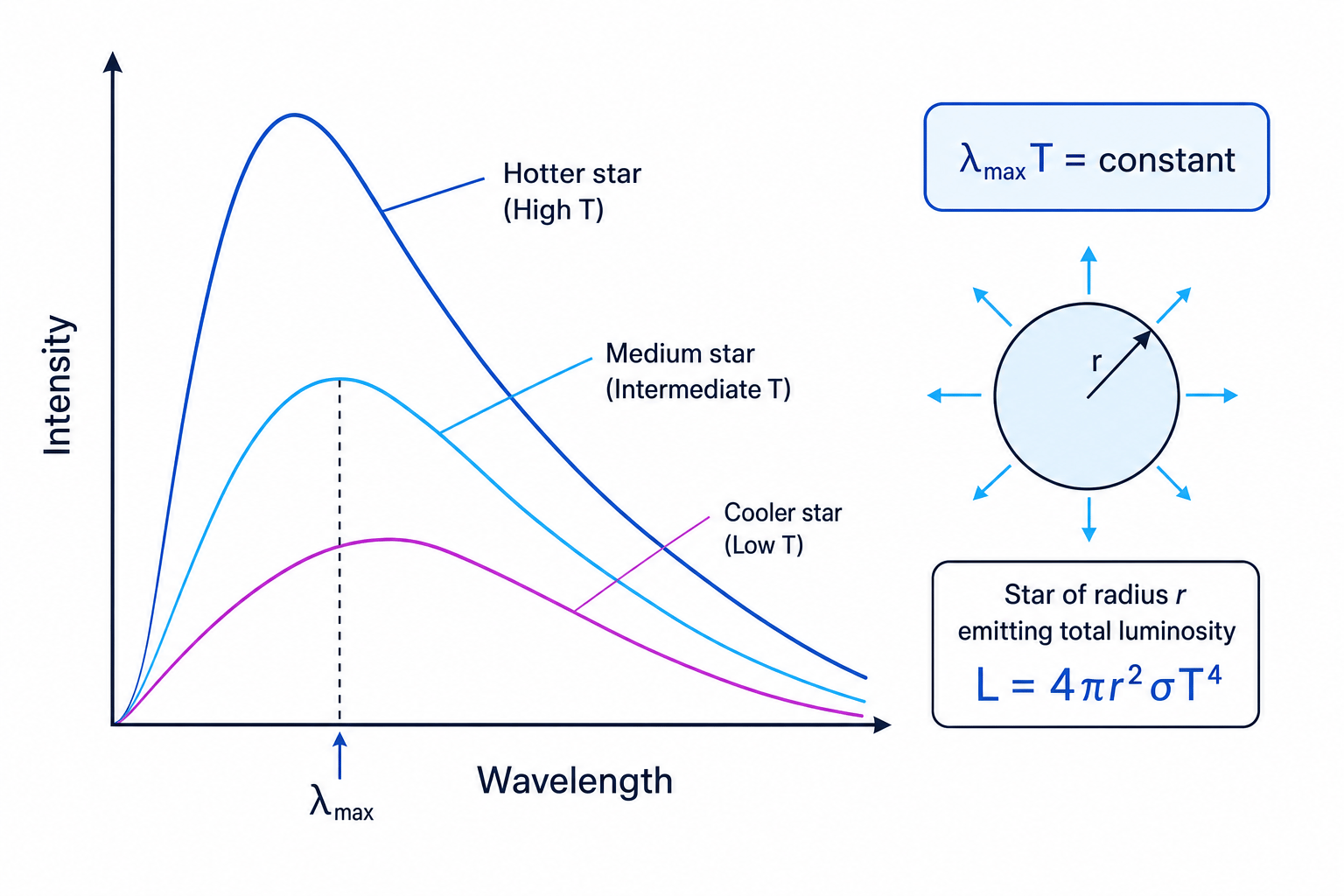
Stars behave approximately like black bodies. A black body is an ideal object that absorbs all incident radiation and emits a characteristic continuous spectrum depending only on its temperature.
For a hotter black body, the peak wavelength is shorter. Wien’s displacement law says:
λmax∝1T\lambda_{\max} \propto \frac{1}{T}λmax∝T1More usefully:
λmaxT=2.9×10⁻³ m K\lambda_{\max} T = 2.9 \times 10^{-3}\ \text{m K}λmaxT=2.9×10⁻³ m Kwhere λmax\lambda_{\max}λmax is the wavelength at which the emitted intensity is greatest, and TTT is the absolute temperature in kelvin.
Estimating a star’s surface temperature
A star’s spectrum has peak wavelength 450 nm. Estimate its surface temperature.
-
Convert the wavelength into metres:
450 nm=450×10−9 m=4.50×10⁻⁷ m450\ \text{nm} = 450 \times 10^{-9}\ \text{m} = 4.50 \times 10^{-7}\ \text{m}450 nm=450×10−9 m=4.50×10⁻⁷ m -
Use Wien’s displacement law:
λmaxT=2.9×10⁻³ m K\lambda_{\max} T = 2.9 \times 10^{-3}\ \text{m K}λmaxT=2.9×10⁻³ m K -
Rearrange and substitute:
T=2.9×10−34.50×10−7T = \frac{2.9 \times 10^{-3}}{4.50 \times 10^{-7}}T=4.50×10−72.9×10−3 T=6.4×10³ KT = 6.4 \times 10^3\ \text{K}T=6.4×10³ K
Temperature sanity check
A shorter peak wavelength means a higher surface temperature. Blue-white stars are hotter than red stars.
Luminosity and Stefan’s law
The luminosity LLL of a star is the total energy it emits per second across all wavelengths. It is a power, so its unit is the watt, W.
For a spherical star of radius rrr and surface temperature TTT, Stefan’s law is:
L=4πr2σT4L = 4\pi r^2 \sigma T^4L=4πr2σT4where σ\sigmaσ is the Stefan constant:
σ=5.67×10⁻⁸ W m−2 K−4\sigma = 5.67 \times 10^{-8}\ \text{W m}^{-2}\ \text{K}^{-4}σ=5.67×10⁻⁸ W m−2 K−4The factor 4πr24\pi r^24πr2 is the surface area of the star, and σT4\sigma T^4σT4 is the power emitted per unit surface area.
Luminosity
Luminosity is the total power radiated by a star. It is not the same as how bright the star looks from Earth, because apparent brightness also depends on distance.
Estimating a star’s radius
If you know the luminosity and can estimate the surface temperature using Wien’s law, you can rearrange Stefan’s law to find the radius:
r=L4πσT4r = \sqrt{\frac{L}{4\pi\sigma T^4}}r=4πσT4LEstimating radius from luminosity and peak wavelength
A star has luminosity 3.8×1026 W3.8 \times 10^{26}\ \text{W}3.8×1026 W and peak wavelength 5.00×10⁻⁷ m5.00 \times 10^{-7}\ \text{m}5.00×10⁻⁷ m. Estimate its radius.
-
Use Wien’s displacement law to estimate the temperature:
T=2.9×10−35.00×10−7T = \frac{2.9 \times 10^{-3}}{5.00 \times 10^{-7}}T=5.00×10−72.9×10−3 T=5.80×10³ KT = 5.80 \times 10^3\ \text{K}T=5.80×10³ K -
Rearrange Stefan’s law for radius:
r=L4πσT4r = \sqrt{\frac{L}{4\pi\sigma T^4}}r=4πσT4L -
Substitute the values:
r=3.8×10264π(5.67×10⁻⁸)(5.80×10³)4r = \sqrt{\frac{3.8 \times 10^{26}}{4\pi(5.67 \times 10^{-8})(5.80 \times 10^3)^4}}r=4π(5.67×10⁻⁸)(5.80×10³)43.8×1026 r=6.9×10⁸ mr = 6.9 \times 10^8\ \text{m}r=6.9×10⁸ mThis is a solar-sized radius, which is a sensible result for these values.
Forgetting the fourth power
In Stefan’s law, temperature is raised to the fourth power. A small error in TTT can cause a large error in LLL or rrr, so keep temperatures in kelvin and do not round too early.
In the exam
-
For spectral line calculations, use the positive energy gap: ΔE=Eupper−Elower\Delta E = E_{\text{upper}} - E_{\text{lower}}ΔE=Eupper−Elower, then apply hf=ΔEhf = \Delta Ehf=ΔE or hcλ=ΔE\frac{hc}{\lambda} = \Delta Eλhc=ΔE.
-
For diffraction gratings, convert line spacing carefully: if given lines per millimetre, change to lines per metre before using d=1Nd = \frac{1}{N}d=N1.
-
For star temperature and radius estimates, use metres for λmax\lambda_{\max}λmax, kelvin for TTT, watts for LLL, and keep enough significant figures until the final answer.
Check yourself
- Why are electron energy levels in atoms negative rather than positive?
- How does an absorption line spectrum form in the outer layers of a star?
- A star has a smaller λmax\lambda_{\max}λmax than the Sun. What does that tell you about its surface temperature?