

What you'll learn
- How to define displacement, amplitude, period, frequency, angular frequency and phase difference.
- How to recognise simple harmonic motion using a=−ω2xa=-\omega^2xa=−ω2x.
- How to use the standard SHM equations for displacement and velocity.
- How to measure and interpret period, frequency and SHM graphs.
Oscillation language
An oscillation is repeated motion about an equilibrium position. The equilibrium position is where the resultant force would be zero if the object were placed there and released.
For a vertical mass on a spring, the equilibrium position is the middle point of its motion. For a pendulum, it is the vertical hanging position.
Core quantities
- Displacement, xxx: the signed distance from equilibrium, measured in metres.
- Amplitude, AAA: the maximum displacement from equilibrium, measured in metres.
- Period, TTT: the time for one complete oscillation, measured in seconds.
- Frequency, fff: the number of complete oscillations per second, measured in hertz.
- Angular frequency, ω\omegaω: the rate at which the phase of the oscillation advances, measured in radians per second.
- Phase difference, Δϕ\Delta\phiΔϕ: how far one oscillation is ahead of or behind another, measured in radians.
One full oscillation corresponds to an angle of 2π2\pi2π radians, so:
f=1Tf=\frac{1}{T}f=T1 ω=2πT=2πf\omega=\frac{2\pi}{T}=2\pi fω=T2π=2πfIf two oscillations have the same frequency, a time delay Δt\Delta tΔt corresponds to a phase difference:
Δϕ=2πΔtT=ωΔt\Delta\phi=\frac{2\pi\Delta t}{T}=\omega\Delta tΔϕ=T2πΔt=ωΔtFinding frequency, angular frequency and phase difference
A mass completes 12 oscillations in 9.60 s. A second identical trace reaches each maximum 0.200 s later. Find TTT, fff, ω\omegaω and the phase difference.
-
Find the period from the total time:
T=9.60 s12=0.800 sT=\frac{9.60\ \text{s}}{12}=0.800\ \text{s}T=129.60 s=0.800 s -
Use f=1/Tf=1/Tf=1/T and ω=2π/T\omega=2\pi/Tω=2π/T:
f=10.800 s=1.25 Hzf=\frac{1}{0.800\ \text{s}}=1.25\ \text{Hz}f=0.800 s1=1.25 Hz ω=2π0.800 s=7.85 rad s−1\omega=\frac{2\pi}{0.800\ \text{s}}=7.85\ \text{rad s}^{-1}ω=0.800 s2π=7.85 rad s−1 -
Convert the time delay into a phase difference:
Δϕ=2π(0.200 s)0.800 s=1.57 rad\Delta\phi=\frac{2\pi(0.200\ \text{s})}{0.800\ \text{s}}=1.57\ \text{rad}Δϕ=0.800 s2π(0.200 s)=1.57 radThe second trace is π2\frac{\pi}{2}2π rad, or a quarter cycle, behind the first.
What makes motion simple harmonic?
Not all oscillations are simple harmonic. For simple harmonic motion (SHM), the acceleration must always point back towards equilibrium and its magnitude must be directly proportional to displacement.
Simple harmonic motion
An object moves with simple harmonic motion when its acceleration is directly proportional to its displacement from equilibrium and is in the opposite direction.
The defining equation is:
a=−ω2xa=-\omega^2xa=−ω2xThe minus sign is crucial. If xxx is positive, aaa is negative; if xxx is negative, aaa is positive. The acceleration is always directed towards equilibrium.
The SHM test
To show that motion is SHM, you must show both parts: acceleration is proportional to displacement, and acceleration acts in the opposite direction to displacement.
Testing an acceleration-displacement relationship
For an oscillator, measurements give a=−36.0xa=-36.0xa=−36.0x, where aaa is in metres per second squared and xxx is in metres. Decide whether the motion is SHM and find its period.
-
Compare with the SHM defining equation:
a=−ω2xa=-\omega^2xa=−ω2xThe relationship has the correct negative sign and is proportional to xxx, so the motion is SHM.
-
Identify ω2\omega^2ω2 from the coefficient:
ω2=36.0 s−2\omega^2=36.0\ \text{s}^{-2}ω2=36.0 s−2 ω=6.00 rad s−1\omega=6.00\ \text{rad s}^{-1}ω=6.00 rad s−1 -
Use ω=2π/T\omega=2\pi/Tω=2π/T to find the period:
T=2πω=2π6.00 rad s−1=1.05 sT=\frac{2\pi}{\omega}=\frac{2\pi}{6.00\ \text{rad s}^{-1}}=1.05\ \text{s}T=ω2π=6.00 rad s−12π=1.05 s
Measuring period and frequency
In practical work, you often determine the period by timing many oscillations, then dividing by the number of oscillations. This reduces the percentage uncertainty caused by reaction time.
The two standard examples are a mass on a spring and a simple pendulum. For the pendulum, the displacement should be small so that the motion is approximately SHM.
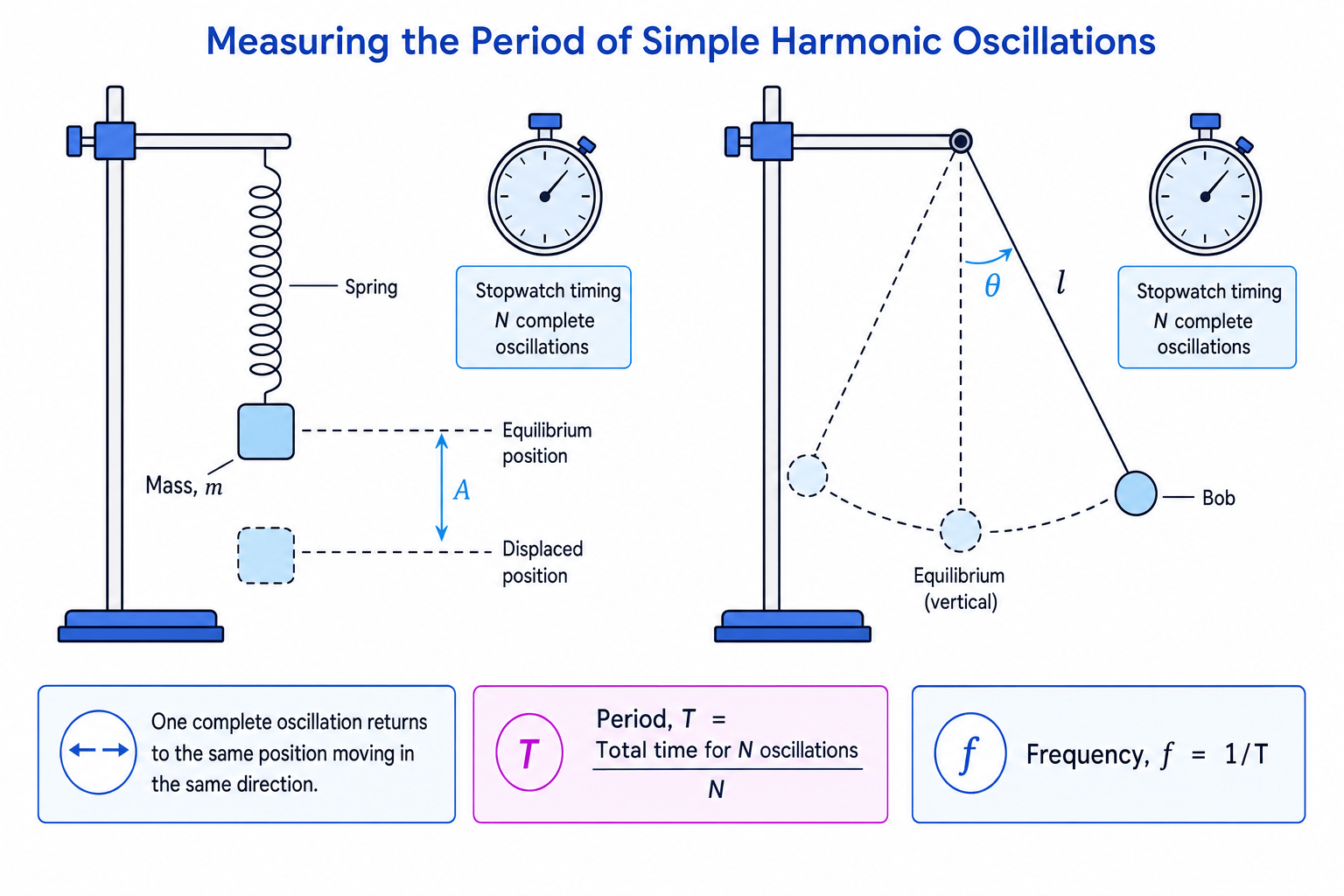
A complete oscillation means returning to the same position moving in the same direction. For example, passing through equilibrium upwards and then next passing through equilibrium upwards.
Determining period and frequency from timing data
A student times 20 complete oscillations of a spring-mass system. The total time is 15.8 s. Find the period and frequency.
-
Divide the total time by the number of complete oscillations:
T=15.8 s20=0.790 sT=\frac{15.8\ \text{s}}{20}=0.790\ \text{s}T=2015.8 s=0.790 s -
Use f=1/Tf=1/Tf=1/T:
f=10.790 s=1.27 Hzf=\frac{1}{0.790\ \text{s}}=1.27\ \text{Hz}f=0.790 s1=1.27 Hz -
Check the scale of the answer: a period less than one second means slightly more than one oscillation per second, so 1.27 Hz is sensible.
Counting half-oscillations
Do not stop timing when the object first reaches the opposite side. That is only half an oscillation. It must return to the same position moving in the same direction.
Displacement equations for SHM
The displacement in SHM varies sinusoidally with time. Two common forms are:
x=Acosωtx=A\cos\omega tx=Acosωt x=Asinωtx=A\sin\omega tx=AsinωtThey describe the same type of motion, but with different starting conditions.
- x=Acosωtx=A\cos\omega tx=Acosωt starts at maximum positive displacement when t=0t=0t=0.
- x=Asinωtx=A\sin\omega tx=Asinωt starts at equilibrium when t=0t=0t=0 and initially moves in the positive direction.
Choosing sine or cosine
Look at the initial displacement. If the oscillator starts at maximum displacement, cosine is usually convenient. If it starts at equilibrium, sine is usually convenient.
Choosing a displacement equation
An oscillator has amplitude 0.080 m and period 1.60 s. It starts at equilibrium and moves initially in the positive direction. Find a suitable expression for xxx and calculate xxx after 0.200 s.
-
Since the oscillator starts at equilibrium and moves positive, use the sine form:
x=Asinωtx=A\sin\omega tx=Asinωt -
Calculate the angular frequency:
ω=2πT=2π1.60 s=3.93 rad s−1\omega=\frac{2\pi}{T}=\frac{2\pi}{1.60\ \text{s}}=3.93\ \text{rad s}^{-1}ω=T2π=1.60 s2π=3.93 rad s−1So:
x=0.080sin(3.93t)x=0.080\sin(3.93t)x=0.080sin(3.93t) -
Substitute t=0.200 st=0.200\ \text{s}t=0.200 s:
x=0.080sin(3.93×0.200)=5.66×10⁻² mx=0.080\sin(3.93\times0.200)=5.66\times10^{-2}\ \text{m}x=0.080sin(3.93×0.200)=5.66×10⁻² mSo the displacement is about 0.057 m.
Velocity in SHM
Velocity is the gradient of a displacement-time graph. In SHM, the speed is greatest at equilibrium and zero at the extremes.
The OCR equation for velocity is:
v=±ωA2−x2v=\pm\omega\sqrt{A^2-x^2}v=±ωA2−x2The maximum speed occurs when x=0x=0x=0:
vmax=ωAv_{\text{max}}=\omega Avmax=ωAThe ±\pm± sign means the equation gives two possible directions. You must decide the sign from the motion described in the question.
Finding velocity at a displacement
An oscillator has amplitude 0.050 m and frequency 3.00 Hz. Find its velocity when x=0.030 mx=0.030\ \text{m}x=0.030 m and it is moving in the negative direction.
-
Calculate angular frequency:
ω=2πf=2π(3.00 Hz)=18.8 rad s−1\omega=2\pi f=2\pi(3.00\ \text{Hz})=18.8\ \text{rad s}^{-1}ω=2πf=2π(3.00 Hz)=18.8 rad s−1 -
Find the speed using the SHM velocity equation:
∣v∣=ωA2−x2|v|=\omega\sqrt{A^2-x^2}∣v∣=ωA2−x2 ∣v∣=18.8(0.050)2−(0.030)2=0.754 m s−1|v|=18.8\sqrt{(0.050)^2-(0.030)^2}=0.754\ \text{m s}^{-1}∣v∣=18.8(0.050)2−(0.030)2=0.754 m s−1 -
Apply the direction. Since the oscillator is moving in the negative direction:
v=−0.754 m s−1v=-0.754\ \text{m s}^{-1}v=−0.754 m s−1
Forgetting the direction of velocity
The square root part gives a speed. Use the wording or the graph to decide whether vvv is positive or negative.
Period is independent of amplitude
A simple harmonic oscillator is isochronous, meaning its period does not depend on amplitude.
So if you double the amplitude of an ideal SHM oscillator, the period stays the same. However, the maximum speed increases because:
vmax=ωAv_{\text{max}}=\omega Avmax=ωAIf AAA doubles while ω\omegaω stays the same, vmaxv_{\text{max}}vmax doubles.
When this approximation can fail
A pendulum is only approximately SHM for small angular displacements. At large amplitudes, the period is no longer perfectly independent of amplitude.
Graphs of displacement, velocity and acceleration
The three SHM graphs are closely linked. The velocity graph is found from the gradient of the displacement graph. The acceleration graph is found from a=−ω2xa=-\omega^2xa=−ω2x, so it is always opposite to the displacement graph.
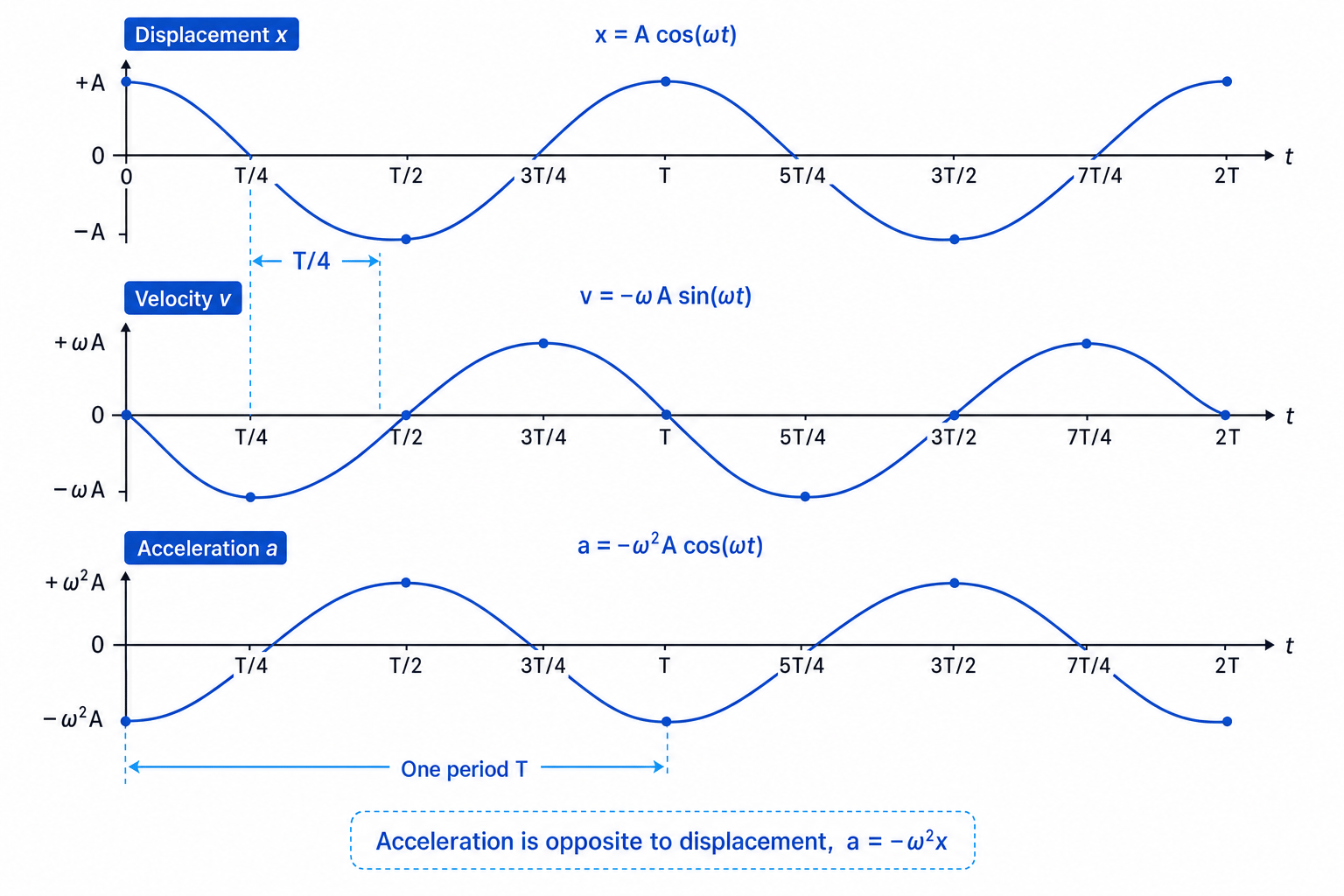
Useful graph facts:
- At maximum displacement, velocity is zero and acceleration has maximum magnitude.
- At equilibrium, acceleration is zero and speed is maximum.
- Velocity is a quarter cycle, or π2\frac{\pi}{2}2π rad, out of phase with displacement.
- Acceleration is half a cycle, or π\piπ rad, out of phase with displacement.
Reading SHM graph relationships
For an oscillator described by x=Acosωtx=A\cos\omega tx=Acosωt, determine vvv and aaa at key points in the first cycle.
-
At t=0t=0t=0, the oscillator is at x=+Ax=+Ax=+A. The displacement-time graph has zero gradient, so v=0v=0v=0. The acceleration is opposite to displacement, so a=−ω2Aa=-\omega^2Aa=−ω2A.
-
At t=T/4t=T/4t=T/4, the oscillator passes through equilibrium. The acceleration is zero because x=0x=0x=0, and the graph gradient is most negative, so v=−ωAv=-\omega Av=−ωA.
-
At t=T/2t=T/2t=T/2, the oscillator is at x=−Ax=-Ax=−A. The velocity is zero again, and the acceleration is now positive:
a=+ω2Aa=+\omega^2Aa=+ω2A
In the exam
- Always include the negative sign when defining SHM: a=−ω2xa=-\omega^2xa=−ω2x.
- Convert between TTT, fff and ω\omegaω early in a calculation.
- Use SI units throughout: metres, seconds, hertz, radians per second.
- For v=±ωA2−x2v=\pm\omega\sqrt{A^2-x^2}v=±ωA2−x2, calculate the speed first, then decide the sign from the direction of motion.
- In practical questions, time many complete oscillations and divide by the number timed.
Check yourself
- An oscillator has period 0.400 s. What are its frequency and angular frequency?
- At x=+Ax=+Ax=+A, what are the velocity and acceleration of an SHM oscillator?
- Why does doubling the amplitude not double the period for an ideal simple harmonic oscillator?
