

What you'll learn
- Why an object moving at constant speed in a circle is still accelerating.
- How angular speed links to linear speed using v=ωrv = \omega rv=ωr.
- How to calculate centripetal acceleration and centripetal force.
- How the whirling bung experiment investigates circular motion.
The key prerequisite: velocity is a vector
A vector is a quantity with both magnitude and direction. Velocity is a vector: its magnitude is speed, but it also has a direction.
So an object can have a constant speed while its velocity changes, if its direction changes. That is exactly what happens in circular motion.
Resultant force
The resultant force is the single force that has the same overall effect as all the forces acting on an object. By Newton’s second law, the resultant force is in the same direction as the acceleration.
Why a perpendicular force makes circular motion
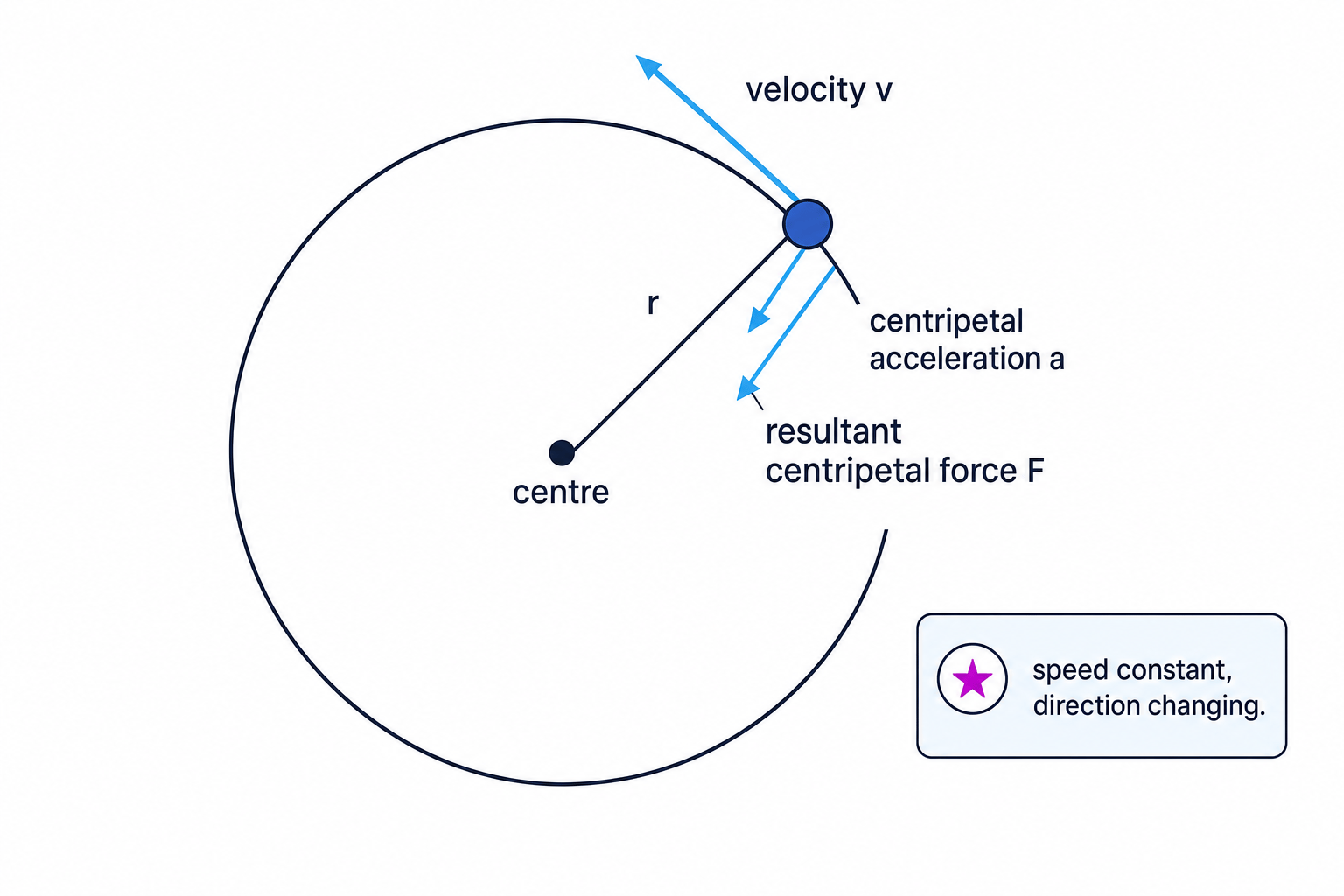
For an object to move in a circle at constant speed, its velocity must keep changing direction. The required acceleration points towards the centre of the circle.
A resultant force that is always perpendicular to the velocity changes the direction of motion, not the speed. If this force has constant magnitude and always points towards a fixed centre, the object follows a circular path.
The direction is the whole point
In uniform circular motion, the velocity is tangent to the circle, while the acceleration and resultant force point towards the centre.
Deciding the direction of the force
A stone on a string is moving in a horizontal circle. At one instant, it is at the right-hand side of the circle and moving upwards. What is the direction of the resultant force?
- The resultant force for circular motion must point towards the centre of the circle.
- From the right-hand side of the circle, the centre is to the left of the stone.
- Therefore, the resultant force is to the left. The velocity is upwards, so the force is perpendicular to the velocity at that instant.
Constant speed and angular speed
In circular motion, the object travels around a circumference. If the radius is rrr, the distance for one complete revolution is 2πr2\pi r2πr.
The period, TTT, is the time for one complete revolution, measured in seconds.
Angular speed
Angular speed, ω\omegaω, is the angle swept out per unit time. It is measured in radians per second, written as rad s−1\text{rad s}^{-1}rad s−1. One complete circle is 2π2\pi2π radians.
For one complete revolution:
ω=2πT\omega = \frac{2\pi}{T}ω=T2πThe linear speed around the circle is:
v=2πrTv = \frac{2\pi r}{T}v=T2πrCombining these gives the key OCR equation:
v=ωrv = \omega rv=ωrFinding linear speed from angular speed
A point on a rotating platform is 0.40 m from the centre. The platform has angular speed 6.0 rad s−16.0\ \text{rad s}^{-1}6.0 rad s−1. Calculate the linear speed of the point.
-
Use the relationship linking linear speed and angular speed:
v=ωrv = \omega rv=ωr -
Substitute the values:
v=6.0 rad s−1×0.40 mv = 6.0\ \text{rad s}^{-1} \times 0.40\ \text{m}v=6.0 rad s−1×0.40 m -
Since radians are dimensionless, the unit becomes metres per second:
v=2.4 m s−1v = 2.4\ \text{m s}^{-1}v=2.4 m s−1
Centripetal acceleration
Centripetal means “centre-seeking”. In circular motion, the acceleration is directed towards the centre of the circle, even when the speed is constant.
Centripetal acceleration
Centripetal acceleration is the acceleration of an object moving in a circular path, directed towards the centre of the circle.
The OCR equations are:
a=v2ra = \frac{v^2}{r}a=rv2and
a=ω2ra = \omega^2 ra=ω2rYou can see the link between them by substituting v=ωrv = \omega rv=ωr into a=v2ra = \frac{v^2}{r}a=rv2:
a=(ωr)2r=ω2ra = \frac{(\omega r)^2}{r} = \omega^2 ra=r(ωr)2=ω2rCalculating centripetal acceleration
A model aircraft flies in a horizontal circle of radius 25 m at a constant speed of 18 m s−118\ \text{m s}^{-1}18 m s−1. Calculate its centripetal acceleration.
-
The speed and radius are given, so choose:
a=v2ra = \frac{v^2}{r}a=rv2 -
Substitute the values:
a=(18 m s−1)225 ma = \frac{(18\ \text{m s}^{-1})^2}{25\ \text{m}}a=25 m(18 m s−1)2 -
Calculate and include the direction:
a=13 m s−2a = 13\ \text{m s}^{-2}a=13 m s−2The acceleration is towards the centre of the circle.
Thinking constant speed means no acceleration
Acceleration means change in velocity, not just change in speed. In circular motion at constant speed, the velocity is changing because its direction is changing.
Centripetal force
Centripetal force is not a new type of force. It is the resultant inward force that causes centripetal acceleration.
Using F=maF = maF=ma with a=v2ra = \frac{v^2}{r}a=rv2:
F=mv2rF = \frac{mv^2}{r}F=rmv2Using a=ω2ra = \omega^2 ra=ω2r:
F=mω2rF = m\omega^2 rF=mω2rThe centripetal force is measured in newtons, N, and always acts towards the centre of the circular path.
In real situations, the inward resultant force might be provided by tension, friction, gravity, or a combination of forces.
Adding a fake centripetal force
Do not draw “centripetal force” as an extra force on a free-body diagram. First draw the real forces, then identify which resultant component acts towards the centre.
Check what is being kept constant
If speed vvv is constant, F∝1rF \propto \frac{1}{r}F∝r1. If angular speed ω\omegaω is constant, F∝rF \propto rF∝r. These sound similar but describe different situations.
Calculating the force on a car going round a bend
A car of mass 950 kg travels around a flat circular bend of radius 45 m at 12 m s−112\ \text{m s}^{-1}12 m s−1. Calculate the centripetal force required.
-
The mass, speed and radius are known, so use:
F=mv2rF = \frac{mv^2}{r}F=rmv2 -
Substitute the values:
F=950 kg×(12 m s−1)245 mF = \frac{950\ \text{kg} \times (12\ \text{m s}^{-1})^2}{45\ \text{m}}F=45 m950 kg×(12 m s−1)2 -
Calculate:
F=3.0×10³ NF = 3.0 \times 10^3\ \text{N}F=3.0×10³ NThis force acts towards the centre of the bend. On a flat road, it is provided by friction between the tyres and the road.
Investigating circular motion with a whirling bung
A common practical uses a rubber bung attached to a string passing through a tube. A hanging mass provides the tension in the string. The bung is whirled in a horizontal circle.
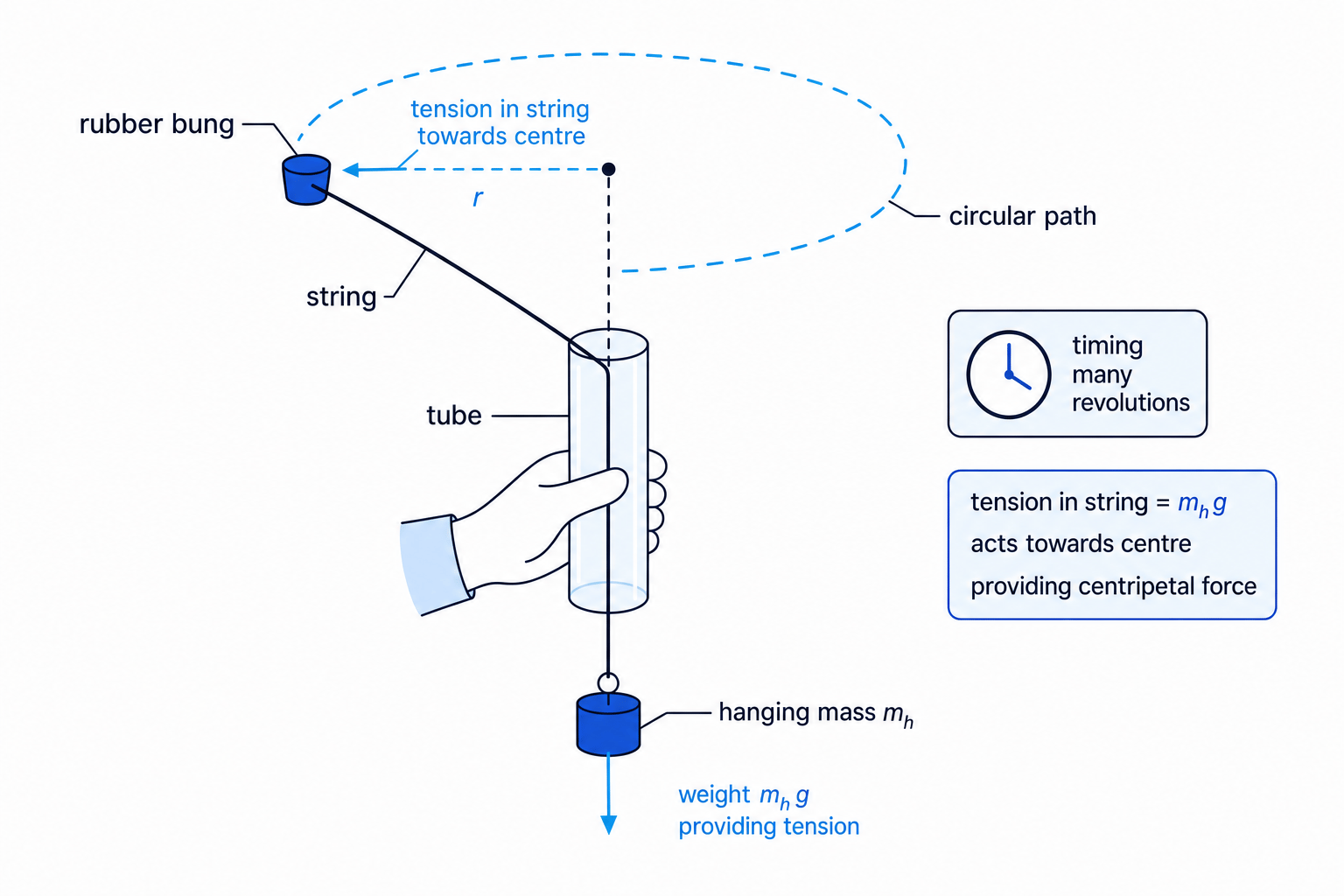
If the hanging mass is stationary, its weight provides the tension in the string:
F=mhgF = m_h gF=mhgwhere mhm_hmh is the hanging mass. This tension acts towards the centre of the bung’s circular path, so it provides the centripetal force for the bung:
mhg=mbv2rm_h g = \frac{m_b v^2}{r}mhg=rmbv2where mbm_bmb is the mass of the bung.
To measure the speed of the bung, time many revolutions rather than just one. If NNN revolutions take time ttt, then:
T=tNT = \frac{t}{N}T=Ntand
v=2πrTv = \frac{2\pi r}{T}v=T2πrA useful analysis method is to plot mhgm_h gmhg against v2r\frac{v^2}{r}rv2. The gradient should be the mass of the bung, mbm_bmb, because:
F=mb(v2r)F = m_b\left(\frac{v^2}{r}\right)F=mb(rv2)Assumptions in the bung experiment
The tension is only approximately equal to mhgm_h gmhg if the hanging mass stays stationary and friction where the string passes through the tube is small.
Improving the measurement
Time at least 10 or 20 revolutions, repeat the timing, and measure the radius from the centre of the tube to the centre of the bung. Use a marker on the string just below the tube to help keep the radius constant.
Analysing whirling bung data
A bung of mass 0.0500 kg is whirled at radius 0.500 m. It completes 20 revolutions in 14.2 s. A hanging mass of 0.200 kg is used. Check whether the data are consistent with the hanging weight providing the centripetal force.
-
Calculate the period and then the speed:
T=14.2 s20=0.710 sT = \frac{14.2\ \text{s}}{20} = 0.710\ \text{s}T=2014.2 s=0.710 s v=2π×0.500 m0.710 s=4.43 m s−1v = \frac{2\pi \times 0.500\ \text{m}}{0.710\ \text{s}} = 4.43\ \text{m s}^{-1}v=0.710 s2π×0.500 m=4.43 m s−1 -
Calculate the centripetal force needed for the bung:
F=0.0500 kg×(4.43 m s−1)20.500 mF = \frac{0.0500\ \text{kg} \times (4.43\ \text{m s}^{-1})^2}{0.500\ \text{m}}F=0.500 m0.0500 kg×(4.43 m s−1)2 F=1.96 NF = 1.96\ \text{N}F=1.96 N -
Compare this with the hanging weight:
mhg=0.200 kg×9.81 N kg−1=1.96 Nm_h g = 0.200\ \text{kg} \times 9.81\ \text{N kg}^{-1} = 1.96\ \text{N}mhg=0.200 kg×9.81 N kg−1=1.96 NThe two values match to three significant figures, so the data support the model well.
In the exam
- Start by drawing a quick sketch: velocity tangent to the circle, acceleration and resultant force towards the centre.
- Choose the equation from the quantities given: use v=ωrv = \omega rv=ωr, a=v2ra = \frac{v^2}{r}a=rv2, a=ω2ra = \omega^2 ra=ω2r, F=mv2rF = \frac{mv^2}{r}F=rmv2 or F=mω2rF = m\omega^2 rF=mω2r.
- In practical questions, remember that the mass moving in the circle is the bung, while the hanging mass provides the tension through its weight.
Check yourself
- Why can an object moving at constant speed in a circle still have acceleration?
- If the angular speed doubles while the radius stays the same, what happens to the centripetal force?
- In the whirling bung experiment, why is it better to time many revolutions rather than one?
