

What you'll learn
- How kinetic energy and potential energy interchange during simple harmonic motion.
- Why the total mechanical energy of an ideal oscillator stays constant.
- How to use the SHM energy equations involving mmm, ω\omegaω, AAA and xxx.
- How to interpret and sketch energy-displacement graphs for a simple harmonic oscillator.
The SHM ideas you need first
A simple harmonic oscillator is a system that undergoes simple harmonic motion: its acceleration is directly proportional to its displacement from equilibrium and acts in the opposite direction.
The defining equation is:
a=−ω2xa = -\omega^2 xa=−ω2xwhere aaa is acceleration in metres per second squared, xxx is displacement from equilibrium in metres, and ω\omegaω is angular frequency in radians per second.
Key positions in SHM
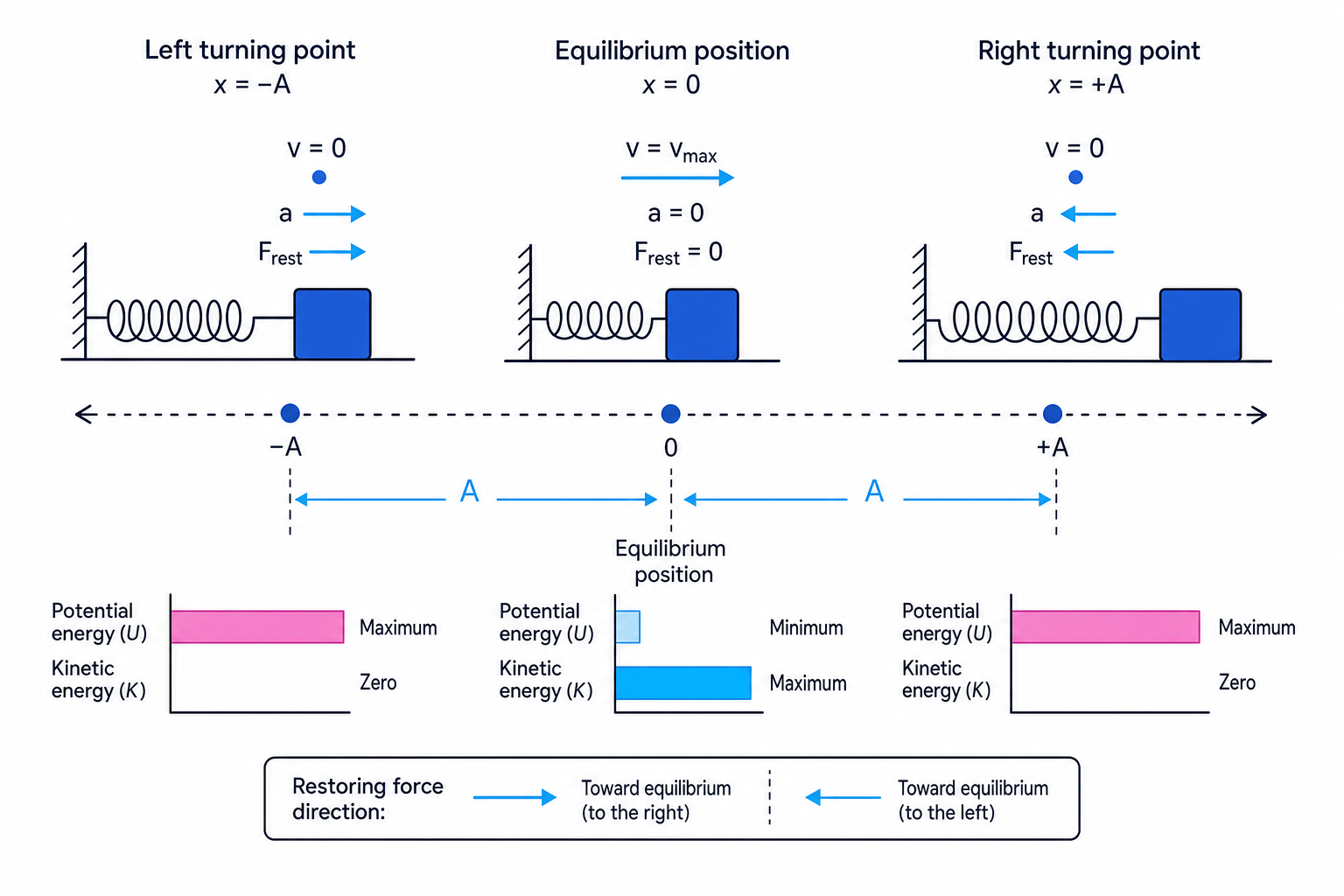
The equilibrium position is where the resultant force is zero. The amplitude AAA is the maximum displacement from equilibrium. The turning points are at x=+Ax = +Ax=+A and x=−Ax = -Ax=−A, where the oscillator momentarily has zero speed.
For a particle of mass mmm, Newton’s second law gives:
F=ma=−mω2xF = ma = -m\omega^2xF=ma=−mω2xSo the restoring force is proportional to displacement. This is why SHM energy graphs have smooth, symmetric curves.
Energy forms in an oscillator
In SHM, energy moves between two stores:
- Kinetic energy EkE_kEk: energy due to motion, given by Ek=12mv2E_k = \frac{1}{2}mv^2Ek=21mv2.
- Potential energy EpE_pEp: energy stored because the oscillator is displaced from equilibrium.
For a horizontal mass-spring oscillator, the potential energy is elastic strain energy. For a pendulum, it is gravitational potential energy. In both cases, for small oscillations that obey SHM, the potential energy is lowest at equilibrium and greatest at the turning points.
Energy interchange
In an ideal undamped oscillator, total mechanical energy is constant. At the turning points, all the energy is potential. At equilibrium, the potential energy is minimum and the kinetic energy is maximum.
The word ideal matters: it means no energy is transferred away to the surroundings by friction, air resistance or internal heating.
Potential energy as a function of displacement
Because the restoring force is proportional to displacement, the work done to move the oscillator slowly from equilibrium to displacement xxx is the area under a straight-line force-displacement graph.
That area is triangular, so:
Ep=12mω2x2E_p = \frac{1}{2}m\omega^2x^2Ep=21mω2x2This assumes we choose the potential energy at equilibrium to be zero.
For a spring oscillator, since mω2=km\omega^2 = kmω2=k, you may also write:
Ep=12kx2E_p = \frac{1}{2}kx^2Ep=21kx2where kkk is the spring constant in newtons per metre.
Why the square matters
Potential energy depends on x2x^2x2, so the potential energy is the same at +x+x+x and −x-x−x. Being equally far left or right of equilibrium stores the same energy.
Total energy of the oscillator
The maximum potential energy occurs at the turning points, where x=±Ax = \pm Ax=±A and the speed is zero.
So the total mechanical energy is:
ET=12mω2A2E_T = \frac{1}{2}m\omega^2A^2ET=21mω2A2For a spring oscillator:
ET=12kA2E_T = \frac{1}{2}kA^2ET=21kA2This tells you an important scaling rule: if the amplitude doubles, the total energy becomes four times larger.
Kinetic energy at any displacement
At any displacement, the total energy is split between potential and kinetic energy:
ET=Ek+EpE_T = E_k + E_pET=Ek+EpSo:
Ek=ET−Ep=12mω2A2−12mω2x2=12mω2(A2−x2)\begin{aligned} E_k &= E_T - E_p \\ &= \frac{1}{2}m\omega^2A^2 - \frac{1}{2}m\omega^2x^2 \\ &= \frac{1}{2}m\omega^2(A^2 - x^2) \end{aligned}Ek=ET−Ep=21mω2A2−21mω2x2=21mω2(A2−x2)This is largest at x=0x = 0x=0 and zero at x=±Ax = \pm Ax=±A.
Using x instead of A for total energy
The total energy depends on the amplitude AAA, not the current displacement xxx. Use ET=12mω2A2E_T = \frac{1}{2}m\omega^2A^2ET=21mω2A2 for the total, then use Ep=12mω2x2E_p = \frac{1}{2}m\omega^2x^2Ep=21mω2x2 for the energy stored at a particular position.
Calculating energy at a displacement
A mass of 0.150 kg oscillates with frequency 2.00 Hz and amplitude 5.0 cm. Calculate the total energy, the potential energy and the kinetic energy when the displacement is 3.0 cm.
-
Convert the distances into metres and calculate angular frequency:
A=5.0 cm=0.050 mx=3.0 cm=0.030 mω=2πf=2π×2.00 Hz=12.6 rad s−1\begin{aligned} A &= 5.0\text{ cm} = 0.050\text{ m} \\ x &= 3.0\text{ cm} = 0.030\text{ m} \\ \omega &= 2\pi f = 2\pi \times 2.00\text{ Hz} = 12.6\text{ rad s}^{-1} \end{aligned}Axω=5.0 cm=0.050 m=3.0 cm=0.030 m=2πf=2π×2.00 Hz=12.6 rad s−1 -
Use the amplitude to calculate the total energy:
ET=12mω2A2=12(0.150 kg)(12.6 rad s−1)2(0.050 m)2=2.96×10⁻² J\begin{aligned} E_T &= \frac{1}{2}m\omega^2A^2 \\ &= \frac{1}{2}(0.150\text{ kg})(12.6\text{ rad s}^{-1})^2(0.050\text{ m})^2 \\ &= 2.96 \times 10^{-2}\text{ J} \end{aligned}ET=21mω2A2=21(0.150 kg)(12.6 rad s−1)2(0.050 m)2=2.96×10⁻² J -
Use the current displacement to calculate the potential energy:
Ep=12mω2x2=12(0.150 kg)(12.6 rad s−1)2(0.030 m)2=1.07×10⁻² J\begin{aligned} E_p &= \frac{1}{2}m\omega^2x^2 \\ &= \frac{1}{2}(0.150\text{ kg})(12.6\text{ rad s}^{-1})^2(0.030\text{ m})^2 \\ &= 1.07 \times 10^{-2}\text{ J} \end{aligned}Ep=21mω2x2=21(0.150 kg)(12.6 rad s−1)2(0.030 m)2=1.07×10⁻² J -
Subtract to find the kinetic energy:
Ek=ET−Ep=2.96×10⁻² J−1.07×10⁻² J=1.89×10⁻² J\begin{aligned} E_k &= E_T - E_p \\ &= 2.96 \times 10^{-2}\text{ J} - 1.07 \times 10^{-2}\text{ J} \\ &= 1.89 \times 10^{-2}\text{ J} \end{aligned}Ek=ET−Ep=2.96×10⁻² J−1.07×10⁻² J=1.89×10⁻² J
Energy-displacement graphs
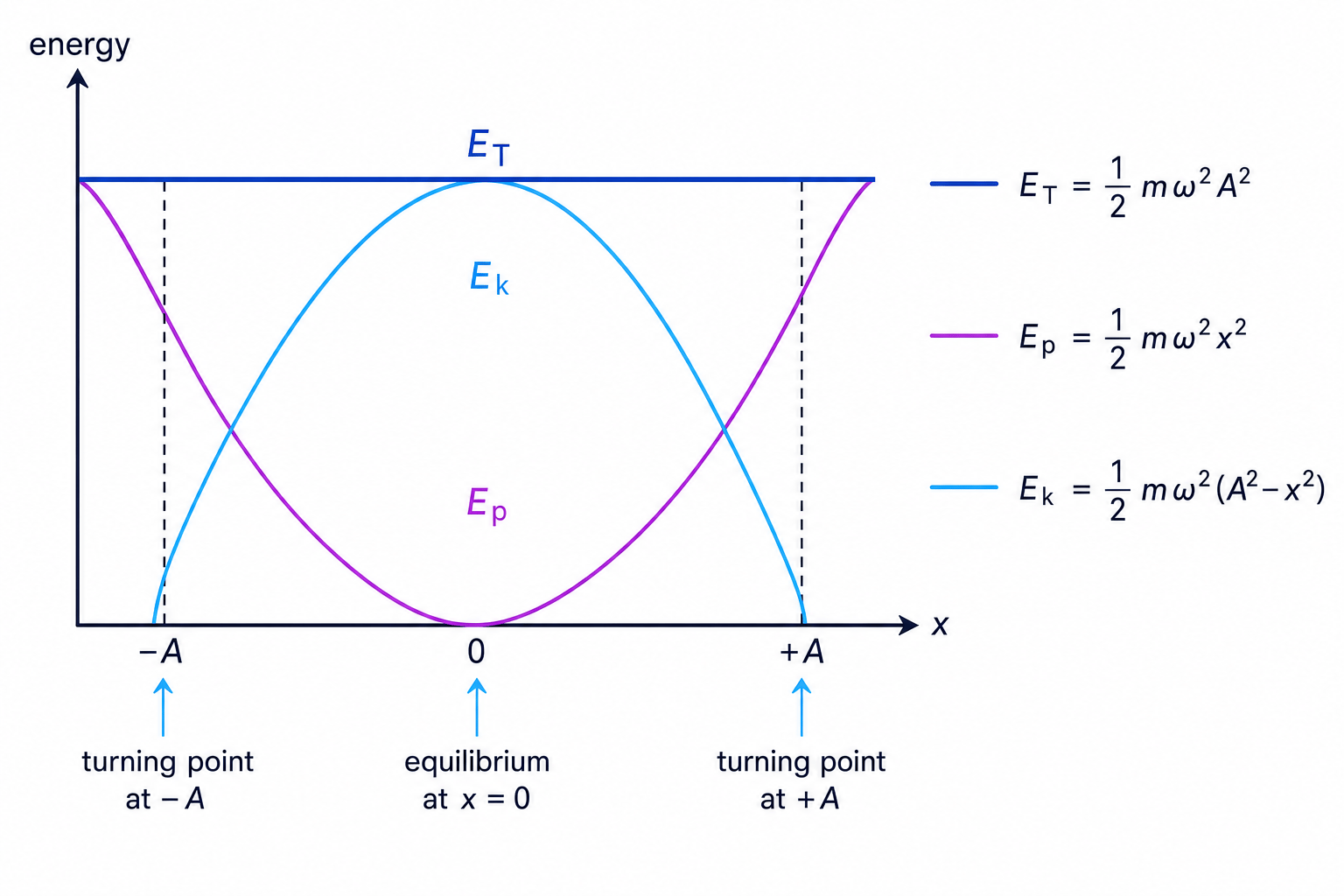
An energy-displacement graph shows how energy depends on position xxx, not on time.
For a simple harmonic oscillator:
- Total energy ETE_TET is a horizontal line.
- Potential energy EpE_pEp is an upward-opening parabola.
- Kinetic energy EkE_kEk is a downward-opening parabola.
- Both EpE_pEp and EkE_kEk are symmetric about x=0x = 0x=0.
- The allowed motion is only between x=−Ax = -Ax=−A and x=+Ax = +Ax=+A.
At the turning points:
x=±A,Ek=0,Ep=ETx = \pm A,\quad E_k = 0,\quad E_p = E_Tx=±A,Ek=0,Ep=ETAt equilibrium:
x=0,Ep=0,Ek=ETx = 0,\quad E_p = 0,\quad E_k = E_Tx=0,Ep=0,Ek=ETThis is not a time graph
An energy-displacement graph does not tell you whether the oscillator is moving left or right. The oscillator passes most displacements twice per cycle, once in each direction, with the same kinetic and potential energies.
Reading graph values using fractions
You can often solve energy graph questions without knowing mmm or ω\omegaω.
Since:
Ep=12mω2x2E_p = \frac{1}{2}m\omega^2x^2Ep=21mω2x2and:
ET=12mω2A2E_T = \frac{1}{2}m\omega^2A^2ET=21mω2A2dividing gives:
EpET=x2A2\frac{E_p}{E_T} = \frac{x^2}{A^2}ETEp=A2x2So:
Ep=ET(xA)2E_p = E_T\left(\frac{x}{A}\right)^2Ep=ET(Ax)2Then:
Ek=ET−EpE_k = E_T - E_pEk=ET−EpReading an energy-displacement graph
An oscillator has amplitude 8.0 cm and total energy 0.32 J. Find the kinetic and potential energies when the displacement is 4.0 cm.
-
Compare the displacement with the amplitude:
xA=4.0 cm8.0 cm=0.50\frac{x}{A} = \frac{4.0\text{ cm}}{8.0\text{ cm}} = 0.50Ax=8.0 cm4.0 cm=0.50 -
Square the fraction to find the fraction of total energy stored as potential energy:
EpET=(0.50)2=0.25\frac{E_p}{E_T} = (0.50)^2 = 0.25ETEp=(0.50)2=0.25 -
Calculate the potential energy:
Ep=0.25×0.32 J=0.080 JE_p = 0.25 \times 0.32\text{ J} = 0.080\text{ J}Ep=0.25×0.32 J=0.080 J -
Use conservation of energy to calculate the kinetic energy:
Ek=0.32 J−0.080 J=0.24 JE_k = 0.32\text{ J} - 0.080\text{ J} = 0.24\text{ J}Ek=0.32 J−0.080 J=0.24 J
A quick method for exam calculations
When you see an SHM energy question, use this order:
- Identify the amplitude AAA and the displacement xxx separately.
- Convert all distances into metres.
- Find ω\omegaω if needed, usually from ω=2πf\omega = 2\pi fω=2πf.
- Calculate total energy using AAA.
- Calculate potential energy using xxx.
- Calculate kinetic energy by subtraction.
In the exam
- Label the turning points x=−Ax = -Ax=−A and x=+Ax = +Ax=+A before interpreting an energy graph.
- Check whether the question gives amplitude, displacement, frequency, period or spring constant; choose the matching energy equation.
- Sanity-check your answer: EkE_kEk cannot be negative, and EpE_pEp cannot exceed ETE_TET for a valid displacement.
Check yourself
- Why is kinetic energy zero at the turning points but maximum at equilibrium?
- If the amplitude of an ideal oscillator is tripled, what happens to its total energy?
- On an energy-displacement graph, why do the curves have the same values at +x+x+x and −x-x−x?
