

What you'll learn
- How to tell whether a physical quantity is a scalar or a vector.
- How to add and subtract vectors using arrows.
- How to find the resultant of two coplanar vectors by scale drawing or calculation.
- How to resolve a vector into perpendicular components using Fx=FcosθF_x = F\cos\thetaFx=Fcosθ and Fy=FsinθF_y = F\sin\thetaFy=Fsinθ.
Physical quantities: magnitude, unit and direction
A physical quantity is something measurable, such as mass, time, force or velocity. A complete measurement usually needs a magnitude and a unit.
For example, a mass might be 2.5 kg. The magnitude is 2.5 and the unit is kilograms, kg.
Some quantities also need a direction. A force of 10 N to the right is not the same as a force of 10 N to the left, even though the magnitudes are the same.
Magnitude
The magnitude of a quantity is its size, written as a positive value with a unit. For a vector, the magnitude is the length of the arrow representing it.
Scalars and vectors
Scalar and vector quantities
A scalar quantity has magnitude only. A vector quantity has both magnitude and direction.
Examples of scalar quantities include:
- mass, measured in kilograms, kg
- time, measured in seconds, s
- temperature, measured in kelvin, K
- distance, measured in metres, m
- speed, measured in metres per second, m s⁻¹
- energy, measured in joules, J
- power, measured in watts, W
Examples of vector quantities include:
- displacement, measured in metres, m
- velocity, measured in metres per second, m s⁻¹
- acceleration, measured in metres per second squared, m s⁻²
- force, measured in newtons, N
- weight, measured in newtons, N
- momentum, measured in kilogram metres per second, kg m s⁻¹
Direction matters
If changing the direction changes the physical effect, the quantity is a vector. If direction is irrelevant, the quantity is a scalar.
Distance and displacement
Distance is the total length of the path travelled. It is a scalar.
Displacement is the straight-line change in position from the start point to the finish point, including direction. It is a vector.
Distance is not displacement
A journey can have a large distance but zero displacement. For example, if you run one complete lap of a circular track and return to the start, your distance is the circumference of the track, but your displacement is zero.
Comparing distance and displacement
A student walks 30 m east, then 40 m north. Find the distance travelled and the displacement from the starting point.
-
Add the path lengths to find the scalar distance:
distance=30 m+40 m=70 m\text{distance} = 30\text{ m} + 40\text{ m} = 70\text{ m}distance=30 m+40 m=70 m -
Treat the east and north parts as perpendicular vector components, so the displacement magnitude is found using Pythagoras’ theorem:
s=(30 m)2+(40 m)2=50 m\begin{aligned} s &= \sqrt{(30\text{ m})^2 + (40\text{ m})^2} \\ &= 50\text{ m} \end{aligned}s=(30 m)2+(40 m)2=50 m -
Find the direction relative to east using trigonometry:
tanθ=4030θ=53∘\begin{aligned} \tan\theta &= \frac{40}{30} \\ \theta &= 53^\circ \end{aligned}tanθθ=3040=53∘ -
The displacement is therefore 50 m at 53° north of east.
Representing vectors with arrows
A vector can be drawn as an arrow.
- The length of the arrow represents the magnitude.
- The arrowhead shows the direction.
- The same vector can be moved around on the page as long as its length and direction do not change.
The magnitude of a vector A⃗\vec{A}A may be written as ∣A⃗∣|\vec{A}|∣A∣, or simply AAA when the context is clear.
Resultant vector
The resultant vector is the single vector that has the same overall effect as two or more vectors acting together.
Vector addition and subtraction
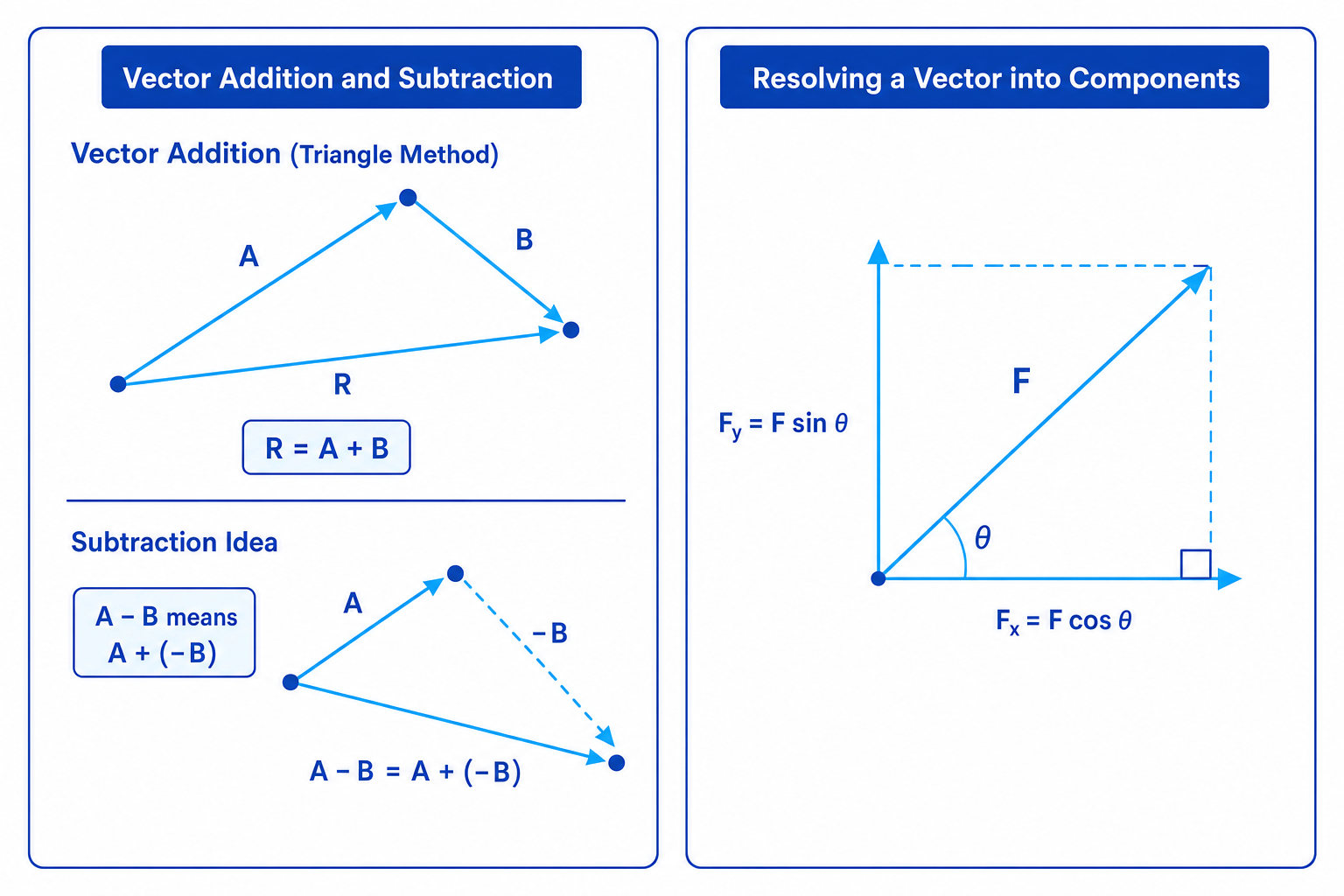
To add vectors, use the head-to-tail method:
- Draw the first vector.
- Draw the second vector starting from the head of the first.
- Draw the resultant from the tail of the first vector to the head of the final vector.
The order of addition does not change the final resultant: A⃗+B⃗=B⃗+A⃗\vec{A} + \vec{B} = \vec{B} + \vec{A}A+B=B+A.
To subtract a vector, add the negative of that vector. The vector −B⃗-\vec{B}−B has the same magnitude as B⃗\vec{B}B but points in the opposite direction.
A⃗−B⃗=A⃗+(−B⃗)\vec{A} - \vec{B} = \vec{A} + (-\vec{B})A−B=A+(−B)The diagram below shows vector addition, subtraction, and the idea of resolving a vector into components.
Adding magnitudes only
You can only add vector magnitudes directly when the vectors act in exactly the same direction. If the directions differ, you must use a vector diagram or components.
Vector triangles
Two vectors are coplanar if they lie in the same plane. For A Level questions in this topic, that usually means they can be drawn on a flat page.
A vector triangle is formed when two vectors are placed head-to-tail and the resultant completes the triangle.
Scale drawing method
A scale drawing is a graphical method for finding a resultant.
- Choose a sensible scale, such as 1 cm representing 2 N.
- Draw the first vector accurately with a ruler and protractor.
- Draw the second vector from the head of the first, at the correct angle.
- Draw the resultant from the start point to the final point.
- Measure the length and direction of the resultant, then convert the length using your scale.
Scale drawing accuracy
Use as large a diagram as the page allows. A tiny vector triangle makes percentage uncertainty in your measured length and angle much larger.
Calculation method
For a right-angled vector triangle, use Pythagoras’ theorem and basic trigonometry.
For non-right-angled triangles, you can use the cosine rule and sine rule, or resolve the vectors into perpendicular components. Components are usually the most reliable method in exam solutions.
Finding a resultant force
Two coplanar forces act on an object. One force is 6.0 N east. The other is 8.0 N at 60° north of east. Find the magnitude and direction of the resultant force.
-
Resolve the 8.0 N force into east and north components:
Feast=8.0cos60∘=4.0 NFnorth=8.0sin60∘=6.93 N\begin{aligned} F_{\text{east}} &= 8.0\cos 60^\circ = 4.0\text{ N} \\ F_{\text{north}} &= 8.0\sin 60^\circ = 6.93\text{ N} \end{aligned}FeastFnorth=8.0cos60∘=4.0 N=8.0sin60∘=6.93 N -
Add the east components, because both forces have eastward parts:
Fx=6.0 N+4.0 N=10.0 NF_{x} = 6.0\text{ N} + 4.0\text{ N} = 10.0\text{ N}Fx=6.0 N+4.0 N=10.0 N -
The only northward component is from the 8.0 N force:
Fy=6.93 NF_{y} = 6.93\text{ N}Fy=6.93 N -
Use Pythagoras’ theorem to find the resultant magnitude:
R=(10.0 N)2+(6.93 N)2=12.2 N\begin{aligned} R &= \sqrt{(10.0\text{ N})^2 + (6.93\text{ N})^2} \\ &= 12.2\text{ N} \end{aligned}R=(10.0 N)2+(6.93 N)2=12.2 N -
Find the angle north of east:
tanθ=6.9310.0θ=34.7∘\begin{aligned} \tan\theta &= \frac{6.93}{10.0} \\ \theta &= 34.7^\circ \end{aligned}tanθθ=10.06.93=34.7∘ -
The resultant force is 12 N at 35° north of east, to two significant figures.
Resolving a vector into perpendicular components
To resolve a vector means to split it into components in chosen directions. The components are not extra forces or extra velocities; they are a mathematically equivalent way of describing the original vector.
Most commonly, vectors are resolved into horizontal and vertical components.
Components
The components of a vector are perpendicular parts which combine to give the original vector. For horizontal and vertical axes, these are often called the xxx-component and yyy-component.
If a force FFF acts at an angle θ\thetaθ above the horizontal, then:
Fx=FcosθF_x = F\cos\thetaFx=Fcosθ Fy=FsinθF_y = F\sin\thetaFy=FsinθHere, FxF_xFx is the horizontal component and FyF_yFy is the vertical component.
Adjacent uses cosine
When the angle θ\thetaθ is measured from the horizontal, the horizontal component is adjacent to the angle, so Fx=FcosθF_x = F\cos\thetaFx=Fcosθ. The vertical component is opposite the angle, so Fy=FsinθF_y = F\sin\thetaFy=Fsinθ.
Check where the angle is measured from
The equations Fx=FcosθF_x = F\cos\thetaFx=Fcosθ and Fy=FsinθF_y = F\sin\thetaFy=Fsinθ apply when θ\thetaθ is measured from the horizontal. If the angle is measured from the vertical, the sine and cosine swap roles.
Resolving a force
A rope pulls a crate with a force of 45 N at 30° above the horizontal. Calculate the horizontal and vertical components of the force.
-
Identify that the angle is measured from the horizontal, so the horizontal component uses cosine:
Fx=Fcosθ=45 Ncos30∘=39 N\begin{aligned} F_x &= F\cos\theta \\ &= 45\text{ N}\cos 30^\circ \\ &= 39\text{ N} \end{aligned}Fx=Fcosθ=45 Ncos30∘=39 N -
Use sine for the vertical component because it is opposite the 30° angle:
Fy=Fsinθ=45 Nsin30∘=23 N\begin{aligned} F_y &= F\sin\theta \\ &= 45\text{ N}\sin 30^\circ \\ &= 23\text{ N} \end{aligned}Fy=Fsinθ=45 Nsin30∘=23 N -
Check that both components are smaller than the original 45 N force, which is sensible because each is only part of the original vector.
Choosing axes
You are free to choose axes that make the problem easier. Horizontal and vertical axes are common, but on a slope it is often better to choose axes parallel and perpendicular to the slope.
Once you choose positive directions, keep them consistent. Opposite directions should be treated as negative components.
Component method for awkward vectors
For several vectors in different directions, resolve every vector into xxx and yyy components, add all the xxx components, add all the yyy components, then recombine using Pythagoras and trigonometry.
In the exam
- State whether a quantity is scalar or vector by referring to direction, not just by giving an example.
- For vector diagrams, draw arrows head-to-tail and label the resultant from the start point to the final point.
- Before using Fx=FcosθF_x = F\cos\thetaFx=Fcosθ and Fy=FsinθF_y = F\sin\thetaFy=Fsinθ, check that θ\thetaθ is measured from the horizontal.
- Give resultant vectors with both magnitude and direction, including units such as N, m, or m s⁻¹.
- For scale drawings, choose a clear scale and use a ruler and protractor carefully; for calculations, carry units through and round sensibly at the end.
Check yourself
- What is the difference between speed and velocity?
- Two forces of 5 N east and 12 N north act on an object. What is the resultant force?
- A force of 20 N acts at 35° above the horizontal. Which component uses cosine, and why?
