

What you'll learn
- What S.I. base quantities and base units are, and which ones OCR expects you to know.
- How derived units such as newtons, joules and volts are built from base units.
- How to check whether an equation is homogeneous using S.I. base units.
- How to convert prefixes and label graph axes/table columns correctly.
Why units matter
Physics is quantitative: you usually describe a physical quantity using a number and a unit. For example, saying a time is “2.4” is incomplete; saying it is 2.4 s tells someone what has been measured.
The Système International d’Unités, usually written SI, is the internationally agreed system of units. OCR may write this as S.I. units. Using the same units worldwide makes measurements comparable, repeatable and useful in science and engineering.
Physical quantity and unit
A physical quantity is a measurable property, such as mass, length, time or current. A unit is the agreed standard used to measure that quantity, such as kilogram, metre, second or ampere.
The whole topic is a toolkit: start from base units, build derived units, handle prefixes, then use units to check equations and present data clearly.
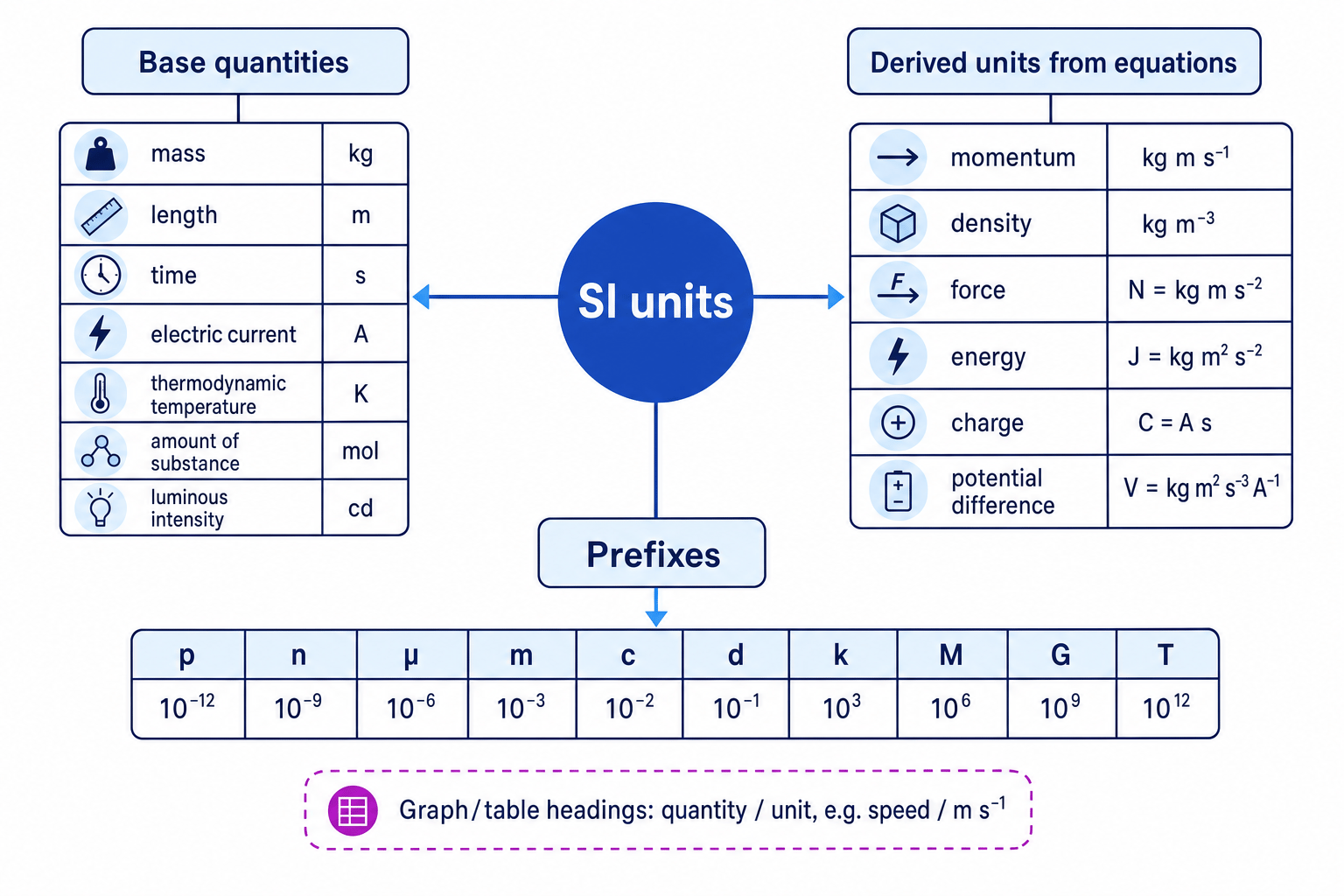
S.I. base quantities and base units
A base quantity is treated as independent: it is not defined by combining other quantities. A base unit is the SI unit for a base quantity.
For OCR A Physics, the key base quantities in this section are:
| Base quantity | SI base unit | Unit symbol |
|---|---|---|
| mass | kilogram | kg |
| length | metre | m |
| time | second | s |
| electric current | ampere | A |
| thermodynamic temperature | kelvin | K |
| amount of substance | mole | mol |
Officially, SI also includes luminous intensity, measured in candela, symbol cd. It is not a major calculation unit in H556, but it is part of the full SI base-unit set.
Writing unit symbols
Unit symbols are case-sensitive and are not pluralised: write 5 kg, not 5 kgs; 300 K, not 300 °K. A capital letter can completely change the meaning, such as m for milli/metre but M for mega.
Derived units
A derived unit is made by combining base units according to the equation defining the quantity.
For example:
- speed has units metre per second, written m s^-1
- acceleration has units metre per second squared, written m s^-2
- momentum has units kg m s^-1
- density has units kg m^-3
Unit algebra
Treat unit symbols like algebraic factors: multiply them, divide them and cancel them using the physical equation.
Deriving units for momentum and density
-
Momentum is given by p=mvp = mvp=mv, where mass has unit kg and velocity has unit m s−1\mathrm{m\,s^{-1}}ms−1.
-
Multiply the units in the equation:
so momentum has units kg m s−1\mathrm{kg\,m\,s^{-1}}kgms−1.
-
Density is given by ρ=mV\rho = \frac{m}{V}ρ=Vm, where mass has unit kg and volume has unit m3\mathrm{m^3}m3.
-
Divide the units:
so density has units kg m−3\mathrm{kg\,m^{-3}}kgm−3.
Named units you should recognise
Many derived units have special names. You still need to know that they are built from base units.
| Unit name | Symbol | Common quantity | Base-unit form |
|---|---|---|---|
| hertz | Hz | frequency | s^-1 |
| newton | N | force | kg m s^-2 |
| joule | J | energy, work done | kg m^2 s^-2 |
| watt | W | power | kg m^2 s^-3 |
| pascal | Pa | pressure | kg m^-1 s^-2 |
| coulomb | C | charge | A s |
| volt | V | potential difference | kg m^2 s^-3 A^-1 |
| ohm | Ω | resistance | kg m^2 s^-3 A^-2 |
| farad | F | capacitance | kg^-1 m^-2 s^4 A^2 |
| tesla | T | magnetic flux density | kg s^-2 A^-1 |
| weber | Wb | magnetic flux | kg m^2 s^-2 A^-1 |
The same letter can mean different things depending on context. For example, italic WWW is often work done in equations such as W=FxcosθW = Fx\cos\thetaW=Fxcosθ, but upright W is the unit watt.
Tesla or tera?
T on its own as a unit symbol means tesla. T before a unit as a prefix means tera, or 101210^{12}1012, such as TW for terawatt.
Checking homogeneity of equations
An equation is homogeneous if every term has the same base units. This is one of the quickest ways to spot impossible equations.
Homogeneous equation
A physical equation is homogeneous when the units on the left-hand side match the units on the right-hand side, and all terms being added or subtracted have the same units.
Constants such as 12\frac{1}{2}21 and functions such as sinθ\sin\thetasinθ or cosθ\cos\thetacosθ have no units. They are dimensionless.
Checking work done equation units
Check whether W=FxcosθW = Fx\cos\thetaW=Fxcosθ is homogeneous.
- Force has units newtons, and from F=maF = maF=ma:
Displacement xxx has unit m, and cosθ\cos\thetacosθ is dimensionless.
- Multiply the right-hand side units:
- Work done is energy, measured in joules, and:
Both sides match, so W=FxcosθW = Fx\cos\thetaW=Fxcosθ is homogeneous.
What homogeneity cannot prove
A homogeneous equation is not necessarily correct. For example, a missing dimensionless constant could still leave the units unchanged. But a non-homogeneous equation is definitely wrong.
Prefixes
A prefix is added before a unit to show a power-of-ten multiplier. Prefixes let you write very large or very small values neatly.
| Prefix | Symbol | Multiplier |
|---|---|---|
| pico | p | 10^-12 |
| nano | n | 10^-9 |
| micro | µ | 10^-6 |
| milli | m | 10^-3 |
| centi | c | 10^-2 |
| deci | d | 10^-1 |
| kilo | k | 10^3 |
| mega | M | 10^6 |
| giga | G | 10^9 |
| tera | T | 10^12 |
In calculations, it is usually safest to convert everything into SI base units before substituting into equations.
Using prefixes in a calculation
A resistor of resistance 4.7 kΩ carries a current of 3.2 mA. Find the potential difference across it.
- Convert the prefixed quantities into SI units:
- Use the equation V=IRV = IRV=IR:
- Combine the numbers and powers of ten:
To two significant figures, the potential difference is 15 V.
Cubed prefixes
Be careful when a prefixed length unit is squared or cubed. Since 1 cm = 10−210^{-2}10−2 m, then 1 cm^3 = 10−610^{-6}10−6 m^3, not 10−210^{-2}10−2 m^3.
Labelling graph axes and table columns
OCR expects graph axes and table headings to follow the convention:
quantity / unit
For example:
- time / s
- speed / m s^-1
- acceleration / m s^-2
- force / N
- potential difference / V
This means the numerical values in the column or on the axis are the quantity divided by that unit. The unit belongs in the heading, not repeated in every data cell.
Labelling a velocity-time graph
You are plotting velocity against time and want the units of the gradient.
-
Label the horizontal axis as time / s and the vertical axis as velocity / m s^-1.
-
A gradient is change in vertical quantity divided by change in horizontal quantity, so the gradient units are:
- Simplify the units:
This is the unit of acceleration, as expected for a velocity-time graph.
A quick axis-label check
If the axis label has only a unit, such as “m s^-1”, it is incomplete. Ask: what quantity is being measured? Write “speed / m s^-1” or “velocity / m s^-1”.
In the exam
-
Convert prefixed quantities to SI units before using formulae, especially mA, kΩ, cm and mm.
-
For unit questions, start from the equation and replace each quantity with its base units.
-
For graphs and tables, use the format quantity / unit, and remember gradient units are vertical-axis units divided by horizontal-axis units.
Check yourself
- What are the SI base units for mass, length, time, current, temperature and amount of substance?
- Show that density has units kg m^-3.
- How should you label the y-axis for a graph of force measured in newtons?

