

What you'll learn
- What a physical quantity is, and why it must have both a number and a unit.
- How changing the unit changes the numerical value, but not the actual quantity.
- How to make sensible estimates using everyday benchmarks and powers of ten.
- How to use estimates to check whether a calculated answer is realistic.
Physical quantities: numbers with meaning
In physics, you rarely write down just a number. A number only becomes useful when you say what it measures and what unit it is measured in.
For example, “5” on its own is not enough. It could mean 5 metres, 5 seconds, 5 kilograms, 5 volts, or something else entirely. The unit tells you the scale being used.
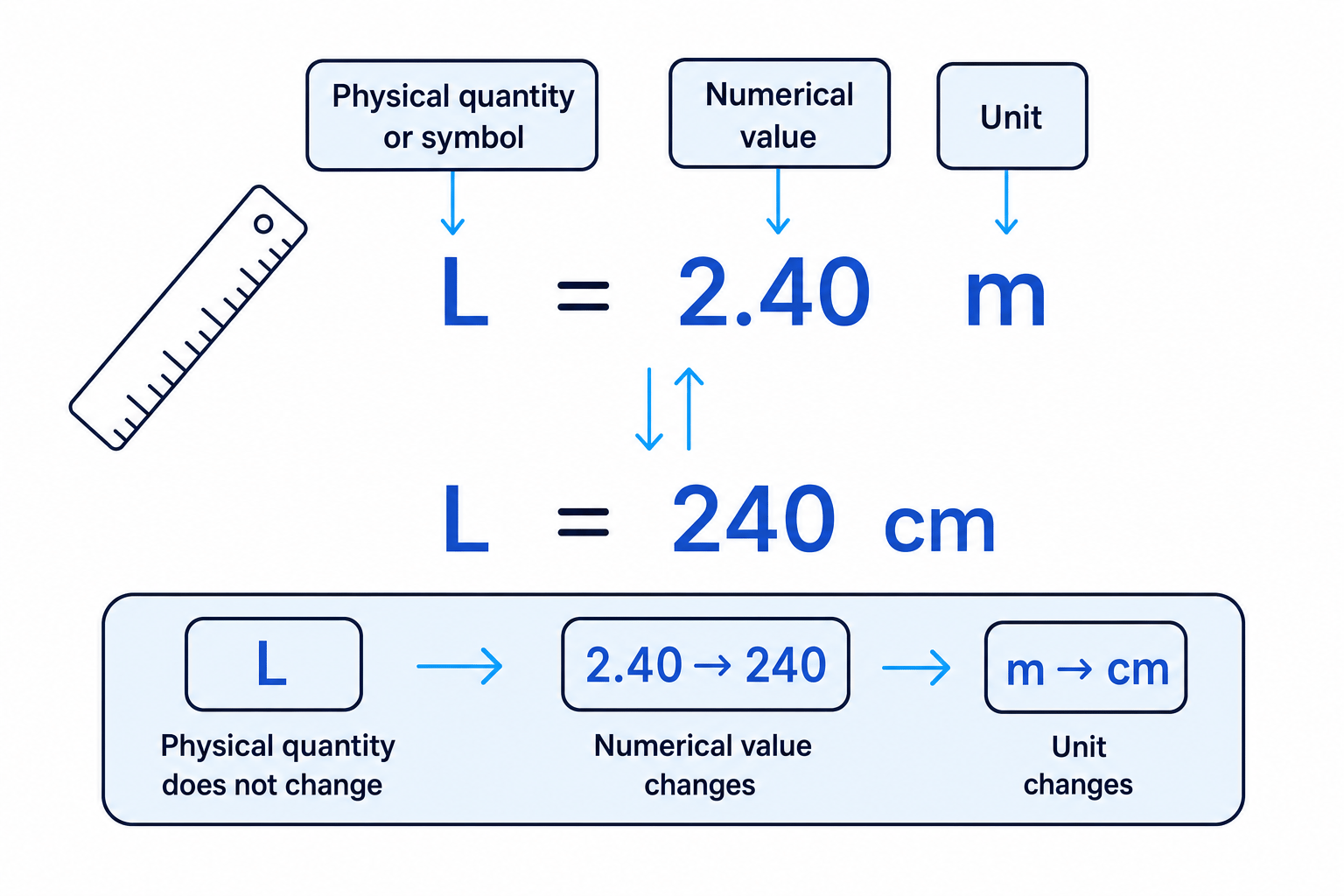
Physical quantity
A physical quantity is a measurable property of an object, system, or event. It is written using a numerical value and a unit, such as length = 2.40 metres, or current = 0.50 amperes.
Numerical value
The numerical value is the number part of a measurement. In the measurement length = 2.40 m, the numerical value is 2.40.
Unit
A unit is the agreed standard used for measurement. For length, the SI unit is the metre, symbol m. For time, the SI unit is the second, symbol s. For mass, the SI unit is the kilogram, symbol kg.
Number and unit come as a pair
A measurement is only complete when it has both a numerical value and a unit. The unit gives the number its physical meaning.
Dropping the unit
Writing an answer such as “speed = 12” is incomplete. You must write the unit, for example speed = 12 m s⁻¹. In exams, missing units can lose marks even when the number is correct.
The same quantity can be written in different units
Changing the unit changes the numerical value, but not the physical quantity itself.
For example:
- 1 metre is the same length as 100 centimetres.
- 1 kilometre is the same distance as 1000 metres.
- 1 millisecond is the same time as 0.001 seconds.
So a length of 2.40 m can also be written as 240 cm. The object has not changed length; only the unit scale has changed.
Changing metres to centimetres
Convert a length of 2.40 m into centimetres.
-
Use the relationship between the units: 1 m = 100 cm.
-
Multiply the numerical value in metres by 100:
- Calculate the new numerical value:
So the length is 240 cm.
Common SI units you will meet early on
The SI system is the internationally agreed system of units used in science. You will use it throughout A-Level Physics.
| Quantity | Common symbol | SI unit | Unit symbol |
|---|---|---|---|
| length | l or x | metre | m |
| time | t | second | s |
| mass | m | kilogram | kg |
| current | I | ampere | A |
| temperature | T | kelvin | K |
| amount of substance | n | mole | mol |
| luminous intensity | — | candela | cd |
You will also meet many derived units, which are built from base units. For example, speed is measured in metres per second, written as m s⁻¹, because it describes distance travelled per unit time.
Prefixes: a compact way to handle very large or small values
Physics often deals with quantities much larger or smaller than everyday values. Prefixes help you avoid long strings of zeros.
| Prefix | Symbol | Multiplier |
|---|---|---|
| pico | p | 10−1210^{-12}10−12 |
| nano | n | 10−910^{-9}10−9 |
| micro | µ | 10−610^{-6}10−6 |
| milli | m | 10−310^{-3}10−3 |
| kilo | k | 10310^3103 |
| mega | M | 10610^6106 |
| giga | G | 10910^9109 |
For example, 5 ms means 5 milliseconds, which is 5×10⁻³⁵ \times 10^{-3}5×10⁻³ s.
Watch the symbol case
Lower-case m means milli, so mm means millimetre. Upper-case M means mega, so MW means megawatt. These are completely different scale factors.
Converting milliseconds to seconds
Convert 25 ms into seconds.
-
Identify the prefix: milli means 10−310^{-3}10−3.
-
Replace ms with 10−310^{-3}10−3 s:
- Write the value in seconds:
Estimating physical quantities
An estimate is a sensible approximate value. It does not need to be exact, but it should be physically reasonable.
Estimating is important because it helps you:
- choose suitable equipment in practical work
- check whether a calculated answer is plausible
- simplify a complex situation into a workable model
- avoid accepting calculator answers that are clearly impossible
Estimate
An estimate is an approximate value based on reasonable assumptions, known reference values, and simple calculation.
Order of magnitude
An order of magnitude is a power-of-ten scale. If a quantity is about 10310^3103 times bigger than another, it is about three orders of magnitude bigger.
For example:
- a human height is about 1 m, so its order of magnitude is 10010^0100 m
- the diameter of an atom is about 10−1010^{-10}10−10 m
- the Earth–Sun distance is about 101110^{11}1011 m
You usually do not need lots of significant figures in an estimate. One significant figure is often enough.
Estimate before you calculate
Before using a calculator, ask: “Should this answer be roughly 0.1, 1, 10, 100, or much bigger?” This makes it easier to spot powers-of-ten mistakes.
A simple method for making estimates
A good estimate usually follows the same structure.
1. Choose a simple model
A model is a simplified version of the real situation. You ignore details that do not strongly affect the answer.
For example, you might model a classroom as a rectangular box, or a person walking at a steady speed.
2. Use benchmark values
A benchmark value is a rough value you already know and can compare with.
Useful A-Level Physics benchmarks include:
| Quantity | Sensible approximate value |
|---|---|
| acceleration of free fall near Earth | about 10 m s⁻² |
| speed of walking | about 1 m s⁻¹ |
| speed of a car on a fast road | about 30 m s⁻¹ |
| speed of sound in air | about 300 m s⁻¹ |
| speed of light in a vacuum | about 3×1083 \times 10^83×108 m s⁻¹ |
| density of water | about 1000 kg m⁻³ |
| density of air | about 1 kg m⁻³ |
| room temperature | about 300 K |
| mains frequency in the UK | 50 Hz |
| UK mains potential difference | about 230 V |
3. Calculate with rounded numbers
Use simple rounded numbers, then keep the answer to a sensible number of significant figures.
Estimating a walking speed
Estimate the speed of a student walking across a laboratory.
-
Choose reasonable values. Suppose the laboratory is about 10 m long and the student takes about 8 s to cross it.
-
Use the definition of speed:
- Substitute the estimated values with units:
- Round suitably for an estimate:
This is reasonable because normal walking speed is around 1 m s⁻¹.
Estimating to check an answer
Estimates are not just for “guessing” answers. They are also a powerful way to test whether a final answer makes sense.
Suppose you calculate the speed of a cyclist and get 400 m s⁻¹. An estimate tells you something is wrong: 400 m s⁻¹ is faster than the speed of sound in air, so it is not a realistic cycling speed. The error might be a unit conversion, a mistyped calculator value, or using minutes instead of seconds.
Calculator answers without sense checks
A calculator can give many digits, but it cannot tell you whether the physics is reasonable. Always compare your answer with a rough estimate or known benchmark.
Significant figures in estimates
A significant figure is a meaningful digit in a measured or calculated value. In estimates, you normally use only one or two significant figures.
For example, if you estimate the mass of air in a room, it would be sensible to write about 100 kg, not 96.428 kg. The input values were approximate, so the final answer should be approximate too.
Estimating the mass of air in a classroom
Estimate the mass of air in a classroom of dimensions 8 m by 5 m by 3 m.
- Model the classroom as a rectangular box and calculate its volume:
- Use a benchmark value for the density of air:
- Use mass = density × volume:
- Round sensibly for an estimate:
So the classroom contains roughly 100 kg of air.
In the exam
-
Always include a unit with any measured or calculated physical quantity.
-
When estimating, state clear assumptions, use rounded values, and keep the final answer to a sensible number of significant figures.
-
Use benchmarks and order-of-magnitude thinking to check whether your answer is physically realistic.
Check yourself
- Why is “time = 12” not a complete physical measurement?
- Convert 0.75 km into metres, and explain what happens to the numerical value.
- Estimate the time it would take you to walk 100 m at normal walking speed.
