

What you'll learn
- Why a projectile’s horizontal and vertical motions can be treated independently.
- How to resolve an initial velocity into perpendicular components.
- How to use constant-acceleration equations separately in each direction.
- How to solve flight time, range, maximum height and impact velocity problems.
The starting point: motion in two dimensions
In earlier motion work, you often used one straight line: left/right or up/down. Projectile motion needs two perpendicular directions at once.
A displacement is the change in position of an object, with both size and direction. A velocity is the rate of change of displacement. An acceleration is the rate of change of velocity.
For projectile motion, we usually choose:
- the horizontal direction as the xxx-direction
- the vertical direction as the yyy-direction
These directions are perpendicular, meaning they are at right angles to each other.
Projectile
A projectile is an object that has been launched and then moves only under gravity. In this A-Level model, air resistance is ignored unless a question explicitly tells you otherwise.
Resolving the initial velocity
A component of a vector is the part of that vector in a chosen direction. Resolving a vector means splitting it into components, usually horizontal and vertical.
If a projectile is launched with speed uuu at an angle θ\thetaθ above the horizontal, then:
ux=ucosθuy=usinθ\begin{aligned} u_x &= u\cos\theta \\ u_y &= u\sin\theta \end{aligned}uxuy=ucosθ=usinθThe horizontal component uses cosine because it is adjacent to the angle. The vertical component uses sine because it is opposite the angle.
Resolving launch velocity
A ball is launched at 18.0 m s−118.0 \ \text{m s}^{-1}18.0 m s−1 at 35.0∘35.0^\circ35.0∘ above the horizontal. Find its initial horizontal and vertical velocity components.
-
Choose horizontal and vertical axes. The launch angle is measured from the horizontal, so the horizontal component is adjacent to the angle and the vertical component is opposite it.
-
Calculate the horizontal component: ux=ucosθ=(18.0 m s−1)cos35.0∘=14.7 m s−1u_x = u\cos\theta = (18.0 \ \text{m s}^{-1})\cos 35.0^\circ = 14.7 \ \text{m s}^{-1}ux=ucosθ=(18.0 m s−1)cos35.0∘=14.7 m s−1.
-
Calculate the vertical component: uy=usinθ=(18.0 m s−1)sin35.0∘=10.3 m s−1u_y = u\sin\theta = (18.0 \ \text{m s}^{-1})\sin 35.0^\circ = 10.3 \ \text{m s}^{-1}uy=usinθ=(18.0 m s−1)sin35.0∘=10.3 m s−1.
The key model: horizontal and vertical motion are independent
Once the projectile is in flight, gravity acts vertically downwards. In the no-air-resistance model, there is no horizontal acceleration.
So the projectile has:
- constant velocity horizontally
- constant acceleration vertically
Near Earth’s surface, the acceleration due to gravity has magnitude g=9.81 m s−2g = 9.81 \ \text{m s}^{-2}g=9.81 m s−2. If you choose upward as positive, then the vertical acceleration is ay=−g=−9.81 m s−2a_y = -g = -9.81 \ \text{m s}^{-2}ay=−g=−9.81 m s−2.
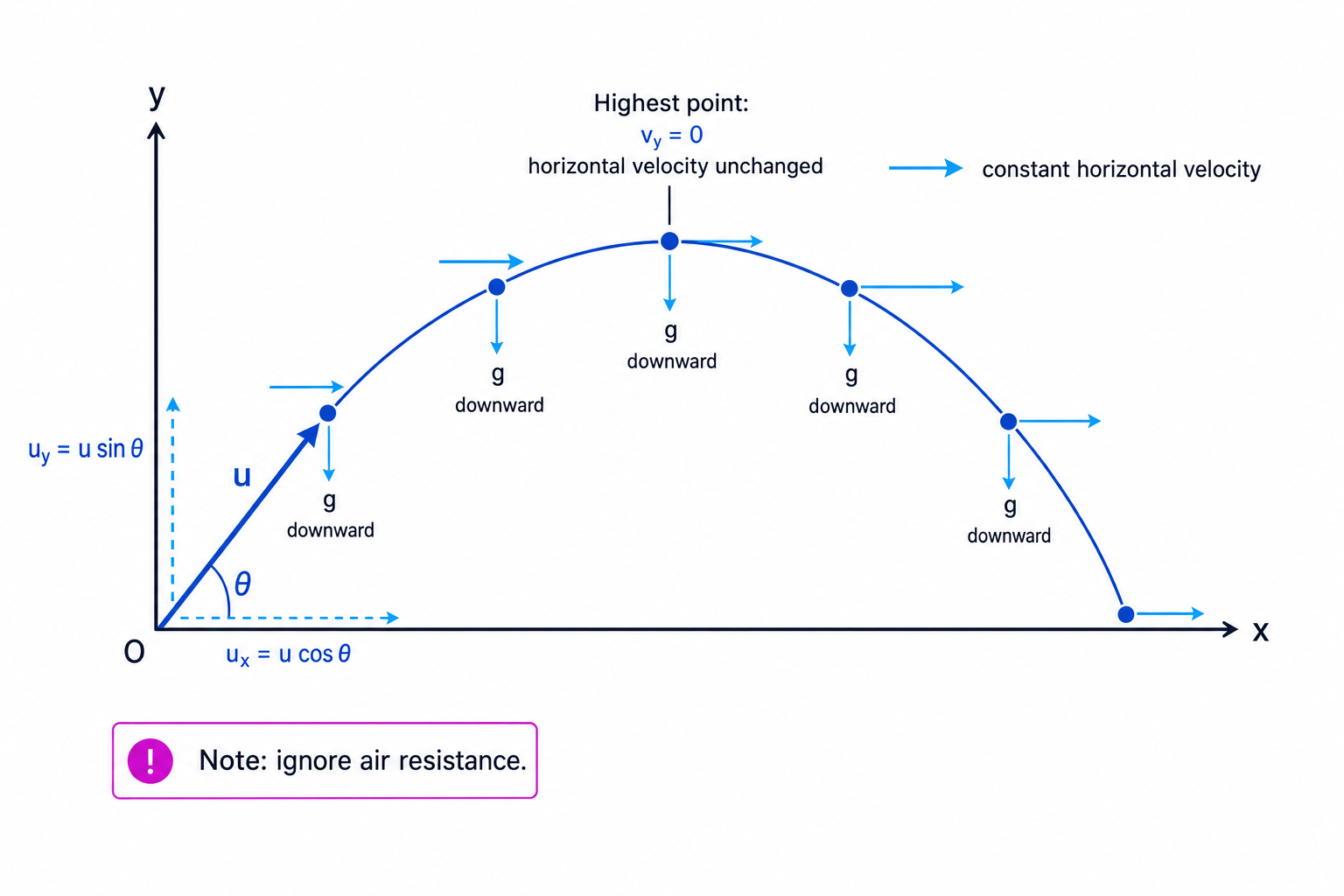
Independence of components
The horizontal and vertical motions share the same time ttt, but the equations are applied separately in each direction. Vertical acceleration does not change the horizontal velocity.
For horizontal motion:
ax=0vx=uxsx=uxt\begin{aligned} a_x &= 0 \\ v_x &= u_x \\ s_x &= u_x t \end{aligned}axvxsx=0=ux=uxtFor vertical motion, use the constant-acceleration equations with ay=−ga_y = -gay=−g if upward is positive:
v=u+ats=ut+12at2v2=u2+2ass=(u+v2)t\begin{aligned} v &= u + at \\ s &= ut + \frac{1}{2}at^2 \\ v^2 &= u^2 + 2as \\ s &= \left(\frac{u+v}{2}\right)t \end{aligned}vsv2s=u+at=ut+21at2=u2+2as=(2u+v)tWhen using these vertically, replace uuu, vvv, aaa and sss with uyu_yuy, vyv_yvy, aya_yay and sys_ysy.
Horizontal launch from a height
A ball rolls horizontally off a table at 6.0 m s−16.0 \ \text{m s}^{-1}6.0 m s−1. The table is 1.25 m1.25 \ \text{m}1.25 m high. Find the time taken to hit the floor and the horizontal distance travelled.
-
Choose upward as positive. Vertically, the ball starts with uy=0 m s−1u_y = 0 \ \text{m s}^{-1}uy=0 m s−1, has displacement sy=−1.25 ms_y = -1.25 \ \text{m}sy=−1.25 m, and acceleration ay=−9.81 m s−2a_y = -9.81 \ \text{m s}^{-2}ay=−9.81 m s−2.
-
Use the vertical equation sy=uyt+12ayt2s_y = u_y t + \frac{1}{2}a_y t^2sy=uyt+21ayt2: −1.25 m=0+12(−9.81 m s−2)t2-1.25 \ \text{m} = 0 + \frac{1}{2}(-9.81 \ \text{m s}^{-2})t^2−1.25 m=0+21(−9.81 m s−2)t2, giving t=0.505 st = 0.505 \ \text{s}t=0.505 s.
-
Use the same time horizontally. Since ax=0a_x = 0ax=0, sx=uxt=(6.0 m s−1)(0.505 s)=3.03 ms_x = u_x t = (6.0 \ \text{m s}^{-1})(0.505 \ \text{s}) = 3.03 \ \text{m}sx=uxt=(6.0 m s−1)(0.505 s)=3.03 m, so the horizontal distance is about 3.0 m3.0 \ \text{m}3.0 m.
Mixing components
Do not put horizontal and vertical quantities into the same SUVAT equation. For example, never combine horizontal displacement with vertical acceleration in one equation.
What the graphs look like
Because the horizontal velocity is constant, the horizontal displacement increases linearly with time. Because the vertical acceleration is constant, the vertical velocity changes linearly with time, and the vertical displacement forms a curved graph.
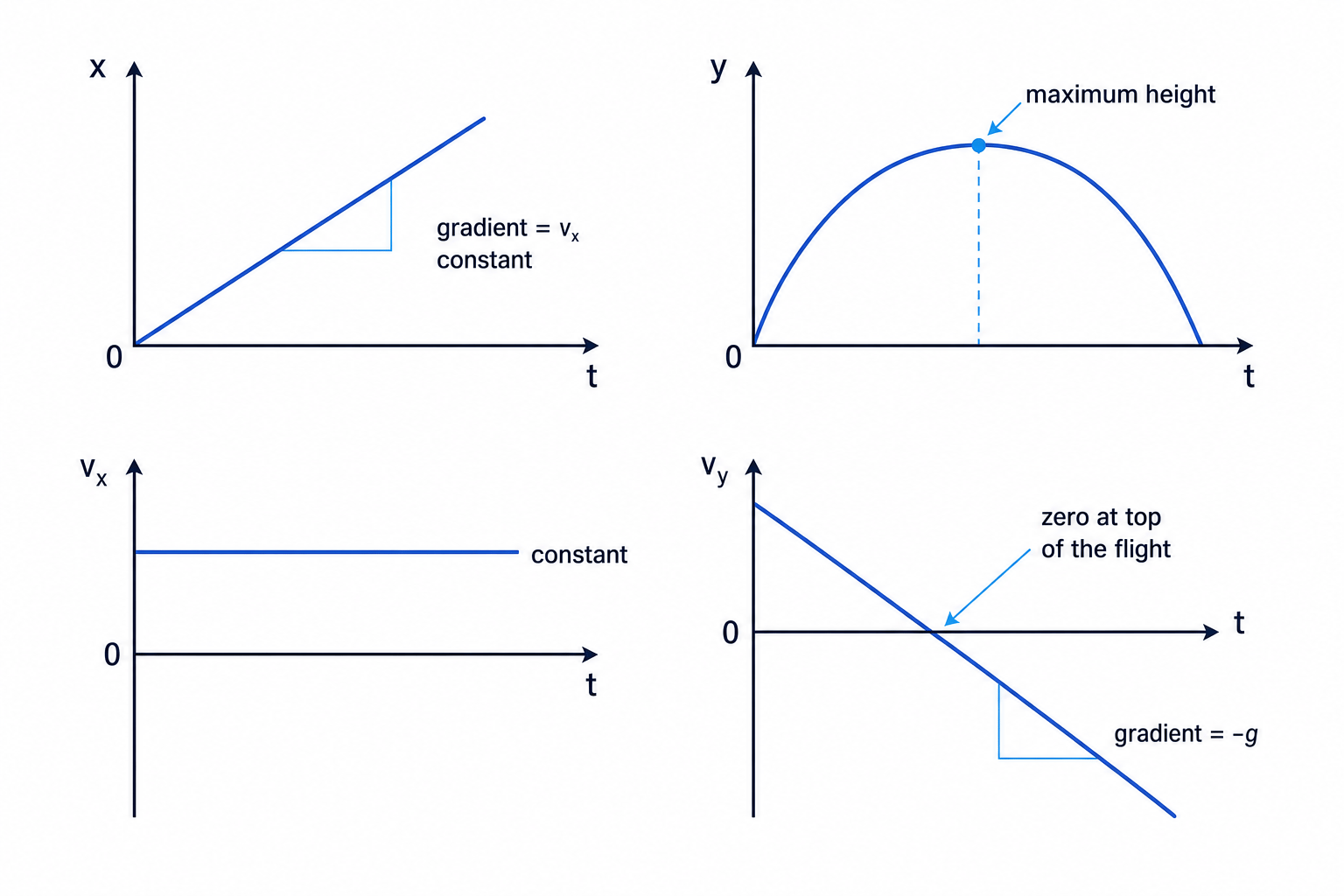
At the highest point of the flight, the vertical velocity is zero. This does not mean the projectile has stopped.
Top of the path
At the highest point, only vyv_yvy is zero. The horizontal velocity vxv_xvx is still unchanged, and the acceleration is still ggg downward.
Using a vertical velocity graph
A projectile has vertical velocity +14.7 m s−1+14.7 \ \text{m s}^{-1}+14.7 m s−1 at launch. Its vertical velocity falls to zero after 1.50 s1.50 \ \text{s}1.50 s. Find the vertical acceleration and the maximum height gained.
-
Use the gradient of the vertical velocity-time graph: ay=ΔvyΔt=0−14.7 m s−11.50 s=−9.80 m s−2a_y = \frac{\Delta v_y}{\Delta t} = \frac{0 - 14.7 \ \text{m s}^{-1}}{1.50 \ \text{s}} = -9.80 \ \text{m s}^{-2}ay=ΔtΔvy=1.50 s0−14.7 m s−1=−9.80 m s−2.
-
The vertical displacement is the area under the vertical velocity-time graph. The area is triangular, so sy=12(1.50 s)(14.7 m s−1)=11.0 ms_y = \frac{1}{2}(1.50 \ \text{s})(14.7 \ \text{m s}^{-1}) = 11.0 \ \text{m}sy=21(1.50 s)(14.7 m s−1)=11.0 m.
-
Since vy=0v_y = 0vy=0 at this instant, this displacement is the maximum height above the launch point.
Solving a full projectile problem
A good method is:
- Draw a simple sketch and choose positive directions.
- Resolve the initial velocity into uxu_xux and uyu_yuy.
- Use vertical motion to find the time, because the height information is usually vertical.
- Use that same time in the horizontal equation.
- If asked for final velocity, combine vxv_xvx and vyv_yvy using Pythagoras and trigonometry.
The time of flight is the total time the projectile is in the air. The range is the horizontal distance travelled before landing.
Best order
Most projectile problems become easier if you find the time from the vertical motion first, then use that time horizontally.
Range and impact velocity for an angled launch
A ball is launched from ground level at 20.0 m s−120.0 \ \text{m s}^{-1}20.0 m s−1 at 30.0∘30.0^\circ30.0∘ above the horizontal. It lands back at ground level. Find the time of flight, range, maximum height and impact velocity.
-
Resolve the initial velocity: ux=(20.0 m s−1)cos30.0∘=17.3 m s−1u_x = (20.0 \ \text{m s}^{-1})\cos 30.0^\circ = 17.3 \ \text{m s}^{-1}ux=(20.0 m s−1)cos30.0∘=17.3 m s−1 and uy=(20.0 m s−1)sin30.0∘=10.0 m s−1u_y = (20.0 \ \text{m s}^{-1})\sin 30.0^\circ = 10.0 \ \text{m s}^{-1}uy=(20.0 m s−1)sin30.0∘=10.0 m s−1.
-
Use vertical motion to find the time of flight. Since it lands at the same height, sy=0 ms_y = 0 \ \text{m}sy=0 m, so 0=(10.0 m s−1)t+12(−9.81 m s−2)t20 = (10.0 \ \text{m s}^{-1})t + \frac{1}{2}(-9.81 \ \text{m s}^{-2})t^20=(10.0 m s−1)t+21(−9.81 m s−2)t2. The non-zero solution is t=2.04 st = 2.04 \ \text{s}t=2.04 s.
-
Use horizontal motion to find the range: sx=uxt=(17.3 m s−1)(2.04 s)=35.3 ms_x = u_x t = (17.3 \ \text{m s}^{-1})(2.04 \ \text{s}) = 35.3 \ \text{m}sx=uxt=(17.3 m s−1)(2.04 s)=35.3 m.
-
Find the maximum height using vy2=uy2+2aysyv_y^2 = u_y^2 + 2a_y s_yvy2=uy2+2aysy, with vy=0 m s−1v_y = 0 \ \text{m s}^{-1}vy=0 m s−1 at the top: 0=(10.0 m s−1)2+2(−9.81 m s−2)sy0 = (10.0 \ \text{m s}^{-1})^2 + 2(-9.81 \ \text{m s}^{-2})s_y0=(10.0 m s−1)2+2(−9.81 m s−2)sy, so sy=5.10 ms_y = 5.10 \ \text{m}sy=5.10 m.
-
Find the impact velocity components. Horizontally, vx=17.3 m s−1v_x = 17.3 \ \text{m s}^{-1}vx=17.3 m s−1. Vertically, vy=uy+ayt=10.0 m s−1−(9.81 m s−2)(2.04 s)=−10.0 m s−1v_y = u_y + a_y t = 10.0 \ \text{m s}^{-1} - (9.81 \ \text{m s}^{-2})(2.04 \ \text{s}) = -10.0 \ \text{m s}^{-1}vy=uy+ayt=10.0 m s−1−(9.81 m s−2)(2.04 s)=−10.0 m s−1. The speed is v=(17.3 m s−1)2+(−10.0 m s−1)2=20.0 m s−1v = \sqrt{(17.3 \ \text{m s}^{-1})^2 + (-10.0 \ \text{m s}^{-1})^2} = 20.0 \ \text{m s}^{-1}v=(17.3 m s−1)2+(−10.0 m s−1)2=20.0 m s−1, directed 30.0∘30.0^\circ30.0∘ below the horizontal.
When the model breaks
If air resistance is included, the horizontal velocity is no longer constant and these simple projectile equations no longer apply directly.
In the exam
-
Draw axes and mark ax=0a_x = 0ax=0 and ay=−ga_y = -gay=−g if upward is positive.
-
Keep horizontal and vertical quantities separate, but remember they share the same time ttt.
-
Do not assume the projectile lands at the launch height unless the question says or shows it.
-
Quote velocities with direction or components, not just a speed, when the question asks for velocity.
Check yourself
-
At the highest point of a projectile’s path, which velocity component is zero and which is not?
-
Why can the time found from the vertical motion be used in the horizontal motion?
-
A ball is launched horizontally from a cliff. Which equation would you use first to find its time of flight?
