

What you'll learn
- How to use the constant-acceleration equations for motion in a straight line.
- How free-fall motion uses the acceleration of free fall, ggg.
- How motion and collisions can be investigated using light gates, ticker timers, data-loggers and video.
- How reaction time, thinking distance, braking distance and stopping distance are linked.
Describing motion in one dimension
Linear motion means motion along a straight line. Because the motion is only along one line, you can choose one direction as positive and the opposite direction as negative.
Core motion quantities
- Displacement, sss, is the change in position in a specified direction. Its unit is the metre, m.
- Velocity, vvv, is the rate of change of displacement. Its unit is m s^-1.
- Acceleration, aaa, is the rate of change of velocity. Its unit is m s^-2.
- In the constant-acceleration equations, uuu means initial velocity, vvv means final velocity, and ttt means time.
Use signs consistently
Choose a positive direction before substituting into equations. If upward is positive, then an object in free fall near Earth has a=−9.81 m s−2a = -9.81\ \text{m s}^{-2}a=−9.81 m s−2; if downward is positive, it has a=+9.81 m s−2a = +9.81\ \text{m s}^{-2}a=+9.81 m s−2.
Constant acceleration and the SUVAT equations
Constant acceleration means the acceleration does not change with time. The velocity then changes by equal amounts in equal time intervals.
The equations are often called SUVAT equations because they connect displacement sss, initial velocity uuu, final velocity vvv, acceleration aaa and time ttt.
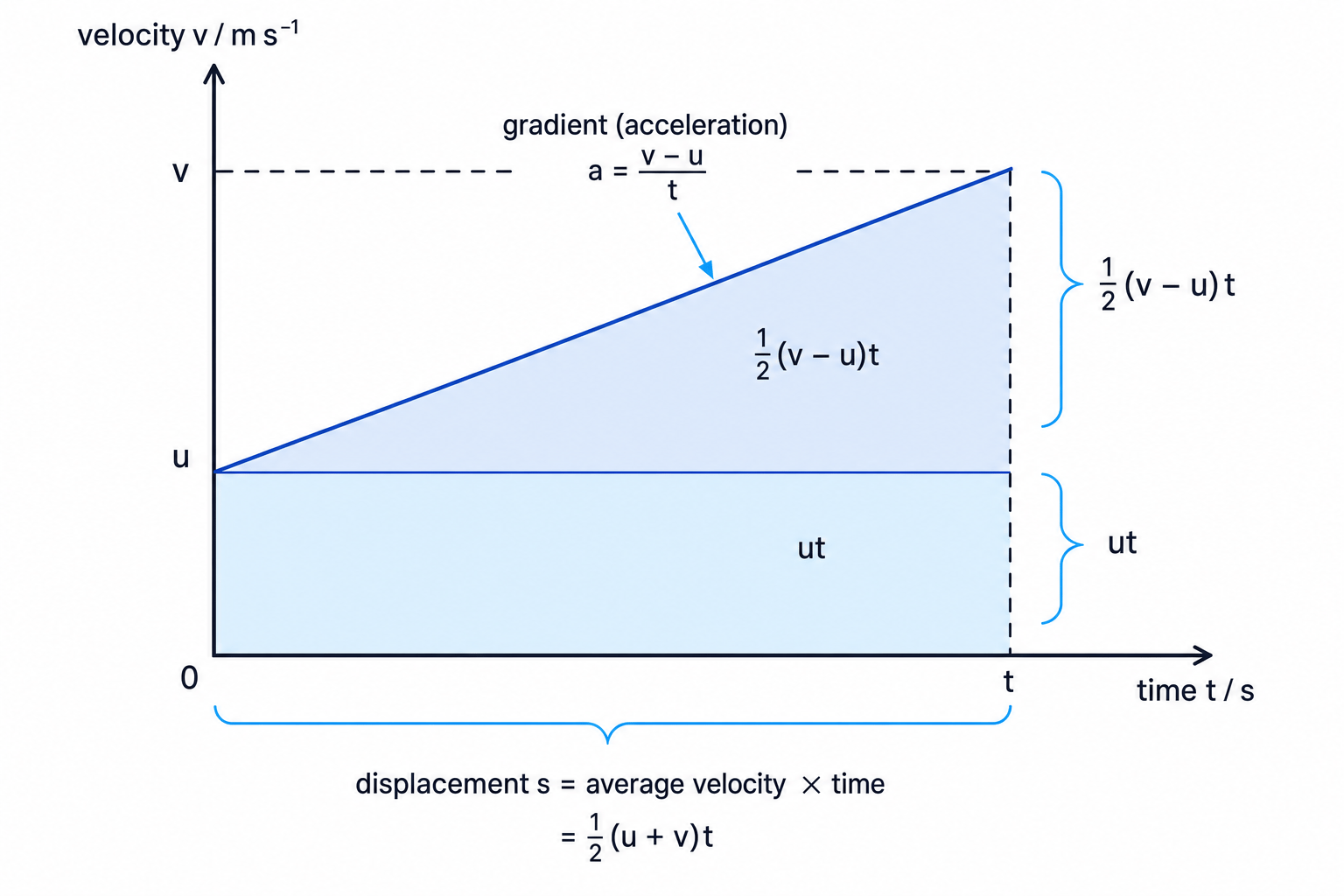
The velocity-time graph below shows why these equations work: the gradient gives acceleration, and the area under the graph gives displacement.
The four constant-acceleration equations
Use these only for motion in a straight line with constant acceleration:
- v=u+atv = u + atv=u+at
- s=12(u+v)ts = \frac{1}{2}(u + v)ts=21(u+v)t
- s=ut+12at2s = ut + \frac{1}{2}at^2s=ut+21at2
- v2=u2+2asv^2 = u^2 + 2asv2=u2+2as
Choosing the right equation
Pick the equation that contains the quantity you want and the quantities you know, but avoids any unknown you do not need. For example, if time is not given, v2=u2+2asv^2 = u^2 + 2asv2=u2+2as is often useful.
Constant acceleration only
These equations are not valid if the acceleration changes significantly, such as for a falling object where air resistance becomes important.
Thrown upwards under gravity
A ball is thrown vertically upwards with initial velocity 12.0 m s−112.0\ \text{m s}^{-1}12.0 m s−1. Ignore air resistance. Find the time to reach its highest point and the height gained.
-
Choose upward as positive. At the highest point the final velocity is v=0v = 0v=0, and the acceleration is a=−9.81 m s−2a = -9.81\ \text{m s}^{-2}a=−9.81 m s−2.
-
Use v=u+atv = u + atv=u+at to find the time:
- Use v2=u2+2asv^2 = u^2 + 2asv2=u2+2as to find the height, because it avoids needing another time calculation:
Forgetting direction
A negative answer is not automatically wrong. It usually means the quantity is in the opposite direction to the positive direction you chose.
Free fall and ggg
Free fall means motion under gravity alone, with no air resistance. Near Earth’s surface, the gravitational field is approximately uniform, so the acceleration is constant.
Acceleration of free fall
The acceleration of free fall, ggg, is the acceleration of an object falling freely in a gravitational field. Near Earth’s surface, g≈9.81 m s−2g \approx 9.81\ \text{m s}^{-2}g≈9.81 m s−2 downward.
All objects have the same acceleration of free fall if air resistance is negligible. A feather and a steel ball would fall with the same acceleration in a vacuum.
Investigating motion and collisions
In practical work, the aim is to measure distances and times accurately enough to calculate velocities and accelerations. Electronic timing is useful because it avoids human reaction-time error.
Common methods include:
- Ticker timers: dots are made at regular time intervals on a tape attached to a moving trolley. Increasing spacing means increasing speed.
- Light gates: an interrupt card of length LLL blocks a beam for time Δt\Delta tΔt, so the speed is v=LΔtv = \frac{L}{\Delta t}v=ΔtL.
- Air tracks or low-friction runways: these reduce friction for trolley or glider experiments.
- Data-loggers and video analysis: position can be recorded repeatedly, then velocities and accelerations can be calculated from the data.
- Collision experiments: measure velocities just before and just after the collision, usually with light gates or video, while keeping the motion along one straight line.
Finding acceleration using light gates
A trolley carries a card of length 0.050 m0.050\ \text{m}0.050 m. It blocks the first light gate for 0.100 s0.100\ \text{s}0.100 s and the second for 0.0625 s0.0625\ \text{s}0.0625 s. The time between the two speed measurements is 0.80 s0.80\ \text{s}0.80 s. Find the acceleration.
- Calculate the speed at the first light gate:
- Calculate the speed at the second light gate:
- Use v=u+atv = u + atv=u+at:
So the acceleration is about 0.38 m s−20.38\ \text{m s}^{-2}0.38 m s−2.
Determining ggg in the laboratory
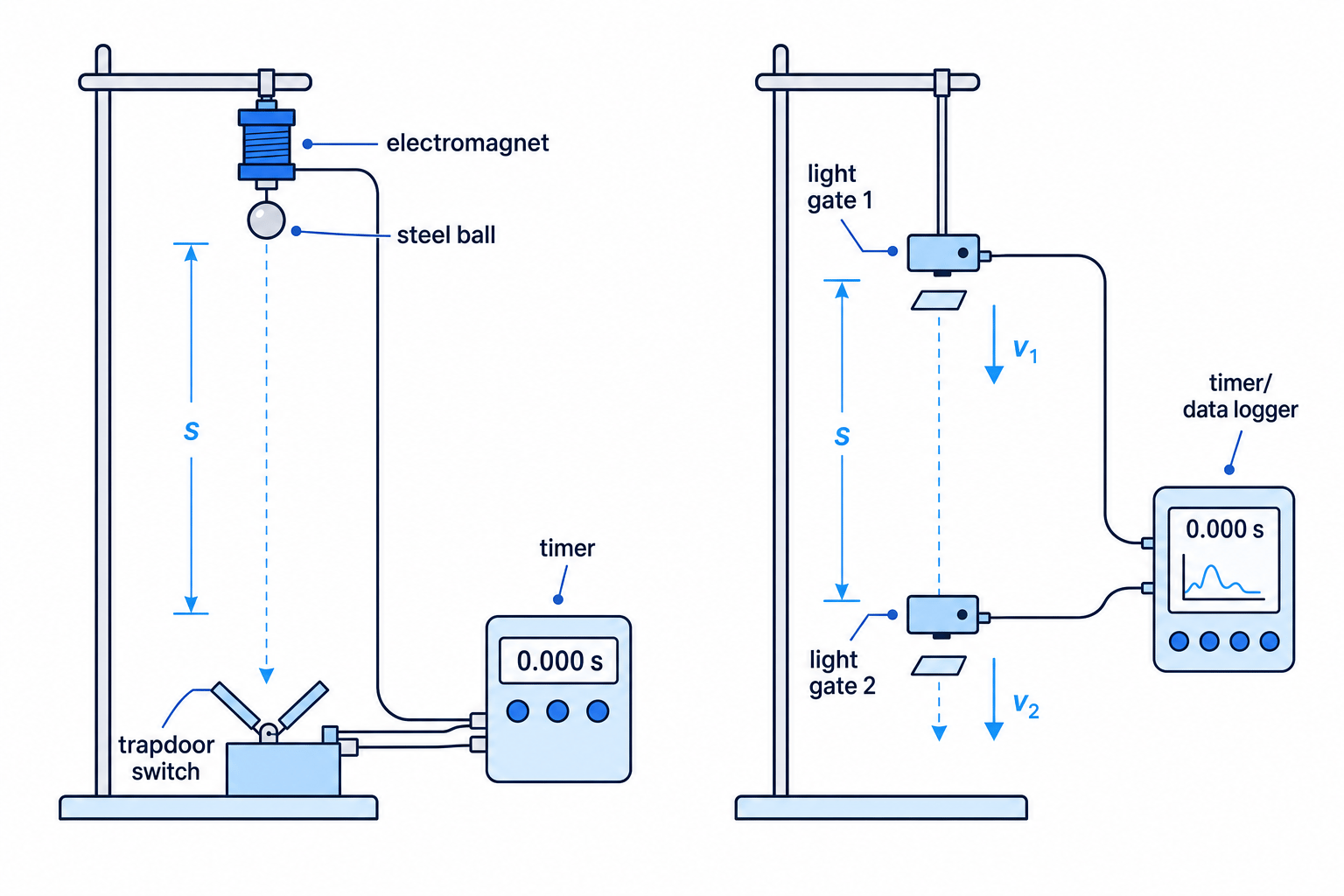
Two standard arrangements are the trapdoor/electromagnet method and the light-gate method. Both are designed to remove timing by human reaction.
Electromagnet and trapdoor
A steel ball is held by an electromagnet. When the current is switched off, the timer starts and the ball falls. When it hits the trapdoor switch, the timer stops.
If the ball is released from rest and downward is positive:
s=12gt2 s = \frac{1}{2}gt^2 s=21gt2A good method is to repeat the experiment for several heights and plot sss against t2t^2t2. The gradient is g2\frac{g}{2}2g, so g=2×gradientg = 2 \times \text{gradient}g=2×gradient.
Light gates and timer
An object falls through two light gates separated by a known distance sss. If its speed at the first gate is uuu and at the second gate is vvv, then:
v2=u2+2gs v^2 = u^2 + 2gs v2=u2+2gsSo:
g=v2−u22s g = \frac{v^2-u^2}{2s} g=2sv2−u2Determining g with two light gates
A falling card has speed 1.00 m s−11.00\ \text{m s}^{-1}1.00 m s−1 at the first light gate and 1.72 m s−11.72\ \text{m s}^{-1}1.72 m s−1 at the second. The gates are separated by 0.100 m0.100\ \text{m}0.100 m. Calculate ggg.
-
Take downward as positive, so the acceleration is ggg and the displacement between gates is positive.
-
Rearrange v2=u2+2gsv^2 = u^2 + 2gsv2=u2+2gs:
- Substitute the data:
This is close to the accepted value, allowing for experimental uncertainty.
Relying on one drop
One timing measurement gives a weak value for ggg. Repeats, several heights, and a graph help reduce the effect of random uncertainty and make anomalies easier to spot.
Reaction time and stopping distances
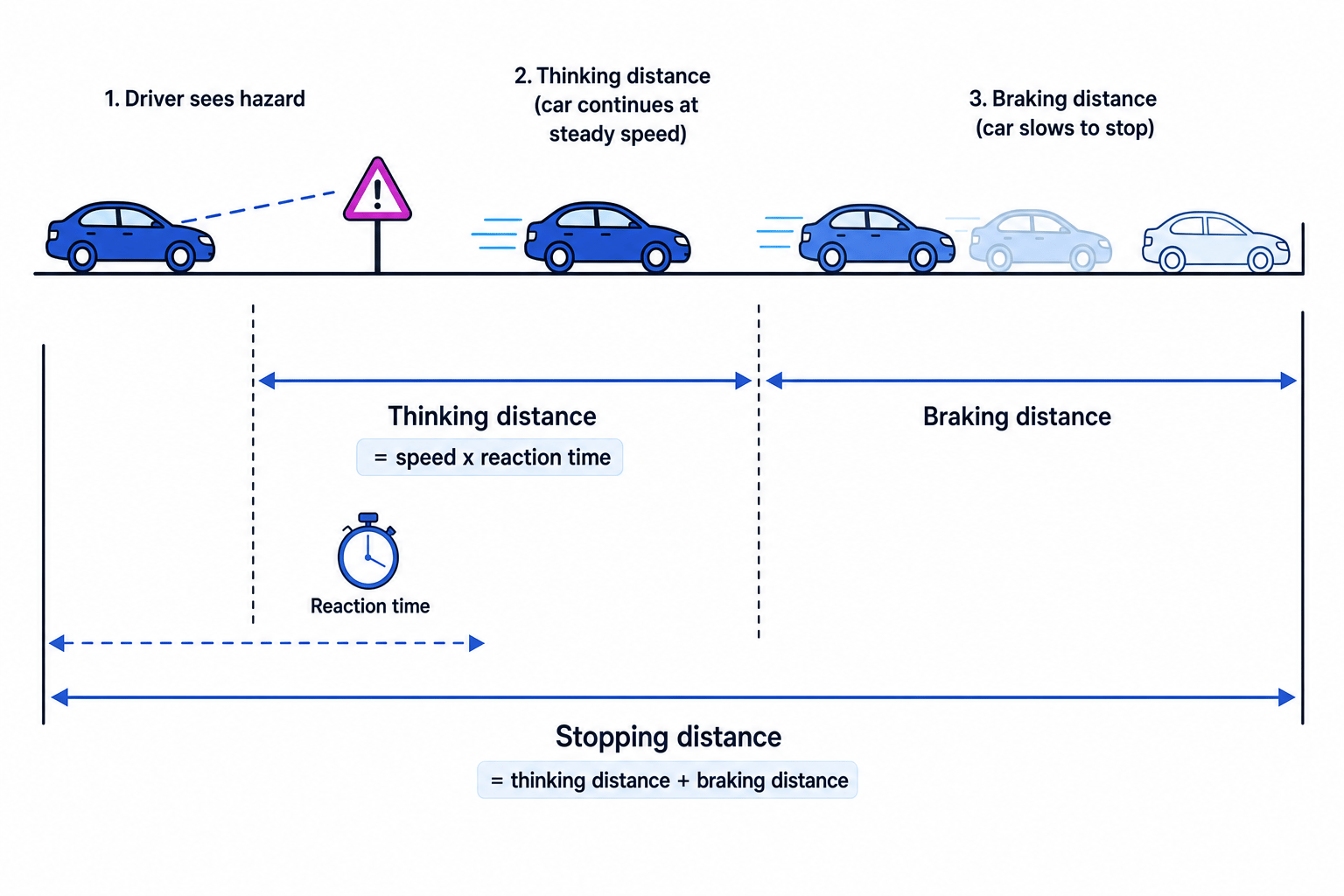
When a driver sees a hazard, the car does not stop instantly. The total stopping distance is split into thinking distance and braking distance.
Stopping-distance terms
- Reaction time is the time between seeing a hazard and starting to brake.
- Thinking distance is the distance travelled during the reaction time.
- Braking distance is the distance travelled while the brakes slow the vehicle to rest.
- Stopping distance is thinking distance plus braking distance.
During the thinking distance, the car is still moving at its original speed:
sthinking=vtreaction s_{\text{thinking}} = vt_{\text{reaction}} sthinking=vtreactionIf the braking acceleration is constant and the vehicle slows from speed uuu to rest, then:
0=u2+2as 0 = u^2 + 2as 0=u2+2asSince braking acceleration is opposite to the motion, aaa is negative if forward is positive.
Speed matters twice
For a fixed reaction time, thinking distance is proportional to speed. For constant braking deceleration, braking distance is proportional to speed squared, so higher speed has a very large effect.
Factors that increase thinking distance include tiredness, alcohol, drugs, distractions and poor visibility. Factors that increase braking distance include higher speed, worn tyres, poor brakes, wet or icy roads, and reduced friction.
Calculating stopping distance
A car travels at 20.0 m s−120.0\ \text{m s}^{-1}20.0 m s−1. The driver’s reaction time is 0.75 s0.75\ \text{s}0.75 s. Once the brakes are applied, the car decelerates uniformly at 6.0 m s−26.0\ \text{m s}^{-2}6.0 m s−2. Find the stopping distance.
- During the reaction time, the car continues at constant speed:
- For braking, take forward as positive, so u=20.0 m s−1u = 20.0\ \text{m s}^{-1}u=20.0 m s−1, v=0v = 0v=0, and a=−6.0 m s−2a = -6.0\ \text{m s}^{-2}a=−6.0 m s−2:
- Add the two parts:
A sensible final answer is 48 m48\ \text{m}48 m.
Mixing up braking and stopping distance
Braking distance starts only when the brakes are applied. Stopping distance includes both the thinking distance and the braking distance.
In the exam
- Define your positive direction before using the SUVAT equations, especially for vertical motion and braking.
- Check that acceleration is constant before applying v=u+atv = u + atv=u+at, s=12(u+v)ts = \frac{1}{2}(u+v)ts=21(u+v)t, s=ut+12at2s = ut + \frac{1}{2}at^2s=ut+21at2 or v2=u2+2asv^2 = u^2 + 2asv2=u2+2as.
- For practical questions, mention repeats, electronic timing, uncertainty in distance/time measurements, and using a graph where possible.
Check yourself
- If a ball is thrown upwards and upward is positive, what sign should the acceleration have?
- Which constant-acceleration equation is most useful when time is not given?
- What is the difference between thinking distance, braking distance and stopping distance?
