

What you'll learn
- How to use F=maF = maF=ma to connect resultant force, mass and acceleration.
- What the newton means, and how weight is calculated using W=mgW = mgW=mg.
- How to recognise tension, normal contact force, upthrust and friction.
- How to draw free-body diagrams and analyse one- and two-dimensional motion under constant force.
Starting point: what dynamics is about
Dynamics is the part of mechanics that links motion to forces. You already know that velocity describes how quickly position changes, and acceleration describes how quickly velocity changes. Dynamics asks: what causes the acceleration?
A force is a push or pull on an object. Force is a vector quantity, meaning it has both magnitude and direction. That direction matters: a 5 N force to the right and a 5 N force to the left do not have the same effect.
Mass is measured in kilograms, kg. It is a measure of an object’s inertia: its resistance to changes in velocity.
Resultant force and acceleration
When several forces act on an object, you combine them as vectors to find the single overall force.
Resultant force
The resultant force, also called the net force, is the vector sum of all the forces acting on an object. It is the single force that would have the same effect as all the individual forces combined.
For OCR A-Level Physics, you must recall:
F=maF = maF=mawhere FFF is the resultant force in newtons, N, mmm is the mass in kilograms, kg, and aaa is the acceleration in metres per second squared, m s^-2.
Force causes acceleration
A non-zero resultant force causes acceleration in the direction of the resultant force. If the resultant force is zero, the acceleration is zero: the object is either stationary or moving at constant velocity.
The newton
One newton, N, is the force needed to give a mass of 1 kg an acceleration of 1 m s^-2. So N is equivalent to kg m s^-2.
Finding the acceleration
A 1.8 kg trolley is pulled forwards with a force of 7.5 N. Friction acts backwards with a force of 1.2 N. Find the acceleration.
-
Choose forwards as positive, then combine the horizontal forces:
F=7.5 N−1.2 N=6.3 NF = 7.5\ \text{N} - 1.2\ \text{N} = 6.3\ \text{N}F=7.5 N−1.2 N=6.3 N -
Apply F=maF = maF=ma and rearrange for acceleration:
a=Fm=6.3 N1.8 kga = \frac{F}{m} = \frac{6.3\ \text{N}}{1.8\ \text{kg}}a=mF=1.8 kg6.3 N -
Calculate the value and include the direction:
a=3.5 m s−2a = 3.5\ \text{m s}^{-2}a=3.5 m s−2The trolley accelerates forwards at 3.5 m s^-2.
Force is not needed to keep moving
Do not say “a force is needed to keep an object moving”. A resultant force is needed to change velocity. If an object moves at constant velocity, its resultant force is zero.
Weight and gravitational field strength
Weight is a force. It is the gravitational force acting on a mass.
You must recall:
W=mgW = mgW=mgwhere WWW is weight in newtons, N, mmm is mass in kilograms, kg, and ggg is the gravitational field strength in newtons per kilogram, N kg^-1.
Near the Earth’s surface, g≈9.81 N kg−1g \approx 9.81\ \text{N kg}^{-1}g≈9.81 N kg−1. Since a freely falling object has acceleration ggg, you will also see this written as 9.81 m s^-2.
Weight
The weight of an object is the gravitational force acting on it. It acts towards the centre of the planet or moon causing the gravitational field.
Mass and weight are not the same. Your mass stays the same if you go to the Moon, but your weight changes because ggg is different.
Comparing weight on Earth and the Moon
A 0.250 kg object is taken from Earth, where g=9.81 N kg−1g = 9.81\ \text{N kg}^{-1}g=9.81 N kg−1, to the Moon, where g=1.62 N kg−1g = 1.62\ \text{N kg}^{-1}g=1.62 N kg−1. Find its weight in each place.
-
Use the same mass in both calculations because the object itself has not changed:
m=0.250 kgm = 0.250\ \text{kg}m=0.250 kg -
Calculate the weight on Earth:
W=mg=0.250 kg×9.81 N kg−1=2.45 NW = mg = 0.250\ \text{kg} \times 9.81\ \text{N kg}^{-1} = 2.45\ \text{N}W=mg=0.250 kg×9.81 N kg−1=2.45 N -
Calculate the weight on the Moon:
W=mg=0.250 kg×1.62 N kg−1=0.405 NW = mg = 0.250\ \text{kg} \times 1.62\ \text{N kg}^{-1} = 0.405\ \text{N}W=mg=0.250 kg×1.62 N kg−1=0.405 NThe mass is still 0.250 kg, but the weight is smaller on the Moon.
Common forces you need to recognise
Four common forces
- Tension is the pulling force in a stretched string, rope or cable. It acts along the rope, away from the object.
- Normal contact force is the force from a surface on an object. It acts perpendicular to the surface.
- Upthrust is the upward force exerted by a fluid, such as a liquid or gas, on an object in it.
- Friction is a contact force that opposes relative motion, or the tendency for relative motion, between surfaces. It acts parallel to the surfaces.
A normal contact force is often labelled RRR in mechanics diagrams. It is called “normal” because “normal” means perpendicular in this context.
Normal contact force is not always equal to weight
The normal contact force only equals mgmgmg in simple cases, such as an object resting on a horizontal surface with no other vertical forces. Angled pulls, upthrust, slopes and vertical acceleration can all change it.
Free-body diagrams
A free-body diagram shows all the forces acting on one object. You either draw the object as a simple shape or as a dot, then add force arrows.
The key rule is: include forces on the object, not forces the object exerts on other things.
For a crate pulled by a rope, the free-body diagram may include weight, normal contact force, tension and friction. The acceleration arrow is useful extra information, but it is not a force.
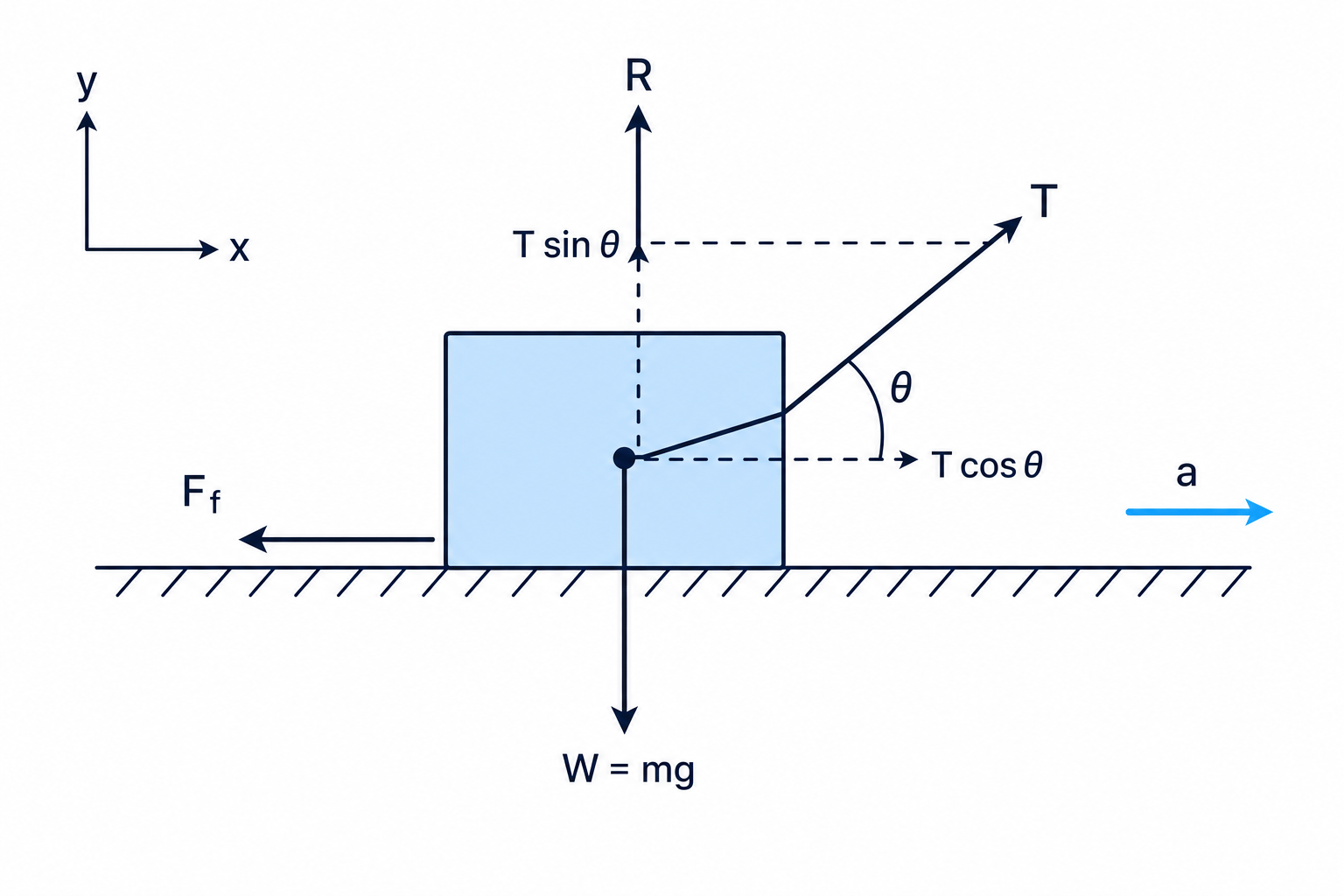
Drawing a free-body diagram
Start with the object, then ask: what is touching it, and what long-range forces act on it? Contact forces need contact; weight does not.
Resolving forces on a pulled crate
A 12 kg crate is pulled by a rope with tension 45 N at 30° above the horizontal. Friction is 8.0 N. The crate stays on the floor, so it has no vertical acceleration. Find the horizontal acceleration and the normal contact force.
-
Resolve the tension into horizontal and vertical components:
Tx=45 Ncos30∘=39.0 NT_x = 45\ \text{N}\cos 30^\circ = 39.0\ \text{N}Tx=45 Ncos30∘=39.0 N Ty=45 Nsin30∘=22.5 NT_y = 45\ \text{N}\sin 30^\circ = 22.5\ \text{N}Ty=45 Nsin30∘=22.5 N -
Find the horizontal resultant force and use F=maF = maF=ma:
Fx=39.0 N−8.0 N=31.0 NF_x = 39.0\ \text{N} - 8.0\ \text{N} = 31.0\ \text{N}Fx=39.0 N−8.0 N=31.0 N a=31.0 N12 kg=2.58 m s−2a = \frac{31.0\ \text{N}}{12\ \text{kg}} = 2.58\ \text{m s}^{-2}a=12 kg31.0 N=2.58 m s−2 -
Use vertical equilibrium to find the normal contact force. Since vertical acceleration is zero, upward forces equal downward forces:
R+22.5 N=12 kg×9.81 N kg−1R + 22.5\ \text{N} = 12\ \text{kg} \times 9.81\ \text{N kg}^{-1}R+22.5 N=12 kg×9.81 N kg−1 R=117.7 N−22.5 N=95.2 NR = 117.7\ \text{N} - 22.5\ \text{N} = 95.2\ \text{N}R=117.7 N−22.5 N=95.2 N
Motion under a constant force
If the resultant force is constant and the mass is constant, then F=maF = maF=ma tells you the acceleration is constant.
That means you can combine dynamics with the constant-acceleration equations, such as:
v=u+atv = u + atv=u+atand
s=ut+12at2s = ut + \frac{1}{2}at^2s=ut+21at2Here, uuu is initial velocity, vvv is final velocity, aaa is acceleration, ttt is time, and sss is displacement.
One-dimensional motion
One-dimensional motion means the motion is along a single straight line. Choose a positive direction, give forces signs, find the resultant force, then use F=maF = maF=ma.
Motion from a constant force
A 0.40 kg puck starts from rest. A constant horizontal resultant force of 2.0 N acts on it for 3.0 s. Find its final speed and displacement.
-
Find the acceleration from F=maF = maF=ma:
a=Fm=2.0 N0.40 kg=5.0 m s−2a = \frac{F}{m} = \frac{2.0\ \text{N}}{0.40\ \text{kg}} = 5.0\ \text{m s}^{-2}a=mF=0.40 kg2.0 N=5.0 m s−2 -
Use v=u+atv = u + atv=u+at with u=0u = 0u=0:
v=0+5.0 m s−2×3.0 s=15 m s−1v = 0 + 5.0\ \text{m s}^{-2} \times 3.0\ \text{s} = 15\ \text{m s}^{-1}v=0+5.0 m s−2×3.0 s=15 m s−1 -
Use s=ut+12at2s = ut + \frac{1}{2}at^2s=ut+21at2:
s=0+12(5.0 m s−2)(3.0 s)2=22.5 ms = 0 + \frac{1}{2}(5.0\ \text{m s}^{-2})(3.0\ \text{s})^2 = 22.5\ \text{m}s=0+21(5.0 m s−2)(3.0 s)2=22.5 m
Two-dimensional motion
Two-dimensional motion needs two perpendicular directions, usually horizontal and vertical. The important idea is that you apply F=maF = maF=ma separately in each direction.
For a projectile with air resistance ignored, the only force is weight. So the horizontal resultant force is zero, while the vertical resultant force is mgmgmg downwards.
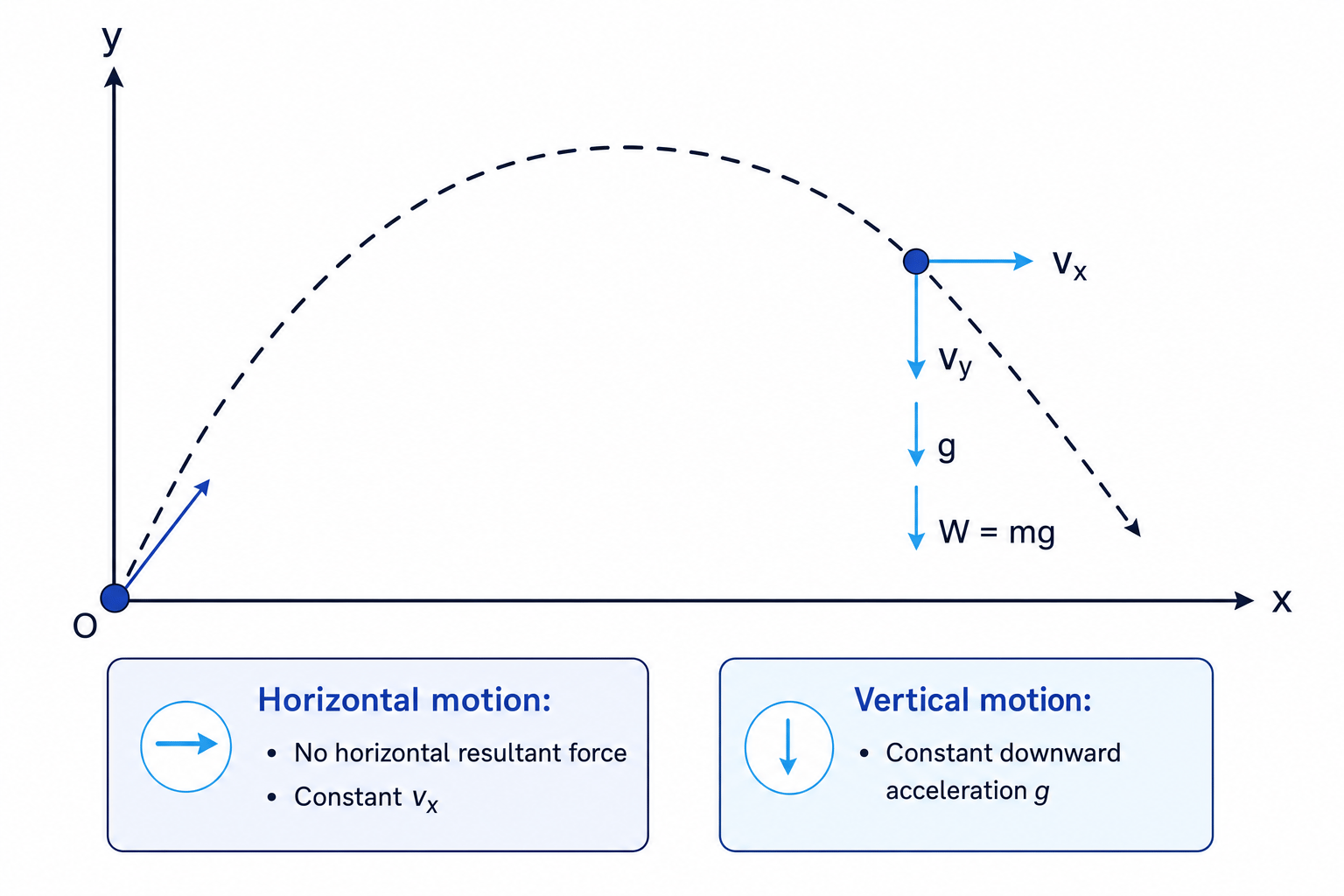
Separate the components
In two-dimensional constant-force problems, resolve forces and motion into perpendicular components. Horizontal motion and vertical motion share the same time, but their accelerations can be different.
Projectile under gravity
A ball is projected horizontally at 12 m s^-1 from a height of 20 m. Ignore air resistance. Find the time to reach the ground and the horizontal distance travelled.
-
In the horizontal direction, there is no resultant force, so horizontal acceleration is zero. The horizontal velocity stays constant:
vx=12 m s−1v_x = 12\ \text{m s}^{-1}vx=12 m s−1 -
In the vertical direction, the only force is weight, so the acceleration is ggg downwards. Taking downwards as positive:
sy=20 m,uy=0,ay=9.81 m s−2s_y = 20\ \text{m}, \quad u_y = 0, \quad a_y = 9.81\ \text{m s}^{-2}sy=20 m,uy=0,ay=9.81 m s−2 -
Use s=ut+12at2s = ut + \frac{1}{2}at^2s=ut+21at2 vertically:
20 m=0+12(9.81 m s−2)t220\ \text{m} = 0 + \frac{1}{2}(9.81\ \text{m s}^{-2})t^220 m=0+21(9.81 m s−2)t2 t=2.02 st = 2.02\ \text{s}t=2.02 s -
Use the same time horizontally:
sx=vxt=12 m s−1×2.02 s=24.2 ms_x = v_x t = 12\ \text{m s}^{-1} \times 2.02\ \text{s} = 24.2\ \text{m}sx=vxt=12 m s−1×2.02 s=24.2 m
When constant-force methods stop working
These simple constant-acceleration equations only apply while the resultant force is constant. Air resistance often changes with speed, so projectile problems usually say to ignore air resistance unless a more advanced model is intended.
In the exam
- Draw a free-body diagram before writing equations, especially if there is more than one force or an angled force.
- Make your sign convention clear: choose positive directions, then subtract forces acting the other way.
- Remember that FFF in F=maF = maF=ma means resultant force, and split two-dimensional problems into horizontal and vertical components.
Check yourself
- If a car moves at constant velocity along a straight road, what is its resultant force?
- Why is weight a force but mass is not?
- In a projectile question with no air resistance, why is the horizontal acceleration zero?
