

What you'll learn
- Why any object with mass produces a gravitational field.
- How and when to model a spherical object as a point mass at its centre.
- How gravitational field lines show direction and relative strength.
- How to use gravitational field strength, g=F/mg = F/mg=F/m, in calculations.
Starting point: gravity is a field effect
You already know that gravity is an attractive force: masses pull on other masses. In A-Level Physics, we describe this using the idea of a field.
A field is a region of space where an object experiences a force because of a particular property it has. For gravity, that property is mass.
Gravitational field
A gravitational field is a region of space where a mass experiences a gravitational force.
So the Earth has a gravitational field around it. The Moon has one too. So do you — although your gravitational field is far too weak to notice in everyday life.
Mass causes gravitational fields
Any object with mass produces a gravitational field. Another mass placed in that field experiences an attractive gravitational force.
This is different from saying “gravity only exists near planets”. Planets simply have large masses, so their gravitational fields are strong enough to dominate our everyday experience.
Point masses
A point mass is an idealised object where all the mass is treated as being concentrated at a single point.
Point mass
A point mass is a model in which an object’s entire mass is assumed to act from one point, usually its centre of mass.
This is a model, not a claim that the object has no size. It is useful because it simplifies gravitational problems: instead of worrying about every part of a planet pulling separately, you can treat the whole mass as if it acts from one point.
Spherical masses as point masses
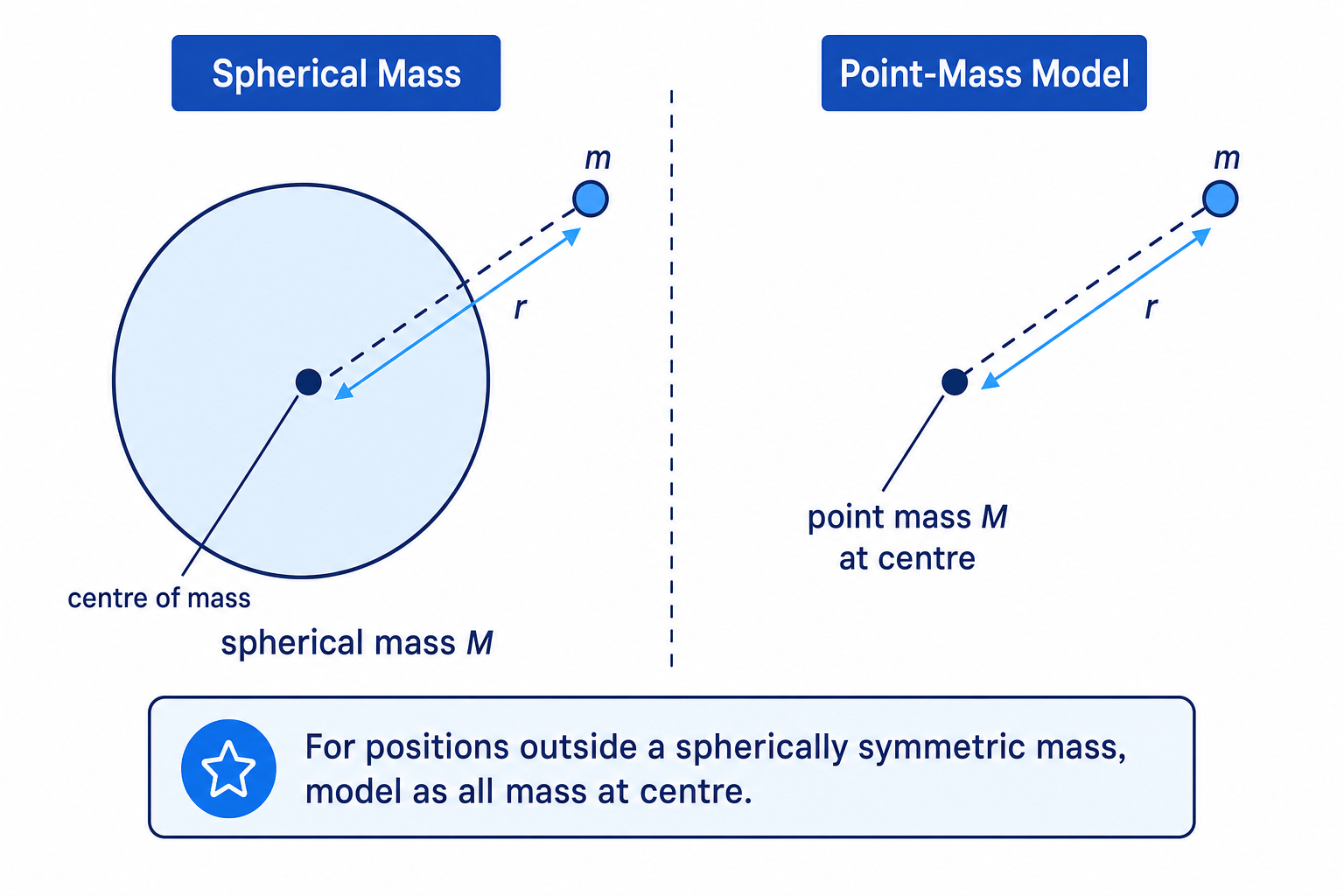
For a spherically symmetric object, such as an ideal planet or moon, the mass is distributed evenly around the centre. For positions outside the object, you can model the entire spherical mass as a point mass at its centre.
The centre matters
When modelling a spherical body as a point mass, distances are measured from the centre of the sphere, not from the surface.
This is especially important for satellites, planets and moons. If a satellite is at height hhh above the Earth’s surface, its distance from the Earth’s point-mass model is:
r=R+hr = R + hr=R+hwhere RRR is the radius of the Earth.
Choosing the correct distance from a spherical mass
A satellite orbits at a height of 410 km above the Earth’s surface. The Earth’s radius is 6.37×10⁶ m6.37 \times 10^6 \text{ m}6.37×10⁶ m. Find the distance rrr from the Earth’s centre to the satellite.
-
Convert the altitude into metres, because SI units are needed:
410 km=410×103 m=4.10×10⁵ m410 \text{ km} = 410 \times 10^3 \text{ m} = 4.10 \times 10^5 \text{ m}410 km=410×103 m=4.10×10⁵ m -
Use the spherical mass model, so measure from the centre of the Earth:
r=R+hr = R + hr=R+h -
Substitute the values:
r=6.37×10⁶ m+4.10×10⁵ mr = 6.37 \times 10^6 \text{ m} + 4.10 \times 10^5 \text{ m}r=6.37×10⁶ m+4.10×10⁵ m -
Add the distances:
r=6.78×10⁶ mr = 6.78 \times 10^6 \text{ m}r=6.78×10⁶ m
So the satellite is 6.78×10⁶ m6.78 \times 10^6 \text{ m}6.78×10⁶ m from the Earth’s centre.
Using height instead of centre-to-centre distance
For gravitational field problems involving planets or moons, do not use height above the surface as rrr unless the question specifically asks for distance above the surface. The gravitational model uses distance from the centre of mass.
Gravitational field lines
A field line is a line drawn to show the direction of the force on a test object placed in the field.
For gravitational fields, the test object is a small mass. Since gravity is always attractive, gravitational field lines point towards the mass causing the field.
Gravitational field line
A gravitational field line shows the direction of the gravitational force on a small test mass placed at that point.
Around an isolated spherical mass, the field is radial: the field lines point directly inwards towards the centre.
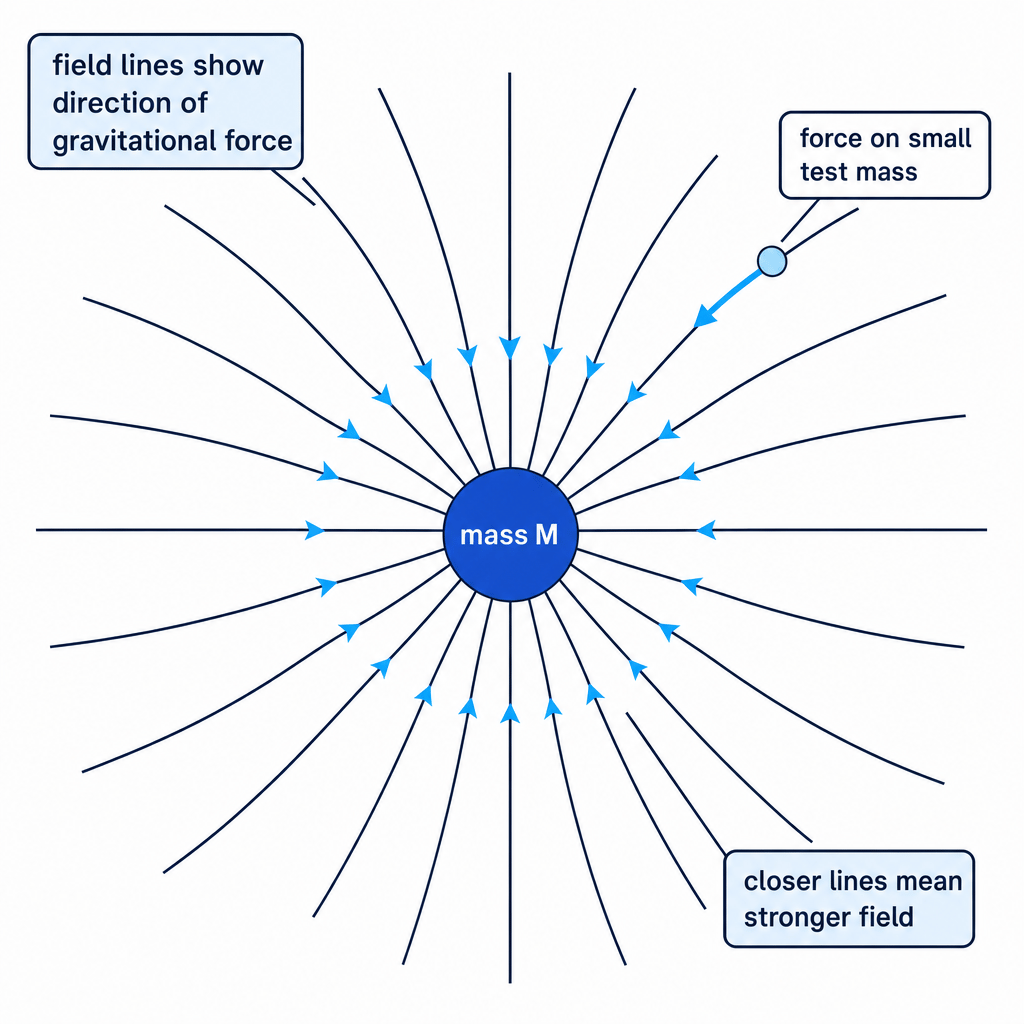
The spacing of field lines represents relative field strength:
- closer field lines mean a stronger gravitational field
- more widely spaced field lines mean a weaker gravitational field
- arrows show the direction of force on a small test mass
Reading gravitational field diagrams
For a single spherical mass, field lines point radially inwards. If your arrows point outwards, you have drawn an electric-field-style diagram for a positive charge, not a gravitational field.
Interpreting field lines near a planet
A diagram shows gravitational field lines around a planet. At point A the lines are close together; at point B, farther from the planet, the lines are more spread out. Compare the gravitational field at A and B.
-
Use the direction of the field lines to decide the force direction. At both A and B, a small mass would be pulled towards the planet’s centre.
-
Compare the spacing of the field lines. The lines are closer together at A than at B.
-
Link spacing to field strength. The gravitational field is stronger at A and weaker at B.
So a mass placed at A would experience a larger gravitational force than the same mass placed at B.
Gravitational field strength
The gravitational field strength at a point is the gravitational force per unit mass placed at that point.
Gravitational field strength
Gravitational field strength, ggg, is defined by:
g=Fmg = \frac{F}{m}g=mFwhere FFF is the gravitational force in newtons, N, and mmm is the mass in kilograms, kg.
The unit of gravitational field strength is newtons per kilogram, N kg−1^{-1}−1.
Near the Earth’s surface, ggg is approximately 9.81 N kg−1^{-1}−1. This means every kilogram of mass experiences a gravitational force of about 9.81 N.
The gravitational force on an object is its weight:
F=mgF = mgF=mgThis is just the same equation rearranged.
Calculating gravitational field strength
A 2.50 kg mass experiences a gravitational force of 24.5 N near the surface of a planet. Calculate the gravitational field strength at that point.
-
Start from the definition of gravitational field strength:
g=Fmg = \frac{F}{m}g=mF -
Substitute the force and mass, keeping units with the calculation:
g=24.5 N2.50 kgg = \frac{24.5 \text{ N}}{2.50 \text{ kg}}g=2.50 kg24.5 N -
Divide the values:
g=9.80 N kg−1g = 9.80 \text{ N kg}^{-1}g=9.80 N kg−1
So the gravitational field strength is 9.80 N kg−1^{-1}−1.
Calculating weight from field strength
An astronaut has mass 72.0 kg. On the Moon, the gravitational field strength is 1.62 N kg−1^{-1}−1. Calculate the astronaut’s weight on the Moon.
-
Use the rearranged definition of gravitational field strength:
F=mgF = mgF=mg -
Substitute the mass and gravitational field strength:
F=72.0 kg×1.62 N kg−1F = 72.0 \text{ kg} \times 1.62 \text{ N kg}^{-1}F=72.0 kg×1.62 N kg−1 -
Calculate the force:
F=117 NF = 117 \text{ N}F=117 N
So the astronaut’s weight on the Moon is 117 N.
Confusing mass and weight
Mass is measured in kilograms, kg, and does not depend on location. Weight is a gravitational force measured in newtons, N, and depends on the local value of ggg.
Gravitational fields as one type of field
Gravity is one example of a field that produces a force. You will also meet other fields in A-Level Physics, including:
- electric fields, where charges experience forces
- magnetic fields, where moving charges or current-carrying wires experience forces
- gravitational fields, where masses experience forces
The shared idea is that an object does not need to be touching another object to experience a force. The field describes how the force would act at each point in space.
Fields describe forces at a distance
A field is a way of modelling non-contact forces. In a gravitational field, the force acts on mass and is always attractive.
A small object used to investigate a field is often called a test object. For gravitational fields, we imagine a small test mass. “Small” means its own gravitational field is negligible compared with the field being studied.
Do not overuse the point-mass model
In this part of the specification, you only need to apply the model for spherical masses from outside the object. You are not expected to derive the result for a sphere or analyse the detailed field inside a planet.
Linking the ideas together
For this section, the key chain of reasoning is:
- Mass produces a gravitational field.
- A mass placed in that field experiences a gravitational force.
- A spherical mass can often be modelled as a point mass at its centre.
- Field lines show the direction of force on a small test mass.
- The strength of the field is the force per unit mass:
In the exam
- If the object is a planet, moon or star, check whether you should measure distance from its centre rather than its surface.
- For field-line diagrams, make gravitational arrows point towards the mass causing the field.
- Keep mass and weight separate: kg for mass, N for force, and N kg−1^{-1}−1 for gravitational field strength.
Check yourself
- Why can a spherical planet often be modelled as a point mass at its centre?
- What does the spacing of gravitational field lines tell you?
- A 5.0 kg object has weight 18 N on a planet. What is the gravitational field strength there?
