What you'll learn
- How Newton’s law of gravitation gives the force between two masses.
- Why gravitational force is an inverse-square force.
- How to calculate gravitational field strength using g=−GMr2g = -\frac{GM}{r^2}g=−r2GM.
- Why, near Earth’s surface, ggg is treated as uniform and equals the acceleration of free fall.
The starting idea: masses attract
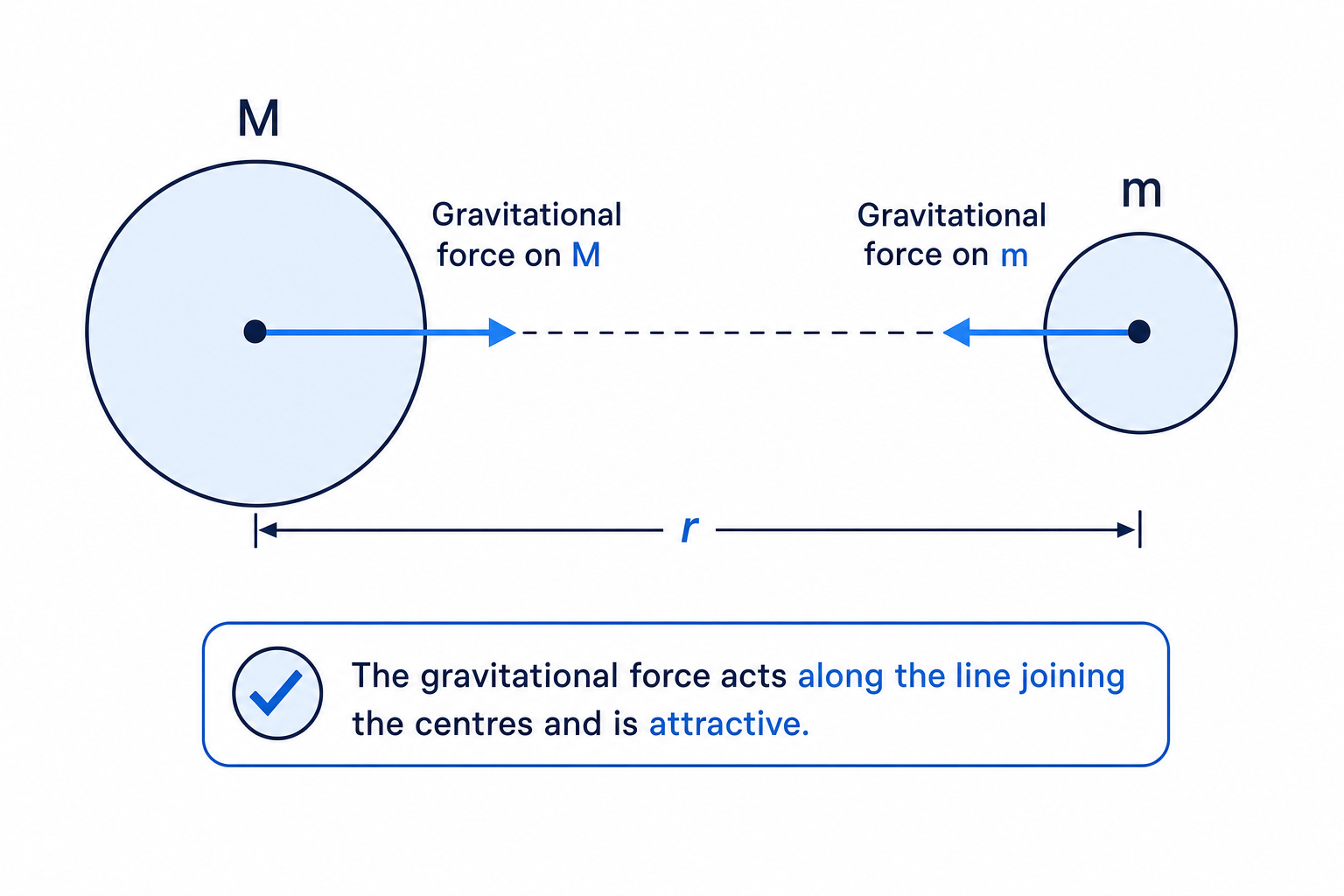
Any two objects with mass attract each other gravitationally. For everyday objects, this force is tiny. For planets, moons and stars, it is large enough to control orbits and motion.
The force acts along the line joining the centres of the two masses, and it is always attractive.
Point mass
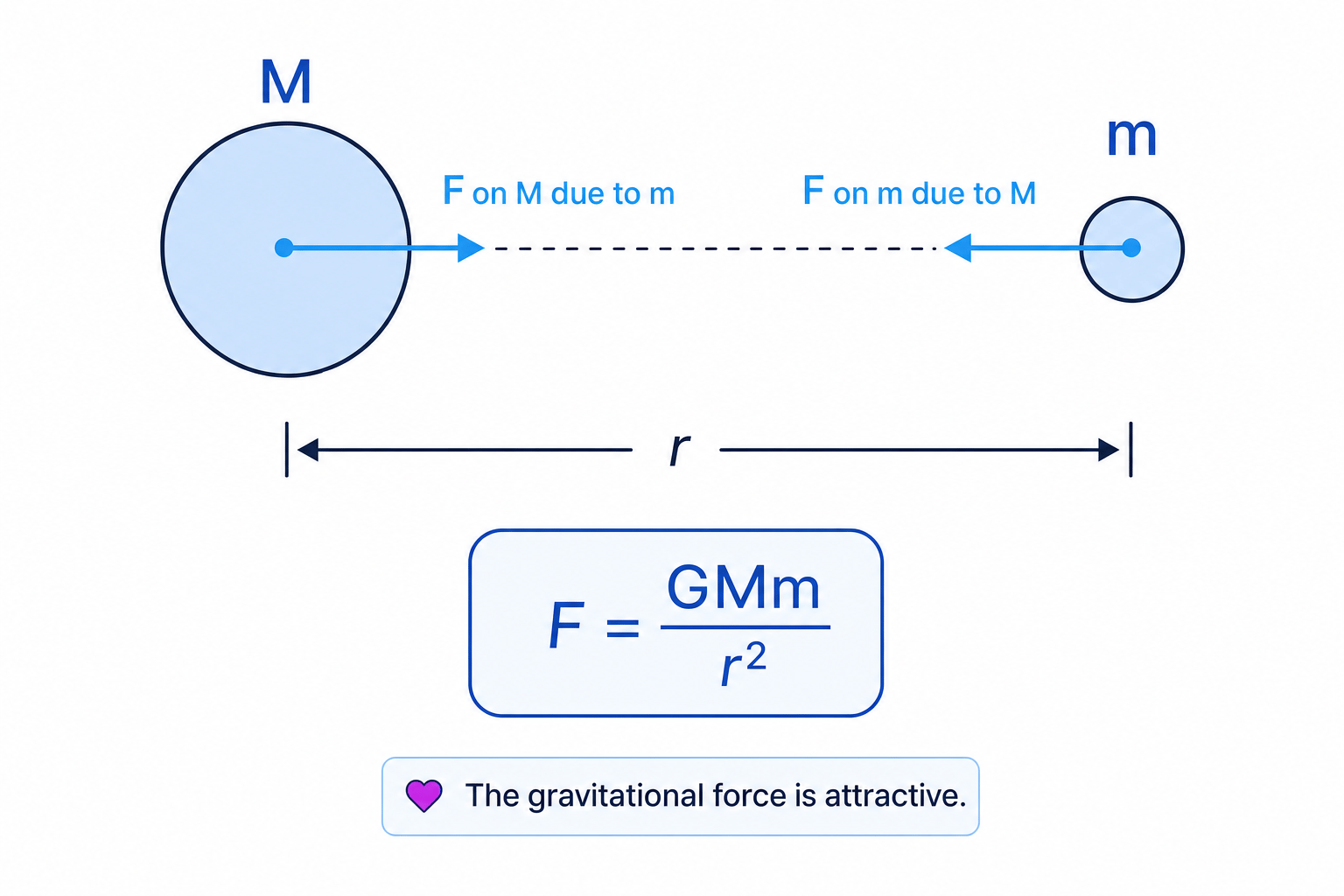
A point mass is an object treated as if all its mass is concentrated at a single point. In this topic, rrr is the distance between the two point masses, or between the centres of two spherical bodies when they are treated as point masses.
Newton’s law of gravitation
Newton’s law of gravitation says that the gravitational force between two point masses depends on both masses and on their separation.
F=−GMmr2F = -\frac{GMm}{r^2}F=−r2GMmwhere:
- FFF is the gravitational force in newtons, N
- GGG is the gravitational constant, 6.67×10⁻¹¹ N m2 kg−26.67 \times 10^{-11}\ \text{N m}^2\text{ kg}^{-2}6.67×10⁻¹¹ N m2 kg−2
- MMM and mmm are the two masses in kilograms, kg
- rrr is the separation between their centres in metres, m
The negative sign shows that the force is attractive. If you define the positive radial direction as “away from” the larger mass, gravity acts in the opposite direction.
The inverse-square law
The magnitude of the gravitational force is proportional to the product of the masses and inversely proportional to the square of the separation: F∝Mmr2F \propto \frac{Mm}{r^2}F∝r2Mm. Doubling rrr makes the force one quarter as large.
In calculations, you often use the magnitude:
F=GMmr2F = \frac{GMm}{r^2}F=r2GMmthen state or show the direction separately.
Calculating the gravitational force between two masses
Two masses of 8.0 kg and 12 kg are separated by 0.50 m. Calculate the magnitude of the gravitational force between them.
-
Identify the quantities in SI units: M=8.0 kgM = 8.0\ \text{kg}M=8.0 kg, m=12 kgm = 12\ \text{kg}m=12 kg and r=0.50 mr = 0.50\ \text{m}r=0.50 m.
-
Substitute into Newton’s law using the magnitude of the force:
F=GMmr2F = \frac{GMm}{r^2}F=r2GMm F=(6.67×10⁻¹¹)(8.0)(12)(0.50)2F = \frac{(6.67 \times 10^{-11})(8.0)(12)}{(0.50)^2}F=(0.50)2(6.67×10⁻¹¹)(8.0)(12) -
Calculate the denominator and evaluate the force:
F=6.40×10−90.25=2.56×10⁻⁸ NF = \frac{6.40 \times 10^{-9}}{0.25} = 2.56 \times 10^{-8}\ \text{N}F=0.256.40×10−9=2.56×10⁻⁸ N -
Quote the answer sensibly: the gravitational force is 2.6×10⁻⁸ N2.6 \times 10^{-8}\ \text{N}2.6×10⁻⁸ N, attractive, acting along the line joining the masses.
Forgetting to square the distance
The distance term is r2r^2r2, not rrr. If the separation changes, the force changes very quickly: tripling rrr makes the force one ninth as large.
What the negative sign means
The equation in the specification is written as:
F=−GMmr2F = -\frac{GMm}{r^2}F=−r2GMmThis is a direction convention, not a sign that the size of the force is negative. Force is a vector quantity, so it has magnitude and direction.
If the positive direction is chosen radially outwards from mass MMM, then the gravitational force on mass mmm points inwards, towards MMM. That inward direction is negative.
Magnitude first, direction second
For most numerical questions, calculate the positive magnitude using F=GMmr2F = \frac{GMm}{r^2}F=r2GMm, then add the direction in words: “towards the other mass” or “towards the centre of the planet”.
Using the inverse-square relationship
A satellite moves from a distance rrr to a distance 2r2r2r from Earth’s centre. Compare the gravitational force at 2r2r2r with the force at rrr.
-
Start from the proportionality for fixed masses: F∝1r2F \propto \frac{1}{r^2}F∝r21.
-
Replace rrr by 2r2r2r:
F2r∝1(2r)2=14r2F_{2r} \propto \frac{1}{(2r)^2} = \frac{1}{4r^2}F2r∝(2r)21=4r21 -
Compare with the original force:
F2r=14FrF_{2r} = \frac{1}{4}F_rF2r=41Fr
So the gravitational force becomes one quarter of its original value.
Gravitational field strength
A gravitational field is a region where a mass experiences a gravitational force.
Gravitational field strength
Gravitational field strength, ggg, is the gravitational force per unit mass on a small test mass placed in the field. Its unit is newtons per kilogram, N kg−1^{-1}−1.
So:
g=Fmg = \frac{F}{m}g=mFFor a point mass MMM, combine this with Newton’s law:
F=−GMmr2F = -\frac{GMm}{r^2}F=−r2GMmDivide by the small mass mmm:
g=−GMr2g = -\frac{GM}{r^2}g=−r2GMThis is the gravitational field strength due to a point mass MMM at distance rrr from its centre.
Field strength does not depend on the test mass
The value of ggg at a point depends on the source mass MMM and the distance rrr, not on the mass of the object placed there.
Calculating gravitational field strength near Earth
Use MEarth=5.97×1024 kgM_\text{Earth} = 5.97 \times 10^{24}\ \text{kg}MEarth=5.97×1024 kg and r=6.37×10⁶ mr = 6.37 \times 10^6\ \text{m}r=6.37×10⁶ m to estimate the gravitational field strength at Earth’s surface.
-
Use the point-mass equation for gravitational field strength:
g=−GMr2g = -\frac{GM}{r^2}g=−r2GMFor the magnitude:
∣g∣=GMr2|g| = \frac{GM}{r^2}∣g∣=r2GM -
Substitute the values:
∣g∣=(6.67×10⁻¹¹)(5.97×1024)(6.37×10⁶)2|g| = \frac{(6.67 \times 10^{-11})(5.97 \times 10^{24})}{(6.37 \times 10^6)^2}∣g∣=(6.37×10⁶)2(6.67×10⁻¹¹)(5.97×1024) -
Evaluate the numerator and denominator:
∣g∣=3.98×10144.06×1013|g| = \frac{3.98 \times 10^{14}}{4.06 \times 10^{13}}∣g∣=4.06×10133.98×1014 -
Calculate the field strength:
∣g∣=9.8 N kg−1|g| = 9.8\ \text{N kg}^{-1}∣g∣=9.8 N kg−1
So the gravitational field strength at Earth’s surface is about 9.8 N kg−19.8\ \text{N kg}^{-1}9.8 N kg−1, directed towards Earth’s centre.
Why ggg has two equivalent units
Gravitational field strength is measured in N kg−1^{-1}−1 because it is force per unit mass.
But from Newton’s second law, F=maF = maF=ma, so:
Fm=a\frac{F}{m} = amF=aTherefore N kg−1^{-1}−1 is equivalent to m s−2^{-2}−2.
That is why near Earth’s surface you will see:
g≈9.81 N kg−1g \approx 9.81\ \text{N kg}^{-1}g≈9.81 N kg−1and also:
g≈9.81 m s−2g \approx 9.81\ \text{m s}^{-2}g≈9.81 m s−2They are numerically the same physical quantity, expressed in equivalent units.
Uniform gravitational field near Earth’s surface
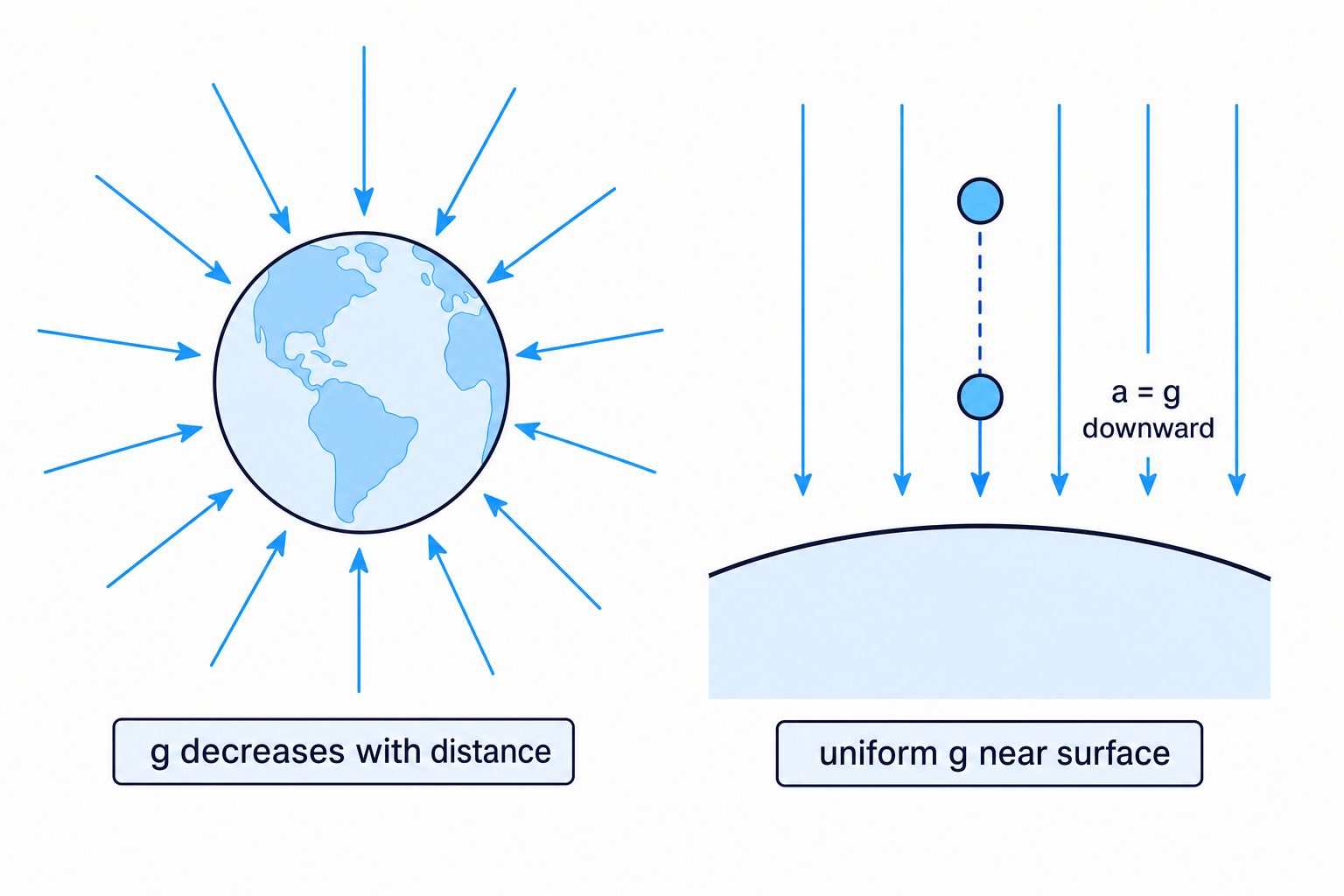
A gravitational field around a planet is actually radial: field lines point towards the planet’s centre, and the magnitude decreases with distance from the centre.
However, close to Earth’s surface, a small laboratory region is tiny compared with Earth’s radius. Over this small height, the field lines are almost parallel and the value of ggg changes very little. So we model the field as uniform.
Uniform gravitational field
A uniform gravitational field has the same field strength and direction at every point in the region being considered.
Near Earth’s surface, the field is taken as:
g≈9.81 N kg−1g \approx 9.81\ \text{N kg}^{-1}g≈9.81 N kg−1directed vertically downwards.
Close to the surface only
The uniform-field approximation is excellent for everyday heights near Earth’s surface, but it is not valid over distances comparable with Earth’s radius. For satellites and planets, use g=−GMr2g = -\frac{GM}{r^2}g=−r2GM.
Checking whether g changes much over a small height
Estimate the percentage change in ggg between Earth’s surface and a height of 100 m above it. Take Earth’s radius as 6.37×10⁶ m6.37 \times 10^6\ \text{m}6.37×10⁶ m.
-
Since g∝1r2g \propto \frac{1}{r^2}g∝r21, compare the field strengths using:
gtopgsurface=(rsurfacertop)2\frac{g_\text{top}}{g_\text{surface}} = \left(\frac{r_\text{surface}}{r_\text{top}}\right)^2gsurfacegtop=(rtoprsurface)2 -
Substitute rsurface=6.37×10⁶ mr_\text{surface} = 6.37 \times 10^6\ \text{m}rsurface=6.37×10⁶ m and rtop=6.37×10⁶+100 mr_\text{top} = 6.37 \times 10^6 + 100\ \text{m}rtop=6.37×10⁶+100 m:
gtopgsurface=(6.37×1066.3701×106)2\frac{g_\text{top}}{g_\text{surface}} = \left(\frac{6.37 \times 10^6}{6.3701 \times 10^6}\right)^2gsurfacegtop=(6.3701×1066.37×106)2 -
Evaluate the ratio:
gtopgsurface≈0.99997\frac{g_\text{top}}{g_\text{surface}} \approx 0.99997gsurfacegtop≈0.99997 -
Convert the difference from 1 into a percentage:
(1−0.99997)×100%≈0.003%(1 - 0.99997) \times 100\% \approx 0.003\%(1−0.99997)×100%≈0.003%
So over 100 m, the change in ggg is tiny. Treating the field as uniform is reasonable.
Acceleration of free fall
An object is in free fall when the only significant force on it is gravity. Air resistance is ignored unless the question says otherwise.
Near Earth’s surface:
F=mgF = mgF=mgBut Newton’s second law gives:
F=maF = maF=maSo for free fall:
ma=mgma = mgma=mgand therefore:
a=ga = ga=gThis means the gravitational field strength is numerically equal to the acceleration of free fall.
Mass cancels in free fall
In the same gravitational field, all objects have the same acceleration of free fall if air resistance is negligible. A larger mass has a larger weight, but also a larger inertia, so the acceleration is unchanged.
Finding weight and free-fall acceleration
A 0.75 kg object is released near Earth’s surface where g=9.81 N kg−1g = 9.81\ \text{N kg}^{-1}g=9.81 N kg−1. Calculate its weight and its acceleration if air resistance is negligible.
-
Use W=mgW = mgW=mg for the gravitational force, often called weight:
W=(0.75)(9.81)W = (0.75)(9.81)W=(0.75)(9.81) -
Calculate the weight:
W=7.36 NW = 7.36\ \text{N}W=7.36 NThe force acts downwards.
-
For free fall, apply F=maF = maF=ma and F=mgF = mgF=mg:
ma=mgma = mgma=mg -
Cancel the mass to find the acceleration:
a=g=9.81 m s−2a = g = 9.81\ \text{m s}^{-2}a=g=9.81 m s−2
So the object’s weight is 7.36 N7.36\ \text{N}7.36 N downwards, and its acceleration is 9.81 m s−29.81\ \text{m s}^{-2}9.81 m s−2 downwards.
Confusing g with weight
ggg is gravitational field strength in N kg−1^{-1}−1 or acceleration in m s−2^{-2}−2. Weight is a force, so it is measured in newtons, N, and is calculated using W=mgW = mgW=mg.
Linking the equations together
You should be comfortable moving between these three ideas:
-
Newton’s law of gravitation gives the force between two masses:
F=−GMmr2F = -\frac{GMm}{r^2}F=−r2GMm -
Gravitational field strength is force per unit mass:
g=Fmg = \frac{F}{m}g=mF -
For a point mass, this becomes:
g=−GMr2g = -\frac{GM}{r^2}g=−r2GM
The negative sign means the force or field acts towards the mass producing the field.
In the exam
-
Check whether the question asks for force or field strength: use F=−GMmr2F = -\frac{GMm}{r^2}F=−r2GMm for force, but g=−GMr2g = -\frac{GM}{r^2}g=−r2GM for field strength.
-
Use the correct distance: rrr is measured from the centre of the mass, not from the surface, unless the question has already defined it that way.
-
Treat ggg as uniform and equal to 9.81 m s−29.81\ \text{m s}^{-2}9.81 m s−2 only close to Earth’s surface; for satellites or large distances, use the inverse-square equation.
Check yourself
- If the separation between two masses is doubled, what happens to the gravitational force between them?
- Why does g=−GMr2g = -\frac{GM}{r^2}g=−r2GM not contain the mass of the small test object?
- In what situation is it reasonable to treat Earth’s gravitational field as uniform?