

What you'll learn
- Why electric fields are produced by charges.
- How to represent electric fields using field lines.
- Why a uniformly charged sphere can often be modelled as a point charge at its centre.
- How to use electric field strength, E=FqE = \frac{F}{q}E=qF, in calculations.
Charges create electric fields
Electric fields belong to the “forces at a distance” part of physics. A charged object can exert a force on another charged object even when they are not touching.
A positive charge and a negative charge attract each other. Two charges of the same sign repel. The electric field is the way we describe the influence of a charge in the space around it.
Electric field
An electric field is a region of space where an electric charge experiences a force.
A charge does not need another charge nearby in order to “have” a field. The field is due to the source charge itself. Another charge placed in the field then experiences a force.
The direction of an electric field is defined using a positive test charge.
Positive test charge
A positive test charge is a very small positive charge used to determine the direction and strength of an electric field without significantly changing the field itself.
So:
- near a positive source charge, the electric field points away from the charge;
- near a negative source charge, the electric field points towards the charge.
Field direction
Electric field direction is the direction of the force on a positive charge placed at that point.
Finding the force direction on a charge
A small negative charge is placed in an electric field that points to the right. What direction is the force on the negative charge?
-
The electric field direction tells you the force direction on a positive charge, so a positive charge would be pushed to the right.
-
The charge in the question is negative, so its force is in the opposite direction to the field.
-
Therefore, the force on the negative charge is to the left.
Point charges
A point charge is an idealised charge that is treated as if all its charge is concentrated at one point. It has no size in the model.
Point charge
A point charge is a model of a charged object where the charge is assumed to act from a single point.
This is useful because many real charged objects are small compared with the distance at which you are observing them. For example, if you are several metres away from a small charged sphere, its actual radius may not matter much.
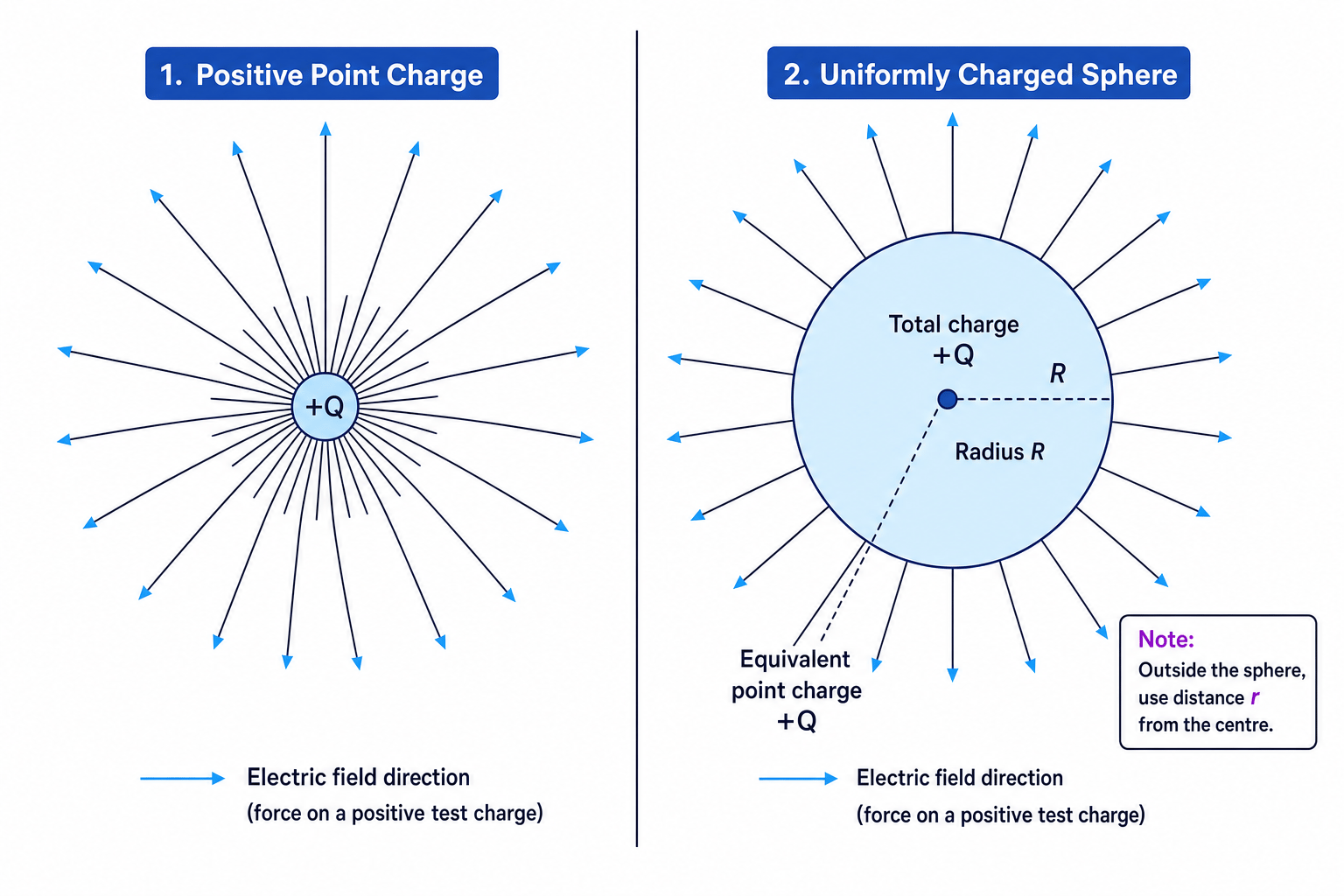
For a positive point charge, the electric field is radial: it points directly outwards in all directions. For a negative point charge, the arrows reverse and point directly inwards.
The diagram shows the radial field pattern for a positive point charge, and how a uniformly charged sphere is represented by an equivalent point charge at its centre for points outside the sphere.
Uniformly charged spheres
A uniformly charged sphere has its charge distributed evenly over or throughout a spherical shape, depending on the model being used. The important idea here is spherical symmetry: from outside the sphere, every direction around the centre looks the same.
For points outside a uniformly charged sphere, the sphere can be modelled as a point charge at its centre. The total charge of the sphere is treated as if it were concentrated at the centre.
Spherical charge model
Outside a uniformly charged sphere, you can model the electric field as if the whole charge were a point charge at the centre of the sphere.
This is a modelling assumption: you replace a complicated real object with a simpler idealised object that gives the same useful prediction in the situation being considered.
Use the centre, not the surface
When using the point-charge model for a sphere, distances are measured from the centre of the sphere, not from its surface.
Choosing the correct distance for a charged sphere
A uniformly charged sphere has radius 0.080 m. A small test charge is placed 0.120 m from the surface of the sphere. What distance should be used from the equivalent point charge?
-
In the model, the sphere’s charge acts from the centre of the sphere, so the required distance is from the centre to the test charge.
-
The test charge is outside the sphere, so add the sphere’s radius to the distance from the surface:
- Therefore:
Measuring from the wrong place
Do not use the distance from the surface when a question asks you to treat a charged sphere as a point charge. Use the distance from the centre.
Electric field lines
Electric fields are invisible, so we use electric field lines to represent them.
Electric field line
An electric field line is a line drawn so that its direction at any point shows the direction of the electric field at that point.
Field line diagrams follow a few important rules:
- arrows show the direction of the force on a positive test charge;
- lines point away from positive charges and towards negative charges;
- closer field lines mean a stronger electric field;
- field lines never cross, because the field cannot have two different directions at the same point.
For a single isolated point charge, the field lines are radial. For a uniform electric field, the field lines would be straight, parallel and equally spaced.
Reading field-line density
Where field lines are closer together, the electric field strength is greater. Where they are more spread out, the electric field is weaker.
Interpreting a field-line map
A diagram shows electric field lines around a positive point charge. The lines are close together near the charge and spread out further away. Compare the field strength near the charge with the field strength further away.
-
Field strength is represented by how close together the field lines are.
-
Near the positive charge, the lines are closer together, so the field is stronger there.
-
Further away, the lines are more spread out, so the field is weaker there.
Electric field strength
The electric field strength at a point tells you how much force would act per unit charge placed at that point.
Electric field strength
Electric field strength, EEE, is the force per unit positive charge on a small test charge placed at that point in the field.
The OCR equation is:
E=Fq E = \frac{F}{q} E=qFwhere:
- EEE is electric field strength, in newtons per coulomb, N C^-1;
- FFF is the force on the charge, in newtons, N;
- qqq is the charge experiencing the force, in coulombs, C.
This equation can also be rearranged:
F=Eq F = Eq F=EqSo a larger charge in the same field experiences a larger force.
Mixing up source charge and test charge
In E=FqE = \frac{F}{q}E=qF, the qqq is the charge that experiences the force. It is not necessarily the charge creating the field.
Calculating electric field strength
A charge of 2.0×10⁻⁶ C2.0 \times 10^{-6}\,\text{C}2.0×10⁻⁶C experiences a force of 3.6×10⁻³ N3.6 \times 10^{-3}\,\text{N}3.6×10⁻³N in an electric field. Calculate the electric field strength.
- Use the definition of electric field strength:
- Substitute the force and charge, keeping the units:
- Calculate the value:
So the electric field strength is 1.8×10³ N C−11.8 \times 10^3\,\text{N C}^{-1}1.8×10³N C−1.
Calculating the force on a charge
A small positive charge of 4.5×10⁻⁹ C4.5 \times 10^{-9}\,\text{C}4.5×10⁻⁹C is placed in an electric field of strength 2.0×10⁴ N C−12.0 \times 10^4\,\text{N C}^{-1}2.0×10⁴N C−1. Calculate the force on the charge.
- Rearrange the equation to make force the subject:
- Substitute the values:
- Multiply the numbers and cancel the charge units:
The force is 9.0×10⁻⁵ N9.0 \times 10^{-5}\,\text{N}9.0×10⁻⁵N, in the direction of the electric field because the charge is positive.
Direction matters
The equation E=FqE = \frac{F}{q}E=qF gives the relationship between field strength, force and charge. In many A-Level questions, you calculate the magnitude first, then decide the direction separately.
For a positive charge:
- force is in the same direction as the field.
For a negative charge:
- force is in the opposite direction to the field.
Sign check
If the charge is negative, do not just attach a negative sign and stop thinking. State the physical direction of the force clearly.
In the exam
-
Define the electric field direction as the force direction on a positive test charge.
-
For a charged sphere, measure distances from the centre when using the point-charge model.
-
In E=FqE = \frac{F}{q}E=qF calculations, use SI units: force in N, charge in C, and field strength in N C^-1.
Check yourself
- Why do electric field lines point away from a positive charge but towards a negative charge?
- When can a uniformly charged sphere be treated as a point charge at its centre?
- A negative charge is placed in a field pointing upwards. What direction is the force on it?
