

What you'll learn
- Kepler’s three laws and what they say about real planetary orbits.
- Why gravity provides the centripetal force for an orbit.
- How to derive and use T2=(4π2/GM)r3T^2 = (4\pi^2/GM)r^3T2=(4π2/GM)r3.
- What makes a satellite geostationary, and why that is useful.
The big picture
Planetary motion is a beautiful link between observation and theory. Kepler described patterns in planetary data. Newton then explained those patterns using gravitational force and circular motion.
For OCR A-Level Physics, you mainly use a circular orbit model. Real planetary orbits are often slightly elliptical, but the circular model is powerful and gives the key equation used for planets, moons, satellites, and exoplanets.
Kepler’s three laws
Orbit and orbital period
An orbit is the path followed by one body moving around another due to gravity. The orbital period, TTT, is the time taken for one complete orbit, measured in seconds (s).
Kepler’s laws are empirical laws: they were found from astronomical observations before Newton’s theory of gravitation explained them.
First law: law of orbits
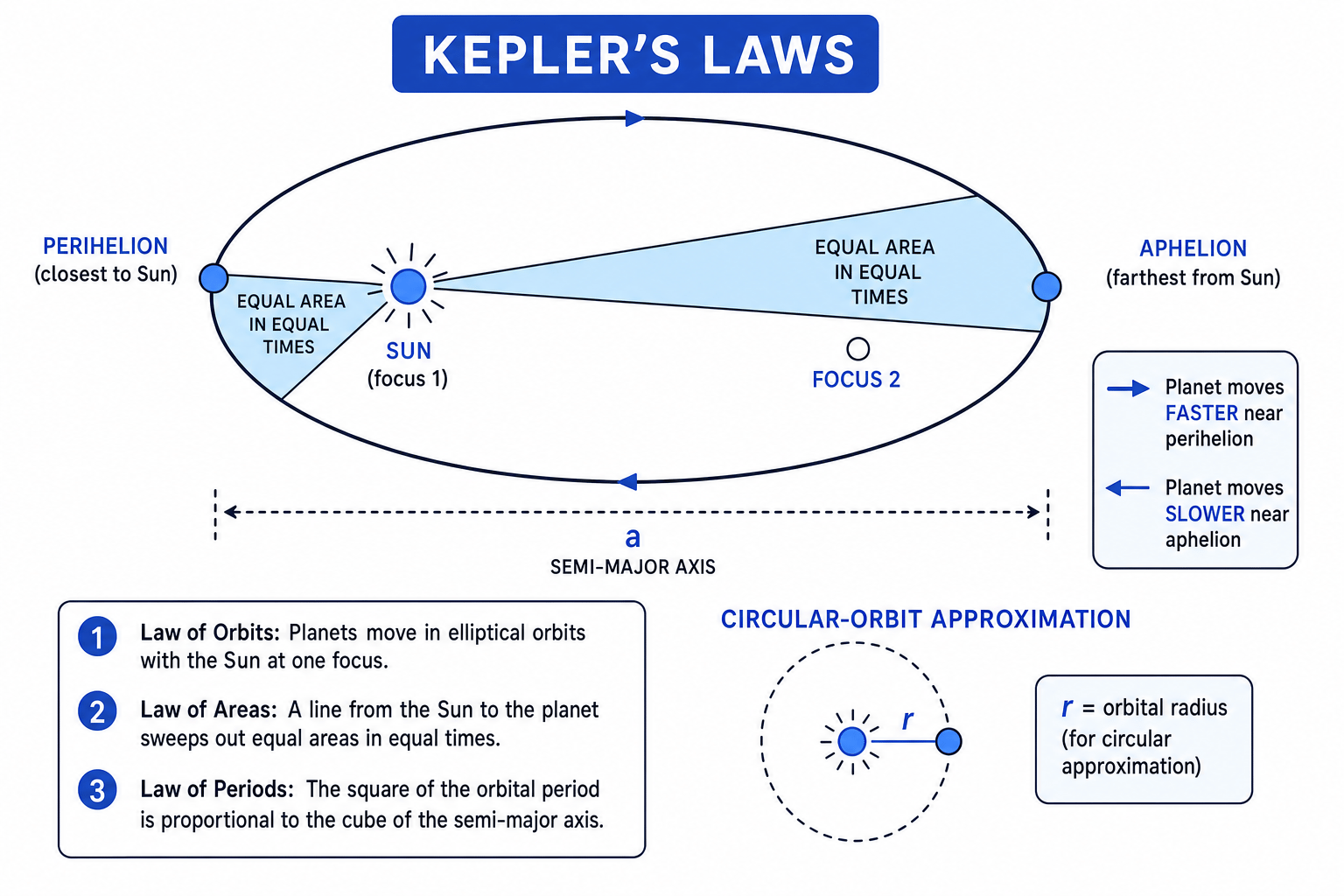
Planets move in elliptical orbits with the Sun at one focus of the ellipse.
Ellipse and focus
An ellipse is a stretched circle. A focus is one of two special points inside the ellipse; for a planet orbiting the Sun, the Sun is at one focus, not usually at the centre.
For many A-Level calculations, the orbit is treated as circular, so the orbital radius rrr is constant.
Second law: law of areas
A line from the Sun to the planet sweeps out equal areas in equal times.
This means a planet moves faster when it is closer to the Sun and slower when it is further away.
Explaining why a planet moves faster near the Sun
-
In equal time intervals, Kepler’s second law says the swept-out areas are equal.
-
Near the Sun, the planet is at a smaller distance from the Sun, so the same area must be swept out using a larger angle and a longer part of the orbit.
-
Since the planet covers a larger distance in the same time near the Sun, its speed is greater there.
Third law: law of periods
For planets orbiting the same central body, the square of the orbital period is proportional to the cube of the orbital size:
T2∝r3T^2 \propto r^3T2∝r3For elliptical orbits, the more precise orbital size is the semi-major axis. In the circular orbit model used for the derivation, this becomes the orbital radius $r`.
Kepler’s third law
For objects orbiting the same central mass, larger orbits have longer periods, and the relationship is not linear: T2∝r3T^2 \propto r^3T2∝r3.
Circular model
The derivation you need assumes a circular orbit of radius rrr. Do not try to derive the full elliptical version; that is beyond the required specification.
Gravity provides the centripetal force
An object in circular motion is constantly changing direction, so it must have an acceleration towards the centre of the circle.
Centripetal force
A centripetal force is the resultant force directed towards the centre of a circular path. It is not a new type of force; it is the role played by an actual force, such as gravity, tension, or friction.
For a planet orbiting the Sun, the gravitational force between the planet and the Sun acts towards the Sun. This inward gravitational force provides the required centripetal force.
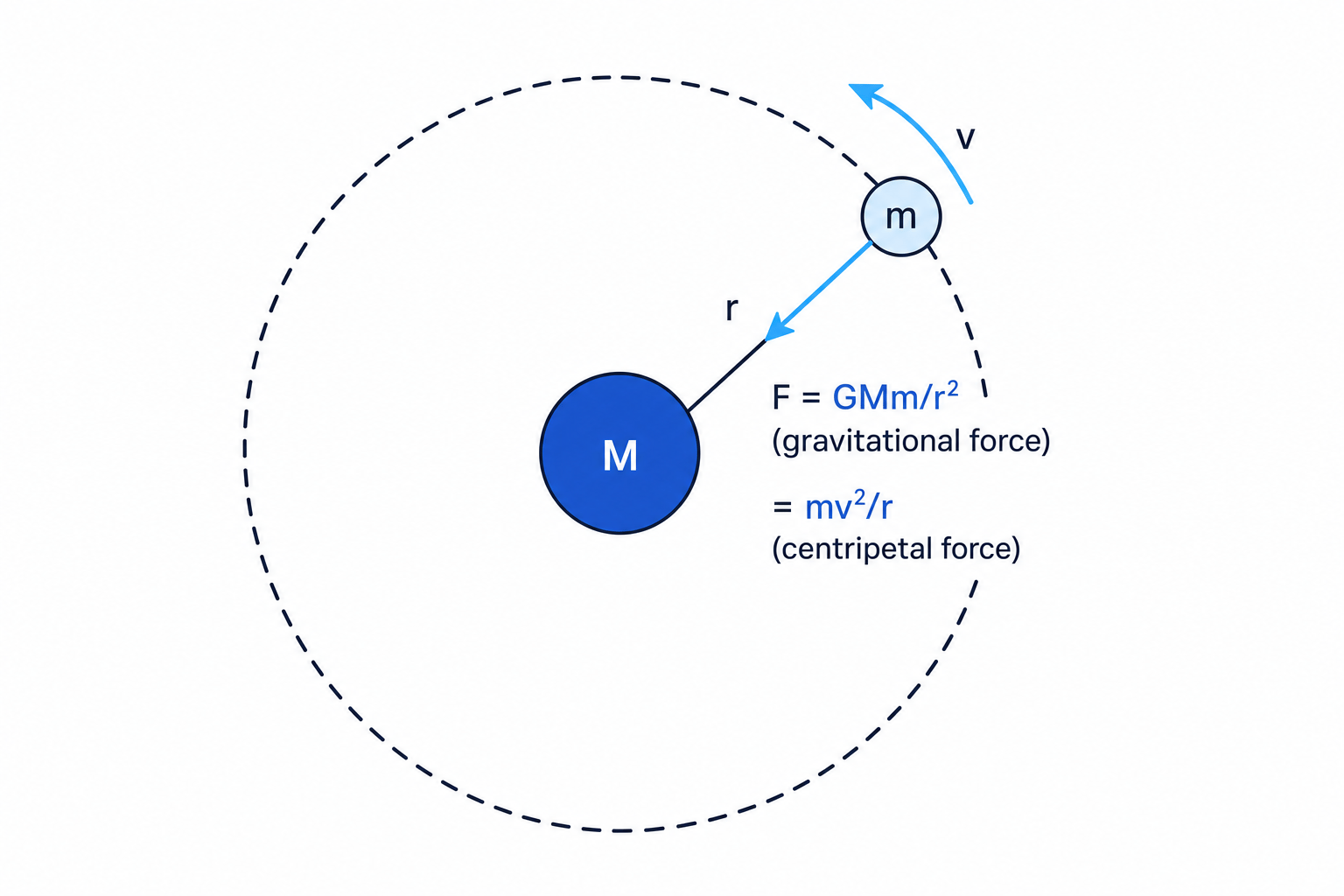
For a planet of mass mmm orbiting a star of mass MMM:
F=GMmr2F = \frac{GMm}{r^2}F=r2GMmFor circular motion:
F=mv2rF = \frac{mv^2}{r}F=rmv2So, for a stable circular orbit:
GMmr2=mv2r\frac{GMm}{r^2} = \frac{mv^2}{r}r2GMm=rmv2Inventing an extra force
Do not draw both “gravity” and “centripetal force” as separate forces on the planet. Gravity is the centripetal force in this situation.
Deriving the orbital period equation
The specification expects you to derive:
T2=(4π2GM)r3T^2 = \left(\frac{4\pi^2}{GM}\right)r^3T2=(GM4π2)r3where:
- TTT is the orbital period in seconds (s)
- GGG is the gravitational constant
- MMM is the mass of the central body in kilograms (kg)
- rrr is the orbital radius measured from centre to centre in metres (m)
Deriving the orbital period equation
-
Equate gravitational force to centripetal force because gravity provides the inward resultant force:
GMmr2=mv2r\frac{GMm}{r^2} = \frac{mv^2}{r}r2GMm=rmv2 -
Cancel the orbiting mass m‘andonefactorofm` and one factor of m‘andonefactorofr`:
v2=GMrv^2 = \frac{GM}{r}v2=rGM -
For one circular orbit, the distance travelled is the circumference $2\pi r`, so the orbital speed is:
v=2πrTv = \frac{2\pi r}{T}v=T2πr -
Substitute this into $v^2 = GM/r`:
(2πrT)2=GMr\left(\frac{2\pi r}{T}\right)^2 = \frac{GM}{r}(T2πr)2=rGM -
Rearrange:
4π2r2T2=GMr\frac{4\pi^2r^2}{T^2} = \frac{GM}{r}T24π2r2=rGM T2=4π2r3GMT^2 = \frac{4\pi^2r^3}{GM}T2=GM4π2r3
Why the planet’s mass cancels
In this model, the period of a circular orbit does not depend on the mass of the orbiting object. A small satellite and a large satellite at the same orbital radius around Earth have the same orbital period.
Using T2=(4π2/GM)r3T^2 = (4\pi^2/GM)r^3T2=(4π2/GM)r3
You can calculate an orbital period if you know the central mass and orbital radius.
Calculating the period of a planet
Mars orbits the Sun at an approximate radius of 2.28×10¹¹ m2.28\times10^{11}\ \text{m}2.28×10¹¹ m. The mass of the Sun is 1.99×1030 kg1.99\times10^{30}\ \text{kg}1.99×1030 kg. Calculate the orbital period of Mars.
-
Choose the orbital period equation and rearrange by square rooting:
T=4π2r3GMT = \sqrt{\frac{4\pi^2r^3}{GM}}T=GM4π2r3 -
Substitute the values, using G=6.67×10⁻¹¹ N m2 kg−2G = 6.67\times10^{-11}\ \text{N m}^2\ \text{kg}^{-2}G=6.67×10⁻¹¹ N m2 kg−2:
T=4π2(2.28×10¹¹ m)3(6.67×10⁻¹¹ N m2 kg−2)(1.99×1030 kg)T = \sqrt{\frac{4\pi^2(2.28\times10^{11}\ \text{m})^3}{(6.67\times10^{-11}\ \text{N m}^2\ \text{kg}^{-2})(1.99\times10^{30}\ \text{kg})}}T=(6.67×10⁻¹¹ N m2 kg−2)(1.99×1030 kg)4π2(2.28×10¹¹ m)3 -
Calculate the period:
T=5.94×10⁷ sT = 5.94\times10^7\ \text{s}T=5.94×10⁷ s -
Convert to days for interpretation:
T=5.94×10⁷ s86400 s day−1=688 daysT = \frac{5.94\times10^7\ \text{s}}{86400\ \text{s day}^{-1}} = 688\ \text{days}T=86400 s day−15.94×10⁷ s=688 days
So the orbital period is about $5.94\times10^7\ \text{s}`, or 688 days.
Using the wrong distance
In orbit equations, rrr is measured from the centre of the central body to the centre of the orbiting body. For a satellite, this is not the height above the surface.
Applying Kepler’s third law beyond the Solar System
Kepler’s third law is not just for planets around the Sun. It applies to any system where a smaller object orbits a much larger central mass under gravity, such as:
- moons orbiting a planet
- artificial satellites orbiting Earth
- exoplanets orbiting another star
For objects orbiting the same central mass:
T2r3=4π2GM\frac{T^2}{r^3} = \frac{4\pi^2}{GM}r3T2=GM4π2The constant depends on the central mass $M`.
Comparing two exoplanets around the same star
An exoplanet has orbital radius 2.00×10¹⁰ m2.00\times10^{10}\ \text{m}2.00×10¹⁰ m and period 20.0 days. A second exoplanet orbits the same star at radius 5.00×10¹⁰ m5.00\times10^{10}\ \text{m}5.00×10¹⁰ m. Estimate the second planet’s period.
-
Since both planets orbit the same star, use the ratio form of $T^2 \propto r^3`:
(T2T1)2=(r2r1)3\left(\frac{T_2}{T_1}\right)^2 = \left(\frac{r_2}{r_1}\right)^3(T1T2)2=(r1r2)3 -
Square root both sides:
T2T1=(r2r1)3/2\frac{T_2}{T_1} = \left(\frac{r_2}{r_1}\right)^{3/2}T1T2=(r1r2)3/2 -
Substitute the radii:
T2=20.0 days(5.00×10¹⁰ m2.00×1010 m)3/2T_2 = 20.0\ \text{days}\left(\frac{5.00\times10^{10}\ \text{m}}{2.00\times10^{10}\ \text{m}}\right)^{3/2}T2=20.0 days(2.00×10¹⁰ m5.00×1010 m)3/2 -
Calculate:
T2=20.0 days(2.50)3/2=79.1 daysT_2 = 20.0\ \text{days}(2.50)^{3/2} = 79.1\ \text{days}T2=20.0 days(2.50)3/2=79.1 days
The second exoplanet has an orbital period of about 79.1 days.
Comparing different stars
You can only use the simple ratio T2∝r3T^2 \propto r^3T2∝r3 directly if the objects orbit the same central mass. Different stars have different masses, so the constant changes.
Geostationary orbit
Geostationary orbit
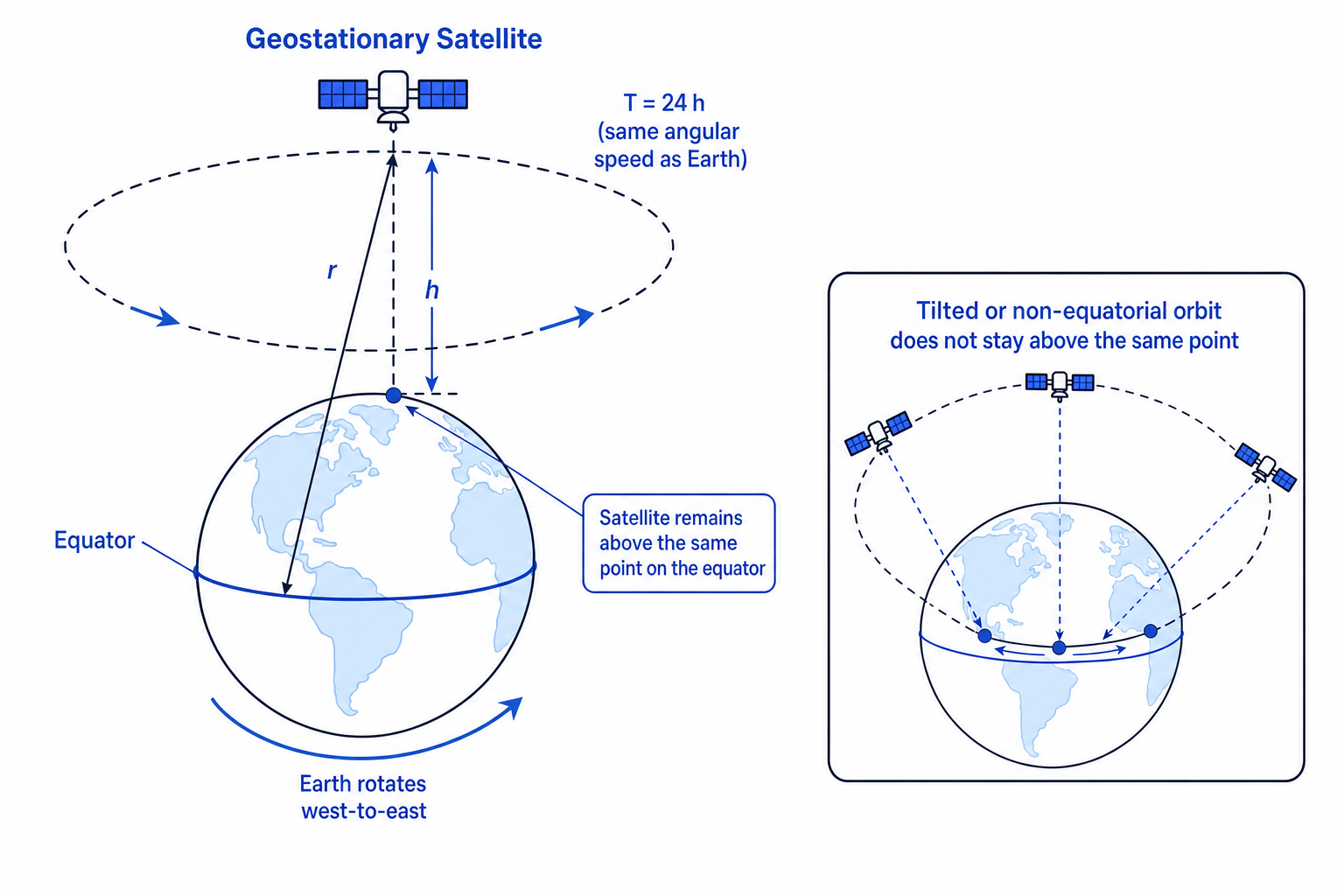
A geostationary satellite is a satellite that remains above the same point on Earth’s equator. It must have a circular orbit in the equatorial plane, travel in the same direction as Earth’s rotation, and have the same angular speed as Earth.
Its orbital period is approximately 24 h. More precisely, it matches Earth’s rotation period relative to the stars, but 24 h is commonly used unless the question gives a more precise value.
Uses of geostationary satellites
Geostationary satellites are useful because ground receivers can point at a fixed position in the sky. Uses include:
- satellite television and radio broadcasting
- telephone and internet communications
- weather monitoring of the same region over time
Why geostationary satellites are predictable
Newtonian gravity and circular motion predict one particular orbital radius for a satellite with a 24 h period around Earth. The satellite’s mass does not affect this radius.
Calculating the height of a geostationary satellite
Calculate the approximate altitude of a geostationary satellite. Use Earth’s mass M=5.97×1024 kg‘,Earth’sradiusM = 5.97\times10^{24}\ \text{kg}`, Earth’s radius M=5.97×1024 kg‘,Earth’sradiusR = 6.37\times10^6\ \text{m}, and $T = 24.0\ \text{h}.
-
Convert the period into seconds:
T=24.0×3600 s=86400 sT = 24.0 \times 3600\ \text{s} = 86400\ \text{s}T=24.0×3600 s=86400 s -
Rearrange the orbital period equation for $r`:
r=(GMT24π2)1/3r = \left(\frac{GMT^2}{4\pi^2}\right)^{1/3}r=(4π2GMT2)1/3 -
Substitute the values:
r=((6.67×10⁻¹¹)(5.97×1024 kg)(86400 s)24π2)1/3r = \left(\frac{(6.67\times10^{-11})(5.97\times10^{24}\ \text{kg})(86400\ \text{s})^2}{4\pi^2}\right)^{1/3}r=(4π2(6.67×10−11)(5.97×1024 kg)(86400 s)2)1/3 -
Calculate the orbital radius from Earth’s centre:
r=4.22×10⁷ mr = 4.22\times10^7\ \text{m}r=4.22×10⁷ m -
Subtract Earth’s radius to find the altitude above the surface:
h=r−R=4.22×10⁷ m−6.37×10⁶ mh = r - R = 4.22\times10^7\ \text{m} - 6.37\times10^6\ \text{m}h=r−R=4.22×10⁷ m−6.37×10⁶ m h=3.58×10⁷ mh = 3.58\times10^7\ \text{m}h=3.58×10⁷ m
The satellite’s altitude is about $3.58\times10^7\ \text{m}`, or 35 800 km.
Period alone is not enough
A 24 h orbit is not automatically geostationary. The orbit must also be circular, above the equator, and in the same direction as Earth’s rotation.
In the exam
-
For orbit calculations, check whether rrr is an orbital radius from the centre or an altitude above the surface.
-
When deriving T2=(4π2/GM)r3T^2 = (4\pi^2/GM)r^3T2=(4π2/GM)r3, start by equating GMmr2\frac{GMm}{r^2}r2GMm and mv2r\frac{mv^2}{r}rmv2, then use $v = 2\pi r/T`.
-
For geostationary satellites, state all three conditions: 24 h period, equatorial circular orbit, and same direction as Earth’s rotation.
Check yourself
- Why does the mass of the orbiting planet or satellite cancel in the derivation?
- What is the difference between orbital radius and altitude?
- Why can’t a satellite in a tilted 24 h orbit be geostationary?
