

Welcome to one of the most exciting and fundamental topics in A-Level Physics. Here, we transition from thinking about classical conservation of mass and conservation of energy as separate laws to understanding how they are two sides of the same coin. This topic explains why the Sun shines, how nuclear power stations generate electricity, and the fundamental limits of nuclear stability.
What you'll learn
- How mass and energy are related through Einstein's famous equation ΔE=Δmc2\Delta E = \Delta m c^2ΔE=Δmc2
- The concepts of mass defect and binding energy, and how to use them to predict reaction energy
- The mechanics of induced nuclear fission inside a commercial power reactor
- The conditions required for nuclear fusion and the engineering challenges we must overcome to harness it
1. Mass-Energy Equivalence
In classical physics, we treat mass and energy as entirely independent quantities. However, in 1905, Albert Einstein published his theory of Special Relativity, showing that mass and energy are equivalent.
Mass-Energy Equivalence
Mass-energy equivalence is the principle that mass is a concentrated form of energy. A change in mass Δm\Delta mΔm is always accompanied by an equivalent change in energy ΔE\Delta EΔE.
This equivalence is quantified by the famous equation:
ΔE=Δmc2 \Delta E = \Delta m c^2 ΔE=Δmc2Where:
- ΔE\Delta EΔE is the change in energy, measured in Joules (J\text{J}J)
- Δm\Delta mΔm is the change in mass, measured in kilograms (kg\text{kg}kg)
- ccc is the speed of light in a vacuum (3.00×10⁸ m s−13.00 \times 10^8 \text{ m s}^{-1}3.00×10⁸ m s−1)
Because the constant c2c^2c2 is incredibly large (≈9.00×10¹⁶ m2 s−2\approx 9.00 \times 10^{16} \text{ m}^2 \text{ s}^{-2}≈9.00×10¹⁶ m2 s−2), a tiny change in mass results in a staggering release of energy.
Pair Production and Annihilation
This equivalence is demonstrated perfectly in interactions between fundamental particles and their antiparticles.
Annihilation
When a particle meets its corresponding antiparticle, they completely destroy one another. This process is called annihilation.
The entire rest mass of the two particles is converted into electromagnetic energy in the form of high-energy photons. To conserve momentum, at least two photons must be produced, travelling in opposite directions.
Annihilation Energy
The minimum energy of each photon, EminE_{\text{min}}Emin, produced during the annihilation of a resting particle-antiparticle pair is equal to the rest mass energy of one of the particles:
Emin=hfmin=mc2 E_{\text{min}} = hf_{\text{min}} = mc^2 Emin=hfmin=mc2where mmm is the rest mass of the single particle, hhh is Planck's constant, and fff is the photon frequency.
Pair Production
The reverse process is pair production. A single high-energy photon vanishes, and its energy is converted into the mass of a particle-antiparticle pair.
For this to happen, the photon must interact with a nucleus to conserve momentum, and its energy must be at least equal to the combined rest mass energies of the two particles created:
Ephoton, min=2mc2 E_{\text{photon, min}} = 2mc^2 Ephoton, min=2mc2Forgetting the partner in annihilation
In calculations involving pair production or annihilation, students often forget that two particles are involved.
- In annihilation, two identical-mass particles (e.g. electron + positron) produce two photons. Thus, the total energy released is 2mc22mc^22mc2, and each photon gets mc2mc^2mc2.
- In pair production, one photon must have at least 2mc22mc^22mc2 of energy to create the pair of particles.
Calculating annihilation photon frequency
An electron and a positron annihilate each other. Calculate the minimum frequency of each of the two photons produced. (Take the rest mass of an electron/positron as me=9.11×10⁻³¹ kgm_e = 9.11 \times 10^{-31} \text{ kg}me=9.11×10⁻³¹ kg, Planck's constant h=6.63×10⁻³⁴ J sh = 6.63 \times 10^{-34} \text{ J s}h=6.63×10⁻³⁴ J s, and the speed of light c=3.00×10⁸ m s−1c = 3.00 \times 10^8 \text{ m s}^{-1}c=3.00×10⁸ m s−1.)
- Identify the rest mass of one particle and calculate its equivalent rest energy using Einstein's equation:
- Recall that the minimum energy of each of the two produced photons must equal this rest mass energy of a single particle:
- Relate the photon energy to its frequency using the Planck relation E=hfE = hfE=hf:
- Compute the frequency and round to a sensible number of significant figures (3 s.f.):
2. Mass Defect and Binding Energy
If you were to measure the mass of an intact Helium-4 nucleus (He−4\text{He}-4He−4), and then compare it to the combined individual masses of two isolated protons and two isolated neutrons, you would discover a strange physical truth: the intact nucleus is lighter than the sum of its individual parts.
Where did this missing mass go? It was released as energy when the strong nuclear force bound the nucleons together.
Mass Defect
The mass defect (Δm\Delta mΔm) of a nucleus is the difference between the total mass of its completely separated individual nucleons and the mass of the intact nucleus.
Where:
- ZZZ is the proton number (atomic number)
- AAA is the nucleon number (mass number)
- mpm_pmp is the mass of a free proton
- mnm_nmn is the mass of a free neutron
- mnucleusm_{\text{nucleus}}mnucleus is the mass of the nucleus
Binding Energy
The binding energy (EbE_bEb) of a nucleus is the minimum energy required to completely separate a nucleus into its constituent protons and neutrons.
The binding energy is directly equivalent to the mass defect:
Eb=Δmc2 E_b = \Delta m c^2 Eb=Δmc2Binding Energy per Nucleon
To compare how tightly bound different nuclei are, we calculate the binding energy per nucleon (Eb/AE_b / AEb/A).
Binding Energy per Nucleon=EbA {\text{Binding Energy per Nucleon}} = \frac{E_b}{A} Binding Energy per Nucleon=AEbA higher binding energy per nucleon means the nucleons are held together more tightly, making the nucleus more stable.
Nucleus vs. Atom mass
OCR exam questions will sometimes give you the mass of the neutral atom rather than the bare nucleus. If given the atomic mass, you must subtract the masses of the orbiting electrons to find the nuclear mass before calculating the mass defect.
Calculating binding energy per nucleon
The mass of an alpha particle (24He^4_2\text{He}24He nucleus) is 6.6447×10⁻²⁷ kg6.6447 \times 10^{-27} \text{ kg}6.6447×10⁻²⁷ kg. The mass of a free proton is 1.6726×10⁻²⁷ kg1.6726 \times 10^{-27} \text{ kg}1.6726×10⁻²⁷ kg and the mass of a free neutron is 1.6749×10⁻²⁷ kg1.6749 \times 10^{-27} \text{ kg}1.6749×10⁻²⁷ kg. Calculate the binding energy per nucleon of the helium nucleus in millions of electronvolts (MeV\text{MeV}MeV). (Take 1 eV=1.60×10⁻¹⁹ J1 \text{ eV} = 1.60 \times 10^{-19} \text{ J}1 eV=1.60×10⁻¹⁹ J).
- Calculate the total mass of the individual, separated constituent nucleons. A helium-4 nucleus contains 2 protons and 2 neutrons:
- Find the mass defect (Δm\Delta mΔm) by subtracting the actual nuclear mass from the mass of the separated nucleons:
- Calculate the total binding energy (EbE_bEb) in Joules using ΔE=Δmc2\Delta E = \Delta m c^2ΔE=Δmc2:
- Convert this energy from Joules into electronvolts (eV\text{eV}eV) and then mega-electronvolts (MeV\text{MeV}MeV):
- Divide by the total number of nucleons (A=4A = 4A=4) to find the binding energy per nucleon:
3. The Binding Energy per Nucleon Curve
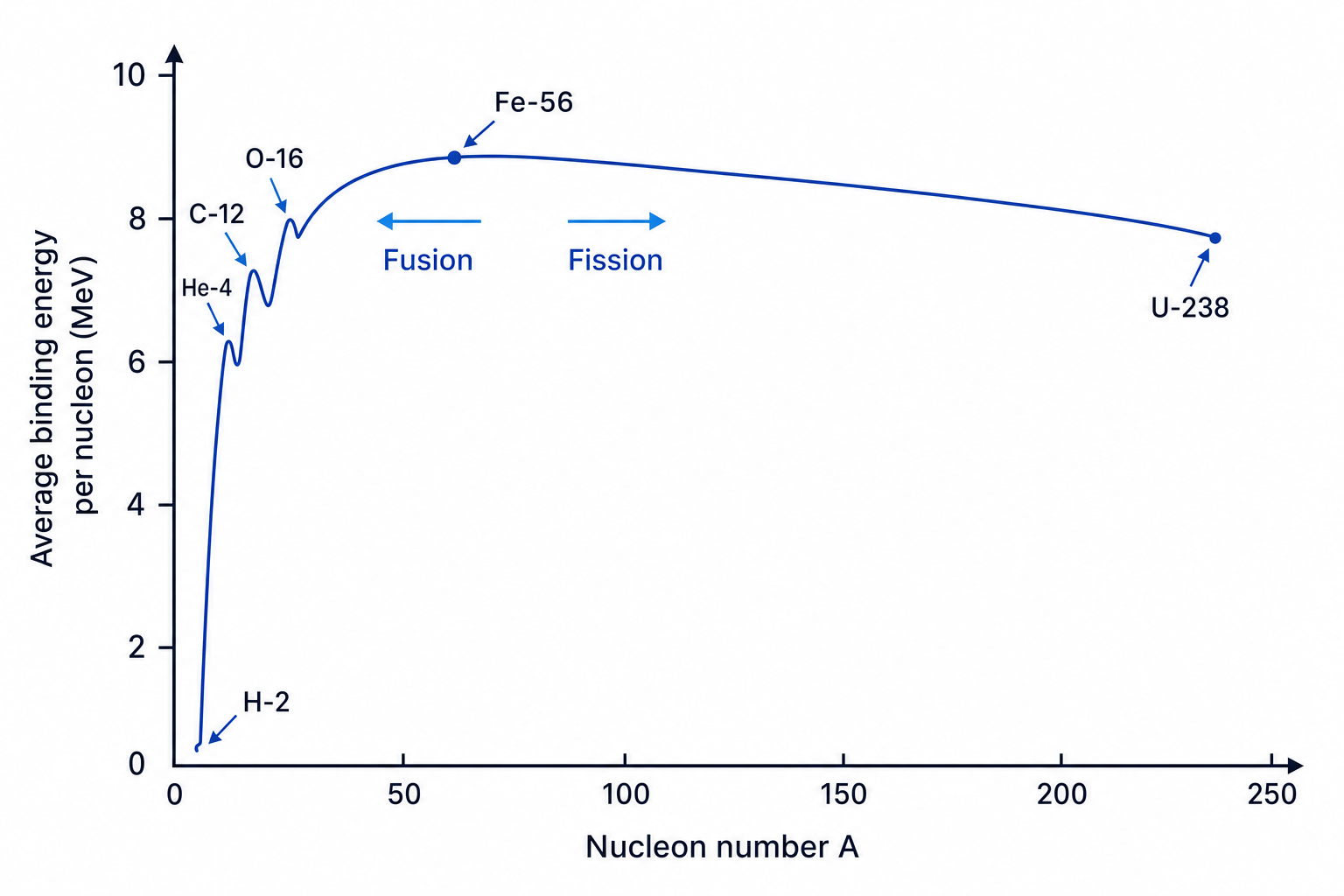
If we plot the binding energy per nucleon (Eb/AE_b / AEb/A) against the nucleon number (AAA) for stable isotopes, we obtain one of the most important graphs in physics:
Key Features of the Curve
- The Peak: The curve reaches its absolute maximum at Iron-56 (56Fe^{56}\text{Fe}56Fe), which has a binding energy per nucleon of approximately 8.8 MeV8.8 \text{ MeV}8.8 MeV. This makes 56Fe^{56}\text{Fe}56Fe the most stable nucleus in nature.
- Left of the Peak (A<56A < 56A<56): Nuclei have relatively low binding energies per nucleon. If two light nuclei join together to form a heavier nucleus closer to the peak, the binding energy per nucleon increases. This process is called nuclear fusion, and it releases energy.
- Right of the Peak (A>56A > 56A>56): Heavy nuclei have slightly lower binding energies per nucleon than Iron. If a heavy, unstable nucleus splits into two lighter daughter nuclei closer to the peak, the total binding energy increases. This process is called nuclear fission, and it also releases energy.
- The Sharp Peaks: There are distinct local maxima at 4He^{4}\text{He}4He, 12C^{12}\text{C}12C, and 16O^{16}\text{O}16O. These peaks indicate that these specific nuclei are exceptionally stable compared to their neighbours.
Energy Release Rule
Energy is released in a nuclear reaction only if the total binding energy of the system increases. In other words, the product nuclei must lie closer to the peak of the binding energy curve (i.e. have a higher binding energy per nucleon) than the reactants.
4. Induced Nuclear Fission
Nuclear Fission
Nuclear fission is the splitting of a heavy, unstable nucleus into two lighter, more stable daughter nuclei, accompanied by the release of neutrons and energy.
While some very heavy nuclei undergo spontaneous fission, commercial energy generation relies on induced nuclear fission.
n + U-235 ---> [U-236]* ---> Ba-141 + Kr-92 + 3n + Energy
The Chain Reaction
In a typical reactor, a slow-moving neutron is absorbed by a Uranium-235 nucleus, forming an extremely unstable, excited Uranium-236 intermediate:
01n+92235U→[92236U]∗→56141Ba+3692Kr+3 01n+Energy ^{1}_{0}\text{n} + ^{235}_{92}\text{U} \to [^{236}_{92}\text{U}]^* \to ^{141}_{56}\text{Ba} + ^{92}_{36}\text{Kr} + 3\ ^{1}_{0}\text{n} + \text{Energy} 01n+92235U→[92236U]∗→56141Ba+3692Kr+3 01n+EnergyNotice how the reaction consumes one neutron but releases three high-energy neutrons. If these released neutrons are absorbed by other 235U^{235}\text{U}235U nuclei, they can trigger further fission events. This self-sustaining sequence is called a chain reaction.
             /---> [Fission Event 1] ---> 3 neutrons ---> 3 more fissions
            /
  n ---> U-235 ---> [Fission Event 2] ---> 3 neutrons ---> 3 more fissions
            \
             \---> [Fission Event 3] ---> 3 neutrons ---> 3 more fissions
Basic Structure of a Fission Reactor
To safely exploit this reaction, nuclear power stations use highly engineered reactors. You must know the function of the three core components:
| Component | Material | Purpose / Mechanism |
|---|---|---|
| Fuel Rods | Uranium enriched with 235U^{235}\text{U}235U (often UO2\text{UO}_2UO2 pellets) | Provides the fissionable nuclei that act as the source of energy. |
| Moderator | Water or graphite | Slowing down fast neutrons. Fission reactions release "fast" neutrons. However, 235U^{235}\text{U}235U nuclei only absorb "slow" thermal neutrons. When fast neutrons collide elastically with the moderator's light atoms, they transfer kinetic energy, slowing them down to thermal speeds. |
| Control Rods | Boron or Cadmium | Absorbing neutrons. To maintain a steady output, exactly one neutron from each fission must go on to cause another. Control rods are lowered or raised into the reactor core to absorb excess neutrons, preventing a runaway chain reaction. |
Environmental Impact and Decision-Making
The construction of nuclear power plants is a highly debated sociopolitical and scientific issue (an example of HSW: How Science Works decision-making).
High-Level Nuclear Waste
The main product of fission is the high-level waste consisting of the highly radioactive daughter nuclei (like 141Ba^{141}\text{Ba}141Ba and 92Kr^{92}\text{Kr}92Kr). Many of these isotopes have incredibly long half-lives (t1/2>104 yearst_{1/2} > 10^4 \text{ years}t1/2>104 years). They present a severe biohazard because they emit ionising radiation (α\alphaα, β\betaβ, and γ\gammaγ).
Waste Management Protocol
- Cooling ponds: Spent fuel rods are placed in deep, water-filled pools inside the station for several years to absorb the heat produced by decay and screen the radiation.
- Vitrification: After cooling, the active isotopes are extracted, mixed with molten glass, and cooled into a solid, stable form.
- Geological storage: The vitrified waste is placed in sealed steel canisters and buried deep underground in stable geological formations, far from water tables and seismic zones.
The Nuclear Debate
In essay-style questions about building new nuclear power stations, structure your points symmetrically:
- Pros: No greenhouse gas emissions (CO2\text{CO}_2CO2) during operation; extremely high energy density; provides reliable, continuous "base-load" electricity unlike solar/wind.
- Cons: High capital cost to build and decommission; risks of catastrophic accidents (though statistically rare); long-term high-level waste storage remains a political challenge.
5. Nuclear Fusion
Nuclear Fusion
Nuclear fusion is the joining together of two light, unstable nuclei to form a heavier, more stable nucleus, releasing energy in the process.
Fusion is the process that powers the Sun. A typical reaction involves fusing two isotopes of hydrogen: Deuterium (12H^2_1\text{H}12H) and Tritium (13H^3_1\text{H}13H).
12H+13H→24He+01n+Energy ^{2}_{1}\text{H} + ^{3}_{1}\text{H} \to ^{4}_{2}\text{He} + ^{1}_{0}\text{n} + \text{Energy} 12H+13H→24He+01n+EnergyThe Fusion Temperature Barrier
Why don't we have commercial fusion power stations on Earth yet? The physics of the nucleus presents a massive barrier:
- Electrostatic Repulsion: Nuclei are positively charged due to their protons. As two nuclei approach, they experience a colossal repulsive Coulomb force.
- The Strong Force Range: For fusion to occur, the nuclei must be brought within approximately 10−15 m10^{-15} \text{ m}10−15 m of each other, where the short-range strong nuclear force can overcome the electrostatic repulsion and bind them.
- High Temperature and Density: To cross this barrier, the reactant nuclei must have incredibly high kinetic energies. This requires temperatures in the region of 1.5×10⁷ K1.5 \times 10^7 \text{ K}1.5×10⁷ K (close to the temperature of the Sun's core). High particle density is also required to maintain a high rate of collisions.
At these temperatures, matter exists as a plasma (a soup of bare nuclei and free electrons), which is extremely difficult to confine and control.
6. Balancing Nuclear Transformation Equations
When writing or completing nuclear equations, you must ensure that two fundamental quantities are balanced on both sides:
- The total nucleon number (AAA) (represented by the top superscript numbers)
- The total proton / charge number (ZZZ) (represented by the bottom subscript numbers)
Balancing a nuclear equation
A nitrogen-14 nucleus captures an alpha particle to produce a proton and an unknown isotope XXX. Identify the mass number, atomic number, and name of element XXX.
- Set up the nuclear equation using placeholders for the unknown mass number AAA and atomic number ZZZ:
- Set up a conservation equation for the top mass/nucleon numbers (AAA):
- Set up a conservation equation for the bottom proton/charge numbers (ZZZ):
- Use the atomic number (Z=8Z = 8Z=8) to identify the element from the periodic table (Oxygen, O\text{O}O): The unknown nucleus is Oxygen-17 (817O^{17}_{8}\text{O}817O).
In the exam
- Always watch your units. Binding energies are calculated in Joules using SI units (kgkgkg, m s−1m\ s^{-1}m s−1) and then converted to MeVMeVMeV using 1 eV=1.60×10⁻¹⁹ J1\ eV = 1.60 \times 10^{-19}\ J1 eV=1.60×10⁻¹⁹ J. Keep conversions clear in your working.
- Show every step. When calculating mass defect, keep all decimal places provided in the question data (often 5 or 6 decimal places). Do not round your mass calculations prematurely, as the mass difference is extremely tiny and rounding will obliterate your answer.
- Learn the moderator mechanism. If asked how a moderator works, your answer must state: neutrons collide elastically with the nuclei of the moderator (e.g., water), transferring kinetic energy and slowing them down to thermal speeds so they can be captured by Uranium-235.
Check yourself
- Can you explain why the products of a nuclear fission reaction have a higher total binding energy than the starting reactants, even though the reaction releases energy?
- Why can we not use Uranium-238 to release energy through fusion reactions? Use the binding energy curve to justify your answer.
- What physical mechanism allows cadmium control rods to control the power output of a reactor core, and how does this contrast with the role of the moderator?
