

What you'll learn
- What drag is, and what affects it for objects moving through air.
- Why a falling object’s acceleration is not constant when drag is present.
- How terminal velocity happens using force diagrams and velocity-time graphs.
- How terminal velocity can be measured in fluids, such as oil or air.
The mechanics you already need
Before adding drag, keep three ideas clear.
Uniform gravitational field
A uniform gravitational field is a region where gravitational field strength ggg is constant in magnitude and direction. Near the Earth’s surface, this means the weight of an object is approximately constant: W=mgW = mgW=mg.
The resultant force is the single overall force after adding all forces with their directions. Newton’s second law is:
F=maF = maF=mawhere FFF is resultant force in newtons, mmm is mass in kilograms, and aaa is acceleration in metres per second squared.
Non-uniform acceleration
Non-uniform acceleration means the acceleration changes with time. On a velocity-time graph, this appears as a curve with a changing gradient.
For a velocity-time graph:
- the gradient gives acceleration
- the area under the graph gives displacement
Do not use SUVAT for the whole fall
Equations such as v=u+atv = u + atv=u+at assume constant acceleration. With drag, acceleration changes, so use force diagrams, Newton’s second law, or velocity-time graphs unless the question clearly states that acceleration is constant over that interval.
Drag: friction from a fluid
Drag
Drag is the frictional force experienced by an object travelling through a fluid, where a fluid means a liquid or gas. Drag acts opposite to the object’s motion relative to the fluid.
For this topic, air is the most common fluid. A falling object moving downward through still air experiences an upward drag force.
Drag is not a fixed value. It usually increases as the object moves faster through the fluid, because the object has to push more air out of the way each second.
Factors affecting drag in air
For an object travelling through air, drag depends on several factors:
- Speed through the air: greater speed gives greater drag.
- Frontal area: a larger cross-sectional area gives greater drag.
- Shape: streamlined shapes reduce drag; flat or blunt shapes increase drag.
- Surface texture: rough surfaces can increase drag.
- Air density: denser air gives greater drag.
- Relative motion of the air: a headwind increases the object’s speed relative to the air.
Mass does not directly change drag
For the same shape, size, speed, and air conditions, increasing mass does not directly increase drag. It increases weight, which can change the acceleration and the terminal velocity.
In investigations, you test these ideas by changing one factor at a time and controlling the others. For example, if you compare two parachutes, you should try to keep the mass, drop height, and material similar while changing the parachute area.
Predicting the effect of a larger parachute
- Identify the direction of motion: the parachutist is moving downward, so drag acts upward.
- Compare the changed factor: a larger parachute has a larger frontal area, so at the same speed it experiences a larger upward drag force.
- Apply Newton’s second law: if drag becomes greater than weight, the resultant force is upward, so the parachutist decelerates until a new lower terminal velocity is reached.
Falling with drag
Consider an object dropped from rest in a uniform gravitational field.
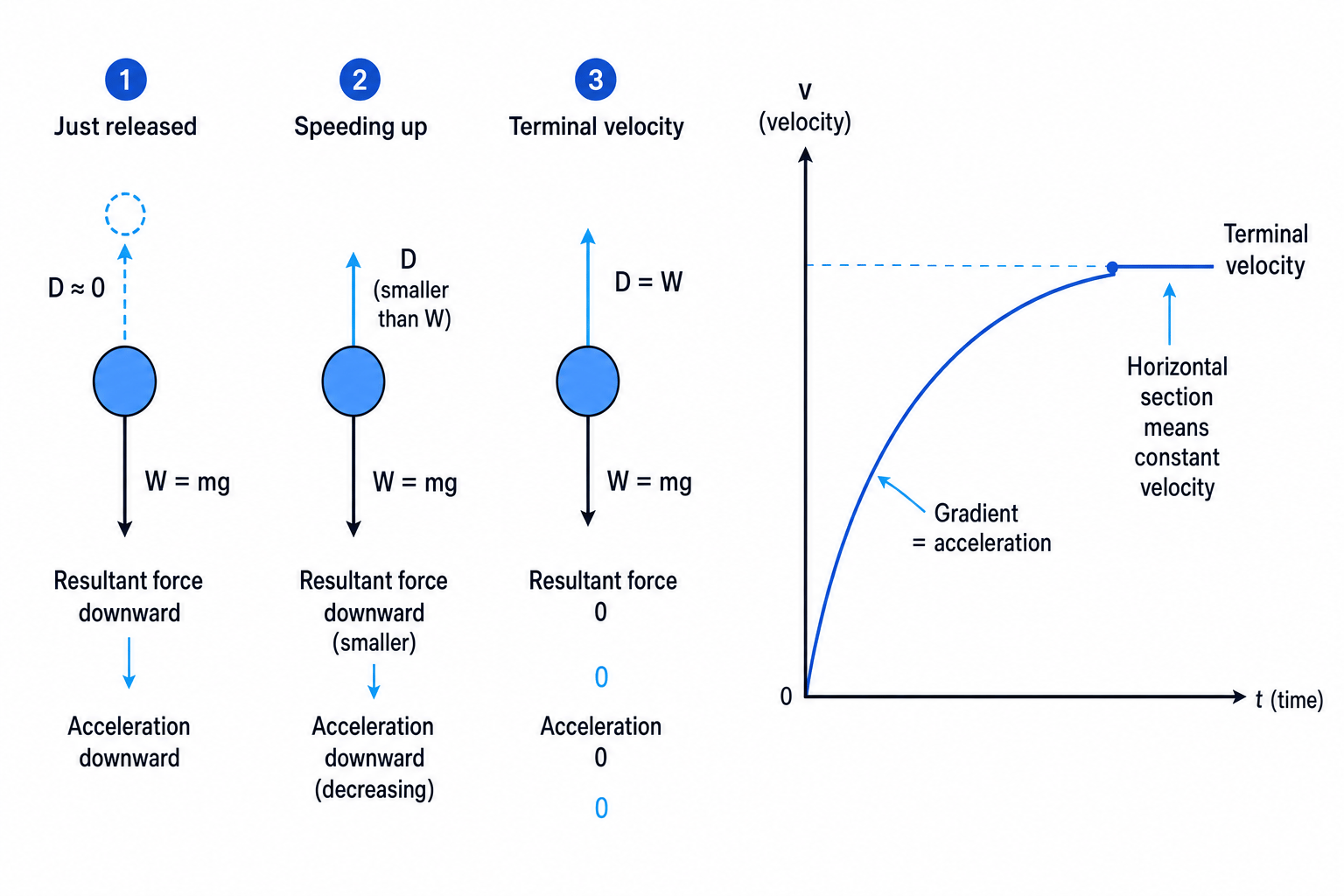
At first, its speed is zero, so drag is approximately zero. The only significant force is weight, so the resultant force is downward and the acceleration is close to ggg.
As the object speeds up, drag increases upward. The weight stays constant, but the resultant downward force gets smaller. Since F=maF = maF=ma, the acceleration also gets smaller.
The force diagrams and velocity-time graph below summarise the full motion.
Why the acceleration changes
A falling object with drag has non-uniform acceleration because its speed changes, which changes the drag force, which changes the resultant force.
Calculating acceleration with drag
A ball of mass 0.080 kg falls through air. At one instant, the upward drag force is 0.35 N. Calculate its acceleration at that instant.
-
Calculate the weight of the ball:
W=mg=0.080 kg×9.81 N kg−1=0.785 NW = mg = 0.080\ \text{kg} \times 9.81\ \text{N kg}^{-1} = 0.785\ \text{N}W=mg=0.080 kg×9.81 N kg−1=0.785 N -
Take downward as positive and find the resultant force:
F=W−D=0.785 N−0.35 N=0.435 NF = W - D = 0.785\ \text{N} - 0.35\ \text{N} = 0.435\ \text{N}F=W−D=0.785 N−0.35 N=0.435 N -
Apply F=maF = maF=ma:
a=Fm=0.435 N0.080 kg=5.44 m s−2a = \frac{F}{m} = \frac{0.435\ \text{N}}{0.080\ \text{kg}} = 5.44\ \text{m s}^{-2}a=mF=0.080 kg0.435 N=5.44 m s−2So the acceleration is 5.4 m s⁻² downward, smaller than ggg because drag is acting upward.
Terminal velocity
Terminal velocity
Terminal velocity is the constant velocity reached when the drag force balances the weight, so the resultant force is zero and the acceleration is zero.
At terminal velocity:
D=WD = WD=Wso:
F=0⇒a=0F = 0 \quad \Rightarrow \quad a = 0F=0⇒a=0The object is still moving, but it is no longer speeding up. This is a very common exam trap: zero acceleration does not mean zero velocity.
On a velocity-time graph, terminal velocity is shown by the graph becoming horizontal. The horizontal gradient means acceleration is zero.
Using a velocity-time graph
A falling object has a velocity-time graph that curves upward and then becomes horizontal at 28 m s⁻¹. At t=3.0 st = 3.0\ \text{s}t=3.0 s, a tangent to the curve passes through the points (1.0 s,13 m s−1)(1.0\ \text{s}, 13\ \text{m s}^{-1})(1.0 s,13 m s−1) and (5.0 s,23 m s−1)(5.0\ \text{s}, 23\ \text{m s}^{-1})(5.0 s,23 m s−1). Find the acceleration at t=3.0 st = 3.0\ \text{s}t=3.0 s and the terminal velocity.
-
Use the gradient of the tangent, not the gradient from the origin, because acceleration is changing:
a=ΔvΔta = \frac{\Delta v}{\Delta t}a=ΔtΔv -
Substitute the two tangent points:
a=23 m s−1−13 m s−15.0 s−1.0 s=2.5 m s−2a = \frac{23\ \text{m s}^{-1} - 13\ \text{m s}^{-1}}{5.0\ \text{s} - 1.0\ \text{s}} = 2.5\ \text{m s}^{-2}a=5.0 s−1.0 s23 m s−1−13 m s−1=2.5 m s−2 -
Read the terminal velocity from the horizontal section of the graph: 28 m s⁻¹.
Measuring terminal velocity in fluids
A common practical method uses a ball-bearing falling through a viscous liquid. Viscosity means how resistant a fluid is to flow; a more viscous liquid gives more drag at the same speed.
You release the ball-bearing near the top of a tall tube. The timing marks or light gates should be low enough that the ball has already reached terminal velocity before entering the timing region.
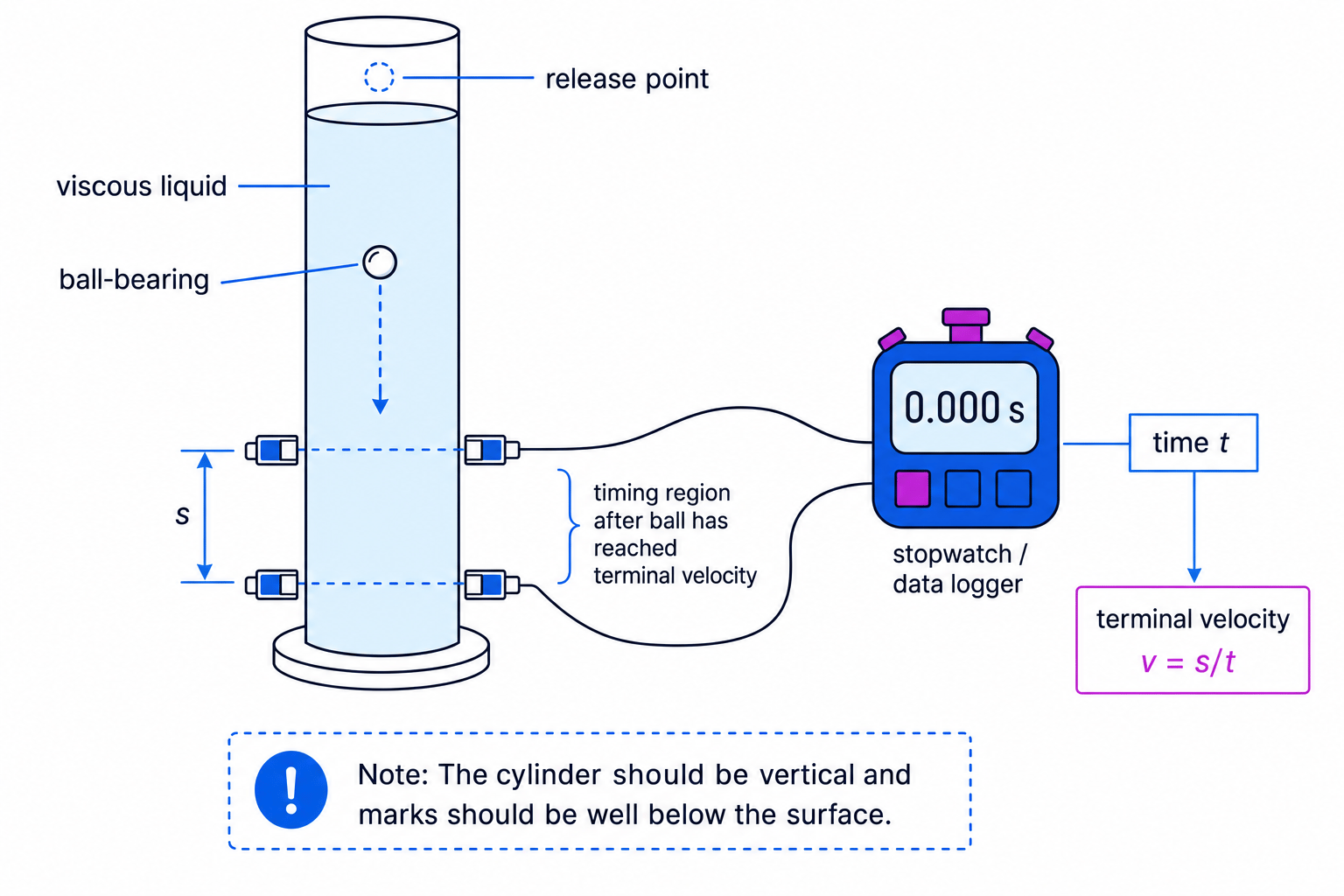
The basic calculation is:
v=stv = \frac{s}{t}v=tswhere sss is the distance between the marks and ttt is the time taken to travel between them.
Good practical technique includes:
- using a tall tube so the object has time to reach terminal velocity
- keeping the tube vertical
- measuring between marks well below the surface
- repeating timings and calculating a mean
- checking that equal distances are covered in equal times near the bottom
- controlling temperature, because viscosity can change with temperature
- using a tube much wider than the ball-bearing to reduce wall effects
You can also investigate terminal velocity using paper cones falling through air. Stacking identical cones is useful because it changes the mass while keeping shape and frontal area almost the same.
Determining terminal velocity from timing data
A ball-bearing travels 0.300 m between two marks in a viscous liquid. Three timings are 1.42 s, 1.39 s, and 1.44 s.
-
Calculate the mean time:
tˉ=1.42 s+1.39 s+1.44 s3=1.42 s\bar{t} = \frac{1.42\ \text{s} + 1.39\ \text{s} + 1.44\ \text{s}}{3} = 1.42\ \text{s}tˉ=31.42 s+1.39 s+1.44 s=1.42 s -
Calculate the terminal velocity using v=stv = \frac{s}{t}v=ts:
v=0.300 m1.42 s=0.211 m s−1v = \frac{0.300\ \text{m}}{1.42\ \text{s}} = 0.211\ \text{m s}^{-1}v=1.42 s0.300 m=0.211 m s−1 -
Quote the result sensibly: the terminal velocity is about 0.21 m s⁻¹.
Checking terminal velocity experimentally
If you time the object over several equal-distance sections near the bottom and the times are approximately the same, the velocity is approximately constant, so terminal velocity has probably been reached.
In the exam
- Start with a force diagram: weight acts downward; drag acts opposite the motion through the fluid.
- Link force to motion using F=maF = maF=ma: as drag increases, resultant force decreases, so acceleration decreases.
- For graphs, use the gradient of the tangent for instantaneous acceleration and the horizontal section for terminal velocity.
Check yourself
- Why does drag increase as a falling object speeds up through air?
- At terminal velocity, what are the resultant force and acceleration?
- How could you check experimentally that a ball-bearing has reached terminal velocity before timing it?

