

What you'll learn
- How to calculate the moment of a force using FxFxFx.
- How a couple produces rotation, with torque FdFdFd.
- How to use the principle of moments with force balance.
- How centre of gravity and the triangle of forces help you analyse equilibrium.
Equilibrium: the big idea
In this topic, you are usually dealing with objects that are stationary: beams, signs, ladders, laminae, balances and objects supported by strings.
Equilibrium
An object is in equilibrium when it has no resultant force and no resultant torque, so it has no linear acceleration and no angular acceleration.
A resultant force is the single overall force found by adding all the forces as vectors. A torque or moment is a turning effect. So equilibrium is not just “not moving” — it also means “not starting to rotate”.
A useful first habit is to draw a free-body diagram: a simplified sketch of one object showing all the external forces acting on it.
Moment of a force
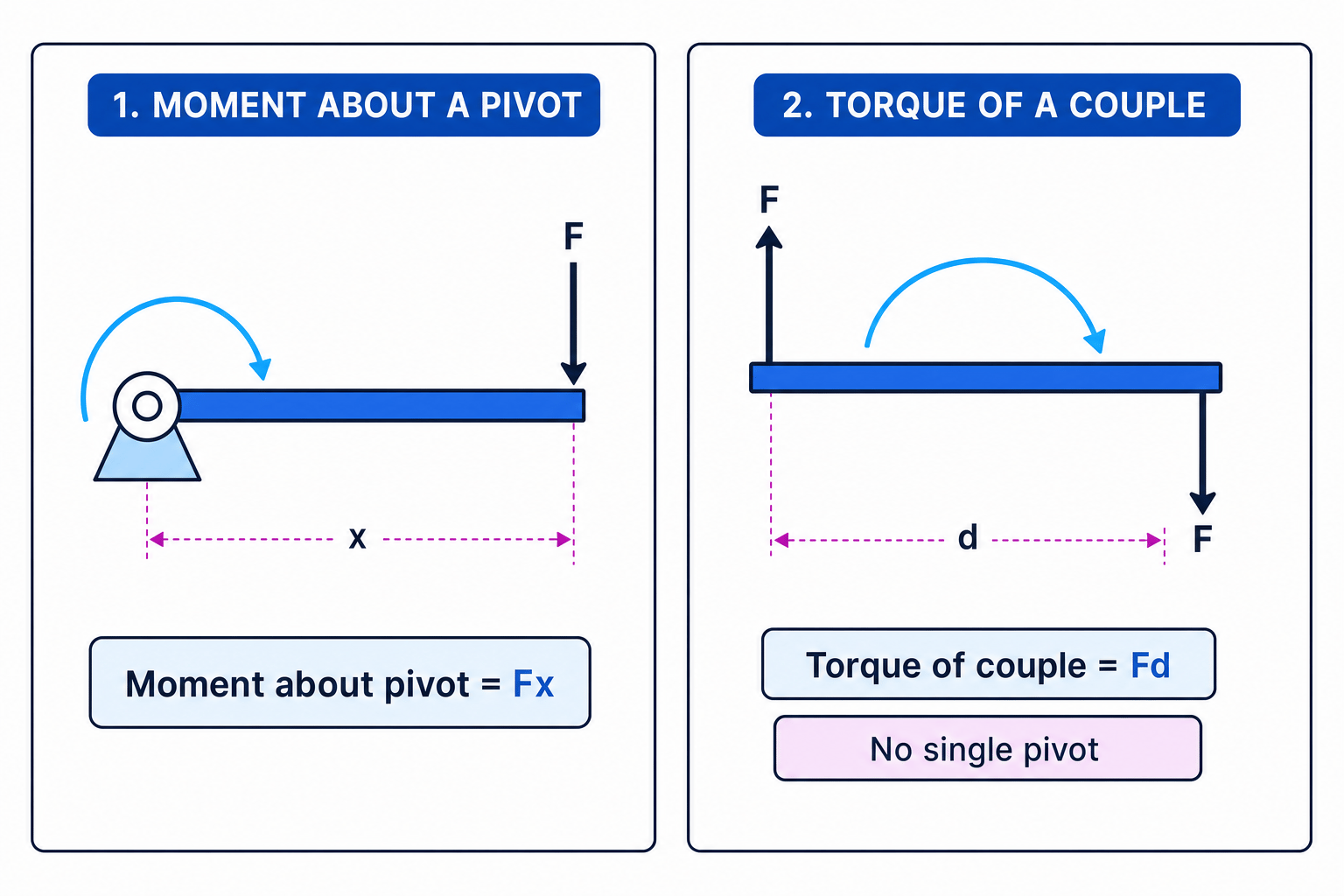
A moment of a force is the turning effect of a force about a point or pivot. A pivot is the point about which the object can rotate.
The line of action of a force is the straight line along which the force acts. The distance used in moments is always the perpendicular distance from the pivot to this line of action.
moment of force=Fx\text{moment of force} = Fxmoment of force=Fxwhere FFF is the force in newtons and xxx is the perpendicular distance from the pivot in metres. The unit of moment is newton metre (N m).
The diagram compares a single force producing a moment about a pivot with a couple producing rotation without a single pivot.
Calculating a moment about a pivot
A 12.0 N force acts downwards at a perpendicular distance of 0.35 m from a pivot. Find the moment.
-
Identify the perpendicular distance from the pivot to the force’s line of action: x=0.35 mx = 0.35\ \text{m}x=0.35 m.
-
Substitute into the moment equation:
moment=Fx=12.0 N×0.35 m\text{moment} = Fx = 12.0\ \text{N} \times 0.35\ \text{m}moment=Fx=12.0 N×0.35 m -
Calculate and include the direction of rotation:
moment=4.2 N m\text{moment} = 4.2\ \text{N m}moment=4.2 N mIf the force makes the object turn clockwise, the moment is a clockwise moment.
Using the wrong distance
Do not automatically use the length of the object. Use the perpendicular distance from the pivot to the line of action of the force. If the force acts through the pivot, x=0x = 0x=0, so the moment is zero.
Couples and torque
A couple is a pair of equal and opposite parallel forces acting on a body, but with different lines of action.
The resultant force of a couple is zero, so it does not cause linear acceleration. However, the two forces produce turning effects in the same rotational direction, so the couple produces rotation.
Torque of a couple
The torque of a couple is given by:
torque of a couple=Fd\text{torque of a couple} = Fdtorque of a couple=Fdwhere FFF is one of the forces and ddd is the perpendicular distance between the two parallel lines of action.
The unit of torque is also newton metre (N m).
Calculating the torque of a couple
Two equal and opposite forces of 18 N act on a steering wheel. The perpendicular distance between their lines of action is 0.42 m. Find the torque of the couple.
-
Use one of the forces, not both added together: F=18 NF = 18\ \text{N}F=18 N.
-
Use the separation between the two lines of action: d=0.42 md = 0.42\ \text{m}d=0.42 m.
-
Substitute into FdFdFd:
torque=18 N×0.42 m=7.6 N m\text{torque} = 18\ \text{N} \times 0.42\ \text{m} = 7.6\ \text{N m}torque=18 N×0.42 m=7.6 N m
Doubling the couple
If ddd is already the distance between the two forces, the torque is FdFdFd, not 2Fd2Fd2Fd. You only get 2Fr2Fr2Fr if rrr is the distance from the centre to each force, because then d=2rd = 2rd=2r.
The principle of moments
The principle of moments is the main tool for balanced rotating objects.
Principle of moments
For an object in equilibrium, the sum of the clockwise moments about a point equals the sum of the anticlockwise moments about the same point.
You can choose any point to take moments about. In calculations, choose a point where an unknown force acts, because that force then has zero moment about that point.
Balancing a seesaw
A 15.0 N weight acts 0.80 m to the left of a pivot. A 20.0 N weight is placed to the right of the pivot. How far from the pivot should it be placed for balance?
-
Set anticlockwise moments equal to clockwise moments about the pivot:
15.0 N×0.80 m=20.0 N×x15.0\ \text{N} \times 0.80\ \text{m} = 20.0\ \text{N} \times x15.0 N×0.80 m=20.0 N×x -
Calculate the known moment:
15.0 N×0.80 m=12.0 N m15.0\ \text{N} \times 0.80\ \text{m} = 12.0\ \text{N m}15.0 N×0.80 m=12.0 N m -
Solve for xxx:
x=12.0 N m20.0 N=0.60 mx = \frac{12.0\ \text{N m}}{20.0\ \text{N}} = 0.60\ \text{m}x=20.0 N12.0 N m=0.60 m
Centre of mass and centre of gravity
The centre of mass is the point where the mass of an object can be considered to be concentrated.
The centre of gravity is the point through which the entire weight of an object can be considered to act. Near the Earth’s surface, for ordinary-sized objects, the gravitational field is effectively uniform, so the centre of mass and centre of gravity are at the same position.
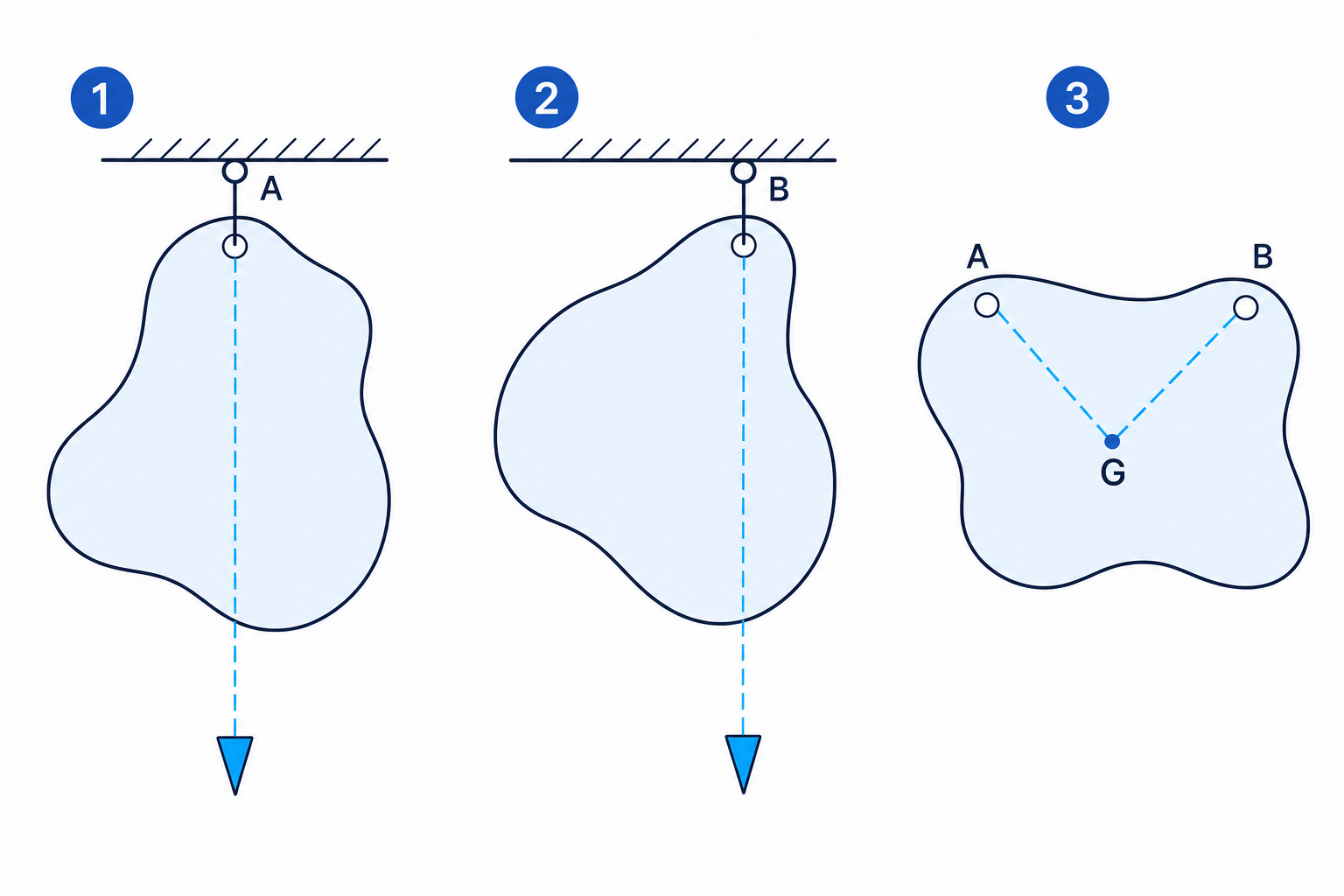
For a uniform symmetrical object, this point is at the geometrical centre. For an irregular shape, you can find it experimentally using suspension and a plumb line.
When a lamina is freely suspended, it comes to rest with its centre of gravity vertically below the point of suspension. A plumb line gives this vertical line. Repeating from a second point gives two lines that cross at the centre of gravity.
Locating the centre of gravity of a lamina
You are given an irregular flat card lamina and a pin, clamp and plumb line.
-
Suspend the lamina freely from a hole near its edge and wait until it is at rest.
-
Hang the plumb line from the same suspension point and draw the vertical line on the lamina.
-
Repeat from a second suspension point. The two marked lines intersect at the centre of gravity, because in each case the weight’s line of action must pass through the suspension point for zero turning effect.
Full equilibrium of an object
For an extended object, equilibrium needs both force balance and moment balance.
For coplanar forces, you often write the conditions as:
∑Fx=0,∑Fy=0,∑M=0\sum F_x = 0,\quad \sum F_y = 0,\quad \sum M = 0∑Fx=0,∑Fy=0,∑M=0This means the horizontal forces balance, the vertical forces balance, and the moments balance.
Forces balanced but still rotating
A zero resultant force is not enough for full equilibrium. A couple has zero resultant force but still produces a torque, so moment balance must also be checked.
Finding support reactions for a beam
A uniform 4.0 m beam has weight 60 N acting at its centre. It is supported at both ends, A and B. A 100 N load is placed 1.0 m from A. Find the upward reactions RAR_ARA and RBR_BRB.
-
Use vertical force balance:
RA+RB=100 N+60 N=160 NR_A + R_B = 100\ \text{N} + 60\ \text{N} = 160\ \text{N}RA+RB=100 N+60 N=160 N -
Take moments about A, so RAR_ARA has zero moment:
RB(4.0 m)=100 N(1.0 m)+60 N(2.0 m)R_B(4.0\ \text{m}) = 100\ \text{N}(1.0\ \text{m}) + 60\ \text{N}(2.0\ \text{m})RB(4.0 m)=100 N(1.0 m)+60 N(2.0 m) -
Calculate the clockwise moments:
RB(4.0 m)=100 N m+120 N m=220 N mR_B(4.0\ \text{m}) = 100\ \text{N m} + 120\ \text{N m} = 220\ \text{N m}RB(4.0 m)=100 N m+120 N m=220 N m -
Solve for RBR_BRB, then use force balance:
RB=55 NR_B = 55\ \text{N}RB=55 N RA=160 N−55 N=105 NR_A = 160\ \text{N} - 55\ \text{N} = 105\ \text{N}RA=160 N−55 N=105 N
Three coplanar forces and the triangle of forces
Coplanar forces are forces acting in the same plane.
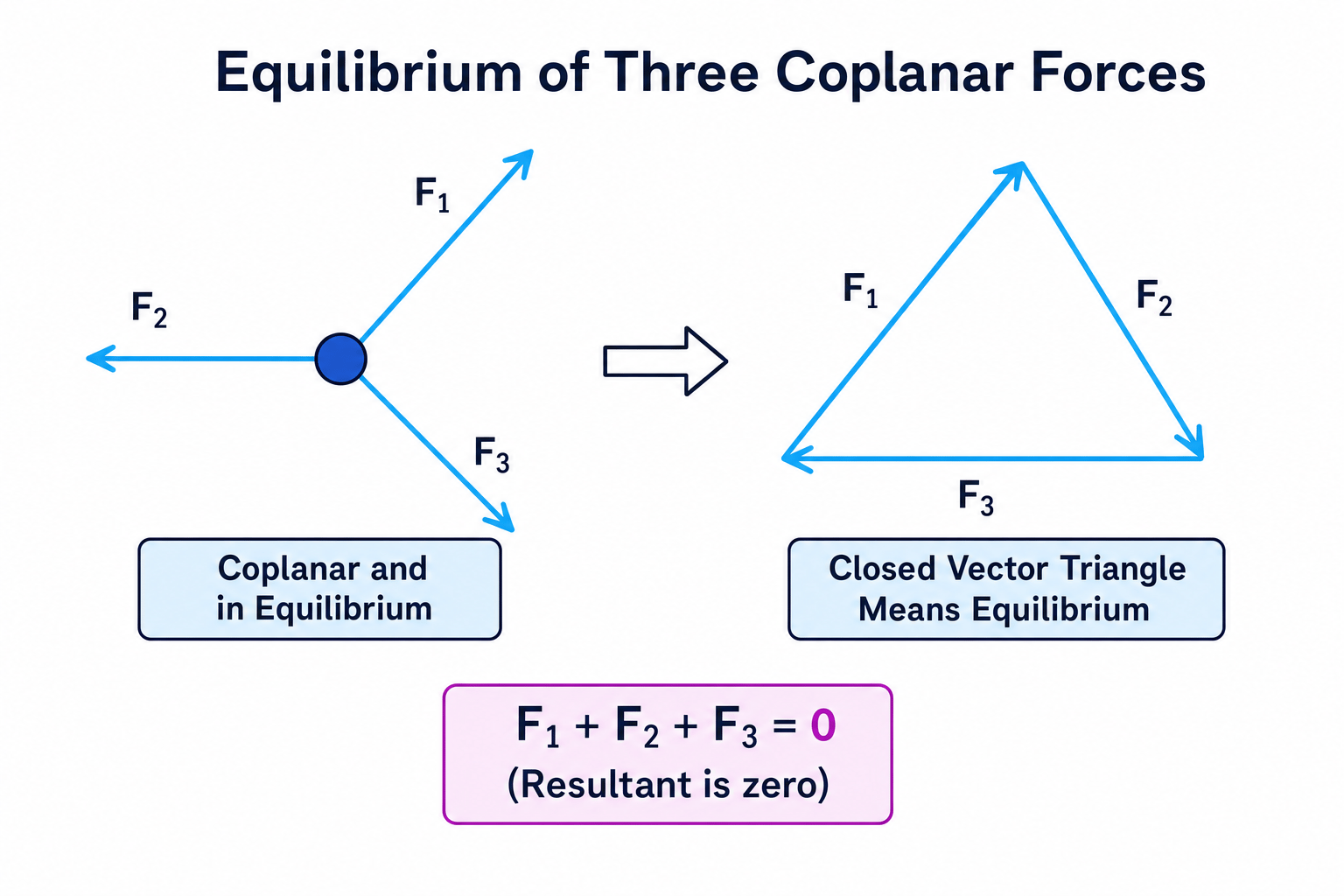
If three coplanar forces keep an object in equilibrium, their vector sum is zero. This means the three force vectors can be drawn head-to-tail to form a closed triangle. This is called the triangle of forces.
For a rigid body acted on by exactly three non-parallel coplanar forces, their lines of action must also pass through a common point. If they did not, there would be a resultant moment.
Closed triangle means zero resultant
If the three force vectors form a closed triangle when placed head-to-tail, the resultant force is zero. If the triangle does not close, the object is not in force equilibrium.
Finding the third force for equilibrium
A ring has a 6.0 N force acting east and an 8.0 N force acting north. Find the third force needed for equilibrium.
-
Find the resultant of the two known perpendicular forces:
R=(6.0 N)2+(8.0 N)2=10 NR = \sqrt{(6.0\ \text{N})^2 + (8.0\ \text{N})^2} = 10\ \text{N}R=(6.0 N)2+(8.0 N)2=10 N -
Find the direction of this resultant above east:
θ=tan−1(8.06.0)=53∘\theta = \tan^{-1}\left(\frac{8.0}{6.0}\right) = 53^\circθ=tan−1(6.08.0)=53∘ -
For equilibrium, the third force must be equal and opposite to the resultant: 10 N at 53° below west.
In the exam
-
Draw a free-body diagram before writing equations; include weights, reactions, tensions and applied forces.
-
For moments, choose a pivot that removes an unknown force from the equation.
-
Always use perpendicular distances, and keep clockwise and anticlockwise moments separate.
-
For three-force equilibrium, either draw a closed vector triangle or resolve forces into horizontal and vertical components.
Check yourself
-
If a force acts directly through a pivot, what is its moment about that pivot?
-
Why does the plumb-line method locate the centre of gravity of an irregular lamina?
-
What two separate conditions must be satisfied for a rigid object to be in full equilibrium?
