

What you'll learn
- How to use F=BQvF = BQvF=BQv for a charged particle moving at right angles to a uniform magnetic field.
- Why a magnetic field can make a charged particle follow a circular path.
- How to combine magnetic force with circular motion equations.
- How crossed electric and magnetic fields form a velocity selector.
Before you start: the ingredients
A charged particle is a particle with electric charge, such as an electron, proton, or ion. Charge is measured in coulombs (C), and we usually use QQQ for the charge.
A uniform magnetic field is a region where the magnetic field has the same strength and direction everywhere. Its strength is described by the magnetic flux density BBB, measured in tesla (T).
A beam is a stream of particles travelling in roughly the same direction with similar speeds.
Right angles to the magnetic field
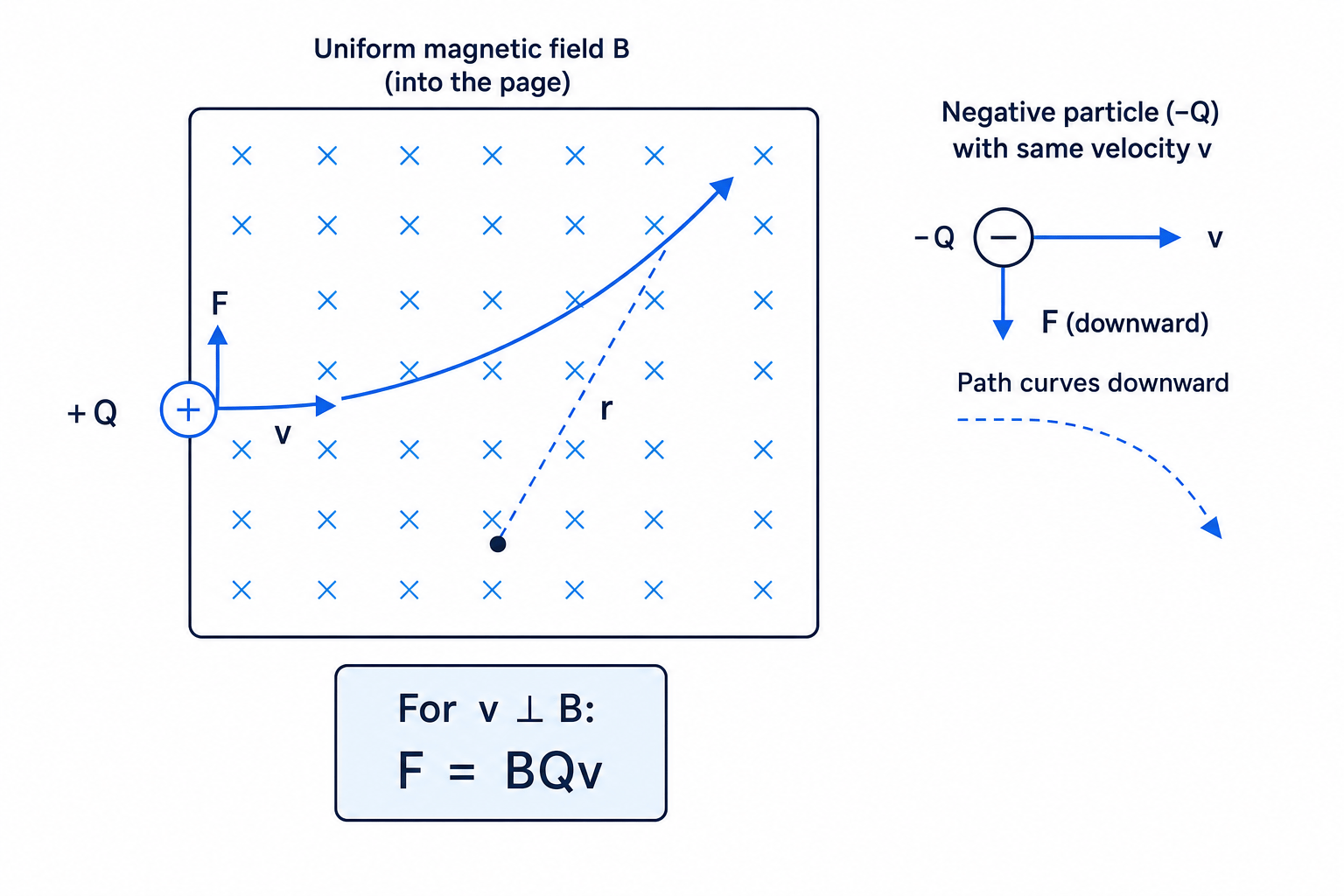
In this topic, the OCR equation F=BQvF = BQvF=BQv applies when the particle’s velocity vvv is perpendicular to the magnetic field BBB.
For field diagrams, crosses mean the magnetic field is going into the page, like the tail feathers of an arrow moving away from you. Dots mean the field is coming out of the page, like the tip of an arrow coming towards you.
Magnetic force on a moving charge
When a charged particle moves through a magnetic field, it can experience a force. For motion at right angles to the field:
F=BQvF = BQvF=BQvwhere:
- FFF is the magnetic force in newtons (N)
- BBB is magnetic flux density in tesla (T)
- QQQ is charge in coulombs (C)
- vvv is speed in metres per second (m s^-1)
This equation gives the magnitude of the force. Direction must be found separately.
Finding the direction
Use Fleming’s left-hand rule:
- First finger: magnetic field
- Second finger: conventional current
- Thumb: force or motion caused by the force
For a positive particle, conventional current is in the same direction as the particle’s velocity. For a negative particle, such as an electron, conventional current is opposite to the particle’s velocity.
Positive first, then reverse if needed
It is often easiest to find the force direction for a positive charge first. If the particle is negative, reverse the force direction.
Calculating magnetic force on a proton
A proton with charge 1.60×10⁻¹⁹ C1.60 \times 10^{-19}\ \text{C}1.60×10⁻¹⁹ C travels at 2.5×10⁶ m s−12.5 \times 10^6\ \text{m s}^{-1}2.5×10⁶ m s−1 at right angles to a magnetic field of flux density 0.18 T0.18\ \text{T}0.18 T. Calculate the magnetic force on the proton.
-
Since the proton travels at right angles to the magnetic field, choose F=BQvF = BQvF=BQv.
-
Substitute the values, keeping units with the quantities:
F=0.18 T×1.60×10−19 C×2.5×106 m s−1F = 0.18\ \text{T} \times 1.60 \times 10^{-19}\ \text{C} \times 2.5 \times 10^6\ \text{m s}^{-1}F=0.18 T×1.60×10−19 C×2.5×106 m s−1 -
Calculate the force:
F=7.2×10⁻¹⁴ NF = 7.2 \times 10^{-14}\ \text{N}F=7.2×10⁻¹⁴ N
So the magnetic force is 7.2×10⁻¹⁴ N7.2 \times 10^{-14}\ \text{N}7.2×10⁻¹⁴ N.
Putting a negative charge into the magnitude calculation
For F=BQvF = BQvF=BQv, use the magnitude of the charge when calculating the size of the force. Use the sign of the charge only when deciding the direction of the force.
Why the path becomes circular
A magnetic force on a moving charge is always perpendicular to the velocity of the particle. That means it changes the direction of the velocity, but not the speed.
A force perpendicular to motion does no work on the particle, because there is no component of force along the direction of motion. So the particle’s kinetic energy stays constant.
Magnetic fields bend, but do not speed up
In a uniform magnetic field, a charged particle moving at right angles to the field follows a circular path at constant speed.
To analyse the circle, use the circular motion idea that a force towards the centre is a centripetal force.
Centripetal force
A centripetal force is the resultant force directed towards the centre of a circular path. It is not a new type of force; here, the magnetic force provides it.
For circular motion:
F=mv2rF = \frac{mv^2}{r}F=rmv2In this topic, the magnetic force provides the centripetal force:
BQv=mv2rBQv = \frac{mv^2}{r}BQv=rmv2Cancelling one factor of vvv gives:
r=mvBQr = \frac{mv}{BQ}r=BQmvThis shows that the radius is larger for a more massive or faster particle, and smaller for a stronger magnetic field or larger charge.
Finding the radius of a proton orbit
A proton of mass 1.67×10⁻²⁷ kg1.67 \times 10^{-27}\ \text{kg}1.67×10⁻²⁷ kg and charge 1.60×10⁻¹⁹ C1.60 \times 10^{-19}\ \text{C}1.60×10⁻¹⁹ C enters a uniform magnetic field of flux density 0.40 T0.40\ \text{T}0.40 T at right angles. Its speed is 3.0×10⁶ m s−13.0 \times 10^6\ \text{m s}^{-1}3.0×10⁶ m s−1. Calculate the radius of its circular path.
-
The magnetic force is the centripetal force, so start from:
BQv=mv2rBQv = \frac{mv^2}{r}BQv=rmv2 -
Rearrange for radius:
r=mvBQr = \frac{mv}{BQ}r=BQmv -
Substitute the values:
r=1.67×10−27 kg×3.0×106 m s−10.40 T×1.60×10−19 Cr = \frac{1.67 \times 10^{-27}\ \text{kg} \times 3.0 \times 10^6\ \text{m s}^{-1}}{0.40\ \text{T} \times 1.60 \times 10^{-19}\ \text{C}}r=0.40 T×1.60×10−19 C1.67×10−27 kg×3.0×106 m s−1 -
Calculate and quote to two significant figures:
r=7.8×10⁻² mr = 7.8 \times 10^{-2}\ \text{m}r=7.8×10⁻² m
The radius is 7.8×10⁻² m7.8 \times 10^{-2}\ \text{m}7.8×10⁻² m, or 7.8 cm.
Check the angle
The equation F=BQvF = BQvF=BQv is for motion at right angles to the magnetic field. If the particle moves parallel to the magnetic field, there is no magnetic force.
Crossed electric and magnetic fields
An electric field is a region where a charge experiences an electric force. The electric field strength EEE is force per unit charge, measured in N C^-1 or V m^-1.
For a charge in an electric field:
F=QEF = QEF=QEIf a region contains both electric and magnetic fields, the charged particle experiences both forces. You must compare their directions and magnitudes.
The velocity selector
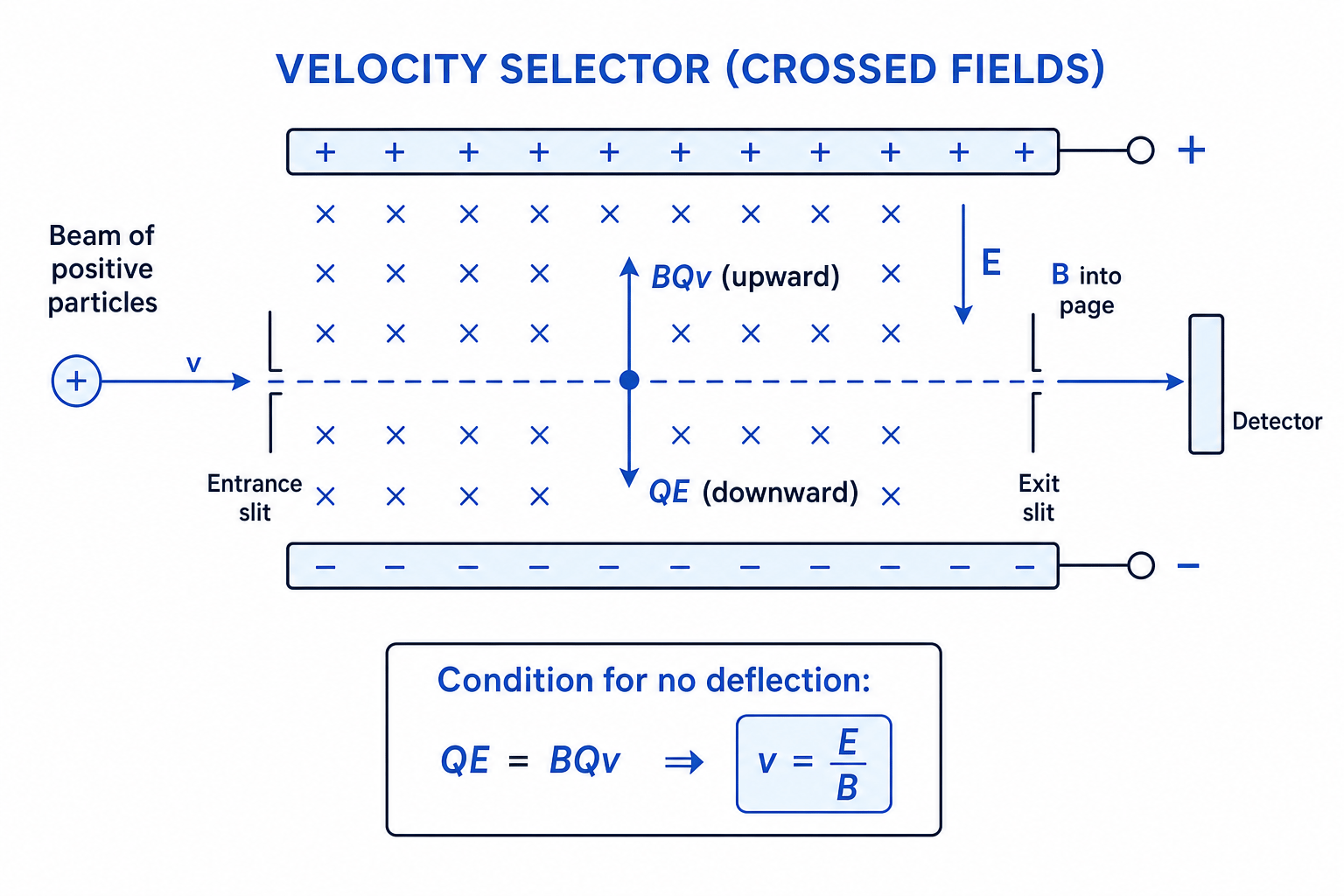
A velocity selector uses crossed electric and magnetic fields to allow only particles with one particular speed to pass through undeflected.
The electric and magnetic forces are arranged in opposite directions. For no deflection:
QE=BQvQE = BQvQE=BQvThe charge cancels:
v=EBv = \frac{E}{B}v=BESo the selected speed depends only on the electric field strength and magnetic flux density, not on the mass or charge of the particle.
Velocity selector
A velocity selector is a device using perpendicular electric and magnetic fields to select particles of speed v=E/Bv = E/Bv=E/B, because only those particles pass through without deflection.
Using a velocity selector
A beam of positive ions passes through crossed fields. The electric field strength is 4.8×10⁴ N C−14.8 \times 10^4\ \text{N C}^{-1}4.8×10⁴ N C−1 and the magnetic flux density is 0.16 T0.16\ \text{T}0.16 T. Calculate the speed of ions that pass through undeflected.
-
For no deflection, the electric and magnetic forces must be equal in magnitude:
QE=BQvQE = BQvQE=BQv -
Cancel QQQ and rearrange:
v=EBv = \frac{E}{B}v=BE -
Substitute the field values:
v=4.8×10⁴ N C−10.16 Tv = \frac{4.8 \times 10^4\ \text{N C}^{-1}}{0.16\ \text{T}}v=0.16 T4.8×104 N C−1 -
Calculate the selected speed:
v=3.0×10⁵ m s−1v = 3.0 \times 10^5\ \text{m s}^{-1}v=3.0×10⁵ m s−1
Only ions travelling at 3.0×10⁵ m s−13.0 \times 10^5\ \text{m s}^{-1}3.0×10⁵ m s−1 pass straight through.
Thinking heavier particles are selected differently
In a velocity selector, mass cancels out because the condition is QE=BQvQE = BQvQE=BQv. Heavy and light particles with the same speed pass through together.
Why this matters
The motion of charged particles in fields is not just a classroom model. It is how physicists control beams of ions and electrons in laboratory instruments.
For example, if you first select particles by speed and then let them enter a magnetic field, their circular radius depends on m/Qm/Qm/Q. This allows instruments to compare particles with different masses or charges.
In the exam
- Start by deciding whether the particle is in a magnetic field only, or in both electric and magnetic fields.
- For magnetic-only circular motion, set BQv=mv2/rBQv = mv^2/rBQv=mv2/r and then rearrange carefully.
- For a velocity selector, use the undeflected condition QE=BQvQE = BQvQE=BQv, cancel QQQ, and write v=E/Bv = E/Bv=E/B.
Check yourself
- Why does a magnetic field change the direction of a charged particle but not its speed?
- A negative particle enters the same field with the same velocity as a positive particle. How does its path differ?
- In a velocity selector, what happens to particles moving faster than E/BE/BE/B?
