

What you'll learn
- What mean drift velocity means for mobile charge carriers in a wire.
- How to use and understand the OCR equation I=AnevI = AnevI=Anev.
- Why conductors, semiconductors and insulators differ in terms of the number density of charge carriers.
- How to avoid common direction and unit mistakes in exam questions.
Starting point: current is flowing charge
Electric current is the rate at which electric charge passes a point in a circuit.
Electric current
Current III is the rate of flow of charge:
I=ΔQΔtI = \frac{\Delta Q}{\Delta t}I=ΔtΔQwhere III is current in amperes (A), ΔQ\Delta QΔQ is charge in coulombs (C), and Δt\Delta tΔt is time in seconds (s).
A charge carrier is a particle that can move through a material and carry electric charge. In a metal wire, the mobile charge carriers are electrons. In other materials, charge carriers can include positive ions, negative ions, or holes in semiconductors.
The charge on one electron has magnitude:
e=1.60×10⁻¹⁹ Ce = 1.60 \times 10^{-19}\ \text{C}e=1.60×10⁻¹⁹ CThe electron itself is negatively charged, with charge −e-e−e. In the drift velocity equation, OCR uses eee as the magnitude of the charge.
Current is not the speed of electrons
A large current does not mean individual electrons are moving quickly along the wire. Current depends on how many charge carriers there are, how much charge each carries, the cross-sectional area, and their mean drift velocity.
Mean drift velocity
Inside a metal, free electrons are already moving randomly at high speeds because of thermal motion. With no potential difference across the wire, this random motion has no preferred direction, so there is no overall current.
When a potential difference is applied, an electric field acts on the electrons. Their motion is still mostly random, but it gains a tiny average motion in one direction. This average motion along the wire is the mean drift velocity.
Mean drift velocity
The mean drift velocity vvv is the average velocity of the charge carriers in the direction of charge flow through a material.
For electrons in a metal, electron drift is opposite to conventional current, because electrons are negatively charged. Conventional current is defined as the direction positive charge would move.
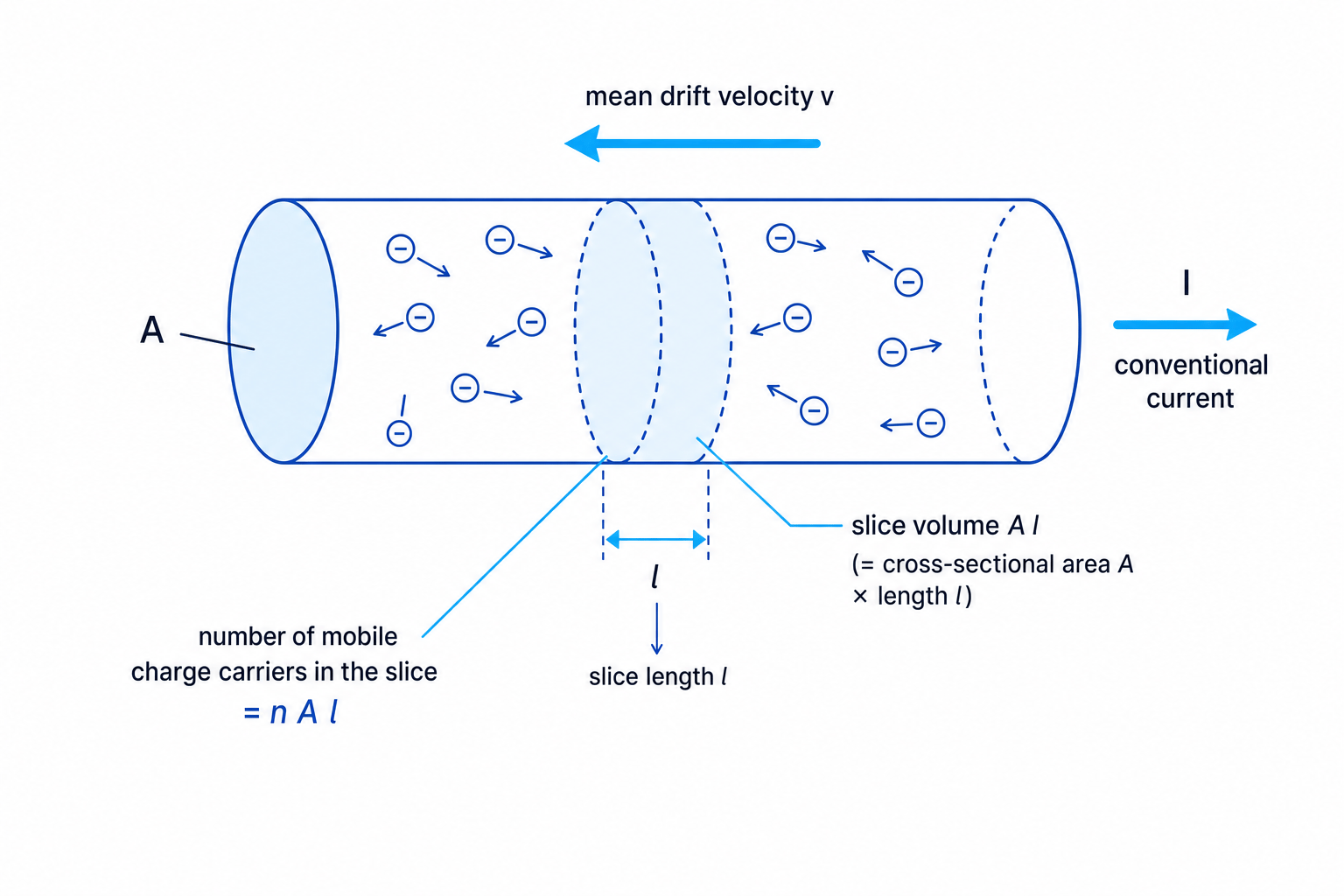
The important physical picture
A current in a metal is not caused by electrons shooting straight down the wire. It is caused by a very small average drift superimposed on random electron motion.
Number density of charge carriers
The number density of charge carriers tells you how many mobile charge carriers there are per unit volume of material.
Number density
The number density nnn is the number of mobile charge carriers per cubic metre, with unit m⁻³.
If a material has a large value of nnn, there are many mobile charge carriers available to carry current. Metals usually have a very large number density of free electrons.
For example, a typical metal may have nnn of order 1028 m−310^{28}\ \text{m}^{-3}1028 m−3, meaning there are about 102810^{28}1028 mobile electrons in each cubic metre.
Deriving the drift velocity equation
OCR gives the equation:
I=AnevI = AnevI=Anevwhere:
- III is current in amperes (A)
- AAA is cross-sectional area of the conductor in square metres (m²)
- nnn is number density of mobile charge carriers in m⁻³
- eee is the elementary charge, 1.60×10⁻¹⁹ C1.60 \times 10^{-19}\ \text{C}1.60×10⁻¹⁹ C
- vvv is mean drift velocity in metres per second (m s⁻¹)
Here is the reasoning behind it.
Imagine a wire with cross-sectional area AAA. In a time Δt\Delta tΔt, charge carriers with drift velocity vvv move an average distance:
distance=vΔt\text{distance} = v\Delta tdistance=vΔtSo the volume of material whose charge carriers pass a point is:
volume=AvΔt\text{volume} = Av\Delta tvolume=AvΔtSince there are nnn charge carriers per cubic metre, the number of charge carriers passing the point is:
number of carriers=nAvΔt\text{number of carriers} = nAv\Delta tnumber of carriers=nAvΔtEach carrier has charge magnitude eee, so the total charge passing the point is:
ΔQ=nAvΔte\Delta Q = nAv\Delta t eΔQ=nAvΔteUsing I=ΔQΔtI = \frac{\Delta Q}{\Delta t}I=ΔtΔQ:
I=nAvΔteΔtI = \frac{nAv\Delta t e}{\Delta t}I=ΔtnAvΔteso:
I=AnevI = AnevI=AnevUnit check for I = Anev
The units combine correctly: m² multiplied by m⁻³ gives m⁻¹; then multiplying by C and m s⁻¹ gives C s⁻¹, which is an ampere.
Calculating mean drift velocity
A copper wire carries a current of 2.0 A. The wire has cross-sectional area 1.5×10⁻⁶ m21.5 \times 10^{-6}\ \text{m}^21.5×10⁻⁶ m2. The number density of free electrons in copper is 8.5×1028 m−38.5 \times 10^{28}\ \text{m}^{-3}8.5×1028 m−3. Calculate the mean drift velocity of the electrons.
-
Start with the OCR equation and rearrange it for vvv:
I=AnevI = AnevI=Anev v=IAnev = \frac{I}{Ane}v=AneI -
Substitute the values, keeping SI units throughout:
v=2.0 A(1.5×10⁻⁶ m2)(8.5×1028 m−3)(1.60×10⁻¹⁹ C)v = \frac{2.0\ \text{A}}{\left(1.5 \times 10^{-6}\ \text{m}^2\right)\left(8.5 \times 10^{28}\ \text{m}^{-3}\right)\left(1.60 \times 10^{-19}\ \text{C}\right)}v=(1.5×10⁻⁶ m2)(8.5×1028 m−3)(1.60×10⁻¹⁹ C)2.0 A -
Calculate the denominator:
Ane=(1.5×10⁻⁶)(8.5×1028)(1.60×10⁻¹⁹)Ane = \left(1.5 \times 10^{-6}\right)\left(8.5 \times 10^{28}\right)\left(1.60 \times 10^{-19}\right)Ane=(1.5×10⁻⁶)(8.5×1028)(1.60×10⁻¹⁹) Ane=2.04×10⁴ C m−1Ane = 2.04 \times 10^{4}\ \text{C m}^{-1}Ane=2.04×10⁴ C m−1 -
Complete the calculation:
v=2.02.04×104 m s−1v = \frac{2.0}{2.04 \times 10^{4}}\ \text{m s}^{-1}v=2.04×1042.0 m s−1 v=9.8×10⁻⁵ m s−1v = 9.8 \times 10^{-5}\ \text{m s}^{-1}v=9.8×10⁻⁵ m s−1
So the mean drift velocity is 9.8×10⁻⁵ m s−19.8 \times 10^{-5}\ \text{m s}^{-1}9.8×10⁻⁵ m s−1, which is less than a millimetre per second.
Why drift velocity is usually so small in metals
This result can feel surprising. You switch on a circuit and the lamp responds almost immediately, but the electrons themselves drift very slowly.
That is because the electric field is established around the circuit very quickly, so charge carriers throughout the circuit begin drifting almost at once. The individual electrons do not need to travel all the way from the cell to the lamp before the lamp lights.
Queue not parcel delivery
Think of a long queue of people. If everyone takes one small step forward at nearly the same time, the effect travels through the queue quickly, even though each person only moves slowly.
Rearranging I = Anev
You may need to calculate any one of the quantities in the equation.
I=AnevI = AnevI=AnevUseful rearrangements are:
v=IAnev = \frac{I}{Ane}v=AneI A=InevA = \frac{I}{nev}A=nevI n=IAevn = \frac{I}{Aev}n=AevIThe equation shows several important proportional relationships:
- For fixed AAA, nnn and eee, current is directly proportional to drift velocity.
- For fixed III, nnn and eee, a larger cross-sectional area means a smaller drift velocity.
- For fixed III, AAA and eee, a material with fewer charge carriers needs a larger drift velocity.
Finding number density from current and drift velocity
A wire has cross-sectional area 3.0×10⁻⁷ m23.0 \times 10^{-7}\ \text{m}^23.0×10⁻⁷ m2. The current in the wire is 0.80 A and the mean drift velocity of the charge carriers is 1.2×10⁻⁴ m s−11.2 \times 10^{-4}\ \text{m s}^{-1}1.2×10⁻⁴ m s−1. Calculate the number density of charge carriers.
-
Rearrange I=AnevI = AnevI=Anev to make nnn the subject:
n=IAevn = \frac{I}{Aev}n=AevI -
Substitute the values:
n=0.80 A(3.0×10⁻⁷ m2)(1.60×10⁻¹⁹ C)(1.2×10⁻⁴ m s−1)n = \frac{0.80\ \text{A}}{\left(3.0 \times 10^{-7}\ \text{m}^2\right)\left(1.60 \times 10^{-19}\ \text{C}\right)\left(1.2 \times 10^{-4}\ \text{m s}^{-1}\right)}n=(3.0×10⁻⁷ m2)(1.60×10⁻¹⁹ C)(1.2×10⁻⁴ m s−1)0.80 A -
Calculate the denominator:
Aev=(3.0×10⁻⁷)(1.60×10⁻¹⁹)(1.2×10⁻⁴)Aev = \left(3.0 \times 10^{-7}\right)\left(1.60 \times 10^{-19}\right)\left(1.2 \times 10^{-4}\right)Aev=(3.0×10⁻⁷)(1.60×10⁻¹⁹)(1.2×10⁻⁴) Aev=5.76×10⁻³⁰ C m3s−1Aev = 5.76 \times 10^{-30}\ \text{C m}^{3}\text{s}^{-1}Aev=5.76×10⁻³⁰ C m3s−1 -
Divide to find nnn:
n=0.805.76×10−30 m−3n = \frac{0.80}{5.76 \times 10^{-30}}\ \text{m}^{-3}n=5.76×10−300.80 m−3 n=1.4×1029 m−3n = 1.4 \times 10^{29}\ \text{m}^{-3}n=1.4×1029 m−3
The number density is 1.4×1029 m−31.4 \times 10^{29}\ \text{m}^{-3}1.4×1029 m−3.
Forgetting to convert the area
Wire diameters are often given in millimetres. You must convert to metres before calculating area. If diameter ddd is given, use A=πr2A = \pi r^2A=πr2 with r=d2r = \frac{d}{2}r=2d in metres.
Conductors, semiconductors and insulators in terms of number density
The OCR specification wants you to distinguish these materials in terms of nnn, the number density of mobile charge carriers.
Conductors
A conductor has a large number density of mobile charge carriers. In metals, many electrons are free to move through the lattice, so nnn is high and current can flow easily.
Examples include copper, aluminium and graphite.
Semiconductors
A semiconductor has a smaller number density of mobile charge carriers than a metal conductor, but larger than a good insulator. Its value of nnn can change significantly with conditions such as temperature, light intensity, or impurities added to the material.
Examples include silicon and germanium.
Insulators
An insulator has a very small number density of mobile charge carriers. Most charges are not free to move through the material, so it is difficult for a current to flow.
Examples include rubber, glass and plastic.
Classifying materials using n
Conductors have high nnn, semiconductors have intermediate and controllable nnn, and insulators have very low nnn.
Comparing drift velocities in two materials
Two wires have the same cross-sectional area and carry the same current. Wire X has a charge carrier number density 100 times larger than wire Y. Compare their mean drift velocities.
-
Use the relationship from I=AnevI = AnevI=Anev. With the same current, area and carrier charge, nvnvnv must stay constant:
I=AnevI = AnevI=Anev nv=IAenv = \frac{I}{Ae}nv=AeI -
If wire X has 100 times the number density of wire Y:
nX=100nYn_X = 100n_YnX=100nY -
Since nvnvnv is the same for both wires:
nXvX=nYvYn_Xv_X = n_Yv_YnXvX=nYvYSubstitute nX=100nYn_X = 100n_YnX=100nY:
100nYvX=nYvY100n_Yv_X = n_Yv_Y100nYvX=nYvY -
Cancel nYn_YnY and compare velocities:
100vX=vY100v_X = v_Y100vX=vY vX=vY100v_X = \frac{v_Y}{100}vX=100vY
Wire X has a mean drift velocity 100 times smaller than wire Y.
Do not over-read the equation
The equation I=AnevI = AnevI=Anev describes the current carried by mobile charge carriers moving with mean drift velocity. It does not by itself explain the microscopic band structure of conductors, semiconductors and insulators.
In the exam
- Check whether the question gives radius or diameter before finding cross-sectional area; if diameter is given, halve it first.
- Convert all lengths to metres and areas to square metres before using I=AnevI = AnevI=Anev.
- Treat e=1.60×10⁻¹⁹ Ce = 1.60 \times 10^{-19}\ \text{C}e=1.60×10⁻¹⁹ C as the magnitude of the electron charge, and state directions separately if asked.
- If comparing materials, focus on the number density nnn: high for conductors, lower and variable for semiconductors, very low for insulators.
Check yourself
- Why is the mean drift velocity of electrons in a metal much smaller than their random thermal speed?
- A wire’s diameter is doubled while the current stays the same. What happens to the mean drift velocity?
- In terms of nnn, how is a semiconductor different from a conductor and an insulator?
