

What you'll learn
- What electric charge is measured in, and why charge comes in tiny “packets” of size eee.
- How to use I=ΔQΔtI = \frac{\Delta Q}{\Delta t}I=ΔtΔQ to link current, charge and time.
- What actually moves in metals and electrolytes when a current flows.
- How Kirchhoff’s first law follows from conservation of charge.
Electric charge: the starting point
Electric charge is a property of matter. It can be positive or negative. Like charges repel; unlike charges attract.
An object is neutral if its total positive charge and total negative charge balance. If they do not balance, the object has a net charge.
The coulomb
Electric charge is represented by the symbol QQQ and is measured in coulombs, symbol C. One coulomb is the charge transported by a current of one ampere in one second:
1 C=1 A s1\ \text{C} = 1\ \text{A s}1 C=1 A sIn circuit questions, you will often use ΔQ\Delta QΔQ, meaning the amount of charge that flows during a time interval, rather than the total charge stored somewhere.
The elementary charge
Charge is not infinitely divisible in ordinary circuit physics. It comes in very small units connected to the charges on protons and electrons.
Elementary charge
The elementary charge is
e=1.6×10⁻¹⁹ Ce = 1.6 \times 10^{-19}\ \text{C}e=1.6×10⁻¹⁹ CAn electron has charge −e-e−e, so its charge is −1.6×10⁻¹⁹ C-1.6 \times 10^{-19}\ \text{C}−1.6×10⁻¹⁹ C. A proton has charge +e+e+e, so its charge is +1.6×10⁻¹⁹ C+1.6 \times 10^{-19}\ \text{C}+1.6×10⁻¹⁹ C.
A neutron has no net charge. In ordinary charging processes, objects usually become charged because electrons move. If an object gains electrons, it becomes negatively charged. If it loses electrons, it becomes positively charged.
Charge is quantised
The net charge on a particle or object is quantised: it must be an integer multiple of the elementary charge eee. In this topic, you can write this as Q=neQ = neQ=ne, where nnn is an integer.
Because eee is so tiny, everyday amounts of charge involve enormous numbers of electrons. That is why charge can seem continuous on a macroscopic scale, even though it is quantised.
Counting electrons from a net charge
An insulating bead gains a net charge of −2.4×10⁻¹⁵ C-2.4 \times 10^{-15}\ \text{C}−2.4×10⁻¹⁵ C. Calculate how many electrons it has gained.
-
Use the magnitude of the charge to find the number of elementary charges:
N=∣ΔQ∣eN = \frac{|\Delta Q|}{e}N=e∣ΔQ∣ -
Substitute the values, keeping the units in coulombs:
N=2.4×10⁻¹⁵ C1.6×10−19 CN = \frac{2.4 \times 10^{-15}\ \text{C}}{1.6 \times 10^{-19}\ \text{C}}N=1.6×10⁻¹⁹ C2.4×10−15 C -
Calculate and interpret the sign:
N=1.5×10⁴N = 1.5 \times 10^4N=1.5×10⁴The charge is negative, so the bead has gained 1.5×1041.5 \times 10^41.5×10⁴ electrons.
Forgetting the sign of the electron
The elementary charge eee is a positive number, but an electron has charge −e-e−e. If an object gains electrons, its net charge becomes negative.
Electric current: charge per second
Current is about how quickly charge flows. A small current means a small amount of charge passes each second. A large current means a larger amount of charge passes each second.
Electric current
Electric current III is the rate of flow of electric charge:
I=ΔQΔtI = \frac{\Delta Q}{\Delta t}I=ΔtΔQwhere ΔQ\Delta QΔQ is the charge that flows in coulombs, C, and Δt\Delta tΔt is the time interval in seconds, s. Current is measured in amperes, A.
Since I=ΔQΔtI = \frac{\Delta Q}{\Delta t}I=ΔtΔQ, one ampere is the same as one coulomb per second:
1 A=1 C s−11\ \text{A} = 1\ \text{C s}^{-1}1 A=1 C s−1Calculating charge from current and time
A lamp has a steady current of 0.25 A0.25\ \text{A}0.25 A for 4.0 minutes. Calculate the charge that passes through the lamp.
-
Convert the time into seconds:
4.0 min=4.0×60=240 s4.0\ \text{min} = 4.0 \times 60 = 240\ \text{s}4.0 min=4.0×60=240 s -
Rearrange the current equation to make charge the subject:
ΔQ=IΔt\Delta Q = I\Delta tΔQ=IΔt -
Substitute the values and calculate:
ΔQ=0.25 A×240 s=60 C\Delta Q = 0.25\ \text{A} \times 240\ \text{s} = 60\ \text{C}ΔQ=0.25 A×240 s=60 CSo the charge that passes through the lamp is 6.0×101 C6.0 \times 10^1\ \text{C}6.0×101 C.
Unit check for current calculations
If your answer is in coulombs, amperes or seconds, check it against I=ΔQΔtI = \frac{\Delta Q}{\Delta t}I=ΔtΔQ. Current is charge per second, so A is equivalent to C s−1\text{C s}^{-1}C s−1.
What actually moves when current flows?
A charge carrier is a charged particle that can move through a material and so carry electric current.
In a metal, the charge carriers are electrons. The positive metal ions are fixed in a lattice, while the outer electrons are free to move through the metal.
In an electrolyte, which is a liquid or solution containing mobile ions, the charge carriers are ions. Positive ions are called cations and move towards the negative electrode. Negative ions are called anions and move towards the positive electrode. Both movements contribute to the current.
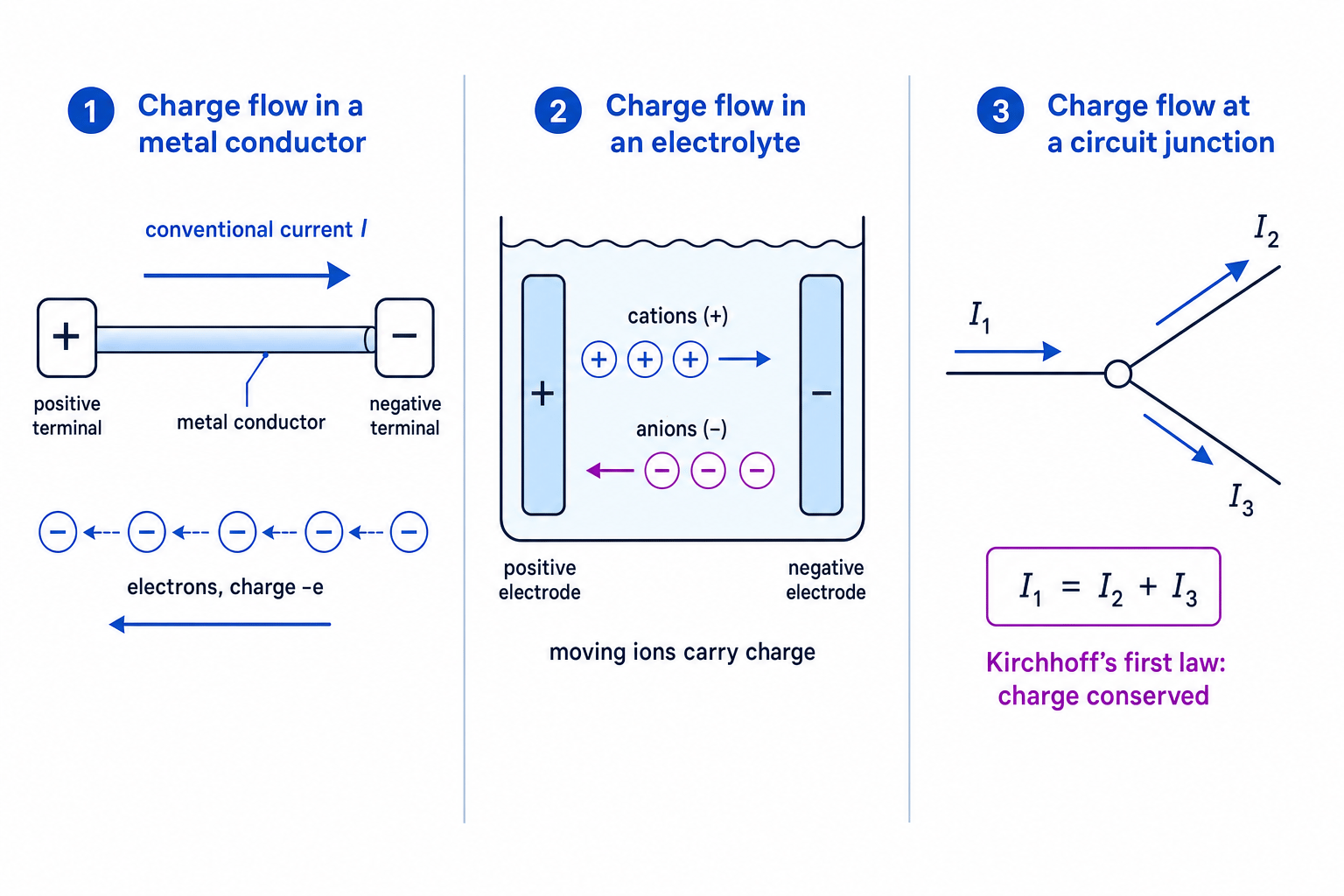
Different materials, different charge carriers
In metals, current is due to the movement of electrons. In electrolytes, current is due to the movement of positive and negative ions.
You do not need the detailed chemistry of the electrode reactions here. The important physics point is that current always involves the movement of charged particles.
Conventional current and electron flow
Circuit diagrams use conventional current. This is defined as the direction in which positive charge would flow.
This convention was established before electrons were discovered. We still use it because it is consistent and works perfectly for circuit analysis.
In a metal wire, the moving charges are electrons, which are negative. So:
- electron flow is the direction electrons move
- conventional current is in the opposite direction to electron flow in a metal
In an electrolyte, positive ions move in the direction of conventional current, while negative ions move opposite to it.
Reversing current arrows in metal wires
On circuit diagrams, current arrows normally show conventional current, not electron flow. In a metal conductor, electrons move in the opposite direction to the conventional current.
Conservation of charge
Charge cannot be created or destroyed in a circuit. It can move around, but the total amount of charge is conserved.
This idea becomes especially useful at a junction, where a wire splits or where several wires meet. Charge cannot pile up indefinitely at the junction, so the rate at which charge enters must equal the rate at which charge leaves.
Kirchhoff’s first law
Kirchhoff’s first law states that at any circuit junction, the total current entering the junction equals the total current leaving the junction:
∑Iin=∑Iout\sum I_{\text{in}} = \sum I_{\text{out}}∑Iin=∑IoutThis is a direct consequence of conservation of charge.
You can see why from the current equation. Over the same time interval Δt\Delta tΔt, the charge entering is linked to the incoming currents, and the charge leaving is linked to the outgoing currents. If charge is conserved, these amounts of charge must be equal, so the currents must balance.
Applying Kirchhoff’s first law at a junction
At a junction, currents of 1.8 A1.8\ \text{A}1.8 A and 0.45 A0.45\ \text{A}0.45 A enter. A current of 0.70 A0.70\ \text{A}0.70 A leaves through one branch, and an unknown current IxI_xIx leaves through another branch. Calculate IxI_xIx.
-
Add the currents entering the junction:
Iin=1.8 A+0.45 A=2.25 AI_{\text{in}} = 1.8\ \text{A} + 0.45\ \text{A} = 2.25\ \text{A}Iin=1.8 A+0.45 A=2.25 A -
Write Kirchhoff’s first law for the junction:
∑Iin=∑Iout\sum I_{\text{in}} = \sum I_{\text{out}}∑Iin=∑Ioutso
2.25 A=0.70 A+Ix2.25\ \text{A} = 0.70\ \text{A} + I_x2.25 A=0.70 A+Ix -
Solve for the unknown current:
Ix=2.25 A−0.70 A=1.55 AI_x = 2.25\ \text{A} - 0.70\ \text{A} = 1.55\ \text{A}Ix=2.25 A−0.70 A=1.55 ATo a sensible number of significant figures, Ix≈1.6 AI_x \approx 1.6\ \text{A}Ix≈1.6 A, leaving the junction.
If your current comes out negative
If you assume a direction for an unknown current and calculate a negative value, the current actually flows in the opposite direction to your arrow.
In the exam
- For I=ΔQΔtI = \frac{\Delta Q}{\Delta t}I=ΔtΔQ, always convert time into seconds before substituting values.
- Treat e=1.6×10⁻¹⁹ Ce = 1.6 \times 10^{-19}\ \text{C}e=1.6×10⁻¹⁹ C as a magnitude: electrons have charge −e-e−e, protons have charge +e+e+e.
- For Kirchhoff’s first law, draw or mark arrows at the junction, then separately total the currents entering and leaving.
Check yourself
- A charge of 18 C18\ \text{C}18 C passes a point in 3.0 min3.0\ \text{min}3.0 min. What is the current?
- Why must the net charge on an object be a multiple of 1.6×10⁻¹⁹ C1.6 \times 10^{-19}\ \text{C}1.6×10⁻¹⁹ C?
- At a junction, currents of 0.40 A0.40\ \text{A}0.40 A and 0.25 A0.25\ \text{A}0.25 A enter, while 0.50 A0.50\ \text{A}0.50 A leaves. What can you say about the remaining branch?
