Describe how an experiment can be carried out to determine the force constant of an elastic cord in the laboratory by plotting a suitable graph. You may assume that the cord obeys Hooke's law.
A simple catapult is made by an elastic cord fixed to two supports, as shown below.
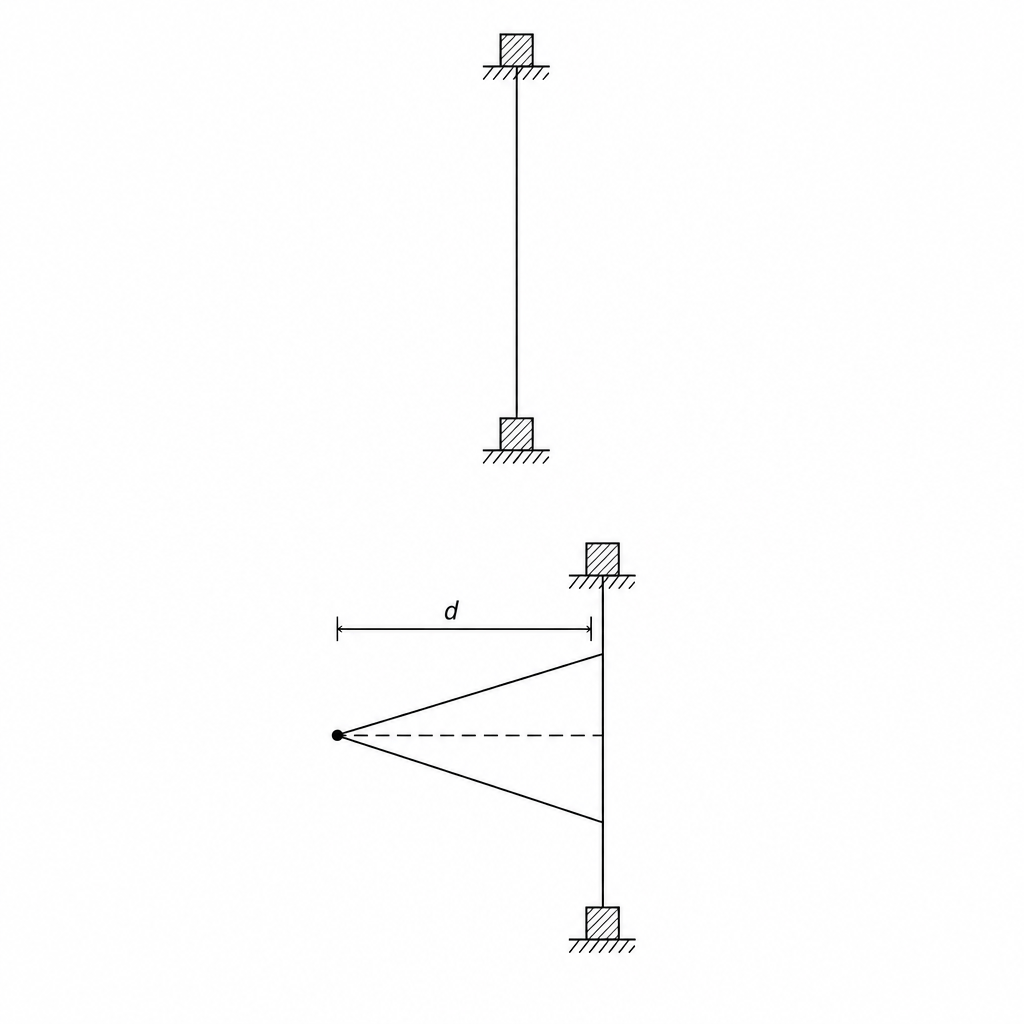
The unstretched length of the cord is the same as the distance between the supports. The distance that the center of the cord has been pulled back is ddd.
The cord has a force constant of 600 N m−1600\text{ N m}^{-1}600 N m−1.
The variation of the extension of the cord with distance ddd is shown below.
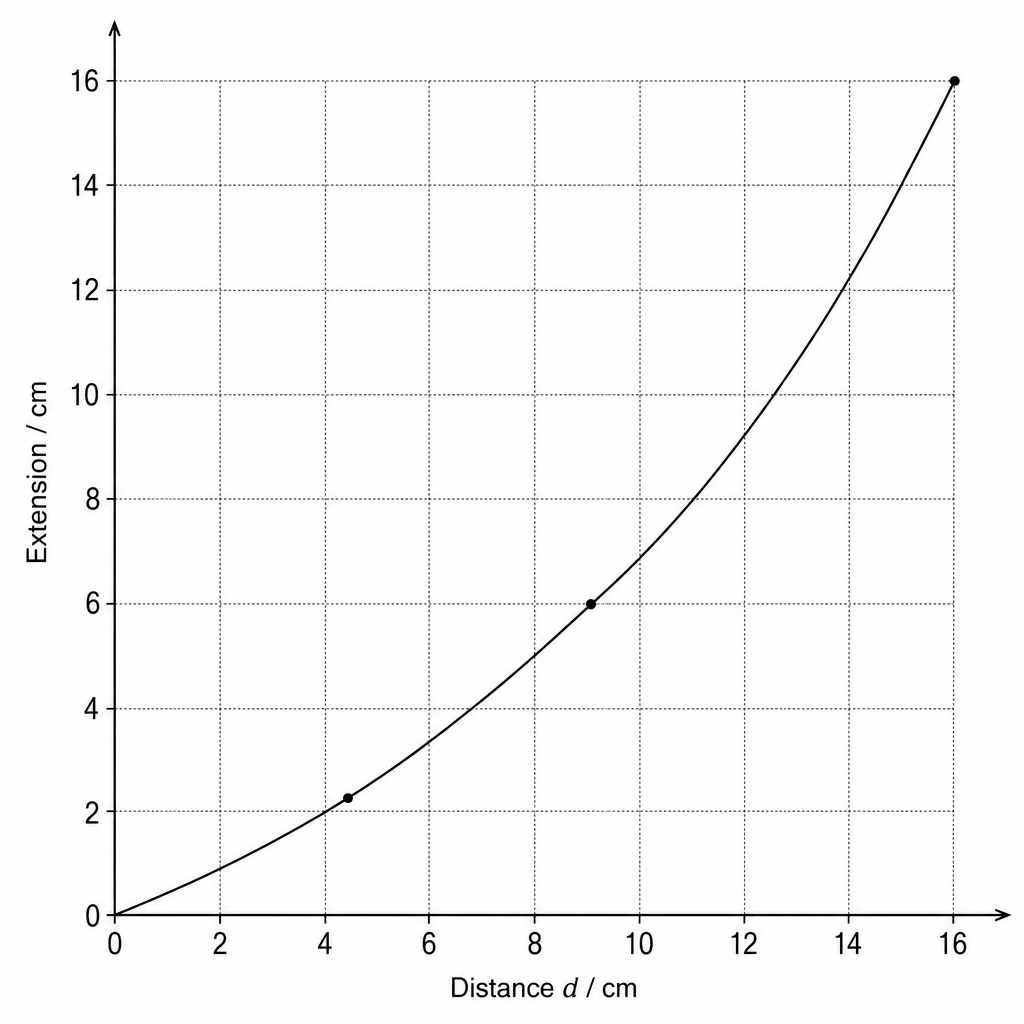
A small ball of mass 40 g40\text{ g}40 g is placed at the center of the cord and drawn back with d=9 cmd = 9\text{ cm}d=9 cm.
The ball is released and launched horizontally from a height of 1.8 m1.8\text{ m}1.8 m above the horizontal ground.
Use the graph to show that the elastic potential energy EEE in the cord is about 1.1 J1.1\text{ J}1.1 J.
Show that the maximum speed at which the ball leaves the catapult is about 7.3 m s−17.3\text{ m s}^{-1}7.3 m s−1.
Calculate the horizontal distance RRR travelled by the ball before it strikes the horizontal ground. Ignore the effects of air resistance in your calculation.
Explain how the value of RRR calculated in (iii) compares with the actual value.

