Explain what is meant by the ultimate tensile strength of a material.
A marine-grade bronze cable is used to suspend a deep-sea environmental sensor pod from a research vessel. The cable has a uniform cross-section and a diameter of 4.00 mm4.00\text{ mm}4.00 mm.
Oceanographers conduct tensile tests to investigate how the extension xxx of a sample of this cable varies with the applied tension force FFF. The results of the test are shown in the force-extension graph below.
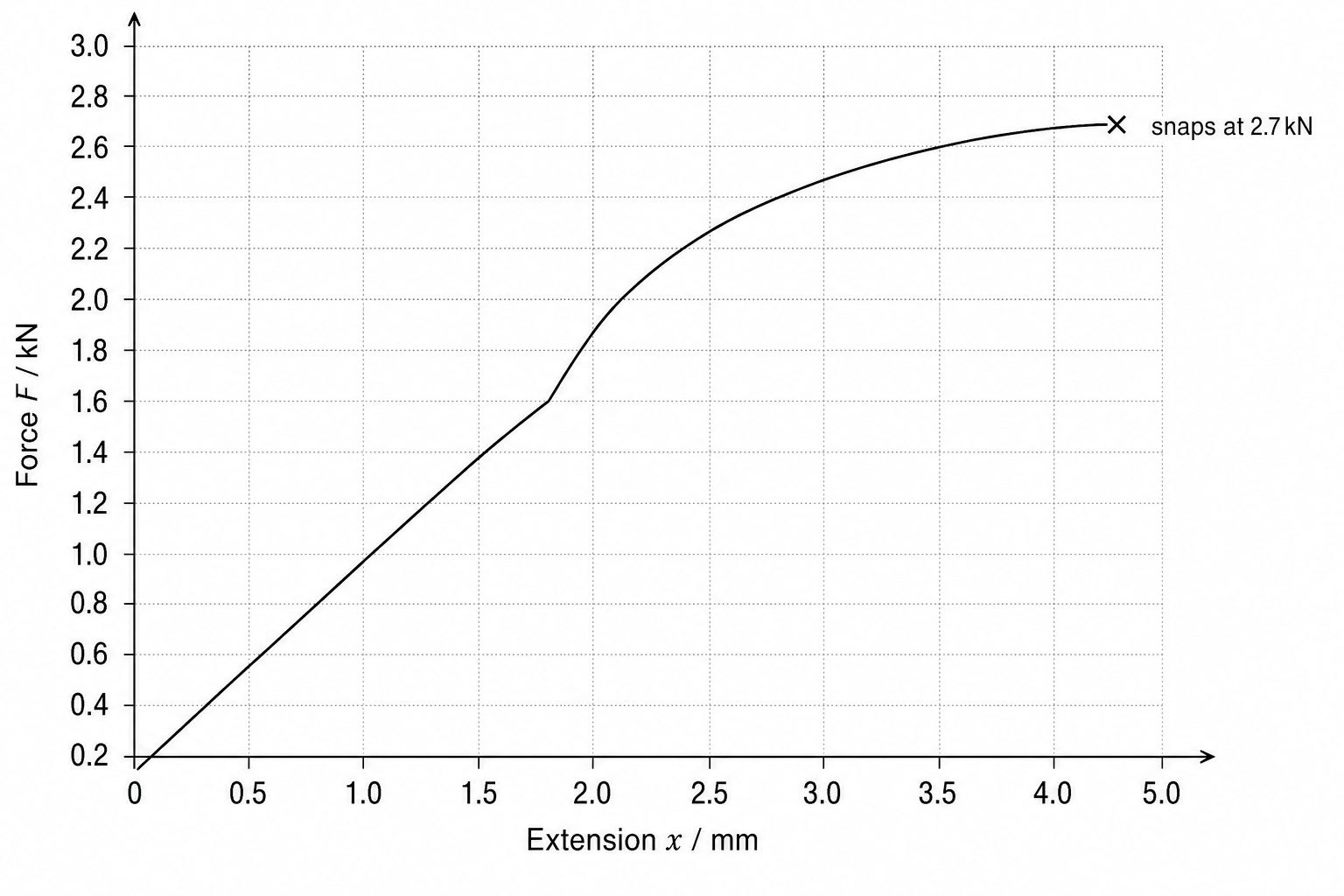
The cable snaps when the applied force reaches 2.7 kN2.7\text{ kN}2.7 kN.
Describe how a suitable measuring device may be used by the oceanographers to demonstrate that the cable has a uniform cross-section.
Use the graph to determine the force constant kkk in N m−1\text{N m}^{-1}N m−1 of the cable.
Calculate the breaking stress σ\sigmaσ of the cable, assuming its cross-sectional area remains constant throughout the test.
Explain, with reference to the graph, why the work done on the cable when its extension increases from 3.0 mm3.0\text{ mm}3.0 mm to 4.0 mm4.0\text{ mm}4.0 mm is greater than when its extension increases from 0.5 mm0.5\text{ mm}0.5 mm to 1.5 mm1.5\text{ mm}1.5 mm.

