What you'll learn
- How the radian measures angle using arc length and radius.
- How period and frequency describe repeated circular motion.
- How to use ω=2πT\omega = \frac{2\pi}{T}ω=T2π and ω=2πf\omega = 2\pi fω=2πf for angular velocity.
- How to avoid the most common unit mistakes in circular-motion calculations.
1. Describing motion around a circle
Circular motion means motion along the circumference of a circle. The circumference is the distance all the way around the circle.
For an object moving in a circle:
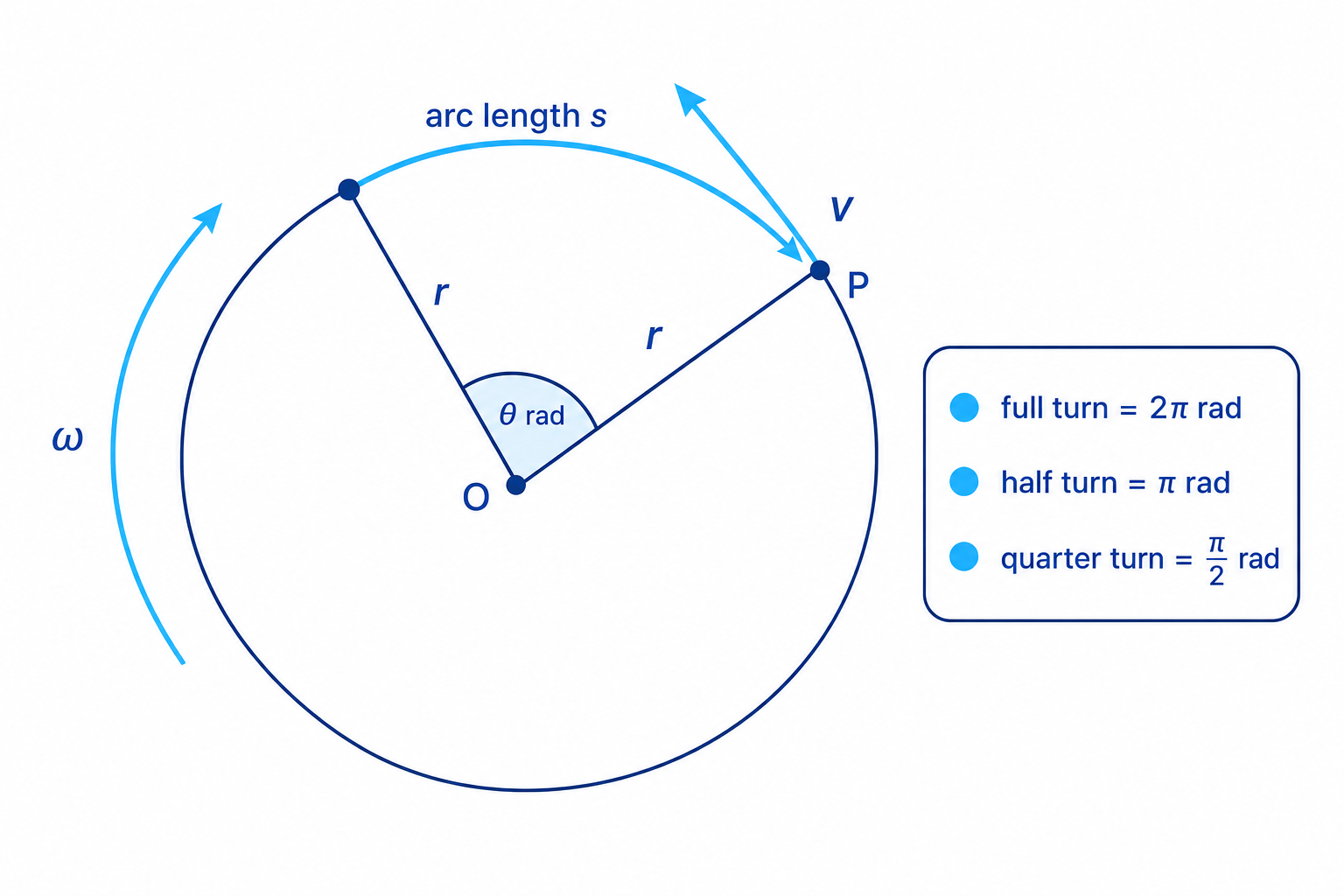
- the radius, rrr, is the distance from the centre of the circle to the object;
- the arc length, sss, is the distance travelled along part of the circumference;
- one complete trip around the circle is called one revolution or one turn;
- the object’s instantaneous velocity is tangential, meaning it points along the tangent to the circle at that instant.
The key idea is that circular motion is often easier to describe using angle turned through, rather than distance along the circle.
2. The radian
At GCSE you probably used degrees. In A-Level circular motion, angles are usually measured in radians.
Radian
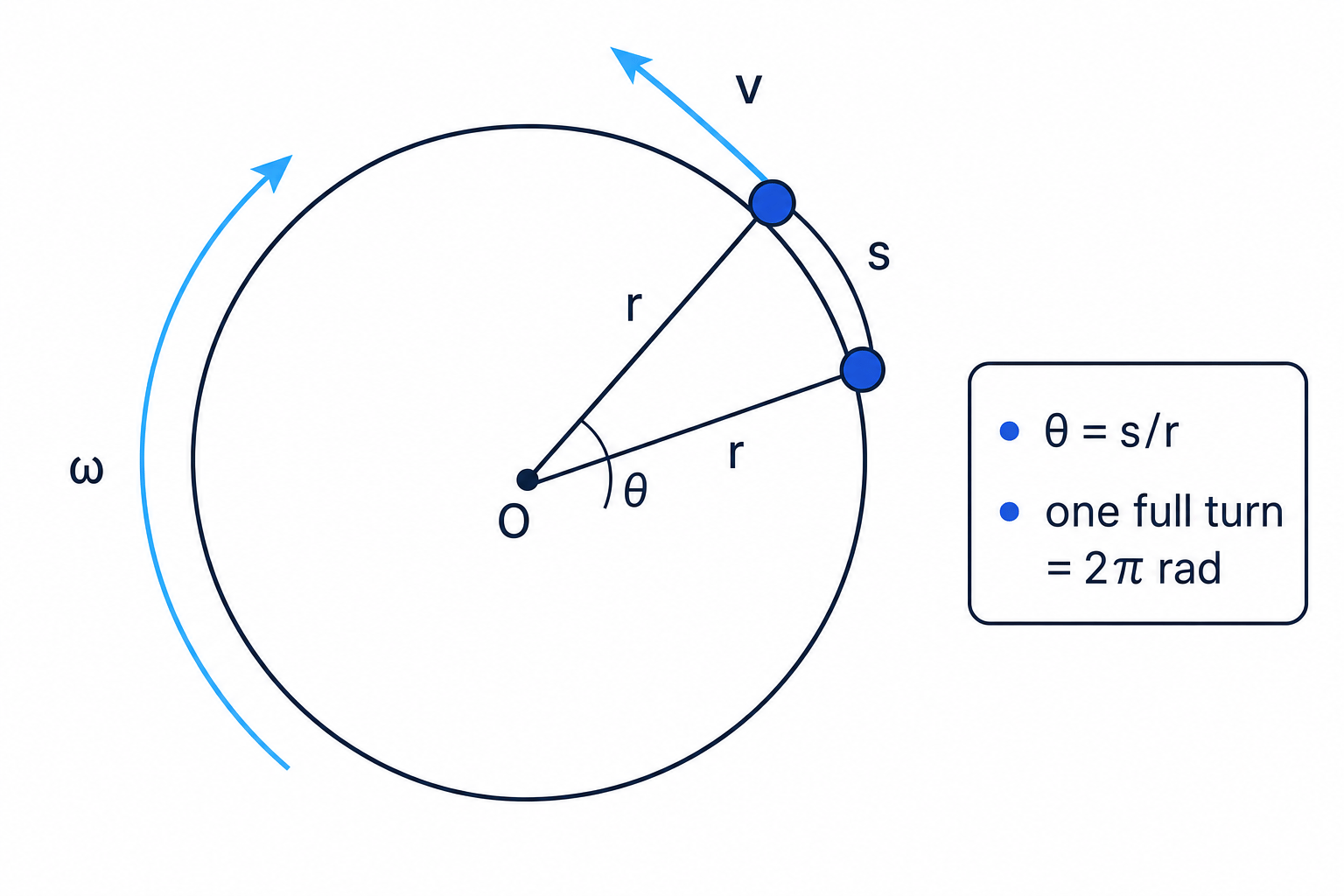
One radian is the angle at the centre of a circle when the arc length is equal to the radius. In symbols, θ=sr\theta = \frac{s}{r}θ=rs, where θ\thetaθ is the angle in radians, sss is the arc length in metres, and rrr is the radius in metres.
The defining equation is:
θ=sr\theta = \frac{s}{r}θ=rsBecause both sss and rrr are lengths, the units cancel. Even so, you should usually write the angle unit as rad to show you are using radians.
For a full circle, the arc length is the circumference, 2πr2\pi r2πr. So:
θ=2πrr=2π rad\theta = \frac{2\pi r}{r} = 2\pi \ \text{rad}θ=r2πr=2π radSo:
- one full turn is 2π rad2\pi \ \text{rad}2π rad;
- half a turn is π rad\pi \ \text{rad}π rad;
- one quarter turn is π2 rad\frac{\pi}{2} \ \text{rad}2π rad.
Radians link distance and angle
Radians are useful because they directly connect distance around the circle to the angle swept out: s=rθs = r\thetas=rθ, as long as θ\thetaθ is in radians.
Calculating an angle in radians
A bead moves along a circular track of radius 0.80 m. It travels an arc length of 0.60 m. Calculate the angle swept out in radians.
-
Use the radian definition because the question gives arc length and radius:
θ=sr\theta = \frac{s}{r}θ=rs -
Substitute the values, carrying the length units through:
θ=0.60 m0.80 m=0.75 rad\theta = \frac{0.60\ \text{m}}{0.80\ \text{m}} = 0.75\ \text{rad}θ=0.80 m0.60 m=0.75 rad -
Check the size of the answer by comparing with a full circle:
2πr=2π(0.80 m)≈5.0 m2\pi r = 2\pi(0.80\ \text{m}) \approx 5.0\ \text{m}2πr=2π(0.80 m)≈5.0 mThe bead travels much less than the full circumference, so an angle much less than 2π rad2\pi \ \text{rad}2π rad is sensible.
Using degrees in radian equations
Equations such as θ=sr\theta = \frac{s}{r}θ=rs only work when θ\thetaθ is measured in radians. Do not substitute degrees into circular-motion formulae unless you have converted them to radians first.
3. Period and frequency
Circular motion is repetitive, so we often describe it using time per revolution or revolutions per second.
Period and frequency
The period, TTT, is the time taken for one complete revolution, measured in seconds. The frequency, fff, is the number of revolutions per second, measured in hertz, Hz.
One hertz means one cycle per second. So frequency has the same base unit as per second, s−1\text{s}^{-1}s−1.
Period and frequency are reciprocals:
f=1Tf = \frac{1}{T}f=T1and
T=1fT = \frac{1}{f}T=f1If something rotates quickly, it has a high frequency and a small period. If it rotates slowly, it has a low frequency and a large period.
Finding frequency and period
A toy car completes 8.0 laps of a circular track in 20 s. Calculate its frequency and period.
-
Frequency is the number of complete revolutions per second:
f=8.020 s=0.40 s−1=0.40 Hzf = \frac{8.0}{20\ \text{s}} = 0.40\ \text{s}^{-1} = 0.40\ \text{Hz}f=20 s8.0=0.40 s−1=0.40 Hz -
Period is the time for one revolution, so use the reciprocal relationship:
T=1f=10.40 Hz=2.5 sT = \frac{1}{f} = \frac{1}{0.40\ \text{Hz}} = 2.5\ \text{s}T=f1=0.40 Hz1=2.5 s -
Check consistency by multiplying laps by time per lap:
8.0×2.5 s=20 s8.0 \times 2.5\ \text{s} = 20\ \text{s}8.0×2.5 s=20 sThis matches the total time, so the values are consistent.
Revolutions per minute
If a rotation rate is given in revolutions per minute, convert to revolutions per second before using it as frequency. Divide by 60 because 1 min = 60 s.
4. Angular velocity
The angular displacement of an object is the angle it has swept out, usually measured in radians.
Angular velocity
Angular velocity, ω\omegaω, is the rate at which angular displacement changes. For uniform circular motion, it is the angle swept out per unit time, measured in radian per second, rad s−1^{-1}−1.
For one complete revolution, the angle swept out is 2π rad2\pi \ \text{rad}2π rad, and the time taken is one period, TTT.
So:
ω=2πT\omega = \frac{2\pi}{T}ω=T2πSince f=1Tf = \frac{1}{T}f=T1, this can also be written as:
ω=2πf\omega = 2\pi fω=2πfThese are the key equations for this part of the specification.
Frequency counts turns, angular velocity counts radians
Frequency tells you how many revolutions happen each second. Angular velocity tells you how many radians are swept out each second. Since one revolution is 2π rad2\pi \ \text{rad}2π rad, ω=2πf\omega = 2\pi fω=2πf.
Calculating angular velocity
A rotor spins at 2.4×1032.4 \times 10^{3}2.4×10³ revolutions per minute. Calculate its angular velocity in rad s−1^{-1}−1.
-
Convert revolutions per minute into frequency in hertz:
f=2.4×10360 s=40 Hzf = \frac{2.4 \times 10^{3}}{60\ \text{s}} = 40\ \text{Hz}f=60 s2.4×103=40 Hz -
Use the angular velocity equation because frequency is now known:
ω=2πf\omega = 2\pi fω=2πf ω=2π(40 s−1)=251 rad s−1\omega = 2\pi(40\ \text{s}^{-1}) = 251\ \text{rad s}^{-1}ω=2π(40 s−1)=251 rad s−1 -
Quote the answer to a sensible number of significant figures:
ω≈2.5×10² rad s−1\omega \approx 2.5 \times 10^{2}\ \text{rad s}^{-1}ω≈2.5×10² rad s−1
Confusing frequency and angular velocity
A frequency of 1.0 Hz does not mean an angular velocity of 1.0 rad s−1^{-1}−1. One full revolution is 2π rad2\pi \ \text{rad}2π rad, so 1.0 Hz corresponds to 2π rad s−12\pi \ \text{rad s}^{-1}2π rad s−1.
5. Choosing the right equation
For this sub-topic, your choice usually depends on what the question gives you.
If you know the period, use:
ω=2πT\omega = \frac{2\pi}{T}ω=T2πIf you know the frequency, use:
ω=2πf\omega = 2\pi fω=2πfIf you know arc length and radius, use:
θ=sr\theta = \frac{s}{r}θ=rsIf you need to move between period and frequency, use:
f=1Tf = \frac{1}{T}f=T1or
T=1fT = \frac{1}{f}T=f1Same rotation, same angular velocity
For a rigid rotating object, such as a disc, all points complete one revolution in the same time. So they have the same TTT, fff and ω\omegaω, even though points farther from the centre travel a longer distance around the circle.
In the exam
- Convert all times to seconds before using TTT, fff or ω\omegaω equations.
- Check whether the question gives period or frequency, then choose either ω=2πT\omega = \frac{2\pi}{T}ω=T2π or ω=2πf\omega = 2\pi fω=2πf.
- Keep radians separate from degrees: circular-motion angle equations require radians.
Check yourself
- A particle travels an arc length of 0.45 m around a circle of radius 0.30 m. What angle has it swept out in radians?
- An object in circular motion has a period of 0.20 s. What are its frequency and angular velocity?
- Why is an angular velocity in rad s−1^{-1}−1 not the same quantity as a frequency in Hz?