A satellite of mass mmm is in a circular orbit of radius rrr around a planet of mass MMM. Show that the relationship between the orbital period TTT of the satellite and its orbital radius rrr is T2∝r3T^2 \propto r^3T2∝r3 using Newton's law of gravitation and the equations of circular motion.
A scientific probe of mass 320 kg320\text{ kg}320 kg was launched into an elliptical orbit around a planet of mass 1.90×1027 kg1.90 \times 10^{27}\text{ kg}1.90×1027 kg. The probe has an orbital orbit period of 24.0 days24.0\text{ days}24.0 days.
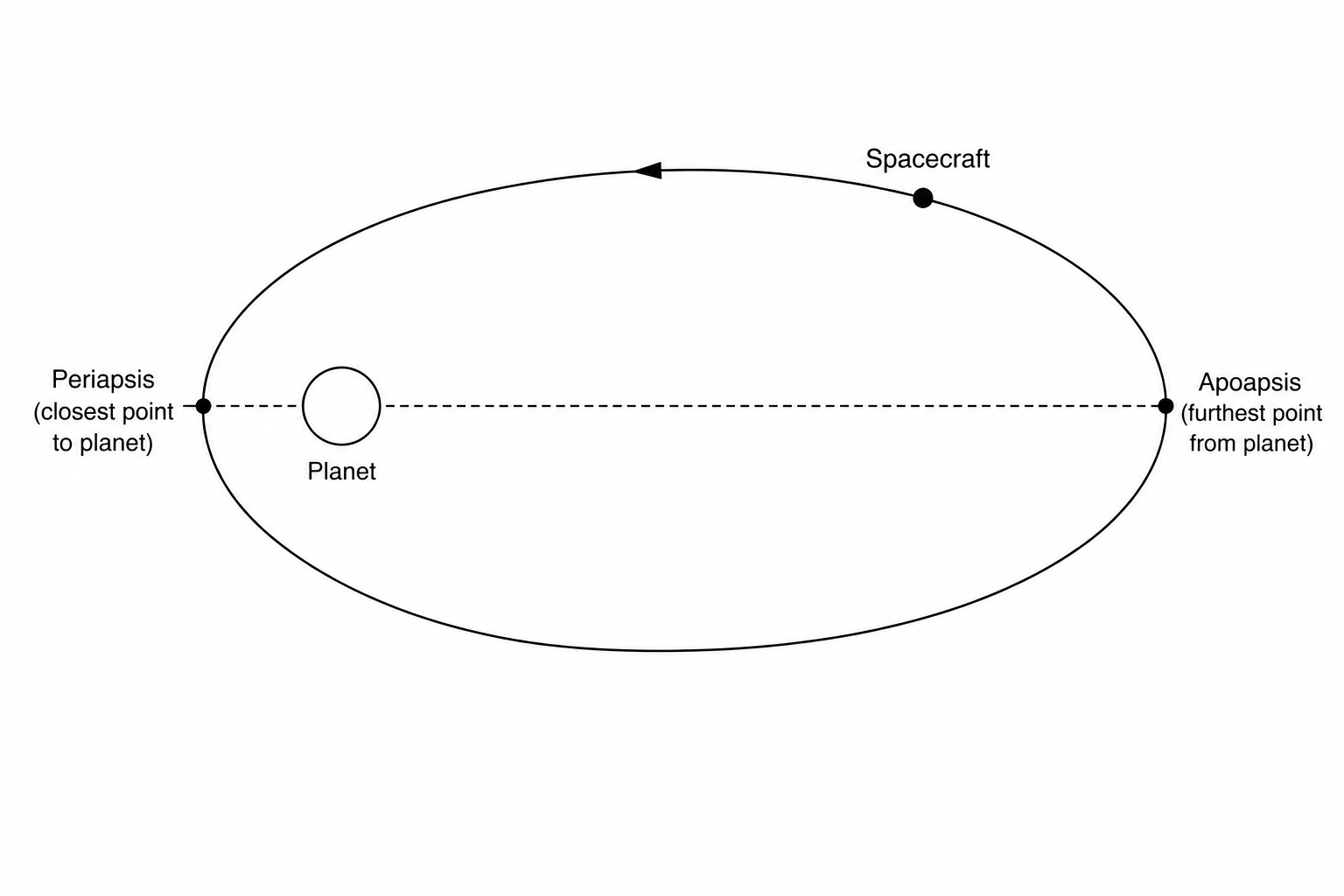
The closest distance of the probe to the planet is 4.00×10⁸ m4.00 \times 10^8\text{ m}4.00×10⁸ m and its furthest distance from the planet is 1.60×10⁹ m1.60 \times 10^9\text{ m}1.60×10⁹ m.
A nearby reference moon has a mean orbital distance of 2.50×10⁸ m2.50 \times 10^8\text{ m}2.50×10⁸ m around the planet and an orbital period of 3.00 days3.00\text{ days}3.00 days. Use Kepler's third law to calculate the mean orbital distance of the probe from the planet.
The total kinetic and gravitational potential energy of the probe in its orbit remains constant. Calculate the change in the kinetic energy of the probe as it travels from its furthest point to its closest point to the planet. (Take G=6.67×10⁻¹¹ N m2 kg−2G = 6.67 \times 10^{-11}\text{ N m}^2\text{ kg}^{-2}G=6.67×10⁻¹¹ N m2 kg−2.)
Suggest why the total energy of the probe in its orbit around the planet is not the same as the total energy of the probe during its launch from the surface of its home planet.