The Trident-Explorer spacecraft orbits Neptune to study its dynamic atmosphere, faint ring system, and icy moons.
The diagram below shows the highly elliptical scientific orbit of Trident-Explorer around Neptune.
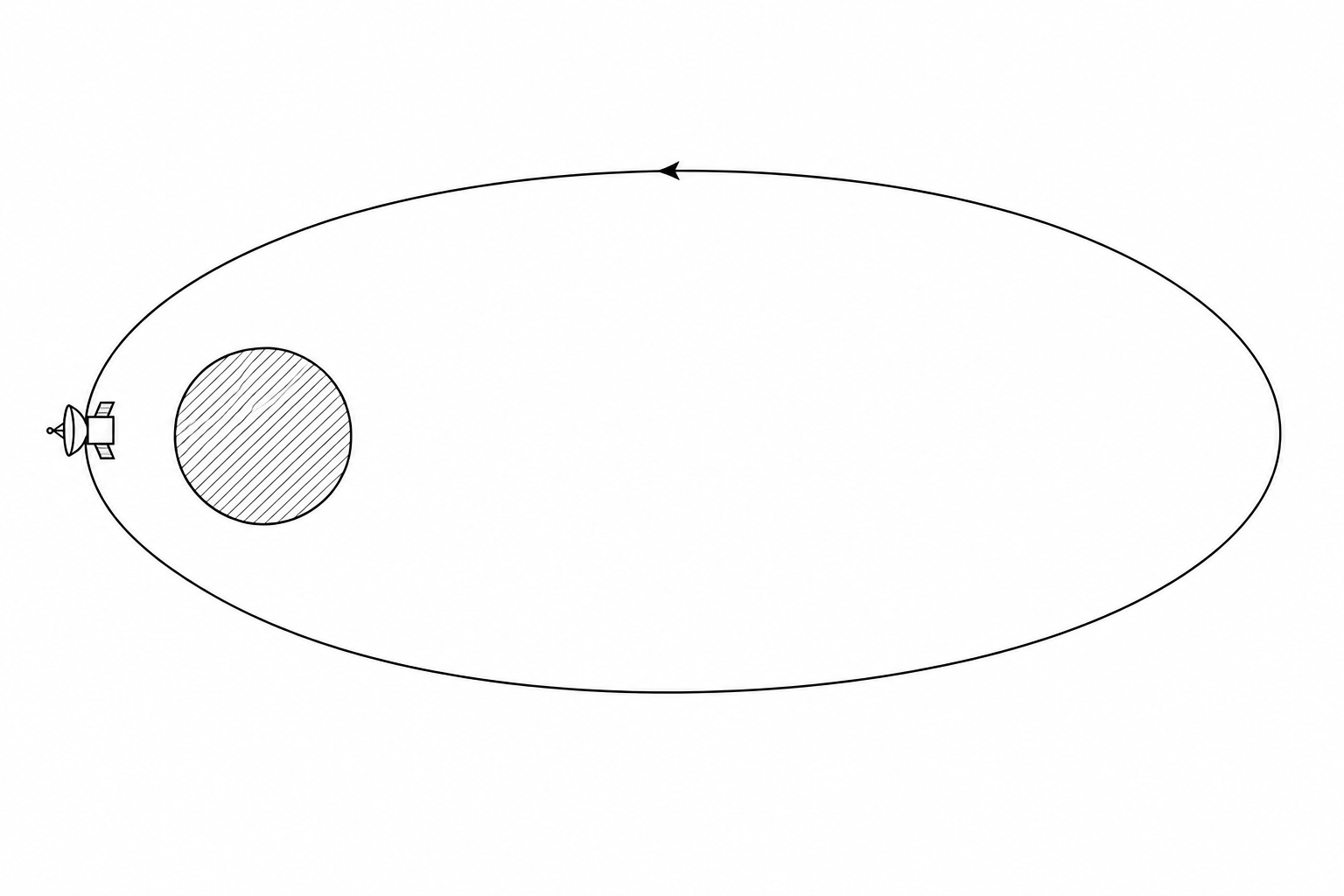
Mark an X on the diagram to show the point in the orbit where Trident-Explorer has minimum speed.
Explain how Kepler's 1st law applies to Trident-Explorer's orbit around Neptune.
The table below shows data for four orbits around Neptune.
Naiad and Galatea are inner moons of Neptune.
A poseidonstationary orbit is Neptune's equivalent of a geostationary orbit for Earth.
| Orbit | Time period TTT / hours | Average distance from centre of Neptune rrr / km |
|---|---|---|
| Trident-Explorer | 12.0 | 68,500 |
| Naiad | 7.1 | 48,200 |
| Galatea | 10.3 | 62,000 |
| Poseidonstationary | 16.1 | 83,500 |
Show that Kepler's 3rd law applies to this data.
Suggest two reasons why Trident-Explorer was not placed in a poseidonstationary orbit.

