

What you'll learn
- How a capacitor stores energy as it is charged.
- Why the area under a p.d.–charge graph gives the energy stored.
- How to use W=12QVW = \frac{1}{2}QVW=21QV, W=12Q2CW = \frac{1}{2}\frac{Q^2}{C}W=21CQ2 and W=12V2CW = \frac{1}{2}V^2 CW=21V2C.
- Why capacitors are useful when energy needs to be released quickly.
Starting point: charge, p.d. and capacitance
A capacitor is a component that stores charge. In its simplest form, it has two conducting plates separated by an insulator. When connected to a supply, one plate becomes positively charged and the other becomes negatively charged.
The charge stored on one plate is written as QQQ and is measured in coulombs, C.
Potential difference
Potential difference, VVV, is the energy transferred per unit charge. One volt means one joule per coulomb: 1 V=1 J C−11\ \text{V} = 1\ \text{J C}^{-1}1 V=1 J C−1.
If a charge QQQ moves through a constant potential difference VVV, the energy transferred is:
W=QVW = QVW=QVwhere WWW is the work done or energy transferred, measured in joules, J.
Capacitance
Capacitance, CCC, is the charge stored per unit potential difference across the capacitor:
C=QVC = \frac{Q}{V}C=VQIt is measured in farads, F.
For a capacitor with constant capacitance, rearranging C=QVC = \frac{Q}{V}C=VQ gives:
V=QCV = \frac{Q}{C}V=CQSo as more charge is stored, the p.d. across the capacitor increases.
The two meanings of C
The symbol CCC can mean capacitance, but C is also the unit symbol for coulomb. Look at the context: C=220 μFC = 220\ \mu\text{F}C=220 μF is capacitance, while Q=220 μCQ = 220\ \mu\text{C}Q=220 μC is charge.
Why charging a capacitor takes increasing work
At the start, an uncharged capacitor has zero p.d. across it. It is relatively easy to move the first small amount of charge onto the plates.
As charge builds up, the p.d. across the capacitor increases. Later charge has to be pushed on against a larger p.d., so more work is needed per coulomb.
This is the key reason the stored energy is not simply QVQVQV.
The p.d. is not constant while charging
For a capacitor charging from zero to final p.d. VVV, the p.d. rises from zero to VVV. The average p.d. during the charging process is therefore V2\frac{V}{2}2V.
The p.d.–charge graph
A p.d.–charge graph plots the potential difference VVV across the capacitor against the charge QQQ stored on it.
For a capacitor with constant capacitance:
V=QCV = \frac{Q}{C}V=CQThis is the equation of a straight line through the origin. The gradient is:
gradient=VQ=1C\text{gradient} = \frac{V}{Q} = \frac{1}{C}gradient=QV=C1So a larger capacitance gives a smaller gradient: the capacitor can store more charge for the same p.d.
The energy stored is the area under the p.d.–charge graph.
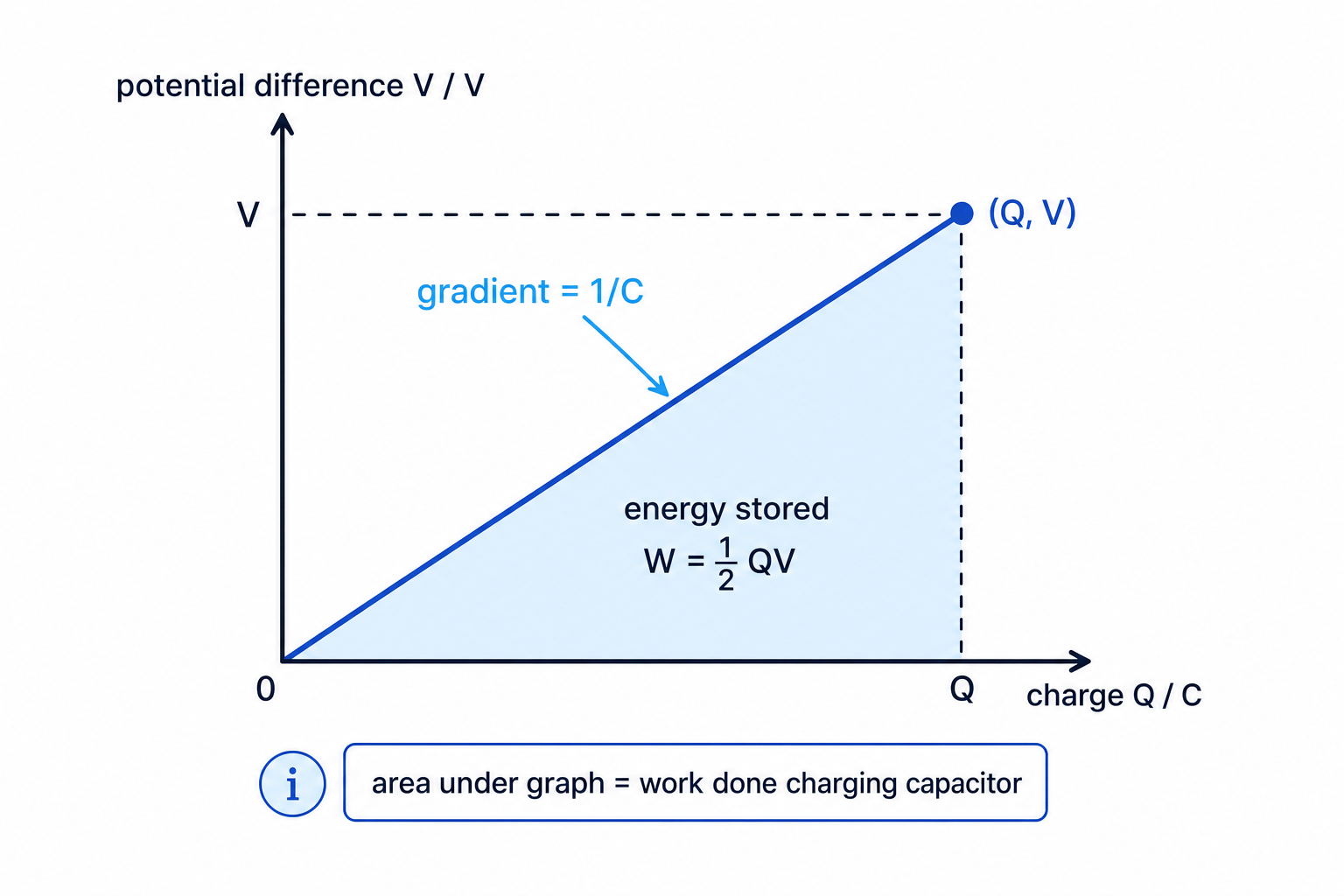
Because the graph is a triangle:
W=12QVW = \frac{1}{2}QVW=21QVwhere QQQ is the final charge and VVV is the final p.d.
Finding energy from a p.d.–charge graph
A capacitor is charged until the charge stored is 4.0×10⁻³ C4.0 \times 10^{-3}\ \text{C}4.0×10⁻³ C and the p.d. across it is 12 V. Find the energy stored and the capacitance.
-
Use the triangular area under the p.d.–charge graph for the energy stored:
W=12QVW = \frac{1}{2}QVW=21QV -
Substitute the final charge and final p.d.:
W=12(4.0×10⁻³ C)(12 V)W = \frac{1}{2}(4.0 \times 10^{-3}\ \text{C})(12\ \text{V})W=21(4.0×10⁻³ C)(12 V) -
Calculate the energy:
W=2.4×10⁻² JW = 2.4 \times 10^{-2}\ \text{J}W=2.4×10⁻² J -
Use C=QVC = \frac{Q}{V}C=VQ to find the capacitance:
C=4.0×10⁻³ C12 V=3.3×10⁻⁴ FC = \frac{4.0 \times 10^{-3}\ \text{C}}{12\ \text{V}} = 3.3 \times 10^{-4}\ \text{F}C=12 V4.0×10−3 C=3.3×10⁻⁴ F
The energy equations for a capacitor
The main capacitor energy equation is:
W=12QVW = \frac{1}{2}QVW=21QVYou can combine this with C=QVC = \frac{Q}{V}C=VQ to get two other useful forms.
Since Q=CVQ = CVQ=CV:
W=12V2CW = \frac{1}{2}V^2 CW=21V2CSince V=QCV = \frac{Q}{C}V=CQ:
W=12Q2CW = \frac{1}{2}\frac{Q^2}{C}W=21CQ2So the three OCR equations are:
W=12QVW=12Q2CW=12V2CW = \frac{1}{2}QV \qquad W = \frac{1}{2}\frac{Q^2}{C} \qquad W = \frac{1}{2}V^2 CW=21QVW=21CQ2W=21V2CUse the version that matches the quantities you are given.
Choosing the right equation
Use W=12QVW = \frac{1}{2}QVW=21QV if you know charge and p.d.; use W=12V2CW = \frac{1}{2}V^2 CW=21V2C if you know capacitance and p.d.; use W=12Q2CW = \frac{1}{2}\frac{Q^2}{C}W=21CQ2 if you know charge and capacitance.
Calculating stored energy from capacitance and voltage
A 2200 µF capacitor is charged to 12.0 V. Calculate the energy stored.
-
Convert the capacitance into farads:
2200 μF=2200×10−6 F=2.20×10⁻³ F2200\ \mu\text{F} = 2200 \times 10^{-6}\ \text{F} = 2.20 \times 10^{-3}\ \text{F}2200 μF=2200×10−6 F=2.20×10⁻³ F -
Choose the equation using capacitance and p.d.:
W=12V2CW = \frac{1}{2}V^2 CW=21V2C -
Substitute the values, keeping units in the calculation:
W=12(12.0 V)2(2.20×10⁻³ F)W = \frac{1}{2}(12.0\ \text{V})^2(2.20 \times 10^{-3}\ \text{F})W=21(12.0 V)2(2.20×10⁻³ F) -
Calculate and quote sensibly:
W=0.158 J≈0.16 JW = 0.158\ \text{J} \approx 0.16\ \text{J}W=0.158 J≈0.16 J
How energy depends on voltage and capacitance
From:
W=12V2CW = \frac{1}{2}V^2 CW=21V2Cthe energy stored is proportional to capacitance and proportional to the square of the p.d.
So:
- doubling the capacitance doubles the energy, if VVV is unchanged;
- doubling the p.d. makes the energy four times larger, if CCC is unchanged;
- tripling the p.d. makes the energy nine times larger, if CCC is unchanged.
Forgetting the square on voltage
The energy stored in a capacitor does not just double when the p.d. doubles. Because W∝V2W \propto V^2W∝V2, doubling VVV gives four times the energy.
Comparing energy at two voltages
A capacitor stores 0.50 J when charged to 5.0 V. Find the energy stored when the same capacitor is charged to 10.0 V.
-
Identify what stays constant: the same capacitor is used, so CCC is unchanged.
-
Use the proportionality from W=12V2CW = \frac{1}{2}V^2 CW=21V2C:
W∝V2W \propto V^2W∝V2 -
Compare the voltages:
10.0 V5.0 V=2\frac{10.0\ \text{V}}{5.0\ \text{V}} = 25.0 V10.0 V=2 -
Square the voltage ratio to find the energy ratio:
22=42^2 = 422=4 -
Multiply the original energy by 4:
W=4(0.50 J)=2.0 JW = 4(0.50\ \text{J}) = 2.0\ \text{J}W=4(0.50 J)=2.0 J
Why the factor of one-half appears
A common question is: if energy transferred by charge through p.d. is W=QVW = QVW=QV, why is capacitor energy W=12QVW = \frac{1}{2}QVW=21QV?
The reason is that the p.d. across the capacitor is not equal to the final value for the whole charging process. It rises from zero to VVV.
For a constant-capacitance capacitor, the average p.d. during charging is:
0+V2=V2\frac{0 + V}{2} = \frac{V}{2}20+V=2VSo the energy stored is:
W=Q(V2)=12QVW = Q \left(\frac{V}{2}\right) = \frac{1}{2}QVW=Q(2V)=21QVArea gives the work done
On a p.d.–charge graph, area represents energy because a small amount of work is given by p.d. multiplied by a small amount of charge. Adding all those small contributions gives the total work done charging the capacitor.
Uses of capacitors as energy stores
Capacitors are especially useful when energy must be stored briefly and then released quickly.
Unlike a battery, a capacitor does not store energy mainly through chemical changes. It stores energy in the electric field between its plates. This means it can often discharge very rapidly, producing a large current for a short time.
Common uses include:
- Camera flashes — energy is stored slowly, then released quickly through a flash lamp.
- Defibrillators — a capacitor stores energy and then releases a controlled pulse through the patient.
- Power supply smoothing — capacitors store energy when the supply voltage is high and release it when the voltage falls.
- Backup power for memory circuits — a capacitor can keep a small circuit powered for a short time if the main supply is interrupted.
Estimating energy for a camera flash
A camera flash uses a 470 µF capacitor charged to 300 V. Estimate the energy stored before the flash fires.
-
Convert the capacitance into farads:
470 μF=470×10−6 F=4.70×10⁻⁴ F470\ \mu\text{F} = 470 \times 10^{-6}\ \text{F} = 4.70 \times 10^{-4}\ \text{F}470 μF=470×10−6 F=4.70×10⁻⁴ F -
Use the equation involving capacitance and voltage:
W=12V2CW = \frac{1}{2}V^2 CW=21V2C -
Substitute the values:
W=12(300 V)2(4.70×10⁻⁴ F)W = \frac{1}{2}(300\ \text{V})^2(4.70 \times 10^{-4}\ \text{F})W=21(300 V)2(4.70×10⁻⁴ F) -
Calculate the energy:
W=21.15 J≈21 JW = 21.15\ \text{J} \approx 21\ \text{J}W=21.15 J≈21 J
High p.d. can be dangerous
Even a small capacitor can store a significant amount of energy if charged to a high p.d., because the energy depends on V2V^2V2. Large charged capacitors should be treated as potentially dangerous.
In the exam
- For a p.d.–charge graph, use the area under the graph for energy stored; for a straight-line capacitor graph, this is a triangle.
- Always convert prefixes before calculating: µF means 10−6 F10^{-6}\ \text{F}10−6 F, mC means 10−3 C10^{-3}\ \text{C}10−3 C.
- Check whether voltage has been squared. If the question compares the same capacitor at different p.d.s, use W∝V2W \propto V^2W∝V2.
Check yourself
- Why is the energy stored by a capacitor 12QV\frac{1}{2}QV21QV rather than QVQVQV?
- What does the gradient of a p.d.–charge graph represent?
- If the p.d. across a capacitor is doubled, what happens to the stored energy?
