

What you'll learn
- What electrical power means as a rate of energy transfer.
- How to use P=VIP = VIP=VI, P=I2RP = I^2RP=I2R and P=V2/RP = V^2/RP=V2/R.
- How to calculate electrical energy transfer using W=VItW = VItW=VIt.
- How the kilowatt-hour links physics to real electricity bills.
Power starts with energy transfer
You have already met energy as something transferred between stores. In circuits, electrical energy may be transferred to thermal energy in a heater, light in a lamp, or kinetic energy in a motor.
Power tells you how quickly that transfer happens. A high-power device transfers energy faster than a low-power device.
Power
Power, PPP, is the rate of energy transfer or the rate of doing work. It is measured in watts, W, where one watt means one joule per second.
The general relationship is:
P=WtP = \frac{W}{t}P=tWwhere WWW is the energy transferred or work done in joules, J, and ttt is the time in seconds, s.
Finding power from energy and time
- A lamp transfers 600 J600\ \text{J}600 J of energy in 30 s30\ \text{s}30 s, so use the rate relationship P=W/tP = W/tP=W/t.
- Substitute the values with units:
P=600 J30 s=20 J s−1P = \frac{600\ \text{J}}{30\ \text{s}} = 20\ \text{J s}^{-1}P=30 s600 J=20 J s−1. - Since 1 J s−1=1 W1\ \text{J s}^{-1} = 1\ \text{W}1 J s−1=1 W, the lamp has power 20 W20\ \text{W}20 W.
Electrical prerequisites
Before using the power equations, you need three circuit quantities.
Current, III, is the rate of flow of charge. It is measured in amperes, A.
Potential difference, VVV, is the energy transferred per unit charge between two points. It is measured in volts, V.
Resistance, RRR, describes how much a component opposes current. It is measured in ohms, Ω\OmegaΩ, and is linked to potential difference and current by V=IRV = IRV=IR.
In this topic, a load means the component receiving electrical energy from the circuit, such as a resistor, lamp, heater or motor. To measure power in a load, the ammeter goes in series to measure III, and the voltmeter goes in parallel across the load to measure VVV.
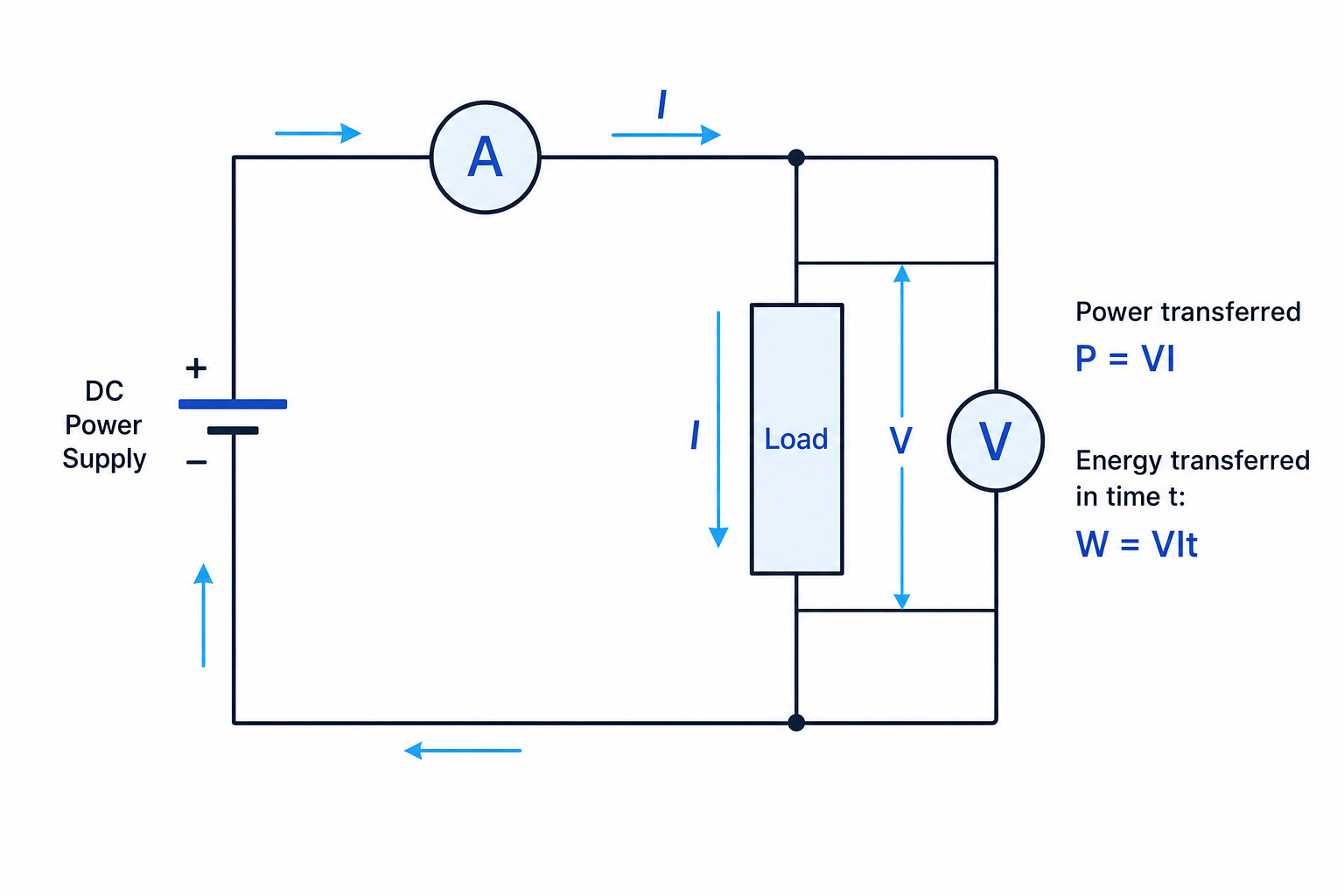
Ammeter and voltmeter placement
An ammeter measures the current through a component, so it must be in series with it. A voltmeter measures the potential difference across a component, so it must be in parallel with it.
Electrical power: P=VIP = VIP=VI
For a component, electrical power is given by:
P=VIP = VIP=VIwhere PPP is power in watts, W, VVV is potential difference in volts, V, and III is current in amperes, A.
This equation makes sense from the units:
- volts mean joules per coulomb
- amperes mean coulombs per second
- multiplying gives joules per second, which is watts
The meaning of P = VI
A component has a high power if each coulomb transfers a lot of energy, high VVV, and/or lots of charge flows each second, high III.
Calculating power from voltage and current
- A motor operates at 12.0 V12.0\ \text{V}12.0 V with a current of 3.5 A3.5\ \text{A}3.5 A, so use P=VIP = VIP=VI.
- Substitute the values:
P=(12.0 V)(3.5 A)=42 WP = (12.0\ \text{V})(3.5\ \text{A}) = 42\ \text{W}P=(12.0 V)(3.5 A)=42 W. - Interpret the result: the motor transfers energy at a rate of 42 J s−142\ \text{J s}^{-1}42 J s−1.
Power in a resistor
For a resistor or a component with a known resistance at that operating point, you can combine P=VIP = VIP=VI with V=IRV = IRV=IR.
Starting with P=VIP = VIP=VI:
- If you know III and RRR, replace VVV with IRIRIR:
- If you know VVV and RRR, replace III with V/RV/RV/R:
So the three OCR equations are:
P=VIP = VIP=VI P=I2RP = I^2RP=I2R P=V2/RP = V^2/RP=V2/RChoosing the quickest power equation
Use the equation that matches the quantities you are given: VVV and III gives P=VIP = VIP=VI; III and RRR gives P=I2RP = I^2RP=I2R; VVV and RRR gives P=V2/RP = V^2/RP=V2/R.
Finding the power dissipated in a resistor
- A resistor has resistance 18.0 Ω18.0\ \Omega18.0 Ω and potential difference 12.0 V12.0\ \text{V}12.0 V across it, so choose P=V2/RP = V^2/RP=V2/R because VVV and RRR are known.
- Substitute carefully, including the square on VVV:
P=(12.0 V)218.0 Ω=8.00 WP = \frac{(12.0\ \text{V})^2}{18.0\ \Omega} = 8.00\ \text{W}P=18.0 Ω(12.0 V)2=8.00 W. - Check using current:
I=VR=12.0 V18.0 Ω=0.667 AI = \frac{V}{R} = \frac{12.0\ \text{V}}{18.0\ \Omega} = 0.667\ \text{A}I=RV=18.0 Ω12.0 V=0.667 A, and P=VI=(12.0 V)(0.667 A)≈8.00 WP = VI = (12.0\ \text{V})(0.667\ \text{A}) \approx 8.00\ \text{W}P=VI=(12.0 V)(0.667 A)≈8.00 W.
Squaring the wrong quantity
In P=I2RP = I^2RP=I2R, only the current is squared. In P=V2/RP = V^2/RP=V2/R, only the potential difference is squared. The resistance is not squared in either equation.
When resistance changes
For components such as filament lamps, resistance can change as temperature changes. Use the resistance value for the actual operating conditions given in the question.
Energy transferred: W=VItW = VItW=VIt
Power is energy transferred per second, so energy transferred is:
W=PtW = PtW=PtUsing P=VIP = VIP=VI gives the electrical energy equation:
W=VItW = VItW=VItwhere WWW is the energy transferred in joules, J, VVV is potential difference in volts, V, III is current in amperes, A, and ttt is time in seconds, s.
Energy from electrical power
W=VItW = VItW=VIt is just “energy equals power times time”, with electrical power written as VIVIVI.
Calculating electrical energy transferred
- A kettle operates at 230 V230\ \text{V}230 V with a current of 9.0 A9.0\ \text{A}9.0 A for 180 s180\ \text{s}180 s, so use W=VItW = VItW=VIt.
- Substitute the values:
W=(230 V)(9.0 A)(180 s)=372600 JW = (230\ \text{V})(9.0\ \text{A})(180\ \text{s}) = 372600\ \text{J}W=(230 V)(9.0 A)(180 s)=372600 J. - Quote sensibly to two significant figures:
W≈3.7×10⁵ JW \approx 3.7 \times 10^5\ \text{J}W≈3.7×10⁵ J.
The kilowatt-hour
Domestic electrical energy use is often much larger than a few joules, so electricity companies use the kilowatt-hour, usually written as kW h or kWh on bills.
Kilowatt-hour
One kilowatt-hour is the energy transferred by a power of one kilowatt operating for one hour.
A kilowatt is 1000 W1000\ \text{W}1000 W and one hour is 3600 s3600\ \text{s}3600 s, so:
1 kW h=1000 W×3600 s=3.6×10⁶ J1\ \text{kW h} = 1000\ \text{W} \times 3600\ \text{s} = 3.6 \times 10^6\ \text{J}1 kW h=1000 W×3600 s=3.6×10⁶ JSo the kilowatt-hour is a unit of energy, not power.
kW h is not kW per hour
A kilowatt-hour means kilowatts multiplied by hours. It is an energy unit. Do not treat it as “kilowatts per hour”.
Calculating the cost of energy
For electricity bills, use:
energy used in kW h=power in kW×time in h\text{energy used in kW h} = \text{power in kW} \times \text{time in h}energy used in kW h=power in kW×time in hThen:
cost=energy used in kW h×price per kW h\text{cost} = \text{energy used in kW h} \times \text{price per kW h}cost=energy used in kW h×price per kW hThis links the circuit physics to real decisions about energy use: the same device costs more to run if it has a larger power, is used for longer, or electricity costs more per kW h.
Calculating the cost of running an appliance
- A microwave has power 850 W850\ \text{W}850 W and is used for 12 min12\ \text{min}12 min each day for 30 days. Convert to billing units:
850 W=0.850 kW850\ \text{W} = 0.850\ \text{kW}850 W=0.850 kW, and total time is 12 min×30=360 min=6.00 h12\ \text{min} \times 30 = 360\ \text{min} = 6.00\ \text{h}12 min×30=360 min=6.00 h. - Calculate the energy in kW h:
energy=(0.850 kW)(6.00 h)=5.10 kW h\text{energy} = (0.850\ \text{kW})(6.00\ \text{h}) = 5.10\ \text{kW h}energy=(0.850 kW)(6.00 h)=5.10 kW h. - If electricity costs 29 p kW h−129\ \text{p}\ \text{kW h}^{-1}29 p kW h−1, calculate the cost:
cost=5.10×29 p=148 p≈£1.48\text{cost} = 5.10 \times 29\ \text{p} = 148\ \text{p} \approx \text{£}1.48cost=5.10×29 p=148 p≈£1.48.
Which time unit should you use?
For W=VItW = VItW=VIt, use seconds so the energy comes out in joules. For electricity cost, use hours with power in kilowatts so the energy comes out in kW h.
In the exam
- Choose your equation from the quantities given: VVV and III for P=VIP = VIP=VI, III and RRR for P=I2RP = I^2RP=I2R, or VVV and RRR for P=V2/RP = V^2/RP=V2/R.
- Keep unit systems consistent: volts, amperes and seconds give joules; kilowatts and hours give kilowatt-hours.
- Check the answer size: small electronics may be a few watts, kettles and heaters are often a few kilowatts, and kW h is energy, not power.
Check yourself
- A 6.0 Ω6.0\ \Omega6.0 Ω resistor carries a current of 2.0 A2.0\ \text{A}2.0 A. Which power equation is quickest?
- How many joules are in 0.50 kW h0.50\ \text{kW h}0.50 kW h?
- A device is rated at 750 W750\ \text{W}750 W and runs for 20 min20\ \text{min}20 min. What conversions are needed before calculating cost in p per kW h?
