A student is investigating a kinetic emergency safety beacon that is powered by shaking. Inside the beacon, a strong magnet slides back and forth through a hollow tube surrounded by a coil of wire. When the magnet passes through the coil, an electromotive force (e.m.f.) is induced. The induced e.m.f. is used to store electrical charge in a capacitor, which subsequently powers a light-emitting diode (LED).
The variation of the induced e.m.f. with time as the magnet passes through the coil in one direction is shown below.
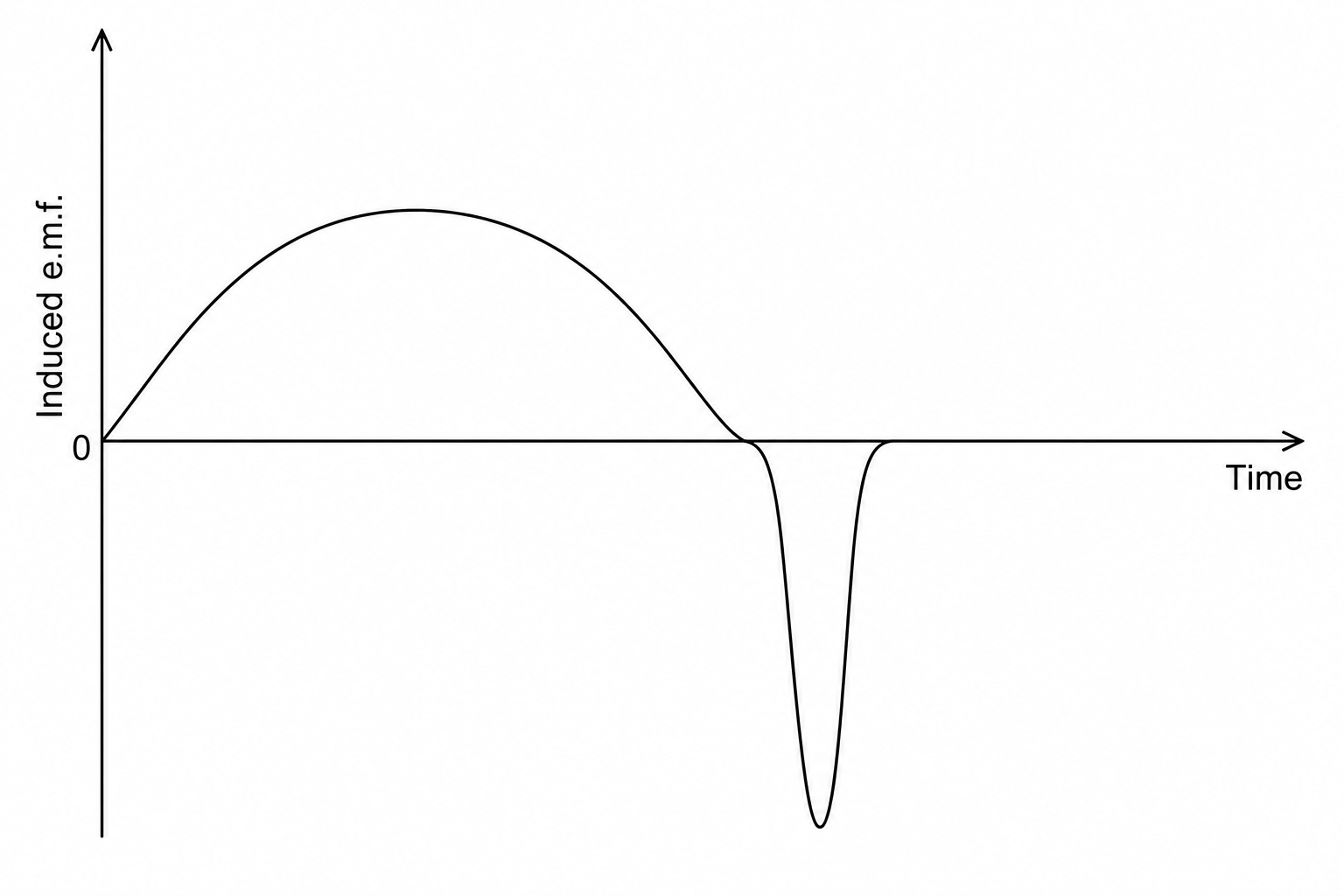
Explain the following features of the e.m.f. curve: (i) why the e.m.f. changes direction (from positive to negative) as the magnet passes through the coil;
(ii) why the second peak has a larger amplitude and a shorter duration than the first peak.
When the beacon is shaken, the pulses of induced e.m.f. charge a capacitor of capacitance 0.080 F0.080\text{ F}0.080 F. Each positive and each negative pulse adds 8.0×10⁻³ C8.0 \times 10^{-3}\text{ C}8.0×10⁻³ C of charge to the capacitor.
(i) The beacon is shaken back and forth such that the magnet passes through the coil 75 times75\text{ times}75 times. Each pass produces one positive and one negative pulse. Calculate the total energy stored in the capacitor.
(ii) When the beacon is switched on, the energy stored in the capacitor powers a 40 mW40\text{ mW}40 mW safety LED. Estimate the time for which the LED remains lit.

