

What you'll learn
- What potential difference (p.d.) means, and why the unit is the volt.
- What electromotive force (e.m.f.) means for a source such as a cell or power supply.
- How to use W=VQW = VQW=VQ and W=EQW = \mathcal{E}QW=EQ for energy transfers.
- How a p.d. can accelerate charged particles using eV=12mv2eV = \frac{1}{2}mv^2eV=21mv2.
Starting point: charge and energy
Electric charge, symbol QQQ, is measured in coulombs (C). In a circuit, charge moves around the loop. The charge is not “used up”; instead, energy is transferred to or from the electrical pathway as the charge passes through different parts of the circuit.
Work done, symbol WWW, means energy transferred. It is measured in joules (J). In this topic, voltage ideas are really about energy transferred per coulomb of charge.
Potential difference, p.d.
Potential difference is usually shortened to p.d. It is measured between two points, usually across a component such as a lamp, resistor, motor, or diode.
Potential difference
The potential difference VVV between two points is the energy transferred WWW per unit charge QQQ moving between those points: V=WQV = \frac{W}{Q}V=QW. A p.d. of 1 volt means 1 joule of energy is transferred per coulomb of charge.
Rearranging the definition gives:
W=VQW = VQW=VQThe unit volt is therefore a joule per coulomb:
1 V=1 J C−11\,\mathrm{V} = 1\,\mathrm{J\,C^{-1}}1V=1JC−1A voltmeter measures p.d. and is connected across the two points being compared.
Energy transferred in a lamp
A lamp has a p.d. of 6.0 V across it. 12 C of charge passes through the lamp. Calculate the energy transferred to the lamp.
- The charge passes through a component, so use W=VQW = VQW=VQ.
- Substitute the values with units: W=(6.0 V)(12 C)=72 JW = (6.0\,\mathrm{V})(12\,\mathrm{C}) = 72\,\mathrm{J}W=(6.0V)(12C)=72J.
- Interpret the result: each coulomb transfers 6.0 J, so 12 C transfers 72 J to the lamp.
A p.d. is not at one point
Avoid saying “the voltage at the resistor” unless a reference point is clear. A potential difference is always between two points, so in circuits you usually say the p.d. across a component.
Electromotive force, e.m.f.
A source is a device that supplies energy to the circuit, such as a cell, battery, generator, or power supply.
Electromotive force
The electromotive force, e.m.f., of a source is the energy supplied by the source per unit charge passing through it. Its symbol is script E, written E\mathcal{E}E, and it is measured in volts.
Despite the name, e.m.f. is not a force. It is a voltage: energy per coulomb.
For a source:
W=EQW = \mathcal{E}QW=EQFor example, a cell with e.m.f. 1.5 V supplies 1.5 J of energy to each coulomb of charge that passes through it.
Real cells can be slightly messier
For an ideal source, the p.d. across the source is equal to its e.m.f. In a real cell with current flowing, some energy can be transferred inside the cell, so the terminal p.d. can be smaller than the e.m.f.; that is developed more fully in internal resistance.
E.m.f. versus p.d.: the energy story
The key difference is the direction of energy transfer.
- E.m.f. describes energy supplied to charge by a source.
- P.d. describes energy transferred from charge to a component.
In a simple ideal circuit, each coulomb gains energy from the source, then transfers that energy to the components around the loop.
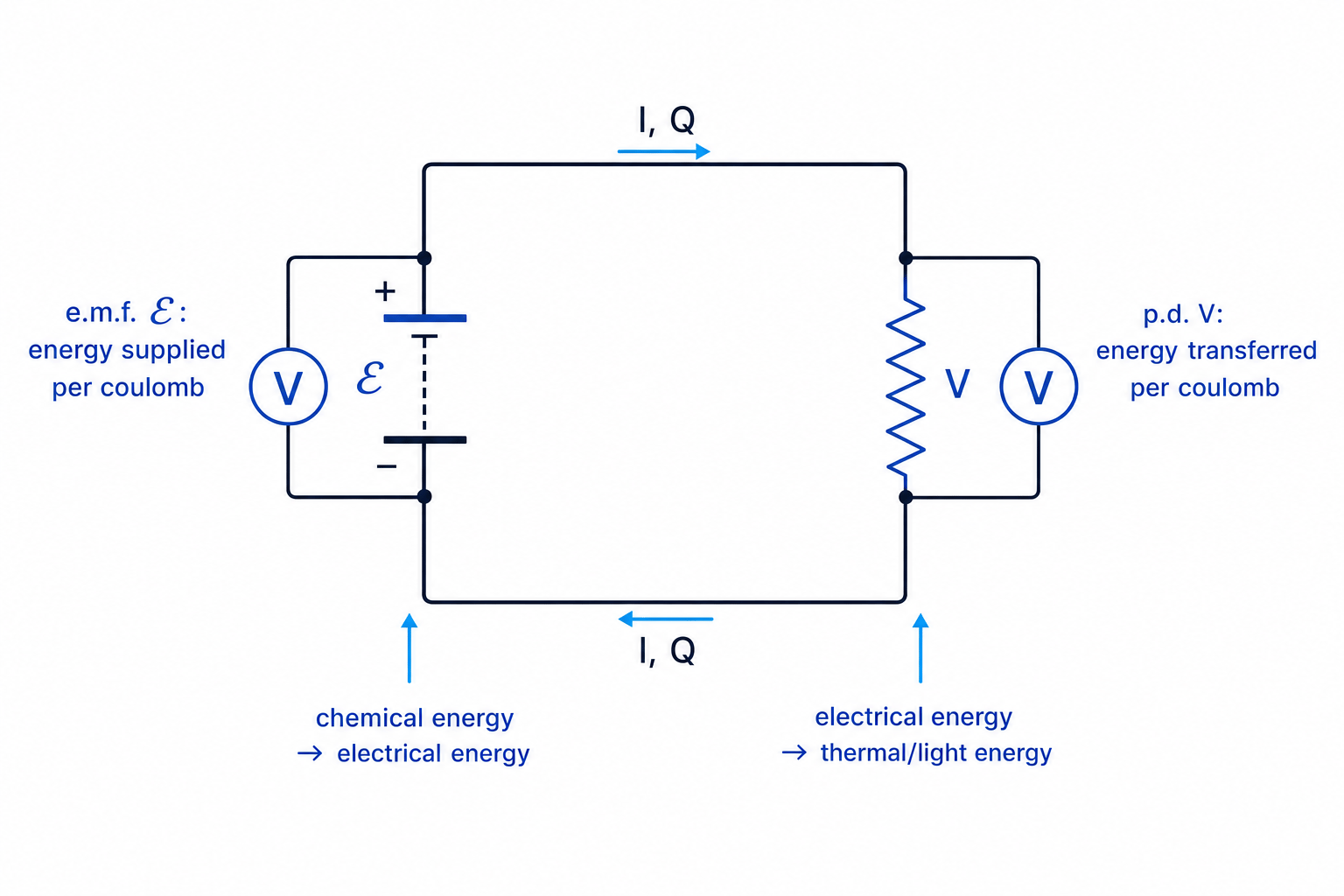
Source gives, components take
E.m.f. is energy supplied per coulomb; p.d. is energy transferred per coulomb. Both are measured in volts, but they describe opposite sides of the energy transfer.
For an ideal circuit, energy conservation means the total p.d. across the external components equals the e.m.f. of the source.
Following energy around a circuit
An ideal 9.0 V supply drives 4.0 C of charge through a lamp and a resistor in series. The p.d. across the lamp is 6.0 V and the p.d. across the resistor is 3.0 V. Compare the energy supplied and transferred.
- Calculate the energy supplied by the source: W=EQ=(9.0 V)(4.0 C)=36 JW = \mathcal{E}Q = (9.0\,\mathrm{V})(4.0\,\mathrm{C}) = 36\,\mathrm{J}W=EQ=(9.0V)(4.0C)=36J.
- Calculate the energy transferred in the components: Wlamp=(6.0 V)(4.0 C)=24 JW_{\text{lamp}} = (6.0\,\mathrm{V})(4.0\,\mathrm{C}) = 24\,\mathrm{J}Wlamp=(6.0V)(4.0C)=24J and Wresistor=(3.0 V)(4.0 C)=12 JW_{\text{resistor}} = (3.0\,\mathrm{V})(4.0\,\mathrm{C}) = 12\,\mathrm{J}Wresistor=(3.0V)(4.0C)=12J.
- Compare the totals: 24 J+12 J=36 J24\,\mathrm{J} + 12\,\mathrm{J} = 36\,\mathrm{J}24J+12J=36J, so the energy transferred by the components matches the energy supplied by the source.
Mixing up E symbols
Use E\mathcal{E}E for e.m.f. and WWW for energy transferred in this topic. Plain EEE may mean energy in other contexts, electric field strength in fields, or Young modulus in materials.
Charged particles accelerated by a p.d.
A charged particle can gain kinetic energy when it moves through a potential difference.
The elementary charge, symbol eee, is the magnitude of the charge on a proton or electron:
e=1.60×10⁻¹⁹ Ce = 1.60 \times 10^{-19}\,\mathrm{C}e=1.60×10⁻¹⁹CAn electron has charge −e-e−e, but when calculating energy gained we usually use the magnitude of the charge.
If a particle starts from rest and all the electrical energy becomes kinetic energy:
qV=12mv2qV = \frac{1}{2}mv^2qV=21mv2For an electron, or any singly charged particle where q=eq = eq=e:
eV=12mv2eV = \frac{1}{2}mv^2eV=21mv2Here, mmm is the mass of the particle and vvv is its final speed. For a particle with charge 2e2e2e, such as an alpha particle, the energy transfer would be 2eV2eV2eV.
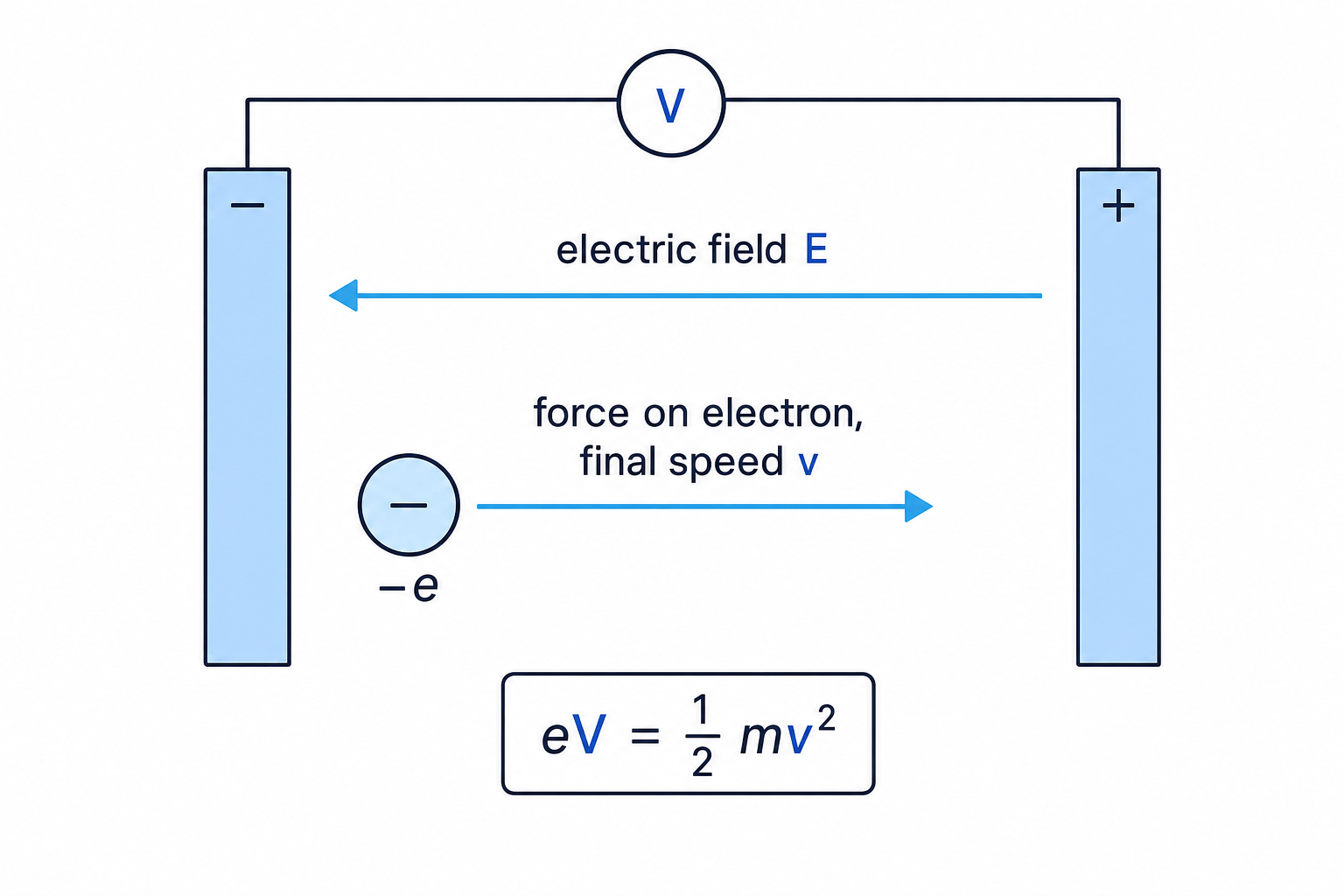
Reading eV carefully
In the product eVeVeV, eee is the elementary charge and VVV is the potential difference. The unit electronvolt is related: one electronvolt is the energy gained by an electron moving through 1 V.
Speed of an accelerated electron
An electron starts from rest and is accelerated through a p.d. of 500 V. Calculate its final speed. Use e=1.60×10⁻¹⁹ Ce = 1.60 \times 10^{-19}\,\mathrm{C}e=1.60×10⁻¹⁹C and m=9.11×10⁻³¹ kgm = 9.11 \times 10^{-31}\,\mathrm{kg}m=9.11×10⁻³¹kg.
- Since the electron starts from rest and electrical energy becomes kinetic energy, use eV=12mv2eV = \frac{1}{2}mv^2eV=21mv2.
- Rearrange for speed: v=2eVmv = \sqrt{\frac{2eV}{m}}v=m2eV.
- Substitute values: v=2(1.60×10⁻¹⁹ C)(500 V)9.11×10⁻³¹ kgv = \sqrt{\frac{2(1.60 \times 10^{-19}\,\mathrm{C})(500\,\mathrm{V})}{9.11 \times 10^{-31}\,\mathrm{kg}}}v=9.11×10⁻³¹kg2(1.60×10⁻¹⁹C)(500V).
- Calculate and quote a sensible answer: v=1.3×10⁷ m s−1v = 1.3 \times 10^7\,\mathrm{m\,s^{-1}}v=1.3×10⁷ms−1.
In the exam
- Define p.d. and e.m.f. using “energy per unit charge”; for e.m.f., say energy supplied by the source.
- Use W=VQW = VQW=VQ for energy transferred across a component and W=EQW = \mathcal{E}QW=EQ for energy supplied by a source.
- For charged particles, check the charge and the “starts from rest / no losses” assumption before using qV=12mv2qV = \frac{1}{2}mv^2qV=21mv2.
Check yourself
- What does a p.d. of 12 V mean in joules per coulomb?
- In one sentence, how is e.m.f. different from p.d.?
- What assumptions are needed before using eV=12mv2eV = \frac{1}{2}mv^2eV=21mv2 for an electron?
