

What you'll learn
- How astronomers measure huge distances using AU, light-years and parsecs.
- How stellar parallax gives distances to nearby stars.
- How Doppler redshift and Hubble’s law support an expanding Universe.
- Why the Big Bang theory is supported by the 2.7 K microwave background radiation.
1. Astronomical distance scales
In cosmology, ordinary metres are often inconvenient because distances are enormous. Astronomers use larger distance units depending on the scale being discussed.
Astronomical distance units
- The astronomical unit, AU, is the mean Earth-Sun distance: 1 AU is approximately 1.50×10¹¹ m1.50 \times 10^{11}\ \text{m}1.50×10¹¹ m.
- A light-year, ly, is the distance light travels in one year: 1 ly is approximately 9.46×10¹⁵ m9.46 \times 10^{15}\ \text{m}9.46×10¹⁵ m.
- A parsec, pc, is the distance at which 1 AU subtends an angle of 1 arcsecond. 1 pc is approximately 3.09×10¹⁶ m3.09 \times 10^{16}\ \text{m}3.09×10¹⁶ m, or about 3.26 ly.
- A megaparsec, Mpc, is 106 pc10^6\ \text{pc}106 pc and is commonly used for galaxy distances.
An arcsecond is a tiny angle: there are 3600 arcseconds in 1 degree.
Converting parsecs into light-years and metres
A star is 12 pc from Earth. Find its distance in light-years and metres.
- Convert parsecs into light-years using 1 pc is about 3.26 ly:
- Convert parsecs into metres using 1 pc=3.09×10¹⁶ m1\ \text{pc} = 3.09 \times 10^{16}\ \text{m}1 pc=3.09×10¹⁶ m:
- Quote sensible significant figures:
2. Stellar parallax
Stellar parallax is the apparent shift in the position of a nearby star against a background of very distant stars, caused by the Earth moving around the Sun.
We observe the star six months apart, when Earth is on opposite sides of its orbit. The nearby star appears to shift slightly. The parallax angle, ppp, is half the total angular shift.
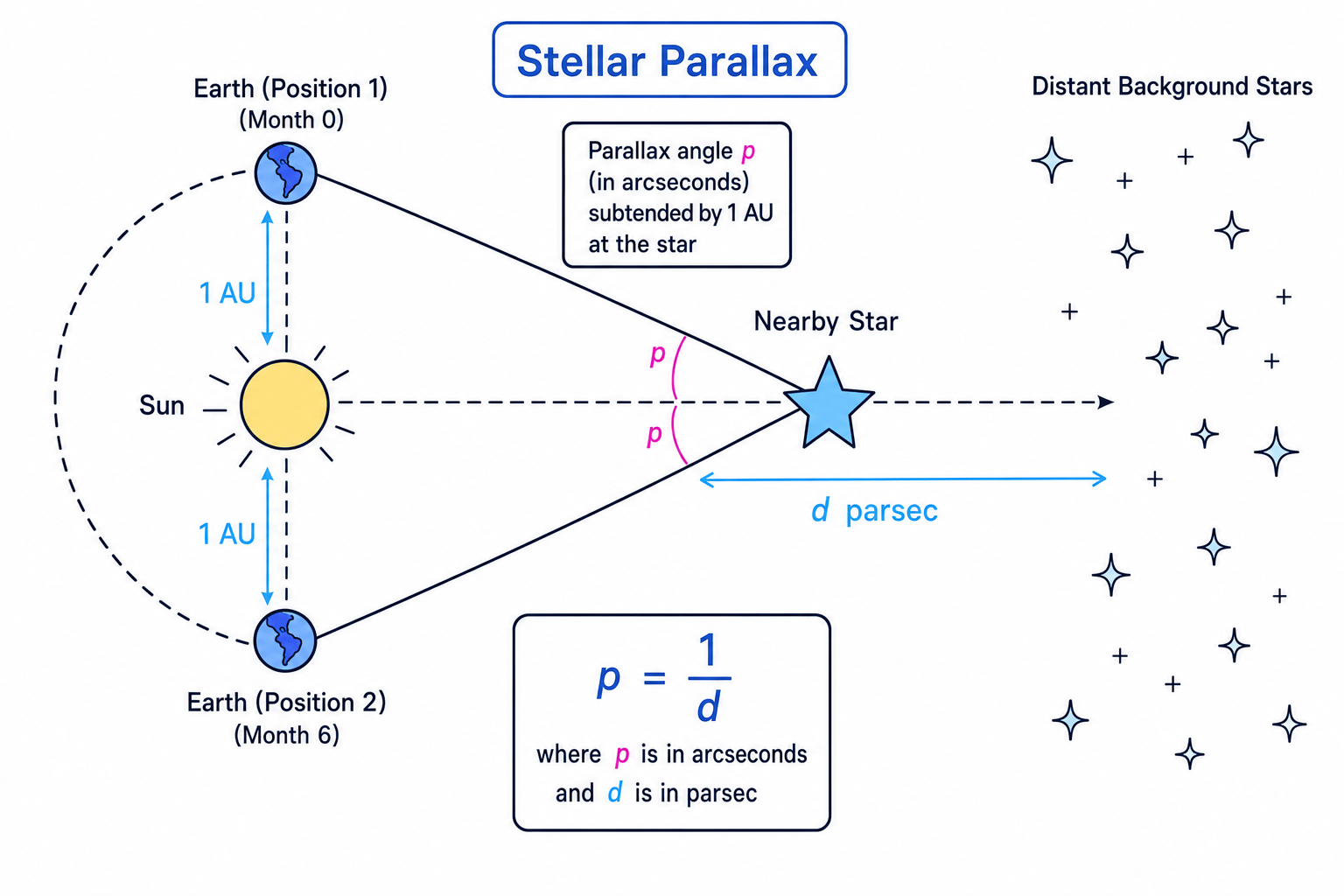
For OCR, the key equation is:
p=1d p = \frac{1}{d} p=d1where ppp is the parallax in seconds of arc and ddd is the distance in parsec.
Using the wrong angle
The parallax angle ppp is half the total apparent shift measured between observations six months apart. The equation p=1/dp = 1/dp=1/d uses ppp in arcseconds and ddd in parsecs; do not put ppp in degrees or radians for this equation.
Finding distance from parallax
A nearby star has a parallax angle of 0.20 arcseconds. Calculate its distance in parsecs and light-years.
- Rearrange the parallax equation:
- Substitute p=0.20p = 0.20p=0.20 arcseconds:
- Convert into light-years:
So the star is about 5.0 pc, or 16 ly, away.
3. The Cosmological principle
The Cosmological principle is an assumption about the Universe on very large scales.
Cosmological principle
On large enough scales, the Universe is homogeneous meaning it has the same average structure everywhere, isotropic meaning it looks the same in every direction, and the laws of physics are universal meaning the same physical laws apply throughout the Universe.
This does not mean every local region is identical. Stars, galaxies and clusters clearly exist. The principle applies when you average over extremely large cosmic distances.
4. Doppler shift of electromagnetic radiation
The Doppler effect is the change in observed wavelength or frequency when a source and observer move relative to one another.
For electromagnetic radiation:
- Redshift means the observed wavelength is longer than the emitted wavelength. This indicates the source is moving away.
- Blueshift means the observed wavelength is shorter. This indicates the source is moving towards the observer.
For speeds much smaller than the speed of light, use the approximate Doppler equation:
Δλλ≈Δff≈vc \frac{\Delta \lambda}{\lambda} \approx \frac{\Delta f}{f} \approx \frac{v}{c} λΔλ≈fΔf≈cvwhere Δλ\Delta \lambdaΔλ is the change in wavelength, Δf\Delta fΔf is the change in frequency, vvv is the relative speed, and ccc is the speed of light in vacuum.
Wavelength and frequency change oppositely
For redshift, wavelength increases but frequency decreases. In many A-Level calculations, Δλ/λ\Delta \lambda / \lambdaΔλ/λ and Δf/f\Delta f / fΔf/f are treated as magnitudes, so use the size of the fractional shift unless the question explicitly asks for a sign.
Calculating speed from redshift
A spectral line has a laboratory wavelength of 486.1 nm. In light from a distant galaxy, the same line is observed at 487.6 nm. Calculate the galaxy’s recessional speed.
- Find the change in wavelength:
- Calculate the fractional wavelength shift:
- Use the Doppler equation with c=3.00×10⁸ m s−1c = 3.00 \times 10^8\ \text{m s}^{-1}c=3.00×10⁸ m s−1:
-
Interpret the shift:
The wavelength is longer, so the galaxy is receding at about 9.3×10⁵ m s−19.3 \times 10^5\ \text{m s}^{-1}9.3×10⁵ m s−1, or 930 km s−1930\ \text{km s}^{-1}930 km s−1.
5. Hubble’s law and the expanding Universe
Observations show that light from most distant galaxies is redshifted. This means those galaxies are receding from us.
Hubble’s law states that, for receding galaxies:
v≈H0d v \approx H_0 d v≈H0dwhere vvv is the recessional speed, ddd is the distance to the galaxy, and H0H_0H0 is the Hubble constant.
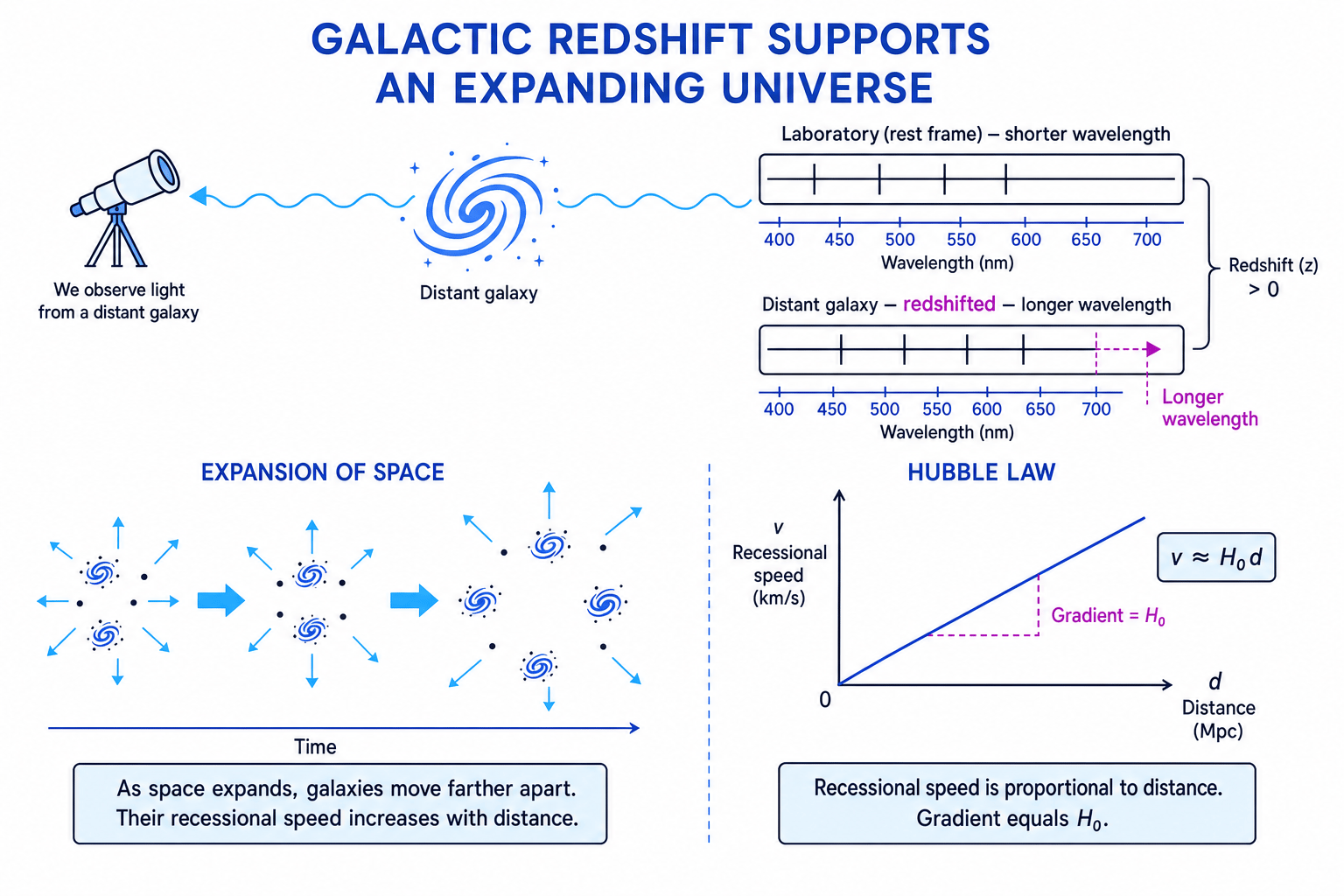
On a graph of recessional speed against distance, the gradient is H0H_0H0. The law supports the model of an expanding Universe: more distant galaxies recede faster because space itself is expanding.
Nearby galaxies can be awkward
Hubble’s law is a large-scale trend. Nearby galaxies can have local motions due to gravitational interactions, so they may not fit the straight-line pattern neatly.
The Hubble constant is often quoted in km s−1 Mpc−1\text{km s}^{-1}\ \text{Mpc}^{-1}km s−1 Mpc−1, because galaxy speeds are often in kilometres per second and distances in megaparsecs. In SI units, H0H_0H0 has unit s−1\text{s}^{-1}s−1 because it is speed divided by distance.
Using Hubble’s law and estimating the age
Take H0=70 km s−1 Mpc−1H_0 = 70\ \text{km s}^{-1}\ \text{Mpc}^{-1}H0=70 km s−1 Mpc−1. A galaxy is 150 Mpc away. Estimate its recessional speed and the age of the Universe.
- Use Hubble’s law for the galaxy:
- Convert H0H_0H0 into s−1\text{s}^{-1}s−1. Since 1 Mpc=3.09×10¹⁹ km1\ \text{Mpc} = 3.09 \times 10^{19}\ \text{km}1 Mpc=3.09×10¹⁹ km:
- Use the estimate for the age of the Universe:
- Convert seconds into years using 1 year≈3.16×10⁷ s1\ \text{year} \approx 3.16 \times 10^7\ \text{s}1 year≈3.16×10⁷ s:
So this gives an estimated age of about 14 billion years.
6. Big Bang theory
Big Bang theory
The Big Bang theory says that the Universe began in a very hot, dense state and has expanded and cooled over time. It was not an explosion into pre-existing space; it gave rise to the expansion of space-time itself.
The galactic redshift evidence fits this model: if the Universe is expanding now, then in the past it was smaller, hotter and denser.
The second major piece of evidence is the cosmic microwave background radiation, often shortened to CMB. This is microwave radiation detected from all directions in space, corresponding to a temperature of about 2.7 K.
Microwave background evidence
The 2.7 K cosmic microwave background is interpreted as leftover radiation from the early hot Universe, stretched to microwave wavelengths as space expanded. Its discovery and measurement were crucial in the scientific community’s acceptance of the Big Bang theory.
This is a good example of how scientific theories become accepted: a model makes sense of existing evidence, survives testing, and gains support when new observations match its predictions.
7. Evolution of the Universe
You do not need a detailed particle-physics timeline, but you should know the broad story.
Soon after the Big Bang, the Universe was extremely hot and dense. As space-time expanded, the Universe cooled. Particles formed, then simple nuclei, and later atoms. Once atoms formed, radiation could travel more freely; this early radiation is now observed as the CMB.
Over much longer timescales, gravity caused matter to clump into stars and galaxies. Stars produced heavier elements, galaxies evolved, and the Universe continued expanding to the present day.
8. What is the Universe made of?
Current ideas suggest the Universe contains:
- Ordinary matter: atoms, ions, electrons, stars, gas, dust, planets and living things. This is only a small percentage of the total.
- Dark matter: matter that does not emit or absorb electromagnetic radiation in the usual way, but has gravitational effects.
- Dark energy: a component associated with the large-scale expansion of the Universe.
A common approximate breakdown is about 5% ordinary matter, 25% dark matter and 70% dark energy.
In the exam
- For parallax, check that ppp is in arcseconds and ddd is in parsecs before using p=1/dp = 1/dp=1/d.
- For Doppler shift, longer wavelength means redshift and recession; calculate speed using the fractional shift times ccc.
- For Hubble calculations, use v≈H0dv \approx H_0 dv≈H0d, remember the graph gradient is H0H_0H0, and convert H0H_0H0 into s−1\text{s}^{-1}s−1 before using t≈H0−1t \approx H_0^{-1}t≈H0−1.
Check yourself
- A star has parallax 0.050 arcseconds. What is its distance in parsecs?
- A spectral line shifts from 500 nm to 505 nm. Is the source approaching or receding, and what speed would you estimate?
- Why is the 2.7 K microwave background radiation strong evidence for the Big Bang theory?
