

What you'll learn
- How to use momentum as a vector quantity in collision calculations.
- How to apply the principle of conservation of momentum in one dimension.
- How to distinguish perfectly elastic and inelastic collisions using kinetic energy.
- How to handle two-dimensional collisions by resolving momentum into perpendicular components.
Momentum: the key quantity in collisions
A collision is a short interaction between bodies where they exert forces on each other. The bodies might bounce apart, stick together, or move off at angles.
Before you can analyse a collision, you need momentum.
Momentum
Momentum is the product of an object’s mass and velocity:
p=mvp = mvp=mvwhere ppp is momentum in kilogram metre per second (kg m s⁻¹), mmm is mass in kilograms (kg), and vvv is velocity in metres per second (m s⁻¹).
Momentum is a vector, because velocity is a vector. That means direction matters. In one-dimensional problems, choose one direction as positive and treat velocities in the opposite direction as negative.
Calculating total momentum
Two trolleys move along the same straight track. Trolley A has mass 0.50 kg and velocity 1.2 m s⁻¹ to the right. Trolley B has mass 0.30 kg and velocity 2.0 m s⁻¹ to the left. Find the total momentum, taking right as positive.
-
Choose the sign convention: right is positive, so trolley A has vA=+1.2 m s−1v_A = +1.2\ \text{m s}^{-1}vA=+1.2 m s−1 and trolley B has vB=−2.0 m s−1v_B = -2.0\ \text{m s}^{-1}vB=−2.0 m s−1.
-
Add the individual momenta as vectors:
- Calculate the result:
The total momentum is zero, even though both trolleys are moving.
Forgetting the signs
Momentum calculations use velocity, not speed. If one object moves in the opposite direction to your chosen positive direction, its velocity is negative.
The principle of conservation of momentum
In a collision, the objects exert forces on each other. These are internal forces within the system. If the system has no resultant external force acting on it, the total momentum stays constant.
System
A system is the collection of objects you choose to analyse. For a two-trolley collision, the system is usually “both trolleys together”.
Conservation of momentum
The total momentum of a system remains constant provided the resultant external force on the system is zero.
This is linked to Newton’s third law: during the collision, the forces between the two bodies are equal and opposite. The momentum gained by one body is equal to the momentum lost by the other.
For a one-dimensional collision:
m1u1+m2u2=m1v1+m2v2m_1u_1 + m_2u_2 = m_1v_1 + m_2v_2m1u1+m2u2=m1v1+m2v2where uuu means velocity before the collision and vvv means velocity after the collision.
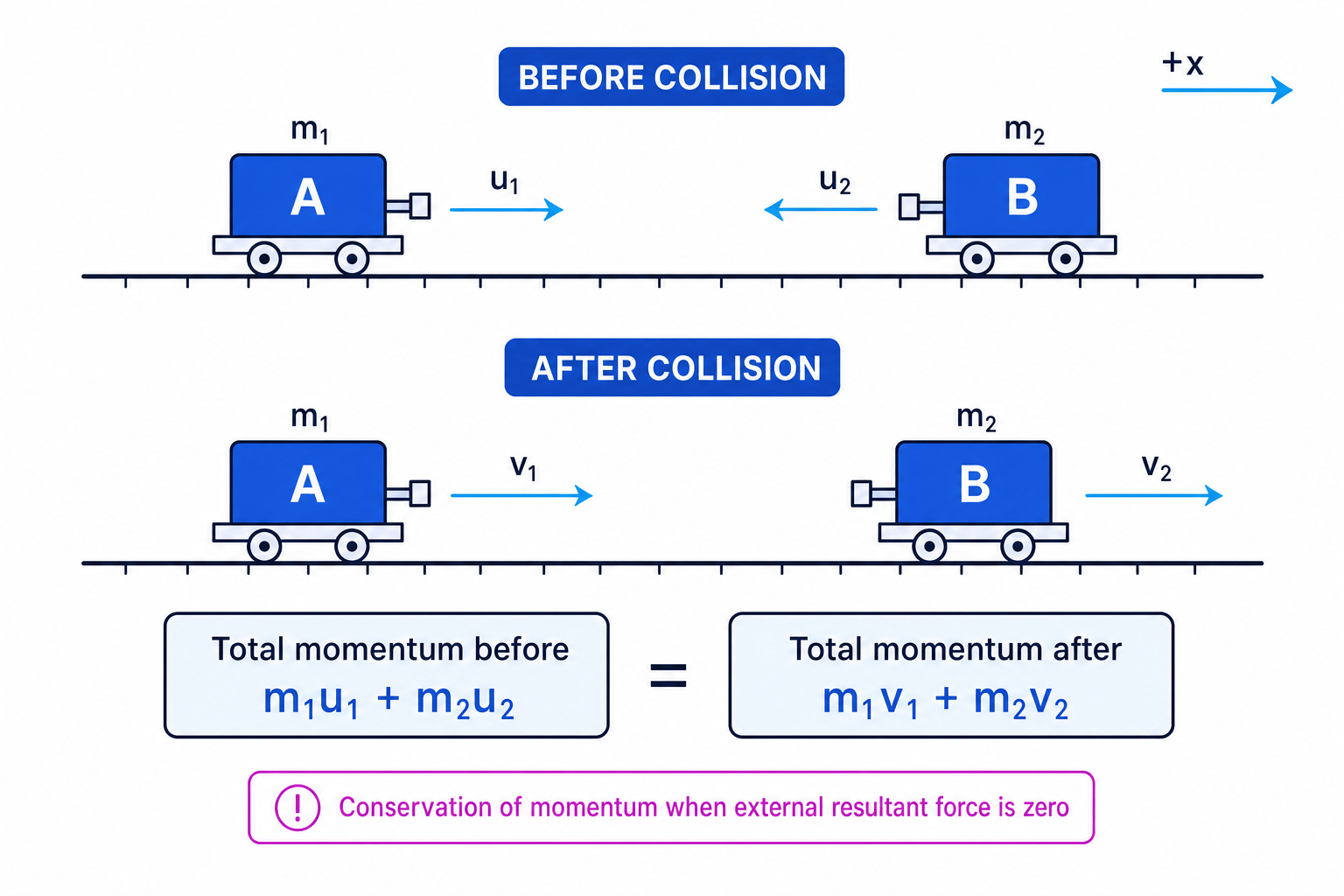
When momentum is not conserved for your chosen system
If a significant external resultant force acts during the time you are analysing, the momentum of your chosen system is not conserved. For example, friction over a long time interval can change the total momentum of two trolleys.
Finding the final velocity after a one-dimensional collision
A 0.40 kg trolley moving at 2.0 m s⁻¹ collides with a stationary 0.60 kg trolley. They stick together. Find their common velocity after the collision.
- Because the trolleys stick together, they share one final velocity vvv. Apply conservation of momentum:
- Substitute the values, carrying units through:
- Solve for vvv:
The joined trolleys move at 0.80 m s⁻¹ in the original direction of the first trolley.
Practical reality
In experiments with trolleys, light gates, or video tracking, momentum before and after will rarely match exactly. Compare the difference with the uncertainty in your velocity measurements before deciding whether conservation is supported.
Elastic and inelastic collisions
Momentum conservation applies to isolated systems in both elastic and inelastic collisions. The difference is what happens to kinetic energy.
Perfectly elastic collision
A perfectly elastic collision is one in which both total momentum and total kinetic energy are conserved.
Inelastic collision
An inelastic collision is one in which total momentum is conserved, but total kinetic energy is not conserved.
Kinetic energy is calculated using:
Ek=12mv2E_k = \frac{1}{2}mv^2Ek=21mv2In an inelastic collision, some kinetic energy is transferred to other forms, such as internal energy, sound, or deformation.
Testing whether a collision is elastic
Two 0.20 kg gliders collide on a track. Before the collision, glider A moves at 1.5 m s⁻¹ and glider B is stationary. After the collision, A moves at 0.50 m s⁻¹ and B moves at 1.0 m s⁻¹, in the same direction as A originally moved. Decide whether the collision is perfectly elastic.
- Check total momentum before and after:
- Check total kinetic energy before:
- Check total kinetic energy after:
- Compare the two kinetic energies. Momentum is conserved, but kinetic energy has decreased, so the collision is inelastic, not perfectly elastic.
Using kinetic energy conservation automatically
Do not assume kinetic energy is conserved in every collision. Use momentum conservation first; use kinetic energy conservation only if the question says or implies the collision is perfectly elastic.
Two-dimensional collisions and interactions
At A level, collisions can also happen in two dimensions. Momentum is still conserved, but because momentum is a vector, you must conserve it separately in perpendicular directions.
Components conserve separately
In two dimensions, apply conservation of momentum in the horizontal direction and in the vertical direction independently.
A common setup is: one object moves initially along the x-axis, then after the collision two objects move off at angles. If there was no initial vertical momentum, the upward and downward components after the collision must cancel.
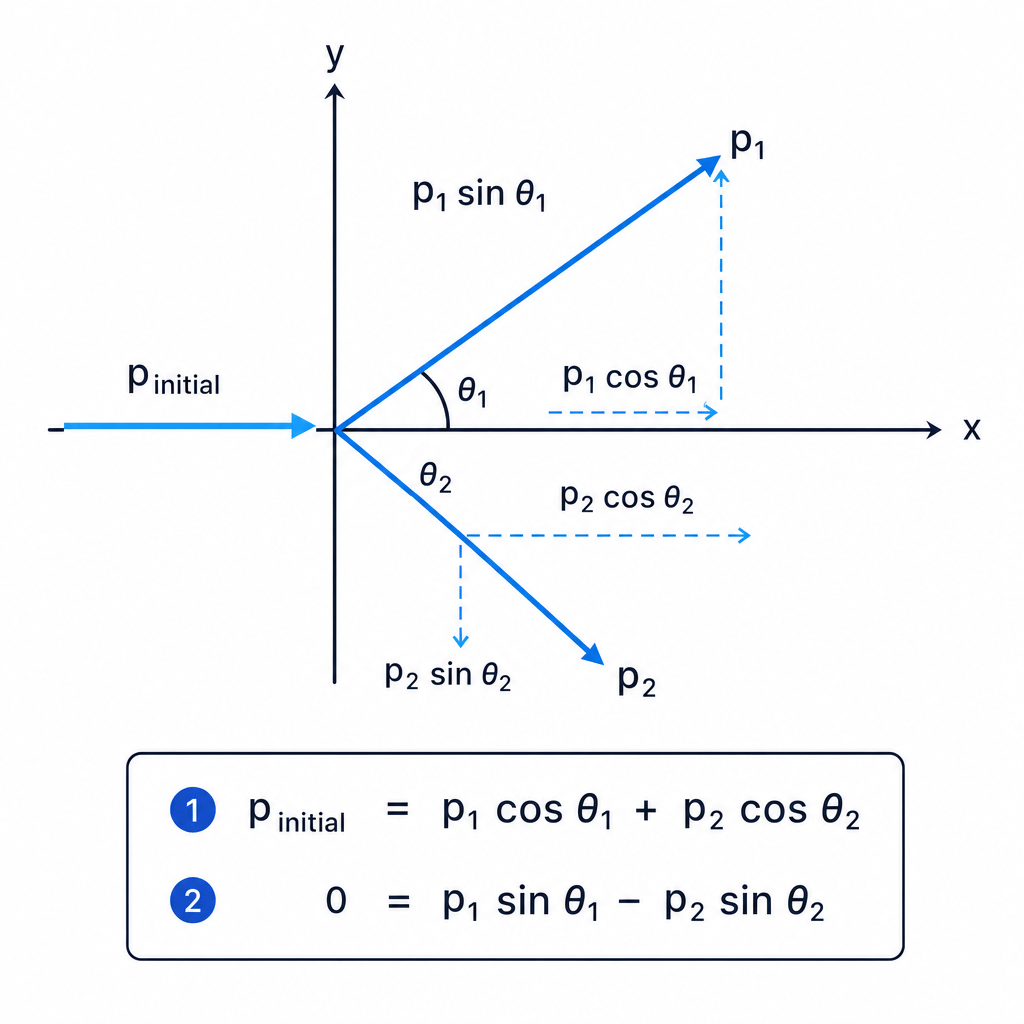
Resolving momentum in two dimensions
A 0.20 kg puck moves east at 4.0 m s⁻¹ and collides with another stationary 0.20 kg puck. After the collision, puck A moves at 3.0 m s⁻¹ at 30° above east. Find the velocity of puck B.
- Calculate the initial momentum and puck A’s final momentum:
- Resolve puck A’s momentum into components:
- Use conservation of momentum to find puck B’s components:
- Find puck B’s momentum magnitude, then its speed:
- Find the direction below east:
So puck B moves at 2.1 m s⁻¹, 47° below east.
Interactions that are not simple “bounces”
The same momentum method works for other short interactions, such as explosions or objects pushing apart. If two objects start at rest and then separate, the initial total momentum is zero, so their final momenta must be equal in magnitude and opposite in direction.
A quick sanity check
If the system starts from rest, the final momentum vectors should add to zero. In one dimension, that usually means one final velocity is positive and the other is negative.
In the exam
- Choose a positive direction, write all velocities with signs, and apply p=mvp = mvp=mv before substituting numbers.
- Use conservation of momentum for the whole isolated system; only use kinetic energy conservation if the collision is stated to be perfectly elastic.
- For two-dimensional problems, draw a vector diagram and write separate momentum equations for the x- and y-directions.
Check yourself
- Why can two moving objects have a total momentum of zero?
- What extra condition, besides momentum conservation, must hold in a perfectly elastic collision?
- In a two-dimensional collision with no initial vertical momentum, what must be true about the final vertical momentum components?
