

What you'll learn
- Why waves diffract at slits and obstacles, and when the spreading is large.
- How superposition gives interference patterns, including Young’s double-slit experiment.
- How to use λ=aΔyD\lambda = \frac{a\Delta y}{D}λ=DaΔy and dsinθ=nλd\sin\theta = n\lambdadsinθ=nλ to determine wavelength.
- How stationary waves form, and how they differ from progressive waves.
Wave ideas you need first
A wave transfers energy by oscillations. For a progressive wave, the disturbance travels through space.
Wavelength, frequency and wave speed
The wavelength λ\lambdaλ is the distance between two neighbouring points in phase, such as crest to crest. The frequency fff is the number of oscillations per second, measured in hertz (Hz). For a wave travelling at speed vvv,
v=fλv = f\lambdav=fλWavefront
A wavefront is a line or surface joining points on a wave that are at the same stage of oscillation, or in phase.
Diffraction
Diffraction is the spreading of waves when they pass through a slit or around the edge of an obstacle. It happens for all waves: water waves, sound waves, microwaves and light.
The amount of diffraction depends on the wavelength compared with the size of the gap or obstacle.
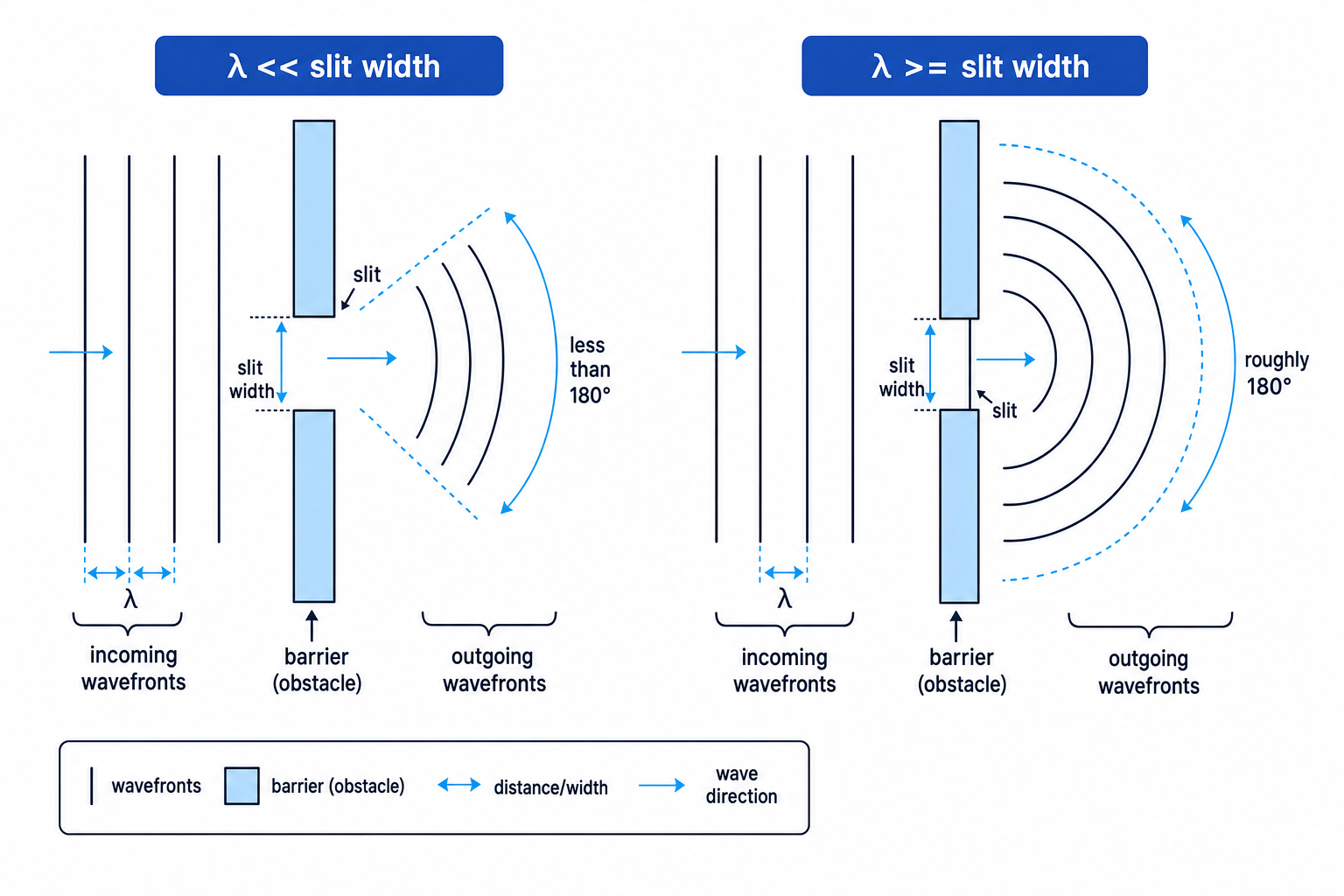
If λ\lambdaλ is much smaller than the slit width, written λ≪slit width\lambda \ll \text{slit width}λ≪slit width, there is little diffraction and the wave continues mainly forwards.
If λ\lambdaλ is equal to or greater than the slit width, the wave spreads out strongly as roughly semicircular wavefronts. If λ\lambdaλ is less than the slit width, the main beam spreads through less than 180°.
When diffraction is greatest
Diffraction is most noticeable when the wavelength is similar to, or larger than, the size of the slit or obstacle.
Comparing diffraction through a doorway
Sound of frequency 500 Hz passes through a doorway of width 0.80 m. Take the speed of sound as 340 m s−1^{-1}−1.
-
Find the sound wavelength using v=fλv = f\lambdav=fλ:
λ=vf=340 m s−1500 Hz=0.68 m\lambda = \frac{v}{f} = \frac{340\ \text{m s}^{-1}}{500\ \text{Hz}} = 0.68\ \text{m}λ=fv=500 Hz340 m s−1=0.68 m -
Compare with the doorway width: 0.68 m is close to 0.80 m, so the sound diffracts strongly.
-
Visible light has λ≈5×10⁻⁷ m\lambda \approx 5 \times 10^{-7}\ \text{m}λ≈5×10⁻⁷ m, which is much smaller than 0.80 m, so visible light diffracts very little through the doorway.
Superposition and interference
When two waves meet, their displacements add.
Principle of superposition
When two or more waves overlap, the resultant displacement at a point is the vector sum of the individual displacements at that point.
This means two crests can combine to give a larger crest, or a crest and trough can cancel.
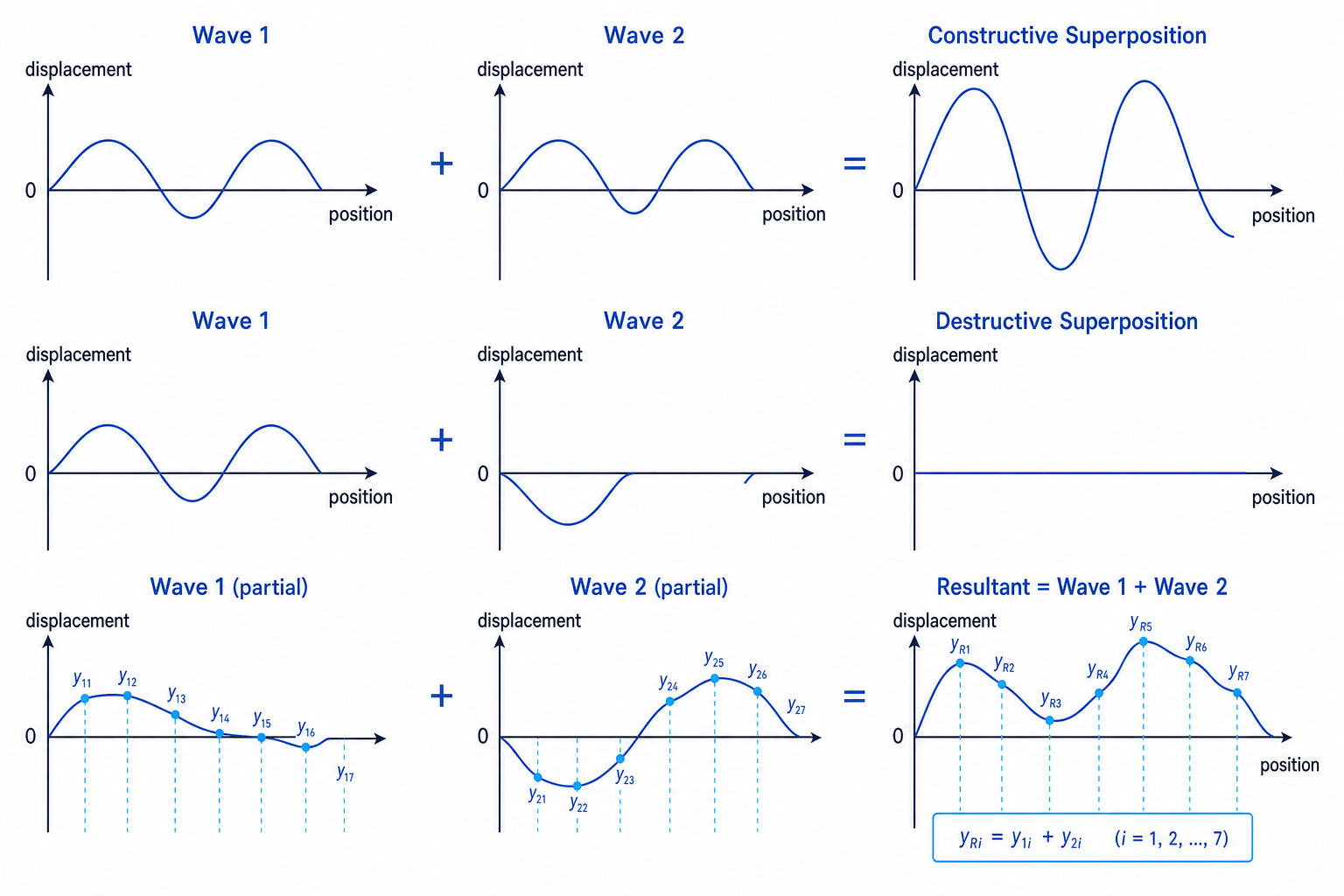
Interference is the pattern produced when waves superpose. For two waves from in phase sources:
- Constructive interference occurs when the path difference is nλn\lambdanλ.
- Destructive interference occurs when the path difference is (n+12)λ\left(n + \frac{1}{2}\right)\lambda(n+21)λ.
Here nnn is an integer: 0, 1, 2, 3, …
Path difference
The path difference is the difference between the distances travelled by two waves from their sources to the same point.
Classifying interference from path difference
Two in phase sources send waves of wavelength 0.50 m to point P. The distances travelled are 2.40 m and 2.15 m.
-
Calculate the path difference:
Δx=2.40 m−2.15 m=0.25 m\Delta x = 2.40\ \text{m} - 2.15\ \text{m} = 0.25\ \text{m}Δx=2.40 m−2.15 m=0.25 m -
Compare with the wavelength:
Δxλ=0.25 m0.50 m=0.50\frac{\Delta x}{\lambda} = \frac{0.25\ \text{m}}{0.50\ \text{m}} = 0.50λΔx=0.50 m0.25 m=0.50 -
The path difference is 12λ\frac{1}{2}\lambda21λ, so the waves arrive in antiphase and give destructive interference.
Coherent sources
For a stable interference pattern, the sources must be coherent.
Coherent sources
Coherent sources are monochromatic, have wavefronts continuous across the beam, and, when comparing more than one source, have a constant phase relationship.
Monochromatic means single frequency, so for a given wave speed it also means single wavelength.
Examples of coherent sources include:
- two slits illuminated by the same laser beam;
- two loudspeakers driven by the same signal generator;
- two water-wave dippers attached to the same oscillator.
Examples of incoherent sources include:
- two separate filament lamps;
- two ordinary independent light sources;
- two lasers that are not phase-locked.
For two-source interference to be observed, the sources must have zero or constant phase difference and their oscillations must be in the same direction. For light, this means the same polarisation.
Same colour is not enough
Two separate lamps emitting the same colour are not automatically coherent. Their phase relationship changes randomly, so any interference pattern averages out.
Young’s double-slit experiment
Young’s double-slit experiment showed that light can produce interference, giving strong historical evidence for the wave nature of light.
A single source illuminates two narrow slits. The two slits act as coherent sources because their light comes from the same original wavefront. Bright and dark fringes form on a screen.
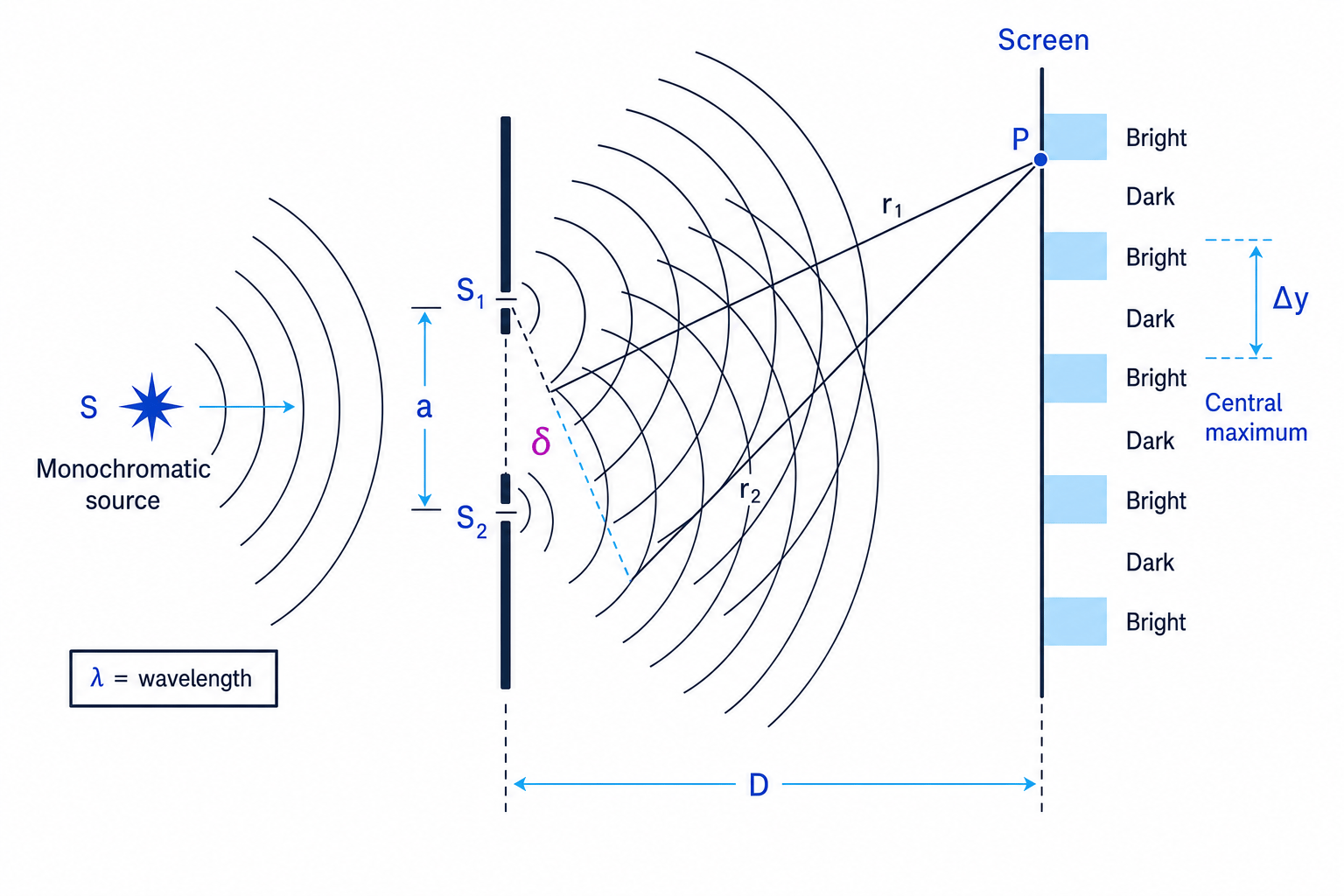
Let:
- aaa be the slit separation;
- DDD be the distance from slits to screen;
- Δy\Delta yΔy be the fringe spacing;
- λ\lambdaλ be the wavelength.
For small angles, sinθ≈tanθ≈θ\sin\theta \approx \tan\theta \approx \thetasinθ≈tanθ≈θ, so:
λ=aΔyD\lambda = \frac{a\Delta y}{D}λ=DaΔySmall-angle condition
The equation λ=aΔyD\lambda = \frac{a\Delta y}{D}λ=DaΔy assumes the screen is far from the slits compared with the slit separation, so the fringe angles are small.
Finding wavelength using Young’s double slits
A laser produces fringes using slits separated by 0.250 mm. The screen is 2.40 m away. The distance across 10 fringe spacings is 48.0 mm.
-
Convert the measured quantities:
a=0.250 mm=2.50×10⁻⁴ ma = 0.250\ \text{mm} = 2.50 \times 10^{-4}\ \text{m}a=0.250 mm=2.50×10⁻⁴ m Δy=48.0 mm10=4.80 mm=4.80×10⁻³ m\Delta y = \frac{48.0\ \text{mm}}{10} = 4.80\ \text{mm} = 4.80 \times 10^{-3}\ \text{m}Δy=1048.0 mm=4.80 mm=4.80×10⁻³ m -
Substitute into λ=aΔyD\lambda = \frac{a\Delta y}{D}λ=DaΔy:
λ=(2.50×10⁻⁴ m)(4.80×10⁻³ m)2.40 m\lambda = \frac{\left(2.50 \times 10^{-4}\ \text{m}\right)\left(4.80 \times 10^{-3}\ \text{m}\right)}{2.40\ \text{m}}λ=2.40 m(2.50×10⁻⁴ m)(4.80×10⁻³ m) -
Calculate and give a sensible unit:
λ=5.00×10⁻⁷ m=500 nm\lambda = 5.00 \times 10^{-7}\ \text{m} = 500\ \text{nm}λ=5.00×10⁻⁷ m=500 nm
Practical: wavelength from Young’s double slits
Use a low-power laser, double slits and a screen. Never look into the laser beam or its reflections.
Good method:
- Measure DDD from the slits to the screen.
- Use the manufacturer’s value for aaa, or a measured value if available.
- Measure across many fringes, then divide by the number of fringe spacings to find Δy\Delta yΔy.
- Repeat and average.
- A useful graph is Δy\Delta yΔy against DDD, since Δy=λDa\Delta y = \frac{\lambda D}{a}Δy=aλD. The gradient is λa\frac{\lambda}{a}aλ.
Reducing percentage uncertainty
Do not measure one fringe spacing if you can measure 10 or 20. A larger measured distance gives a smaller percentage uncertainty.
Diffraction gratings
A diffraction grating has many equally spaced slits. The slit spacing is called the grating spacing ddd.
If a grating has NNN lines per metre, then:
d=1Nd = \frac{1}{N}d=N1Bright beams are called orders. The central maximum is the zero order, n=0n = 0n=0. The first bright beam on either side is the first order, n=±1n = \pm 1n=±1.
For adjacent slits, the path difference at angle θ\thetaθ is dsinθd\sin\thetadsinθ. A bright order occurs when this path difference is a whole number of wavelengths:
dsinθ=nλd\sin\theta = n\lambdadsinθ=nλ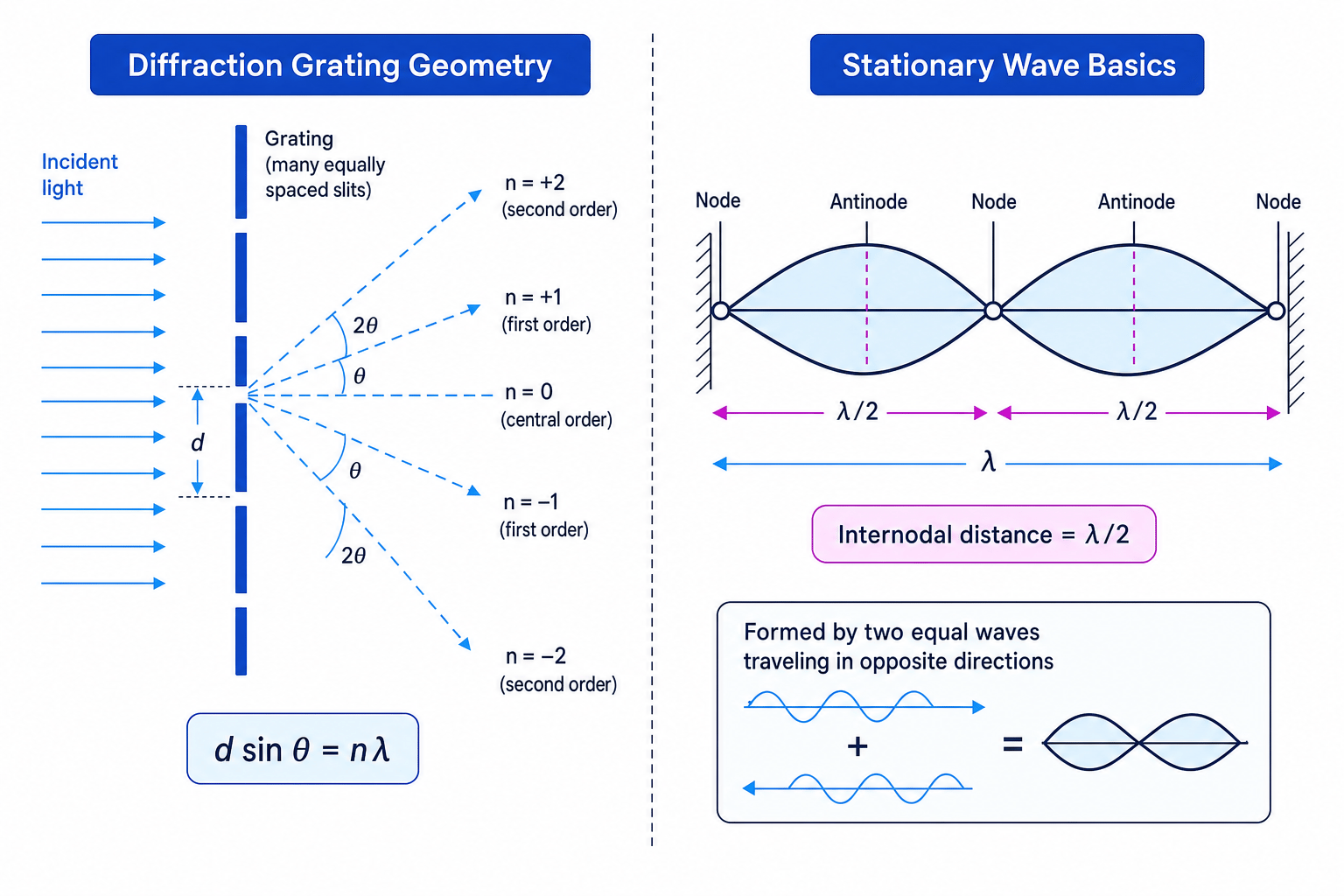
A grating has very small ddd, so the beams are much further apart than in Young’s experiment. The large number of slits also makes the bright beams much sharper, because destructive interference cancels light strongly between the maxima.
Using a diffraction grating
Light of wavelength 589 nm589\ \text{nm}589 nm is incident normally on a grating with 600 lines per millimetre. Find the first-order angle and the highest possible order.
-
Convert the line density into lines per metre:
N=600×103 m−1=6.00×10⁵ m−1N = 600 \times 10^3\ \text{m}^{-1} = 6.00 \times 10^5\ \text{m}^{-1}N=600×103 m−1=6.00×10⁵ m−1So:
d=1N=16.00×10⁵ m−1=1.67×10⁻⁶ md = \frac{1}{N} = \frac{1}{6.00 \times 10^5\ \text{m}^{-1}} = 1.67 \times 10^{-6}\ \text{m}d=N1=6.00×10⁵ m−11=1.67×10⁻⁶ m -
Use dsinθ=nλd\sin\theta = n\lambdadsinθ=nλ for the first order, where n=1n = 1n=1:
sinθ=nλd=1×589×10−9 m1.67×10−6 m=0.353\sin\theta = \frac{n\lambda}{d} = \frac{1 \times 589 \times 10^{-9}\ \text{m}}{1.67 \times 10^{-6}\ \text{m}} = 0.353sinθ=dnλ=1.67×10⁻⁶ m1×589×10−9 m=0.353 θ=20.7∘\theta = 20.7^\circθ=20.7∘ -
For the highest order, require sinθ≤1\sin\theta \le 1sinθ≤1:
n≤dλ=1.67×10⁻⁶ m589×10−9 m=2.83n \le \frac{d}{\lambda} = \frac{1.67 \times 10^{-6}\ \text{m}}{589 \times 10^{-9}\ \text{m}} = 2.83n≤λd=589×10−9 m1.67×10−6 m=2.83The highest possible order is therefore n=2n = 2n=2.
Practical: wavelength from a diffraction grating
Use a laser or spectral lamp, a diffraction grating and a screen or spectrometer.
Good method:
- Measure angles to matching orders on both sides and average them.
- Use d=1Nd = \frac{1}{N}d=N1 from the grating line density.
- Calculate λ=dsinθn\lambda = \frac{d\sin\theta}{n}λ=ndsinθ.
- For better analysis, plot sinθ\sin\thetasinθ against nnn. The gradient is λd\frac{\lambda}{d}dλ.
Line density conversion
600 lines per millimetre is not 600 lines per metre. It is 600×103 m−1600 \times 10^3\ \text{m}^{-1}600×103 m−1.
Stationary waves
A progressive wave transfers energy from one place to another. A stationary wave has a fixed pattern of nodes and antinodes and transfers no net energy along the wave.
Nodes and antinodes
A node is a point of zero amplitude. An antinode is a point of maximum amplitude.
A stationary wave can be regarded as the superposition of two progressive waves of equal amplitude and frequency travelling in opposite directions. The distance between neighbouring nodes is called the internodal distance, and it is:
λ2\frac{\lambda}{2}2λKey differences:
- In a progressive wave, the wave profile moves; in a stationary wave, the pattern stays fixed.
- In a progressive wave, energy is transferred; in a stationary wave, there is no net energy transfer.
- In a progressive wave, all points usually have the same amplitude if there is no damping; in a stationary wave, amplitude depends on position.
- In a stationary wave, adjacent loops are in antiphase.
Finding the speed of sound from a stationary wave
A loudspeaker produces sound of frequency 1.00 kHz in a tube. A microphone detects adjacent antinodes separated by 0.170 m.
-
Adjacent antinodes are separated by λ2\frac{\lambda}{2}2λ, so:
λ=2×0.170 m=0.340 m\lambda = 2 \times 0.170\ \text{m} = 0.340\ \text{m}λ=2×0.170 m=0.340 m -
Use v=fλv = f\lambdav=fλ:
v=(1.00×10³ Hz)(0.340 m)v = \left(1.00 \times 10^3\ \text{Hz}\right)\left(0.340\ \text{m}\right)v=(1.00×10³ Hz)(0.340 m) -
Calculate the speed:
v=340 m s−1v = 340\ \text{m s}^{-1}v=340 m s−1
Practical: speed of sound using stationary waves
A loudspeaker connected to a signal generator sends sound along a tube. Reflections create a stationary wave. Move a microphone along the tube and use an oscilloscope or data logger to locate nodes and antinodes.
Measure the distance between several neighbouring nodes or antinodes, then divide by the number of gaps to reduce uncertainty. Since adjacent nodes or adjacent antinodes are separated by λ2\frac{\lambda}{2}2λ, find λ\lambdaλ and then use v=fλv = f\lambdav=fλ.
In the exam
- Check which geometry you are using: Young’s fringes use λ=aΔyD\lambda = \frac{a\Delta y}{D}λ=DaΔy, while gratings use dsinθ=nλd\sin\theta = n\lambdadsinθ=nλ.
- Convert all distances to metres before substituting, especially millimetres and nanometres.
- For interference questions, decide whether the path difference is a whole number of wavelengths or a half-integer number of wavelengths.
Check yourself
- Why does sound diffract through a doorway much more than visible light?
- What two conditions must two sources satisfy for a stable interference pattern?
- Why are diffraction grating maxima sharper than Young’s double-slit fringes?
